The Purges Must End

Matt Steinglass defends the latest from Ponnuru and Lowry by arguing that “Republicans who attack the tone and tactics of tea-party politics, without explicitly disagreeing on policy grounds, are not dissenting in a merely cosmetic fashion”:

The subordination of policy to tactics is a feature of apocalyptic-extremist factional politics. It’s a mistake to think that extremist parties are characterised by ideological rigidity; in fact, on any question on which there can be internal competition in such parties, there tends to be a succession of changes in position. Each shift produces apostates who can be purged on the basis of previously holding positions that have now been revealed as incorrect, and this provides opportunities for advancement to lower-ranking members.

A party caught up in this dynamic can’t take any policy positions on which it might be able to compromise with the opposition, or win new constituencies outside of existing insiders; the compromise would be a death sentence for the members who agree to it, and allegiance to new constituents is suspect in the eyes of existing ones. The GOP has to wrench itself out of this internal political spiral in order to make concrete moves on policy or even on the kind of image it wants to project to non-conservatives, and it makes sense for worried Republicans to take up this problem as an issue in its own right.

I tend to agree with Matt. To turn the current abstract, rhetorical performance art into a civil, even if passionate, conversation within the party is essential. Hence my post yesterday on exactly this element in a civilized conservatism. You begin within the party; with any luck, you can then begin having a conversation with those outside it. Focusing on tone first – and then policy, as Mike Lee has put it – is the right set of priorities. It unwinds the fundamentalist psyche propelling so much of this.

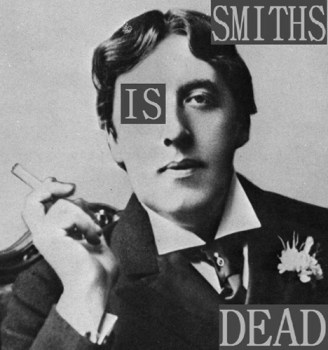
The Smiths’ Wilde Side

Moira Donegan studies the creative and personal similarities between Morrissey and his idol and muse, Oscar Wilde:

As two Irishmen, they pretended to be more English than the English. $T2eC16dHJHEE9ny2sr(GBQ6CV(8q0!~~60_57 Morrissey had little of the formal education whose affectations he adopted; Wilde was absent from the rituals of heterosexual sociality whose ridiculousness he mimed. They were outsiders, and therefore they perhaps had the luxury of disinterested observation. But such an analysis overlooks what is perhaps the emotional crux of their work, the core that becomes lucid only after repeated readings. For though they each lay claim to certain forms of social exception, neither Morrissey nor Wilde is wholly comfortable or unqualifiedly smug in his position as an outsider. Both men’s work is tinged, too, with a desire for belonging.

The problem with using humor to conceal your anxieties is that it tends to be a pretty weak disguise.

In jokes, the psyche often rears its head where it’s not supposed to. This might be why there is a sincere and disquieting bitterness detectible in these men’s work beneath all the snark and sheen. Why would Morrissey quip, in “Cemetery Gates,” that Keats and Yates are on your side, if he had no desire to demonstrate the erudition that is held as a standard of worthiness by the sort of people who admire Keats and Yates? Why would Wilde write When I was young I thought that money was the most important thing in life; now that I am old I know that it is, if he did not wish to show himself to be a self-conscious member of the leisure class? One of the prices of upward mobility—be it an upward mobility of wealth, culture, education, or just social popularity—is the twinging shame of knowing that you’re not quite a native in this new strata of yours. It can be difficult to shake the dark suspicion that you will be rejected as readily as you were welcomed, once your new admirers discover that you’re a fraud.

Recent Dish on Wilde here and recent coverage of Morrissey’s new autobiography here.

(Image of a Smiths-Wilde T-shirt via eBay)

Yglesias Award Nominee

“If our generation of conservatives wants to enjoy our own defining triumph, our own 1980 — we are going to have to deserve it. That means sharpening more pencils than knives. The kind of work it will require is neither glamorous nor fun, and sometimes it isn’t even noticed. But it is necessary. To deserve victory, conservatives have to do more than pick a fight. We have to win a debate. And to do that, we need more than just guts. We need an agenda,” – Senator Mike Lee, who recently threatened to destroy the entire global economy to make a point.

Hey, it’s a sign that the fever may be subsiding.

The Mass Delusion That Wasn’t?

Today is the 75th anniversary of Orson Welles’ War of the Worlds broadcast. Marc Wortman calls it “arguably the most widely known delusion in United States, and perhaps world, history”:

The New York Times front page story the next morning reported that “a wave of mass hysteria seized thousands of radio listeners throughout the nation…[leading them] to believe that an interplanetary conflict had started with invading Martians spreading wide death and destruction in New Jersey and New York.” But what made so many Americans so gullible? It was a case of the jitters, a nation primed to jump at the word “Boo!”

Jefferson Pooley and Michael Socolow calls this episode of hysteria a “myth”:

The supposed panic was so tiny as to be practically immeasurable on the night of the broadcast. Despite repeated assertions to the contrary in the PBS and NPR programs, almost nobody was fooled by Welles’ broadcast.

How did the story of panicked listeners begin?

Blame America’s newspapers. Radio had siphoned off advertising revenue from print during the Depression, badly damaging the newspaper industry. So the papers seized the opportunity presented by Welles’ program to discredit radio as a source of news. The newspaper industry sensationalized the panic to prove to advertisers, and regulators, that radio management was irresponsible and not to be trusted. In an editorial titled “Terror by Radio,” the New York Times reproached “radio officials” for approving the interweaving of “blood-curdling fiction” with news flashes “offered in exactly the manner that real news would have been given.” Warned Editor and Publisher, the newspaper industry’s trade journal, “The nation as a whole continues to face the danger of incomplete, misunderstood news over a medium which has yet to prove … that it is competent to perform the news job.”

Ways Obamacare Could Go Wrong

Kate Pickert highlights one:

Hundreds of thousands—if not millions—of people who purchase coverage independently are now receiving letters from insurers canceling policies that do not comply with new Affordable Care Act (ACA) regulations. In cancelling such plans, some insurers are telling customers they will be automatically enrolled in alternative ACA-compliant coverage unless they object.

This could be a major snag in the ACA’s plan to subsidize insurance purchased on the individual market. New tax credits, available to individuals earning less than 400 percent of the federal poverty level, or about $46,000 per year, can only be accessed through new ACA insurance marketplaces. Those who purchase coverage outside the exchanges cannot claim subsidies, even if they qualify for them, according to the Centers for Medicare and Medicaid Services, the agency overseeing implementation of the ACA. Automatic enrollment directly through an insurer would avoid the exchanges, and the subsidies, entirely.

Scott Gottlieb identifies another potential problem with the ACA:

The potential woes stem from an oversight made by the architects of Obamacare.

Under the law, insurers who offer policies inside the Obamacare exchanges are required to treat their enrollees inside and outside the exchange as a single risk pool. Among other things, this provision was meant to reduce the chance that insurers would steer healthier patients into plans sold outside the exchanges.

But the law doesn’t prevent insurers from offering plans exclusively outside the exchange. If they are entirely outside the exchange, they get to create their own risk pool, and aren’t subject to the same pricing that burdens plans inside the exchange. (See this Commonwealth Fund Brief for a fuller explanation)

As the pool inside the exchange becomes older, sicker, and costlier, more plans will have an economic incentive to get out of the Obamacare market altogether.

Once outside, they are free to price their products to match a better risk pool.

Other provisions will further encourage plans to drop out.

Obviously we need to make some fixes to the law. But how can we when the House will only vote to repeal it? I remain gobsmacked that the president did not meticulously prepare his core domestic policy initiative. I know the broader project makes sense, but is he really trying to prove that in practice, technocratic government is an oxymoron?

The Idiocy Of The Afghan Government

The NYT recently reported that the government was recently “seeking to aid the Pakistan Taliban in their fight against Pakistan’s security forces.” Isaac Chotiner sighs:

To describe the Afghan government’s initiative as insane would be generous. Yes, it is true that Afghan resentment at Pakistan is understandable and deep, and that the country’s weariness and anger about being treated in a colonial manner by its larger and nuclear-armed neighbor makes plenty of sense. But the idea that this is going to help Afghanistan emerge from its decades-long troubles is far-fetched, to say the least.

For starters, Pakistan is much, much more powerful than Afghanistan, and is unlikely to take kindly to this particular proxy war. Secondly, the attempt to discriminate among different Taliban factions is destined for disaster. Indeed, this is precisely what has motivated Pakistani policy in Afghanistan for the past decade, with horrific results…for Pakistan. There may be distinctions to be made among different Taliban factions, but they are all extreme and interconnected, and nurturing some of them while opposing others has brought Pakistan to its current, blood-soaked impasse.

Meanwhile, Yochi Dreazen fears that Afghanistan’s future will look a lot like Iraq’s present:

It’s impossible to say how much of Iraq’s current carnage could have been prevented by a continued US military presence in the country, but a pair of retired officers with long experience in the country said the withdrawal of elite Special Operations Forces like the Navy SEALs and the Army’s Delta Force made it significantly harder for the Iraqis to track down and kill individual militants. The withdrawal also meant that Iraqi troops were no longer receiving video footage from U.S. drones and surveillance aircraft. Iraq recently asked the U.S. to send the drone aircraft back to the country, but the White House said no.

Karzai could get a similar cold shoulder from the administration, which has made clear that it’s running out of patience with Karzai’s dithering over a troop immunity deal. Secretary of State John Kerry spent two days in Kabul earlier this month trying to get Karzai to budge, but the Afghan leader said he opposed giving troops protecting from Afghan law and would instead refer the matter to a gathering of key Afghan tribal and religious leaders known as a Loya Jirga. The Obama administration wanted to close the Afghan deal by the end of October, a deadline which now seems impossible, and White House officials are now openly saying that they might pull all U.S. troops out of Afghanistan at the end of 2014, when most foreign troops are already set to leave the country.

Adapting To The Afterglow

Stray dogs play in front of the Chernoby

The plants and animals of Chernobyl are bouncing back:

Lately, some weird reports have been coming from the Chernobyl Exclusion Zone – wild animals have returned, and, for the most part, they seem fine. Moose, deer, beaver, wild boar, otter, badger, horses, elk, ducks, swans, storks and more are now being hunted by bears, lynx and packs of wolves, all of which look physically normal (but test high for radioactive contamination). In fact, even early effects of mutations in plants, including malformations and even glowing are now mostly limited to the five most-contaminated places.

Although not everyone is ready to agree that Chernobyl is proof that nature can heal herself, scientists agree that studying the unique ecosystem, and how certain species appear to be thriving, has produced data that will ultimately help our understanding of long term radiation effects. For example, wheat seeds taken from the site shortly after the accident produced mutations that continue to this day, yet soybeans grown near the reactor in 2009 seem to have adapted to the higher radiation. Similarly, migrant birds, like barn swallows, seem to struggle more with the radiation in the zone than resident species. As one expert explained, they’re studying the zone’s flora and fauna to learn the answer to a simple question: “Are we more like barn swallows or soybeans?”

Meanwhile, in Fukushima:

Update from a reader:

I’m one of those scientists managing a research group that is trying to tease out answers to radiation effects on animals and plants. There are not a lot of robust studies that include radiation dose AND measured effect for organisms in natural settings. Unfortunately what you find are a lot of anecdotal reports that play into peoples existing stereotypes about radiation exposure and impact.  Even with Chernobyl and Fukushima, funding for this type of research is piddling. Particularly in the USA.  So you get stories like “Chernobyl is a wildlife paradise – or death trap.”

(Photo: Stray dogs play in front of the Chernobyl nuclear power plant. By Sergei Supinsky/AFP/Getty Images)

Countries Don’t Have Friends; Just Interests

Michael Totten wrote that “Foreign Policy 101 dictates that you reward your friends and punish your enemies.” It’s a spectacularly dumb statement, reflective of neoconservative tribalism rather than sensible foreign policy. You can tell it’s of neocon provenance because if its crudeness and simplicity. It’s the kind of idiotic thinking that Cheney holds to. Larison easily explains why:

Whatever one thinks of Obama’s foreign policy, it’s not true that the conduct of foreign policy should be guided by the principle of “reward your friends and punish your enemies.” The priority should always be to secure the country’s just interests first, and that may sometimes require reaching agreements with antagonistic states and being at odds with allies and clients on certain issues. It is tempting but misguided to think of international relationships in terms of friendship. States can have productive and cooperative relations, and they can even be allies for many decades, but they aren’t ever really “friends.”

The famous quote from Lord Palmerston, along with many others, is more stringent still: “England has no eternal friends, England has no perpetual enemies, England has only eternal and perpetual interests”. That’s why I object to notions of an “unbreakable bond” between the US and Israel. George Washington, in the most prescient and emphatic repudiation of AIPAC and the Cuban Lobby ever delivered, explained why a long, long time ago:

Nothing is more essential, than that permanent, inveterate antipathies against particular Nations, and passionate attachments for others, should be excluded; and that, in place of them, just and amicable feelings towards all should be cultivated. The Nation, which indulges towards another an habitual hatred, or an habitual fondness, is in some degree a slave. It is a slave to its animosity or to its affection, either of which is sufficient to lead it astray from its duty and its georgewashingtoninterest. Antipathy in one nation against another disposes each more readily to offer insult and injury, to lay hold of slight causes of umbrage, and to be haughty and intractable, when accidental or trifling occasions of dispute occur. Hence frequent collisions, obstinate, envenomed, and bloody contests. The Nation, prompted by ill-will and resentment, sometimes impels to war the Government, contrary to the best calculations of policy. The Government sometimes participates in the national propensity, and adopts through passion what reason would reject; at other times, it makes the animosity of the nation subservient to projects of hostility instigated by pride, ambition, and other sinister and pernicious motives. The peace often, sometimes perhaps the liberty, of Nations has been the victim.

So likewise, a passionate attachment of one Nation for another produces a variety of evils. Sympathy for the favorite Nation, facilitating the illusion of an imaginary common interest, in cases where no real common interest exists, and infusing into one the enmities of the other, betrays the former into a participation in the quarrels and wars of the latter, without adequate inducement or justification. It leads also to concessions to the favorite Nation of privileges denied to others, which is apt doubly to injure the Nation making the concessions; by unnecessarily parting with what ought to have been retained; and by exciting jealousy, ill-will, and a disposition to retaliate, in the parties from whom equal privileges are withheld. And it gives to ambitious, corrupted, or deluded citizens, (who devote themselves to the favorite nation,) facility to betray or sacrifice the interests of their own country, without odium, sometimes even with popularity; gilding, with the appearances of a virtuous sense of obligation, a commendable deference for public opinion, or a laudable zeal for public good, the base or foolish compliances of ambition, corruption, or infatuation.

Millman agrees completely:

The whole paradigm of “reward and punish” is derived from the game theory strategy of “tit for tat” which, indeed, reliably produces the best results in simulations. But those simulations are one-dimensional. The real world isn’t.

India and the United States have common interests in fighting Islamist terrorism and in providing a strategic counterweight to China. But India has a fruitful relationship with Iran that they see no reason to sever. Should we “punish” them for that? How would we do that without also “punishing” them for being our allies against the Taliban? Should we have “punished” our ally, France, for not supporting our war in Iraq by not supporting their war in Libya? Or should we have supported our ally Britain for its staunch support in Iraq by joining the very same war against Libya? Should we have rewarded Russia for its support for our war in Afghanistan by dropping our support for Georgian membership in NATO? Or should we have rewarded Georgian support for the Iraq war by pushing harder for their membership in NATO?

Larison follows-up:

Offering reflexive support for clients and their goals may seem like the sort of thing that a reliable patron should do, but this requires one to forget that the relationship exists for the sake of advancing common interests rather than indulging clients in all of their preoccupations.