The Game Cruz Is Playing

Here he is announcing that he won’t delay the Senate bill:

Barro has his number:

Nothing has changed today to make delay and destruction any more futile than it was yesterday, back when Cruz was in favor of delay and destruction.

The only thing that has changed, I think, is that Ted Cruz has more to lose than to gain by continuing to wreak havoc. He made his point and drastically increased his national profile. He built an army of deluded conservative supporters who adore him. Taking another grandstanding opportunity and pushing this Senate vote back by a day or two won’t raise his profile very much, and it will make his Republican colleagues even more furious with him than they already are.

But in the future, when wreaking havoc is once again in Cruz’s political interest, you can expect him to do so.

Allahpundit unpacks Cruz’s strategy:

[H]e already positioned himself as “the purest conservative in the 2016 field” after all this? The policy goal of defunding O-Care was always quixotic but the political benefits of pounding the table against the law, staging a 21-hour speech against it, and backing the first major government shutdown in nearly 20 years to protest it are obvious. Whether he’s now the “purest” conservative in the field, he’s certainly the most famously populist conservative. Which, I think, was his main goal on the political side of this.

Weigel adds:

Cruz was never going to jam the House by delaying a deal and absorbing all the blame for the consequences. That the media thought so reveals that his image has changed radically since getting to the Senate. He’s no longer viewed as the GOP’s answer to Barack Obama. The media views him as the Sarah Palin of the Senate.

The Political Price Of Epistemic Closure, Ctd

Debt Ceiling Denailism

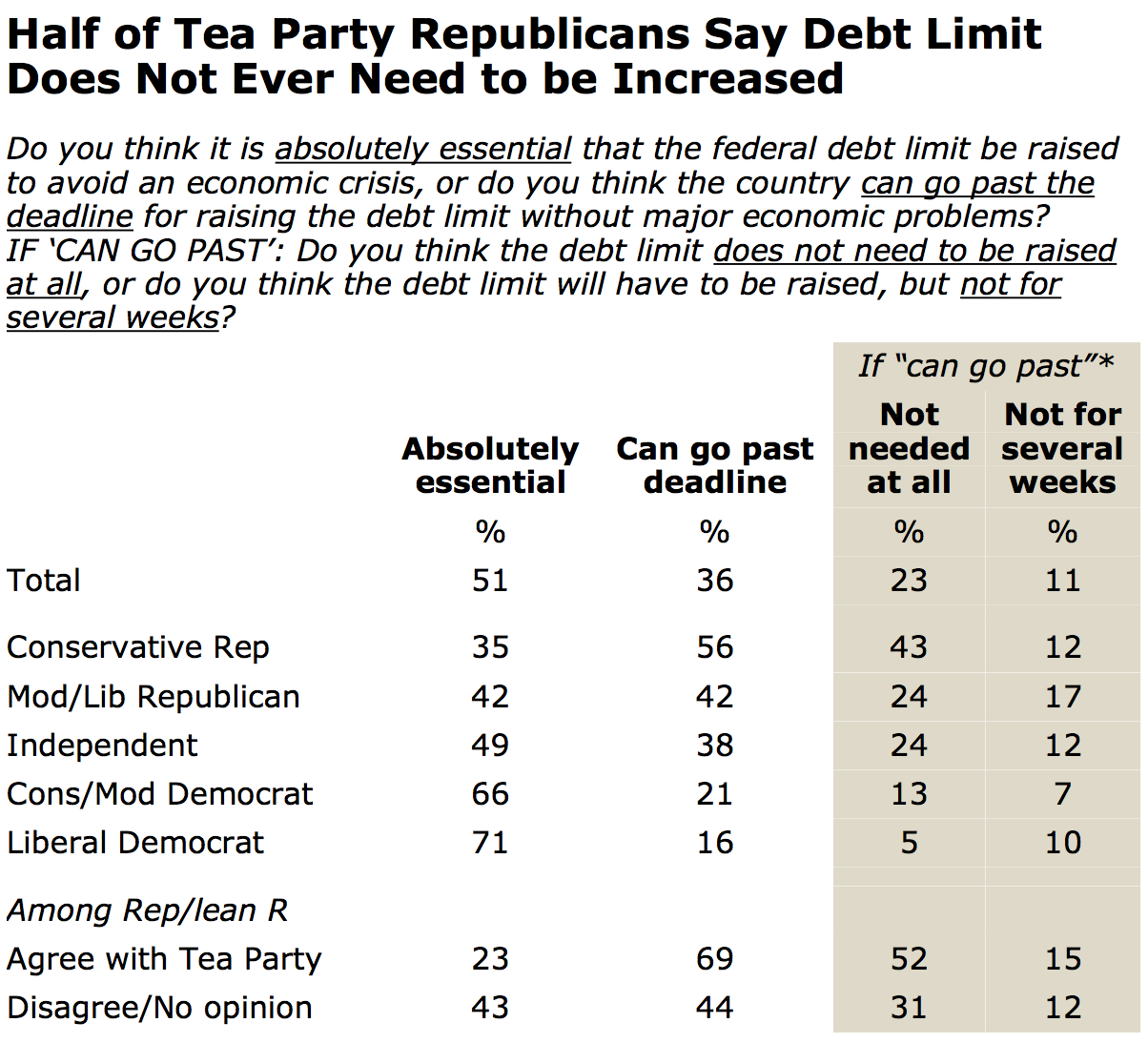
Plumer flags the numbers above from Pew:

[A] majority of Republicans say that the United States can blow past the Oct. 17 debt ceiling deadline without “major economic problems,” Pew finds. But what’s striking is that 52 percent of tea party Republicans don’t think we ever need to raise the ceiling.

Maybe this is the moment we discuss the Dunning-Kruger Effect, defined thus:

The Dunning–Kruger effect is a cognitive bias in which unskilled individuals suffer from illusory superiority, mistakenly rating their ability much higher than average. This bias is attributed to a metacognitive inability of the unskilled to recognize their mistakes.

Of course, understanding that the debt ceiling is not permission to raise spending further but merely to pay the bills already agreed to is counter-intuitive. It takes some explanation. People aren’t stupid for grasping this, just understandably ill-informed. But that’s where elites are necessary, from within a political coalition. And those elites are missing or compromised. John McCain can complain all he likes about wacko-birds. But who was it who put a Class A wacko-bird on his own national ticket? McCain empowered Palinism as much as anyone. A reader adds:

First, thanks for your continuing coverage and commentary regarding the debt limit and government shutdown battle. My thought is this: where is the courage of the leaders of the Republicans?  Where is the Bush family?  Where are the so-called moderates, like Chris Christie?

Where are the business leaders? They should be hammering the GOP to extend the debt limit. They have much at stake, far more than any favors the GOP can do for them. Why are the more sane thought leaders and influencers of the Republican party either silent, or at the very least very reserved?  Are they all afraid of the bullies in the Tea Party and conservative media? My feeling is that if anyone stood up to the bullies, they would find that bullies usually back down when confronted and are not that tough.

The national and world economies hang in the balance.  Our leadership in the world hangs in the balance. Make no mistake, if the US defaults this country will never be the world leader it is today again.  There is so much at stake that you think some on the GOP and their allies in the corporate community would rise up to tame the radicals in the party.

The Tea Party is like crack to the Republican party.  It has produced some highs, but it is also a poison that destroys.  Someone in the GOP needs to get the party to break its addiction.

But intelligent, educated Republicans, like Charles Krauthammer and George Will have defected to the loonies. The Bush family? They’ve made some sane comments – but not at a critical moment like this past week, when one would have thought their simple patriotism would have demanded some kind of intervention. And so the epistemic closure tightens and out polity’s dysfunction intensifies still more.

The Tea Party As A Religion

Mitt Romney Attends Tea Party Rally In New Hampshire

Dishheads know I believe that you cannot understand the current GOP without also grasping how bewildered so many people are by the dizzying onset of modernity. The 21st Century has brought Islamist war to America, the worst recession since the 1930s, a debt-ridden federal government, a majority-minority future, gay marriage, universal healthcare and legal weed. If you were still seething from the eruption of the 1960s, and thought that Reagan had ended all that, then the resilience of a pluralistic, multi-racial, fast-miscegenating, post-gay America, whose president looks like the future, not the past, you would indeed, at this point, be in a world-class, meshugganah, cultural panic.

When you add in the fact that the American dream stopped working for most working-class folks at some point in the mid 1970s, and when you see the national debt soaring from the Reagan years onward, made much worse by the Bush-Cheney years, and then exploded by the recession Bush bequeathed, you have a combustible mixture. It’s very easy to lump all this together into a paranoid fantasy of an American apocalypse that must somehow be stopped at all cost. In trying to understand the far-right mindset – which accounts for around a quarter of the country – I think you have to zoom out and see all of this in context.

Many of us found in Barack Obama a very post-ideological president, a pragmatist, a Christian, and a traditional family man, and naively NEGATIVE# josephm 210524--SLUG-ME-VA-AG-1-DATE--11/03/2009--LOCAbelieved that he could both repair the enormous damage done by the Bush-Cheney administration and simultaneously reach out to the red states as well. I refuse to say the failure is his. Because he tried. For years, he was lambasted by the left for being far too accommodating, far too reasonable, aloof, not scrappy enough, weak … you know the drill by now. In fact, he was just trying to bring as much of the country along as he could in tackling the huge recession and massive debt he inherited at one and the same time, and in unwinding the 9/11 emergency, and in ending two wars and the morally and legally crippling legacy of torture (about which the GOP is simply in rigid denial).
Obama got zero votes from House Republicans for a desperately needed stimulus in his first weeks in office. So I cannot believe he could have maintained any sort of detente with the Republican right, dominated by the legacy of Palin, rather than McCain. But the healthcare reform clearly ended any sort of possibility of coexistence – and the cold civil war took off again. The first black president could, perhaps, clean up some of the mess of his predecessor, but as soon as he moved on an actual substantive change that he wanted and campaigned on, he was deemed illegitimate. Even though that change was, by any standards, a moderate one, catering to private interests, such as drug and insurance companies; even though it had no public option; even though its outline was the same as the GOP’s 2012 nominee’s in GOP Candidates Rick Perry And Michelle Bachmann Appear At Columbia, SC Veterans Day ParadeMassachusetts, this inching toward a more liberal America was the casus belli. It still is – which is why it looms so large for the Republican right in ways that can easily befuddle the rest of us.

But it is emphatically not the real reason for the revolt. It is the symptom, not the cause. My rule of thumb is pretty simple: whenever you hear a quote about Obamacare, it’s more illuminating to remove the “care” part. And Obama is a symbol of change people cannot understand, are frightened by, and seek refuge from.

That desperate need for certainty and security is what I focused on in my book about all this, The Conservative Soul. What the understandably beleaguered citizens of this new modern order want is a pristine variety of America that feels like the one they grew up in. They want truths that ring without any timbre of doubt. They want root-and-branch reform – to the days of the American Revolution. And they want all of this as a pre-packaged ideology, preferably aligned with re-written American history, and reiterated as a theater of comfort and nostalgia. They want their presidents white and their budget balanced now. That balancing it now would tip the whole world into a second depression sounds like elite cant to them; that America is, as a matter of fact, a coffee-colored country – and stronger for it – does not remove their desire for it not to be so; indeed it intensifies their futile effort to stop immigration reform. And given the apocalyptic nature of their view of what is going on, it is only natural that they would seek a totalist, radical, revolutionary halt to all of it, even if it creates economic chaos, even if it destroys millions of jobs, even though it keeps millions in immigration limbo, even if it means an unprecedented default on the debt.

This is a religion – but a particularly modern, extreme and unthinking fundamentalist religion. And such a form of religion is the antithesis of the mainline Protestantism that once dominated the Republican party as well, to a lesser extent, the Democratic party.

It also brooks no distinction between religion and politics, seeing them as fused in the same cultural and religious battle. Much of the GOP hails from that new purist, apocalyptic sect right now – and certainly no one else is attacking that kind of religious organization. But it will do to institutional political parties what entrepreneurial fundamentalism does to mainline churches: its appeal to absolute truth, total rectitude and simplicity of worldview instantly trumps tradition, reason, moderation, compromise.

Francis Wilkinson has studied the scholarship of Roger Finke and Rodney Stark, authors of The Churching of America 1776-1990. He wrote a passage yesterday that resonated with me:

An important thesis of the book is that as religious organizations grow powerful and complacent, and their adherents do likewise, they make themselves vulnerable to challenges from upstart sects that “impose significant costs in terms of sacrifice and even stigma upon their members.” For insurgent groups, fervor and discipline are their own rewards.

Right now, the Republican Party is an object of contempt to many on the far right, whose adamant convictions threaten what they perceive as Republican complacency. The Tea Party is akin to a rowdy evangelical storefront beckoning down the road from the staid Episcopal cathedral. Writing of insurgent congregations, Finke and Stark said that “sectarian members are either in or out; they must follow the demands of the group or withdraw. The ‘seductive middle ground’ is lost.”

In other words, this is not just a cold civil war. It is also a religious war – between fundamentalism and faith, between totalism and tradition, between certainty and reasoned doubt. It may need to burn itself out – with all the social and economic and human damage that entails. Or it can be defeated, as Lincoln reluctantly did to his fanatical enemies, or absorbed and coopted, as Elizabeth I did hers over decades. But it will take time. The question is what will be left of America once it subsides, and how great a cost it will have imposed.

(Photos: from a Tea Party rally, Ken Cucinnelli, far right candidate for governor of Virginia, and Michele Bachmann, apocalyptic prophet, by Getty Images.)
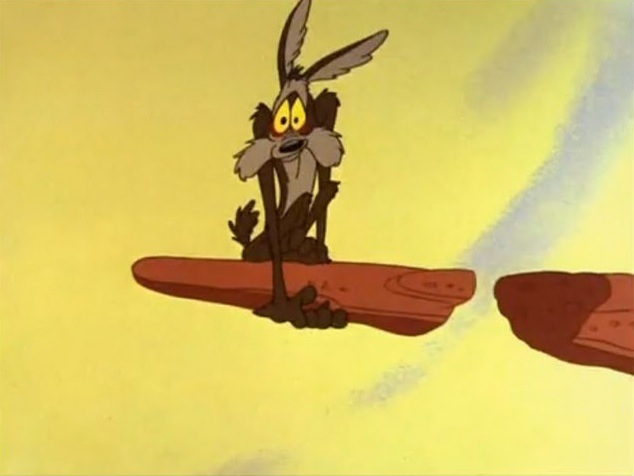
Meep Meep

The deal just announced strikes me as an even bigger defeat for the Cruzniks than seemed possible even a day ago:

wile-e-coyoteThe deal, with the government shutdown in its third week, yielded virtually no concessions to the Republicans, other than some minor tightening of income verifications for people obtaining subsidized insurance under the health care law. Under the agreement, the government would be funded through Jan. 15, and the debt ceiling would be raised until Feb. 7. The Senate will take up a separate motion to instruct House and Senate negotiators to reach accord by Dec. 13 on a long-term blueprint for tax-and-spending policies over the next decade.

Cruz will not stand in the way. The one critical factor in resolving this? The president’s poker-faced refusal to compromise the way he did in 2011. He has not been center-stage this past week, but that doesn’t mean his stance hasn’t affected this fiasco. It saved us. Costa:

Votes on the measure will begin this afternoon. The Senate will vote first, and then the House will consider the legislation. House leadership aides predict if 70-plus senators support the deal, it’ll have an easier chance of winning Republican votes in the House… Most Senate Republicans are expected to back the agreement, according to sources familiar with the whip count.

Here’s hoping the House can get a bipartisan majority as well.

It Will Only Get Worse

Tomasky crouches:

This is the worst it’s ever been in modern America. But it is going to get worse. They aren’t going to stop hating Obama and Obamacare. They aren’t suddenly going to decide to make their peace with him or it. They sure aren’t going to decide that gee, using default as leverage is naughty. A big chunk of them want the United States to default on Obama’s watch, so they can then blame him for what they themselves caused, say, “The black guy wrecked the economy. Couldn’t you have predicted it?” New horrors await us that you and I, being normal people, can’t begin to dream up. But rest assured, they will.

I loved this quote from Congresswoman Jacqueline Speier:

This is like a pre school that’s gone awry. I’ve been in public office for 30 years, and I’ve never seen anything like it.

I’d say that’s putting it mildly. But here’s Brit Hume last night rationalizing the Tea Party’s dead-end strategy at the expense of the nation and the world:

In conventional terms, it seems inexplicable, but Senator Cruz and his adherents do not view things in conventional terms. They look back over the past half-century, including the supposedly golden era of Ronald Reagan, and see the uninterrupted forward march of the American left. Entitlement spending never stopped growing. The regulatory state continued to expand. The national debt grew and grew and finally in the Obama years, exploded. They see an American population becoming unrecognizable from the free and self-reliant people they thought they knew.

And they see the Republican Party as having utterly failed to stop the drift toward an unfree nation supervised by an overweening and bloated bureaucracy. They are not interested in Republican policies that merely slow the growth of this leviathan. They want to stop it and reverse it. And they want to show their supporters they’ll try anything to bring that about. And if some of those things turn out to be reckless and doomed, well so be it.”

On cue, Eric Erickson calls for an even more extreme Republican party:

We only need a few good small businessmen and women to stand up and challenge these Republicans who are caving. If they refuse to fight for us, we must fight them. It is the only way we will finally be able to fight against Obamacare. I am tired of funding Republicans who campaign against Obamacare then refuse to fight. It’s time to find a new batch of Republicans to actually practice what the current crop preaches.

And the beat goes on.

Who Is Ted Cruz?

Veterans, their families and supporters hold a rally at the WWII Memorial to protest its' closing, in Washington, DC.

A reader writes:

On the Ted Cruz ego vs. paranoia discussion, I will say I knew him pretty well in college, law school, and beyond, and it’s hard to believe that he’s actually become someone who believes this stuff. He’s incredibly well-educated, and at least used to have a circle of friends that included people very different from his general conservative bent. Sarah Palin, for instance, wouldn’t have survived a day at Princeton, and certainly not as an editor on the Harvard Law Review. My sense is that being in the Senate has taken him too far outside his natural skill-set. He has always been a debater at heart – someone who enjoys taking extreme positions – not because he believes them necessarily, but because it’s fun.

Being a lawyer was a great fit in that way because you are paid to take a side, knowing that you are not tasked with crafting the outcome, but instead are playing your part in an adversarial system. Making policy, on the other hand, requires a very different mindset, and rewards different skills. I didn’t watch the filibuster, but having heard about it, it’s completely in his comfort zone, and exactly the kind of thing he knows how to do – talk for hours about why an extreme position actually makes a lot of sense because working out compromises with fellow legislators, or considering the actual consequences of taking such extreme positions – not naturally his strong suit, and not what he enjoys doing.

Honestly, I think Obama could figure him out in five minutes. Hell, Obama probably managed people much like Ted when Obama was editor of the Harvard Law Review. More importantly, Obama’s natural strong suit – using the rope-a-dope strategy – is perfect for sending Ted back to the private sector (where he would probably be happier anyway). There is no limit to the extremism of the positions Ted would take, given the chance, and the right encouragement. He treats every political discussion like a college-style debate, and the more ordinary people see of his scorched-earth argument style, I think the less they’re going to like it.

Update from a reader:

Back in 2007 or 2008 when Ted Cruz was the Texas Solicitor General, he came to speak at my law school. He was already then seen as a star in conservative legal circles, and I think many safely assumed he would have a very rapid political ascent. One anecdote that he shared, which I still remember vividly today, speaks volumes. He was a young member of the Bush legal team in Bush v. Gore, and he told us that the night before the Supreme Court argument he led a small group of Bush attorneys in a recitation of the St. Crispin’s Day speech from Henry V. As he recounted the story and a recited a few lines of the speech for us, it was quite clear that this was for him a very fond and proud memory.

Isn’t it clear to all, by now, that Ted Cruz relishes being one of the “few, we happy few?” When Cruz has been spouting off nonsense, many have asked whether he isn’t smart enough to know better. From everything I’ve heard, Ted Cruz is smart enough to know better as a matter of policy. But smarts are no guarantee of a lack of hubris, and Cruz’s prideful side is busy telling him that the crazier he is, the more alone he is in his positions; and the more alone he is in his positions, the more attention he alone will receive. It’s exactly as Henry V said: “the fewer men, the greater share of honour.”

(Photo: Cruz makes his way through a crowd of veterans, their families and supporters holding a rally at the WWII Memorial to protest its closing on October, 13, 2013. By Bill O’Leary/The Washington Post via Getty Images)

Will Cruz Put Up A Fight?

Beutler doubted it. Josh Green isn’t so sure:

In my talks with Cruz allies over the past couple of days, a clear theme emerged: Republicans were losing because those RINOs in the Senate wouldn’t man up and fight. To pin this defeat on others, Cruz will have to do everything he can to heighten this distinction.

In all likelihood, there’s no reason to panic if Cruz decided to keep tilting at windmills. According to the Congressional Budget Office, the U.S. wouldn’t risk missing a payment until sometime between Oct. 22 and Oct. 31 if the debt ceiling isn’t lifted, and Cruz couldn’t possibly stall for that long. So any delaying tactic would be a make-believe effort to force default in the same way that Cruz’s 21-hour talkathon before the shutdown was a make-believe filibuster. Afterward, he could declare another make-believe victory, while the rest of us got on with our lives.

The Speaker’s Job Is – Amazingly – Safe

US-POLITICS-ECONOMY

Or so it would appear:

Despite the aborted coup that momentarily threatened Boehner’s re-election as Speaker in January, House hardliners have described the past few months as Boehner’s finest. And why not? He gives them every opportunity to take the stands they need to secure re-election, while ultimately cushioning them from the consequences of economic catastrophe. Moreover, there are few credible candidates waiting in the wings—the threat posed by the ambitious Majority Leader Eric Cantor, which hung over the 2011 debt ceiling negotiations, has receded—and even fewer who would actually want the job.

Bernstein thinks “it’s extremely likely that most House Republicans blame the radicals, Ted Cruz, and Jim DeMint a lot more than they blame John Boehner.” Again, I have to keep scratching my head. I understand Bernstein’s narrow point about the Congressional GOP, but from the country’s point of view, Boehner has been unable to get even his own caucus to any kind of majority consensus, rendering the House effectively neutered, apart from its ability, now possibly weakened, to blow the whole system and economy apart. Since when does a Speaker who cannot even do that get to carry on in his job?

From the country’s point of view, that means total stalemate for another year, as immigration reform languishes, infrastructure crumbles, and future entitlements and taxes remain untouched. More to the point, Boehner has been exposed as lacking any core convictions himself. He’s not a leader; he’s a rag-doll tossed around by roiling factionalism in his own ranks. He commands no wide public support; and his entire job is essentially keeping his own job. To my mind, that is unacceptable and after this disaster, he should quit, if he has any self-respect.

Jon Cohn is on my side:

[Boehner] may not command the power of his predecessors, who were able to parcel out earmark spending projects. He may have an unusually petulant and impractical caucus on his hands. But he still has some power to push back—to challenge his critics, to rally his own supporters, and to appeal to the public at large. Standing up to his party’s right wing would have meant risking ouster, but sometimes that’s what leaders do—they take controversial stands and dare their followers to undermine them. Boehner didn’t do that. Instead, he accommodated the Tea Party and waited until the very last minute before defying them, in the hopes they would understand he had no choice.

The gambit will probably work for Boehner, just as it has before: He’ll get to keep his job. But the rest of the country is paying a price.

And this is not leadership. It’s simply pathetic.

(Photo: Saul Loeb/Getty)

The Sabotage Has Already Happened

public-sector-jobs

Ezra wants recognition of the less obvious damage being done to America:

Spectacular crises aren’t the only way a political system can fail. A Congress that can’t avoid own-goals like sequestration, that can’t routinely legislate to address problems like aging infrastructure, and that misses opportunities like immigration reform will, over time, meaningfully harm the country’s growth prospects. And it will do so in a way that’s hard to notice, and thus hard to fix: People don’t much miss the three-tenths of a percentage point worth of growth they didn’t have that quarter. But compounded over time, it’s a disaster.

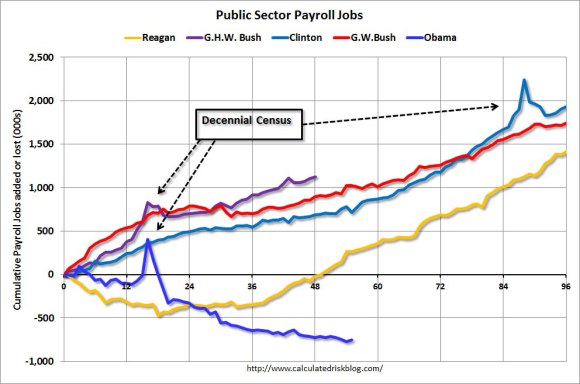
The shutdown has also impacted the mortgage and the home construction markets negatively. And the result of the default psycho-drama – by which I mean a drama badly choreographed by psychos – remains tight controls on discretionary spending via the sequester and still no long-term debt relief through any sort of coherent bipartisan bargain on taxes, defense and entitlements. Added to this has been the massive loss of public sector jobs, largely by Republican governors, that prolonged the recession and made Obama’s re-election less likely (see above from Calculated Risk). Beinart makes the point rather tightly:

In early September, a “clean” CR—including sequester cuts—that funded the government into 2014 was considered a Republican victory by both the Republican House Majority Leader and Washington’s most prominent Democratic think tank. Now, just over a month later, the media is describing the exact same deal as Republican “surrender.”

Drum highlights a Macroecomic Advisors report that details the economic consequences of recent US fiscal policy. Drum’s bottom line:

[T]he combined effect of past budget deals + sequester + fiscal cliff + debt ceiling crisis is probably a reduction of about half in our economic growth rate this year.

And one suspects that for some Republicans, that’s the point. Pure, spiteful sabotage of a presidency because they have no viable alternative to offer that could begin to command a majority of Americans.