The Best Of The Dish Today

Congress Convenes On Columbus Day As Government Shutdown Continues

There were some signs that Senators McConnell and Reid were inching toward an agreement to avert economic catastrophe tonight. Here’s the NYT summary of the alleged near-deal:

Negotiators talked into the evening as senators from both parties coalesced around a plan that would lift the debt limit through Feb. 7, pass a resolution to finance the government through Jan. 15 and conclude formal discussions on a long-term tax and spending plan no later than Dec. 13, according to one Senate aide briefed on the plan.

That’s a very small window of relief until the next debt ceiling raise and an even smaller window for some kind of Grand Bargain breakthrough. But it’s better than default; and largely a defeat for the ugly forces that rallied yesterday outside the White House, accusing cops of being “brownshirts” for doing their jobs. Speaking of those protestors, we examined what exactly constitutes being an asshole; debunked the notion that gerry-mandering alone is the cause of polarization; and appreciated the anguish of Dave Chappelle’s tip-toeing through the minefields of comedy and race.

The most popular post of the day was my description of the horrifying, racist nullification rhetoric at the Tea Party rally yesterday: “This Is Where We Are.” The second was my take on Sarah Palin’s apparent invocation of the right to armed rebellion – except she probably wasn’t. She’d have to know who John Locke is first.

See you on AC360 Later at 10 pm every night this week, and, of course, in the morning.

(Photo: A sign blocks a hallway at the Capitol Building on October 14, 2013 in Washington, DC. As Democratic and Republican leaders negotiate an end to the shutdown and a way to raise the debt limit, the White House postponed a planned Monday afternoon meeting with Boehner and other Congressional leaders. The government shutdown is currently in its 14th day. By Andrew Burton/Getty Images.)

Rap’s Reggae Roots

After a summer of rap artists sampling reggae, Wayne Marshall chronicles the way New York’s ragamuffin counterculture actually birthed hip-hop:

Growing in number since the late 60s, a wave of new immigrants from Jamaica, including ruthless footsoldiers of Kingston’s infamous gang coalitions, eventually reshaped New York’s party culture, organized crime, and the very meanings of Jamaicanness—not to mention the sound of New York. Although reggae offered a template for hip-hop, the sounds of Jamaica were slow to appear in rap recordings. The Fat Boys professed their love of “Hardcore Reggae” in 1984 and Yellowman accompanied Run DMC on an awkward outing called “Roots, Rap, Reggae” in ‘85, but the real turning point was registered—and amplified—by Boogie Down Productions’ Criminal Minded in early 1987.

BDP refashioned the sound of hip-hop by delivering patois-laced lyrics about the ravages of the crack age over choppy, distorted, and stark backing tracks beckoning from the bleeding edge of audio culture. And while KRS-One’s street-level realism takes inevitable cues from precursors like Grandmaster Flash’s 1982 smash “The Message,” the narrator of tracks like “P Is Free” and “9mm Goes Bang” is a rather different character, less a wary observer or potential victim and more an eager participant, a ready reaper of Reagan-era spoils. Criminal Minded signaled a strong tonal shift in hip-hop’s representation of urban malaise and its effects on community relationships, and the album’s first-person “badman” perspective was deeply informed and inflected by dancehall reggae’s images of black, modern gangsters.

The Ethics Of Mathematicians

Amid controversy about the NSA’s surveillance program, Edward Frenkel urges his fellow mathematicians to consider the political uses – and abuses – of their work:

I think it’s very similar to the dilemma that physicists faced when they realized the power of the nuclear bomb. We are talking about a group of physicists who were just trying to understand the structure of the universe, the structure of matter, and inadvertently discovered this incredible power. I would not tell any scientist to stop his or her research because it might have some possible evil applications. But once you discover that it does have these applications, I think it’s also your responsibility to do whatever you can to prevent the discovery from being used for evil purposes. … Mathematical power is not the power of a bomb. You cannot see its effect as immediately as Hiroshima and Nagasaki. But a formula can be just as powerful in terms of controlling our lives. It can alter the course of history.

Ann Finkbeiner says notably few mathematicians have spoken out against NSA surveillance:

NSA-supported mathematicians and computer scientists have remained mostly quiet, to the growing frustration of others in similar fields. “Most have never met a funding source they do not like,” says Phillip Rogaway, a computer scientist at the University of California, Davis, who has sworn not to accept NSA funding and is critical of other researchers’ silence. “And most of us have little sense of social responsibility.”

Mathematicians and the NSA are certainly interdependent. The agency declares that it is the United States’ largest maths employer, and Samuel Rankin, director of the Washington DC office of the American Mathematical Society, estimates that the agency hires 30 to 40 mathematicians every year. The NSA routinely holds job fairs on university campuses, and academic researchers can work at the agency on sabbaticals. In 2013, the agency’s mathematical sciences program offered more than $3.3 million in research grants.

Face Of The Day

Extravagant Hair Styles Take To The Catwalk At The Alternative Hair Show

Models are styled by the Dmitry Vinokurov team before performing at the ENIGMA Alternative hair Show in the Royal Albert Hall on October 13, 2013 in London, England. The Alternative Hair Show is one of the world’s most prestigious hairdressing events, bringing together international teams of hair artists to showcase groundbreaking hair styling. The show was launched 30 years ago by acclaimed hair designer Tony Rizzo to raise money for Leukaemia & Lymphoma Research following the death of his son Valentino and to date over 9 million GBP has been raised. By Oli Scarff/Getty Images.

Pushing Poverty Out Of Our Thoughts

Vikram Bath charges that most people in the developed world – including himself – simply “disbelieve” in the reality of poverty:

If you actually believed that you could save a human life for $2,500, how would you act from now on? Let’s make it a bit more explicit: Some sort of deity who is able to demonstrate his powers to your satisfaction tells you that from now on, every time you fail to find an opportunity to save to spend $2,500 on mosquito nets, you will find the corpse in your bedroom closet of the person you failed to save. The body will vanish at the end of the day without inconvenience or legal issues. You would nevertheless endeavor to avoid finding corpses in your closet.

If that were to happen, your creativity in finding $2,500 would become unbounded. You’d scrap most expenses, trade in your collection of crap, negotiate a higher salary, and get a second or third or fourth job until you stopped finding corpses. You would start companies in your time off. You would structure your whole life around your knowledge of poverty.

Previous Dish on philanthropy and moral obligations here.

“America’s Black Friend”

A reminder of what happened to Dave Chappelle:

One of the reasons Chappelle abandoned his sketch comedy series at its peak of popularity was that he grew uncomfortable with the response to his racially charged humor from white audiences. During the taping of an ill-fated sketch in which he donned blackface as a “black-pixie” who prodded black people to perform as stereotypes, Chappelle noticed that one white male audience member seemed to find it a little too funny. “When he laughed, it made me uncomfortable,” he said. “As a matter of fact, that was the last thing I shot before I told myself I gotta take fucking time out after this. Because my head almost exploded.”

In a study of Chappelle, Rachel Kaadzi Ghansah explores how comedy can reveal truths about race:

[Chappelle’s Show co-creator Neal] Brennan brings up an idea first posited by the psychologist Beverly Tatum about the ways we tend to segregate ourselves as we get older and grow apart from our friends of different races.

Neal tells me, “It’s like when black kids sit at the lunch table with only black kids, and the white kids sit with white kids. I think it is just like, ‘Well, they look like family.’ It is just some animal shit. It is safety.” When I read Tatum’s book, she says something that sticks with me: that so often the difficultly in discussing race is about working around the divide of that which we do not know.

As I listen to Brennan talk, I think about how he is right, that comedy is different. Comedians live for the joke and the joke alone. White writers have long written jokes for black comics with great success (my favorites being Ed. Weinberger for Bill Cosby and Louis C.K. for Chris Rock), but at the same time none of this goodwill can negate the possibility that Chappelle experienced what his mother had written about twenty years before: the desire to “learn to know himself again.” And that for all the post–civil rights progress we have made, it is possible that you could be best friends with someone of a different race without being able to enter worlds and spaces that they can, or in the way that they do.

Previous Dish on the clarifying power of comedy here and here.

A Pilgrimage With No Vacancies

The Economist finds that it has become harder for Muslims to complete the haj:

[T]he growing global Muslim population of 1.6 billion, coupled with cheaper international travel, has brought its own problems. Back in 2004, 2.2m Muslims went to Mecca. Last year the number was 3.2m, the highest ever. Stampedes in 1990, 2004 and 2006 caused hundreds of deaths. This year Saudi Arabia, which gives a quota of haj visas to each country on the basis of the size of its Muslim population, has slashed the number of visas for foreign pilgrims by 20%, as it carries out renovation works to expand the capacity of the Grand Mosque. … Next year the renovations should mean more visas once again. But the growing number of Muslims, and growing prosperity in many Muslim countries, means the backlog is likely to grow: South Africa recently announced that citizens on the waiting list may face another six years before they get a slot.

Additionally, Rebecca Kreston points out that “the Hajj poses serious challenges in the prevention and control of infectious diseases among the millions of faithful worshipers who seek to complete one of the five pillars of Islam”:

It’s not only that the Saudi Ministry of Health must be on the look out for the typical pathogenic fare that thrive on large masses of humans – such as meningitis, various exotic gastrointestinal bugs, or tuberculosis – but also for more troublesome pathogens. This year in particular seems hardwired for trouble as the beginning of flu season is coinciding with continuing instances of polio trickling throughout Northern Africa and the Middle East.

Last year, Kreston wrote at length about the Haj’s health issues:

Following the Stoning of the Devil and the completion of their religious rites, Hajjees migrate to Mina where hundreds of barbers await with razor blades to shave the scalps of male pilgrims and where women will trim a finger-length lock of hair. This last ritual seals the deal, so to speak, allowing pilgrims to compete their observance of the Hajj. Saudi officials require all barbers to be licensed though makeshift barbers still abound, waiting on roads for eager pilgrims with razors in hand. Pilgrims may also buddy up to shave each other’s scalps. These unlicensed barbers and pilgrims can often be found reusing unsterilized blades to communally head-shave Hajjees, a fabulous technique for transmitting blood-borne diseases (BBDs).

If You See Something, Text Something, Ctd

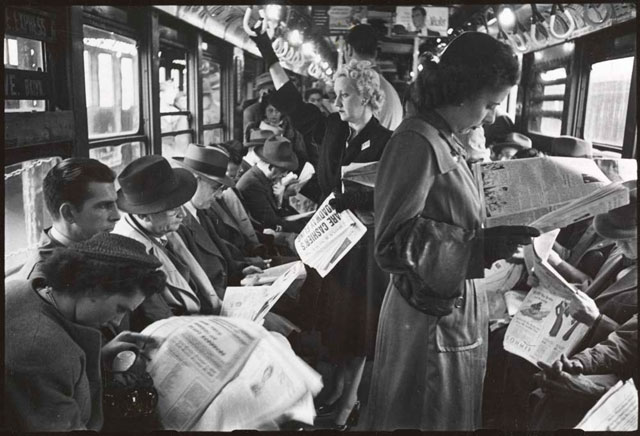
kubrick-subway-newspapers

A reader sends the above scene that Stanley Kubrick captured in 1946:

Yes, smartphones and iPads are the problem, because in the old days we all used to talk to each other on the subway instead of staring down at an electronic object …

Another:

Joe Eskenazi made an uncomfortable point:

Authorities are preaching vigilance, which is probably a smarter thing to do than play Angry Birds. But left unsaid is just what the hell a train full of vigilant people were supposed to do if they noticed a man waving about a pistol – a man, specifically, in search of a random passenger to murder. What then?

I would make a similar but different point.

The reason why people withdraw so much from the public world in transit is because there are about six people in your personal bubble, which is generally considered unpleasant, because you invited none of them. The only way to stay sane in our sardine-packed transit system is to withdraw in your own world. People used to close their eyes and pretend to sleep, or read. These days smart devices give more options to relieve the stress of being squeezed against that fat, sweaty, blob that didn’t shower in the last three weeks, than can be possible relieved by a vigilant, paranoid crowd looking for criminals and terrorists and preventing an occasional crime or very rare terror plot. If we were to allow the latter, the terrorists have won.

Another reader:

Regarding the idea that mobile devices have made us less aware of our surroundings, I would argue that this has actually helped to reduce crime. As a New Yorker and daily subway rider, I can attest to the fact that absorption in texting or gaming can reduce interpersonal incidents that can lead to violence. Additionally, wearing headphones allows you to legitimately ignore an insult – a response that satisfies your honor as well as that of the person trying to pick a fight with you.

Sitting Makes Us Soft

The evidence:

Comprehensive analyses of the incidence of back pain around the world consistently find that back pain is twice as high in developed versus less developed countries; further, within low-income countries, the incidence is roughly twice as high in urban versus rural areas. For example, lower back pain afflicts about 40 percent of farmers in rural Tibet but 68 percent of sewing machine operators in India. Neither of these populations lounges about in La-Z-Boys, but a general trend is that people who frequently carry heavy loads and do other “back-breaking” work get fewer back injuries than those who sit in chairs for hours bent over a machine.