Putting A Price Tag On Wikipedia

Jonathan Band and Jonathan Gerafi researched (pdf) the economic value of the free encyclopedia. Rose Eveleth relays the results:

[T]he two researchers identified a few factors that could help answer the question: market value, replacement cost and consumer value. They looked at what other sites that get similar traffic are worth, how much people would be willing to pay for Wikipedia if it weren’t free, and how much it would cost to replace the site. In the end Band and Gerafi conclude that the website is worth “tens of billions of dollars” and has a replacement cost of $6.6 billion dollars.

For context, it costs the site $25 million each year to run. And for comparison, Twitter’s recent IPO announcement has their company valued at about $12.8 billion. Band and Gerafi write, “The millions of hours contributed by volunteer writers and editors leverage this modest budget, funded by donations, into an asset worth tens of billions of dollars that produces hundreds of billions of dollars of consumer benefit.”

Self-Building Blocks

Scientists have created small, simple automated cubes that are the first step toward self-reconfiguring machines:

M-Blocks are a new breed of self-assembling robot currently in development at MIT. Each cube is about an inch and a half across on each face, with a flywheel on the inside and an array of magnets on the outside. By spinning the flywheel at high speeds–up to 20,000 revolutions per minute–the self-contained units can scoot across tables and flip themselves through the air. Once they come close to another block, a clever system of self-aligning magnets attaches them to their partner. Seeing a single cube clamber on top of another isn’t especially impressive.

But watch several move at once, with disparate parts moving independently and the larger whole rapidly taking a totally new form, and you can start to see a hazy path towards Optimus Prime.

The Authoritarian Editor

The tyrannical tendencies of Stalin were evident in the “editorial mania” he exercised at Pravda:

Even when not wielding his blue pencil, Stalin’s editorial zeal was all-consuming. He excised people—indeed whole peoples—out of the manuscript of worldly existence, had them vanished from photographs and lexicons, changed their words and the meanings of their words, edited conversations as they happened, backing his interlocutors into more desirable (to him) formulations. “The Poles have been visiting here,” he told the former Comintern chief Georgi Dimitrov in 1948. “I ask them: What do you think of Dimitrov’s statement? They say: A good thing. And I tell them that it isn’t a good thing. Then they reply that they, too, think it isn’t a good thing.”

All editors, wrote the cultural historian Jacques Barzun, “show a common bias: … what the editor would prefer is preferable.” Being an author is well and good, and Stalin wrote several books—the word “author” does after all share a root with the word “authority”—but he knew that editing was a higher power. Naimark argues that editing is as much a part of Stalinist ideology as anything he said or wrote. This insight warrants amplification. Under Stalinism, anyone could speak or write, but since Stalin was the supreme gatekeeper of the censorship hierarchy and the gulag system, the power to edit was power itself.

Reality Check

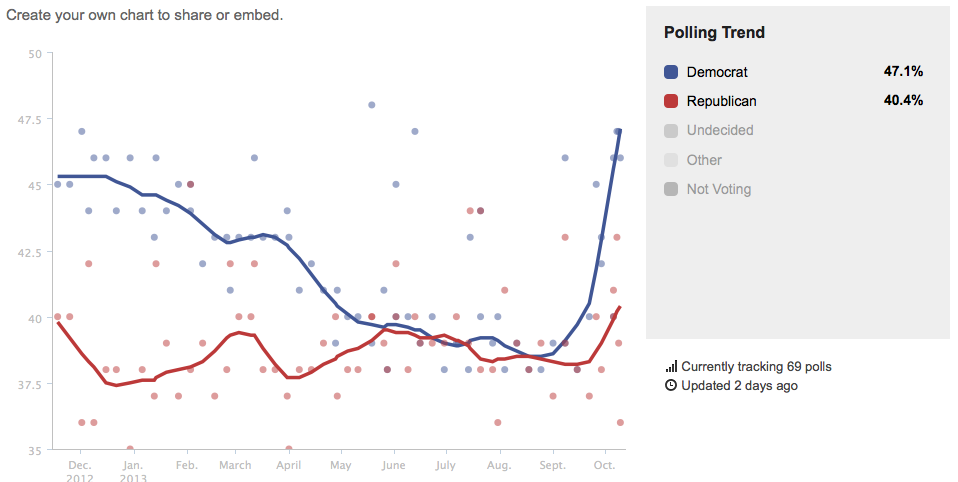
Here’s the poll of polls for the state of the 2014 national Congressional race (at the most sensitive level) from April of this year to today:

Screen Shot 2013-10-13 at 9.22.25 PM

None of this really tells us much about 2014, but it sure tells us something about broad public reaction to the self-induced crisis of the last two weeks. I just hope the Democrats don’t fall into the illusion that these kinds of numbers drive the Tea Party. They are driven by much deeper, less rational, more emotional forces than self-interest. Many of them want to destroy the GOP as well.

Is Palin Invoking Locke’s Right Of Rebellion?

Of course, she’s never heard of John Locke, but the person who made the flag above her sure did. A reader writes:

Note the white sign with the green arrow, pointing up with the text “Appeal to Heaven.” I would suspect that most casual observers, perhaps even most reporters, would assume that meant something like, “Let’s pray about all this” or “Let’s pray to God to change Obama’s mind” or something other prayer-centered interpretation of what that sign might mean.

However, that exact phrase appears, as I’m sure you will recall, in Ch. 14 of Locke’s Second Treatise, which describes the nature and extent of executive power, especially the executive’s “prerogative,” i.e. discretionary power. Here’s the relevant passage, in which “appeal to heaven” is used in the context of unjust or abusive uses of prerogative power:

The people have no other remedy in this, as in all other cases where they have no judge on earth, but to appeal to heaven: for the rulers, in such attempts, exercising a power the people never put into their hands, (who can never be supposed to consent that any body should rule over them for their harm) do that which they have not a right to do. And where the body of the people, or any single man, is deprived of their right, or is under the exercise of a power without right, and have no appeal on earth, then they have a liberty to appeal to heaven, whenever they judge the cause of sufficient moment.

It is clear that “appeal to heaven” in the text means revolution or rebellion. When the usual, political channels – i.e. earthly channels – are exhausted, then you can revolt in the name of the “laws of nature” or the “rights” we all possess and which no “government” can take away. I’ll spare you a lengthy exegesis of these sentences; my point is that “appeal to heaven” is not a random phrase, but one from the history of political thought that clearly means revolution or rebellion – and one the people take into their own hands, even.

I don’t think we can ignore the fact that many on the Republican right now believe themselves to be in open, non-violent rebellion against the government of the United States. Having the lost the appeal to the majority of Americans, they will soon be invoking an appeal to a higher power – against the president.

Update from a reader:

Your reader who identified Locke in the context of the “Appeal to Heaven” flag is correct in getting the reference, but wrong in thinking the flag is anything new. It’s the flag of Washington’s Cruisers, one of the flags of the American Revolution. That’s not a “green arrow”; it’s a pine tree. Alas, just like the Gadsden flag and it’s famous “Don’t Tread on Me” snake, it has now been appropriated by the Tea Party movement. I am a liberal Democrat who used to regularly fly those historic flags outside my home on the Fourth of July to commemorate the American Revolution – when there was a real, not imagined and hysterical, reason for revolt – but now I’m afraid I have to confine them to the closet. The idea that my neighbors might affiliate me with these crazies is too much to bear.

A Rolling Coup

How else do you explain this amendment to the following rule passed by the House just before it shut down the government:

Here’s the rule in question:

  • When the stage of disagreement has been reached on a bill or resolution with House or Senate amendments, a motion to dispose of any amendment shall be privileged.

In other words, if the House and Senate are gridlocked as they were on the eve of the shutdown, any motion from any member to end that gridlock should be allowed to proceed. Like, for example, a motion to vote on the Senate bill. That’s how House Democrats read it. But the House Rules Committee voted the night of Sept. 30 to change that rule for this specific bill. They added language dictating that any motion “may be offered only by the majority Leader or his designee.” So unless House Majority Leader Eric Cantor (R-VA) wanted the Senate spending bill to come to the floor, it wasn’t going to happen. And it didn’t.

So, in advance, the GOP changed parliamentary procedure to ensure that no clean resolution, based on a Senate budget agreement, could get on the floor of the House for a general vote. The hostage-takers made it impossible to defuse the bomb they have attached to our system of government without their consent – even against a majority of House members of both parties.

These people are deadly serious. Since they lost an election, they decided to start a cold civil war.

This Is Where We Are

This embed is invalid

 
This is a fascinating speech from today’s rally at the World War II veterans’ memorial. It’s fascinating because it’s a riveting, candid insight into the forces that are behind the government shut-down and the debt-ceiling blackmail of the country and the world. They do not believe this president is a legitimate president. It is beyond their understanding that he was re-elected handily, or that he commands, even during this assault on our system of government, far more support than the Tea Party. Let’s not be mealy-mouthed. This speaker, Larry Klayman of Freedom Watch, accuses the president of treason in this speech, of deliberately pursuing policies to kill members of the armed services, because he is an Islamist, and allegedly “bows to Allah”. What he is saying is the president is a deliberate mole of foreign agents determined to destroy the American way of life. And there is no pushback from the crowd and no pushback from GOP leaders.

This is what we’re dealing with. This is not an alternative budget; it is not another way of insuring millions and cutting healthcare costs; it is not a contribution to anything but to the logic of nullification of an election. It is yet another declaration of cold civil war – a call for a nonviolent refusal to be governed by a re-elected president because he is pursuing policies with which an electorally defeated minority disagree. Simply pursuing those policies has rendered Obama a “monarch” who is arguing “his way or the highway.” But all Obama is doing is implementing a campaign promise and settled law, while governing under a continuing resolution that reflects the sequester’s level of spending, a level agreed to by the Republicans. He wants a budget agreement between the House and Senate in a conference that the Republican House has long resisted entering. He has said that he is happy to negotiate with anyone on anything as long as the blackmail of a government shut-down and of a threatened global depression are ended. And his record shows that he has compromised again and again – as his own most fervent supporters look on in dismay.

I’m not privy to the negotiations now going on in the Senate and can only glean from outsiders what the meetings with legislators have been like. But I’m not distorting the raw facts of the situation here, or trying to distract from them. And I’d love a much more expansive Grand Bargain on taxes and entitlements, that could ease our long-term debt (but it would have to be a bargain, not merely a set of Republican demands). But the rank threats of unimaginably radical consequences if a re-elected president doesn’t junk what he was re-elected to do are so foul in their lack of concern about the common good, so poisonous in their slander of a president, and so contemptuous of our orderly system of government, that it is vital the threats do not work and are not accommodated. No president of any party has any right to legitimize such an attack on the American system of government and the way it conducts business – by elections, debates, compromises and budgets, not threats of total government shut-down and the collapse of the dollar if our global credit rating is effectively destroyed overnight.

I hoped we’d be nearing some kind of deal at this point, rather than witnessing this upping of the ante from the forces that truly live on the fringes of the far right, but which, without any resistance, have now defined the Republican party. It is no accident that among those addressing this rally to blackmail the country and the world were Sarah Palin and Ted Cruz. I can see a very powerful populist electoral ticket with both of those on it – either of a third Tea Party or of an even more  radicalized GOP. And perhaps that is the only way to expunge this nihilist extremism from our system. Except that it may succeed in expunging the system and the economy before we can test it where in a democracy we are accustomed to test it: in elections, not in the chaos of economic blackmail.

Quote For The Day

“One thing we’re certain around the table, it was that if there is that degree of disruption, that lack of certainty, that lack of trust in the U.S. signature, it would mean massive disruption the world over. And we would be at risk of tipping yet again into a recession. That was the impression around that big table,” – Christine Lagarde, the IMF’s managing director, on the fiscal crisis in the US.

Face Of The Day

dish_reflections

Photographer Tom Hussey’s Reflections series depicts elders gazing into mirrors that reflect back images of their younger selves.  Tiffany Diamond spoke to Hussey about his inspiration:

I don’t care how old you are, when you look into a mirror, you think of yourself as younger than you are. You have a memory of a time in your life that was pivotal — be it when you got your drivers license, your senior year in High School, or maybe the year you married.

(Photo by Tom Hussey)

The Mind’s Enduring Mysteries

Michael Hanlon reminds us of why human consciousness eludes our understanding:

The problem is that, even if we know what someone is thinking about, or what they are likely to do, we still don’t know what it’s like to be that person. Hemodynamic changes in your prefrontal cortex might tell me that you are looking at a painting of sunflowers, but then, if I thwacked your shin with a hammer, your screams would tell me you were in pain. Neither lets me know what pain or sunflowers feel like for you, or how those feelings come about. In fact, they don’t even tell us whether you really have feelings at all. One can imagine a creature behaving exactly like a human — walking, talking, running away from danger, mating and telling jokes — with absolutely no internal mental life. Such a creature would be, in the philosophical jargon, a zombie.

Why there’s no end in sight to the problem’s intransigence:

Nearly a quarter of a century ago, Daniel Dennett wrote that: ‘Human consciousness is just about the last surviving mystery.’ A few years later, [David] Chalmers added: ‘[It] may be the largest outstanding obstacle in our quest for a scientific understanding of the universe.’ They were right then and, despite the tremendous scientific advances since, they are still right today. I do not think that the evolutionary ‘explanations’ for consciousness that are currently doing the rounds are going to get us anywhere. These explanations do not address the hard problem itself, but merely the ‘easy’ problems that orbit it like a swarm of planets around a star. The hard problem’s fascination is that it has, to date, completely and utterly defeated science. Nothing else is like it. We know how genes work, we have (probably) found the Higgs Boson; but we understand the weather on Jupiter better than we understand what is going on in our own heads. This is remarkable.