“We Always Called It ‘Black Snow'”

Katie Drummond reports that military-operated “burn pits” in Iraq and Afghanistan have put servicemembers’ health at risk:

[W]hen Le Roy [Torres] arrived at [Joint Base] Balad in the summer of 2007, the first thing he noticed was the smell. A noxious, overwhelming stench reminiscent of burning rubber. “I was like, ‘Wow, that is something really bad, really really bad,’” he recalls. Soon, he also noticed the smoke: plumes of it curling into the air at all hours of the day, sometimes lingering over the base as dark, foreboding clouds. That smoke, Le Roy soon learned, was coming from the same place as the stench that had first grabbed him: Balad’s open-air burn pit.

The pit, a shallow excavation measuring a gargantuan 10 acres, was used to incinerate every single piece of refuse generated by Balad’s thousands of residents. That meant seemingly innocuous items, like food scraps or paper. But it also meant plastic, styrofoam, electronics, metal cans, rubber tires, ammunition, explosives, human feces, animal carcasses, lithium batteries, asbestos insulation, and human body parts — all of it doused in jet fuel and lit on fire. The pit wasn’t unique to Balad: open-air burn pits, operated either by servicemembers or contractors, were used to dispose of trash at bases all across Iraq and Afghanistan.

It’s no secret that open-air burning poses health hazards. …

That’s because of both the size of the particulate matter emitted from the pits and its composition. Smoke from any combustion process fills the air with what are known as “fine particles” or PM2.5. Because they’re so small — measuring 2.5 microns in diameter or less — these particles burrow more deeply into the lungs than larger airborne pollutants, and from there can leach into the bloodstream and circulate through the body. The military’s burn pits emitted particulate matter laced with heavy metals and toxins — like sulfur dioxide, arsenic, dioxins, and hydrochloric acid — that are linked to serious health ailments. Among them are chronic respiratory and cardiovascular problems, allergies, neurological conditions, several kinds of cancer, and weakened immune systems.

Update from a reader:

On the subject of the dangers of burn pits in Iraq, you and your readers might be interested in the story of Joshua Casteel. As a military interrogator in Iraq he apparently conducted over 100 interrogations at Abu Ghraib in the aftermath of the allegations of abuses there in 2004, only to decide that his role was incompatible with his Christian faith. His application for conscientious objector status was approved by the Army and he went on to work with Iraq Veterans Against the War and speak out against what he saw as his abuses in numerous public forums. As a graduate student in the Divinity School at the University of Chicago (I am a student in the English Department there; I didn’t know him, but I know people who did), he was diagnosed with lung cancer and died relatively soon thereafter, in August 2012. His friends and family strongly believe that his quarters in Iraq had something to do with it; he slept near an active burn pit for almost six months while serving there. Here and here are few links for background. Some of his writings also appeared in Harper’s, but I don’t have the link.

(Hat tip: Eric Levenson)
Carl Sagan’s Cannabis Closet

Perhaps the greatest highdea ever:

Sagan wrote eloquently – but pseudonymously  about the joys of weed. As his friend Lester Grinspoon recalls:

As much as [Sagan] loved marijuana, he was always very concerned about people finding out. For instance, one of the early pieces I wrote on the subject appeared in The New York Times Magazine, and in it I said something to the effect, “People have the idea that only these hirsute young hippie kids use marijuana, but in fact a lot of ordinary and even extraordinary people smoke it, including professionals.” Then I mentioned doctors, lawyers, etc. Well, in that list I included astronomers. And when that came out, it was the only time Carl ever expressed any anger towards me. Because he thought mentioning astronomers would give him away based on our friendship.

Grinspoon recounts the time the two got baked on a cruise to the South Pacific to see Halley’s Comet:

I smuggled about an ounce of marijuana on board, and we had a wonderful time. Carl had the top cabin on the ship, including a deck where we could sit and smoke and talk and eat—for hours on end—while watching the beautiful cloud formations over the Pacific. When the cruise was over, we still had some marijuana left. I didn’t want to go through Customs with it, so I told Carl that I was going to toss it down a companionway I had noticed was marked “Crew Only,” trusting that it would be enjoyed among the mates. But he asked me not to, because we might somehow be found out. So we weighed the baggie down with one of those old glass ashtrays, and tossed it overboard. I hated to let this precious stuff go down to the bottom of the sea, and didn’t really see how we could ever have gotten caught passing it along, but I had to respect Carl’s objection. Really, it was very important that he not get in trouble. He was testifying before NASA and Congressional committees all the time.

Previous Dish on Sagan and marijuana here.

Buzzfeed Goes Global

Evgeny Morozov expects the site’s new translation project to hurt foreign news outlets:

Here is BuzzFeed’s version of “global village”: If its plan works, more and more people around the globe will be reading about U.S. popular culture in their native languages. No, what it is interested in is taking viral stories that have already proven their worth in English and taking them global, conquering even more eyeballs that were previously hard to reach due to language barriers.

In the process, it gains even more traffic and could someday enter local advertising markets—BuzzFeed is launching local editions in Spanish, French, and Brazilian Portuguese, too. National news players that produce genuine hard news—the kind that takes money to report and might not receive many likes and shares on social networks, as it focuses on issues that are grim rather than viral—would have a powerful new competitor.

There’s no scenario in which BuzzFeed’s “cosmopolitan turn” is good for foreign news sites: They will be pressed to either soften up their own news coverage—to boost social media friendliness—or be faced with the prospect of making even less money off their online advertising.

The Buzzfeed model is not inevitable; it gets tired pretty quickly; and it can and has financed real journalism – like Ben Smith’s or Chris Geidner’s or McKay Coppins’. We’ll adapt. But Buzzfeed’s voracity could do a lot of damage to real journalism in the long run. Its core innovation – passing off advertizing as editorial, and refusing to call it advertorial – has spread far and wide to almost every media outlet. I mean, when you read Forbes now, do you really know if you’re reading something paid for by a company or written by an actual independent journalist? I can’t unless I take time to examine it very closely.

Update from a reader:

The passage in question, as quoted on the Dish, is from a previous version of the Slate article that contained several errors. Slate has since issued a correction and removed or altered sentences from the portion of the article quoted.

Our pull-quote from Morozov’s piece has now been replaced with the updated version. Slate‘s full correction is after the jump:

This article originally used different analytics platforms to compare the BBC’s and BuzzFeed’s traffic. The sentence about the BBC has been removed because the comparisons are not exact. The piece also said that “The Viral Web in Real Time” is BuzzFeed’s motto. It was a prominently displayed tag line on the site for some time, but no longer is. The article also said that BuzzFeed is not interested in bringing local foreign news to the English-language blogosphere; BuzzFeed has a foreign editor and correspondents in Turkey, Syria, and Moscow. That sentence has been removed. The article also originally suggested that BuzzFeed is entering local advertising markets in foreign countries. BuzzFeed is not currently in local markets.

The original pull-quote, for the record:

BuzzFeed does not seem to be interested in finding overlooked stories in the foreign press and bringing them to the masses, in English or in any other language. No, what it is interested in is taking viral stories that have already proven their worth in English and taking them global, conquering even more eyeballs that were previously hard to reach due to language barriers.

In the process, it gains even more traffic and enters local advertising markets—BuzzFeed is launching local editions in Spanish, French, and Brazilian Portuguese, too. National news players that produce genuine hard news—the kind that takes money to report and might not receive many likes and shares on social networks, as it focuses on issues that are grim rather than viral—would have a powerful new competitor.

There’s no scenario in which BuzzFeed’s “cosmopolitan turn” is good for foreign news sites: They will be pressed to either soften up their own news coverage—to boost social media friendliness—or be faced with the prospect of making even less money off their online advertising.

Poseur Alert

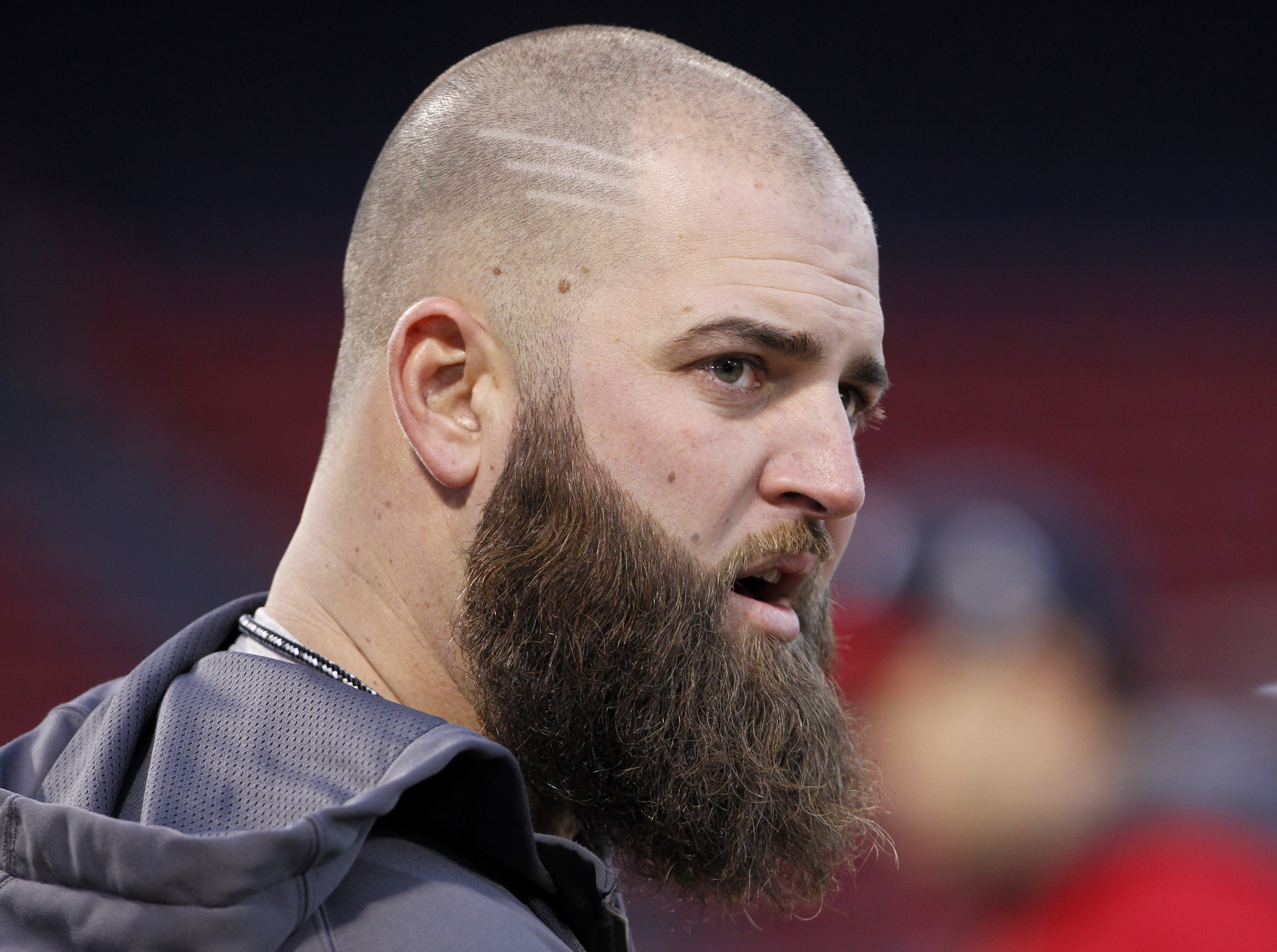
Boston Red Sox Practice

No, not Mike Napoli – Richard Brody, of The New Yorker:

One of the beauties of the beard is that its lushness is polysemic, lending itself to an interpretive exuberance to match its flow.

A beard is a celebration of nature that brings appearance closer to that of untamed human animals—a Rousseau-esque gesture that was crucial to the age of Aquarius, a time when long-established norms of behavior collapsed and made public life a clearer expression of formerly unspeakable private desires. By contrast, the shaven and crew-cut athlete suggests a martial fury that is joyless—a grim, self-denying efficiency that may work in war but is exactly the opposite of the essence of baseball, which, for all its competitive ardor, is playtime. (And the over-all increasing regimentation and militarization of modern life has no more powerful, intimate symbol than the fanatical prevalence of depilation).

Roger Angell, objecting to the idea of unkempt beards rather than the peuce prose, only makes it worse:

How does it feel to wake up, night after night, in immediate proximity to a crazed Pomeranian or a Malamute or an Old English sheepdog stubbornly adhering to the once caressable jaw of the guy on the nearest pillow? Doesn’t it scratch? Doesn’t it itch? Doesn’t it smell, however faintly, of tonight’s boeuf en daube or yesterday’s last pinch of Red Man?

Boeuf an daube? Probably remnants of chowder.

Look: Beards need no highfalutin defense. They’re simply the default for most men. Do nothing and you’ll have a beard.  At some point, you’ll need to trim it. Go to a barber who knows what he’s doing. That’s about it. Keep it as you would an English hedge. Tended from time to time but not fussed over. And if you see a debate in The New Yorker on their “Rousseau-esque gesturing,” roll your eyes and have a good chuckle.

(Hat tip: Amanda Hess. Photo: Mike Napoli’s magnificent manliness, by Jessica Rinaldi for The Boston Globe via Getty Images. Dish Award glossary – explaining all our annual awards – is here.)

The Smithers Test

Willa Paskin sees mixed results in the portrayal of gays and lesbians on the box:

The preponderance of lesbians on TV [is] progressive—representation is a good thing—but not nearly as progressive as it first appears. While the characters on Orange [is the New Black], The Fosters, and The Killing are fully developed, on shows likes The Crazy OnesDraculaRookie Blue, and Mistresses, girl-on-girl dabbling is often presented as just another quirk of a sexually adventurous young woman, proof that she is fit to star in a straight dude’s fantasy, even if it’s also simultaneous proof of her emotional depth. (On Mistresses, Josslyn’s relationship with a woman was the most serious she’d ever had, while also being a kinky phase she could tease future boy-toys with.) Shows like MistressesRookie Blue, Betrayal, and Once Upon a Time put lesbians or bisexual women in supporting roles to signify their adult aesthetic.

Lesbian story lines are to network television what nudity is to premium cable: a turn-on masquerading as proof of seriousness. There is at least an upside to this: Lesbians have become shorthand for sophisticated, steamy, romantic, intriguing. In the interest of titillation, television has banished the stereotype of the sexless lesbian.

But while “women longing for other women may be hot, [men] longing for other men is still decidedly not”:

Other than the sweet first-love story between Kurt and Blaine on Glee, most gay men on television are non-sexual. (HBO’s Looking, about three gay men in San Francisco, will presumably do what it can to address this shortfall when it arrives early next year.) Modern Family’s Cam and Mitchell still don’t kiss much. Andre Braugher’s character on Brooklyn Nine-Nine is remarkable for being so stoically butch. Thomas on Downton Abbey is heartbreakingly isolated. And Sean Hayes’ character on Sean Saves the World gets less play than Will and Grace’s Jack did. It’s a great time for lesbians on television, but I eagerly await the romantic, sexy storyline about Prince Charming falling for Hercules.

Me too. But I’d give Downton Abbey a pass, for Pete’s sake. It’s a period drama. Daniel D’Addario also isn’t satisfied with how gay characters are depicted:

Call it the Smithers Test: Does a gay television character serve a purpose other than engaging with outdated stereotypes? Many straight characters across the dial live, love and laugh about all manner of things; they’re not the sum of their dating lives and aren’t governed by stereotypes about how straight men or straight women should act. But from Smithers — who exists to play out a mocking image of gay men — to the hirsute, messy Max on the departed “Happy Endings” — who was a waddling gay joke for the constantly-remarked-upon reason that he wasn’t like other gay guys — television is very good at commenting upon how gay people are perceived in our culture and less good at portraying gay people. It’s an endless feedback loop: Television has the power to create or reinforce stereotypes, and then it slyly comments upon them, as well.

Casey Quinlan focuses on the portrayals of bisexuality:

[D]espite some improvements in quantity and quality of bisexual male characters on TV, it still seems far more shocking for a man to be bisexual than for a man to be gay. Bisexual women may be portrayed more often, but their sexual preferences have been frequently portrayed merely as an aphrodisiac for men.

Why? In 2013, a straight male audience is more likely to understand that gay men don’t choose to be gay, but still can’t seem to grapple with why a bisexual man would choose to sleep with another man rather than a woman. Perhaps that’s because a straight male audience or an audience informed by the straight male perspective tends to believe the female body is innately more appealing than the male body. Seeing the world from this point of view, it’s easier to understand why a woman would stray from the acceptable heterosexual path, lured by the female form’s beauty. Thus, the bisexual woman’s preferences are more socially acceptable and are often seen as more natural than the bisexual man’s. A 2002 paper in the Journal of Sex Research titled “Heterosexuals’ attitudes toward bisexual men and women in the United States” reflects this: It showed that heterosexual men rated male homosexuals and bisexuals less favorably than female homosexuals and bisexuals.

Update from a reader:

ABC deserves some credit in this realm for Revenge.  Despite its flaws, the show has presented the character of Nolan Ross as a computer genius/billionaire/eccentric who just happens to be bisexual.  He’s been shown in relationships with both men and women, yet these don’t especially come off as any different from the other relationships depicted throughout the show’s run.

Another has some food for thought:

Smithers certainly does not exist “to play out a mocking image of gay men.” He exists to play out a mocking image of craven Capitalists. We know that Burns is in love with him, but are we sure Smithers is even gay?

From Smithers’ Wiki page:

Smithers was partly based on how numerous Fox executives and staff members acted towards Barry Diller. In many ways, Smithers represents the stereotype of the closeted gay man, and numerous overt allusions and double entendres concerning his homosexuality are made, though some of the show’s producers instead refer to him as a “Burns-sexual”.

Why Won’t Republicans Help Reform Obamacare?

The obvious answer is that Obama created it – and they’re that petty. But it is based in many parts on a moderate Republican idea – the kind of market-friendly, private-sector-based reforms that George H W Bush and Mitt Romney backed (not to speak of Heritage, which has gone from providing some of the core features of the ACA to screaming like a rabid wolf at the moon). The ACA is much more conservative than Nixon’s healthcare vision or Clinton’s. Beutler notes the many ways the GOP could usefully fix some of the inevitable problems that will emerge:

We could reduce the impact of cross-subsidization on young, healthy people by making subsidies more generous or stretching the age band or loosening minimum essential coverage standards or some combination of the three.

Barro is on the same page:

Adrianna McIntyre calculates that there are about 7 million Americans aged 18-64 who have incomes over 400% of [Federal Poverty Level (FPL)] and who are uninsured or insured through the individual market. That’s less than 3% of the population. Of these, just 1.5 million are 35 or younger; the older members of the group are not as likely to be made worse off by new insurance rules.

If Republicans were interested in working with Democrats to improve Obamacare and reduce the economic distortions it creates, they could fix this group’s problem.

For example, they could restrict the value of the tax exclusion for employer-provided coverage (shrinking a needless tax benefit for rich people like Sen. Ted Cruz) and use the savings to extend the subsidy range above the 400% of FPL mark.Reforms like this, needless to say, are not high on the Republican policy agenda.

Jonathan Bernstein calls the GOP a “post-policy” party:

It’s not just failure to, say, draft an alternative to the Affordable Care Act. It’s also about refusing to distinguish between aspects of the Affordable Care Act they really hate and those which they only mildly dislike (or, if they were really honest, those they actually support). Even if you want to compromise, it’s almost impossible for negotiations to work (what Greg called “the normal give and take of governing”) if you can’t make those kind of decisions.

They’re just increasingly uninterested in governing. But the GOP’s golden era under Reagan followed a burst of intellectual, wonkish energy at the granular level. Just think of what Policy Review used to put out. There was so much interest in policy you were almost overwhelmed by rightwing wonkishness. Now? Pure rhetorical vacuity. The decline and fall of Heritage is a micro-cosm of a macro-implosion of constructive, reformist conservative thought and analysis.

Your Moment Of Pope

A little boy wanders on stage with Francis and won’t let him go.

I’m struck by a simple fact: this happened to Jesus a lot, and his response – even more revolutionary in his day  – was Francis’: “Let the children come to me and do not prevent them; for the kingdom of God belongs to such as these.”

From raping children to seating them on the papal chair. Know hope.

Quote For The Day

“I voted against it, but once it passed I certainly determined that I would try to do everything I could to make sure that New Yorkers understood it, could access it, and make the best of it,” – then-Senator Hillary Clinton in 2006, on the Medicare D entitlement pushed by the GOP, which had some terrible start-up glitches and problems.

Why is there not a single Republican in the Congress able to be as pragmatic and patriotic as Hillary Clinton about something that is now the law of the land?

Your Place For Politics And Octopus

dish_octophant-SD

A reader responds to a recent post:

I was one of your dawdling freeloaders. But I finally caved, and it wasn’t your coverage of the debt-crisis that did it. While politics are somewhat similar around the world, as a Canadian, I have been simply shocked by Congress and the insane behaviour on display. Riveting reading, and I could not get enough. But in the middle of it all, with pending economic annihilation, you added to your delightful octopus post. Sweet relief – a sign of intelligent life! I raised my debt-ceiling and subscribed.

You can join her [tinypass_offer text=”here”] for just $1.99/month. Previous Dish on the wonders of the octopus hereherehere, and here. Below is more coverage for our new subscriber and others:

This time last year, one unlucky Seattle octopus was reportedly beaten to death by a local diver and then brought home to be eaten for dinner. The story riled cephalopod fans near and far and has been covered extensively in the press, including a feature story this past weekend in The New York Times Magazine.

The diver, a teenager who was collecting his first octopus for part of a school project as well as for dinner, had been made the villain of the infamous encounter. He was, however, abiding by the law and had a fishing license to collect marine life in the area. And accounts of the incident do suggest he was following the rules prohibiting instruments that would “penetrate or mutilate the body,” such as a spear or knife. In fact he appears to have gotten the octopus very much by hand; he was described as “punching” the octopus repeatedly—for nearly half an hour—before overpowering it and carrying it to his truck.

From this, I can only think of the words of fictional film news anchorman Ron Burgundy, I’m not even mad; that’s amazing.

The octopus in question was a giant Pacific octopus (Enteroctopus dofleini) and this particular one was estimated to be about six feet long and weigh 80 pounds. The diver describes the initial encounter with the octopus in which he goaded it into attacking him. It then grabbed his body with its suckered arms and pulled out his regulator—a situation that seems like it could easily have turned deadly for the teen instead of the octopus. … Although octopuses usually go after prey smaller than themselves, they can use their strength to overpower substantial adversaries, including sharks. In fact, it was also in Seattle, at the Seattle Aquarium, that a giant Pacific octopus was filmed killing a shark a few years ago.

Seen here:

Lindsay Abrams looks for the larger lesson in the Seattle story:

Locals took up arms against Mayer’s actions — but at the same time lavished praise on a high-end restaurant renowned for its, yes, giant Pacific octopus. And so the foodie community was tasked with an uncomfortable dilemma: “Should it save the giant Pacific octopus or just eat it?”

“Mayer’s real offense,” writes [NYT magazine writer Marnie] Hanel, “may have been forcing a community to realize that just because they’ve embraced local fare doesn’t mean they’re necessarily ready to see, in gory detail, it slaughtered or hunted or punched out and dragged from the bay.” It’s a local lesson that we can all identify with — even ethically raised meat, animal rights activists will remind you, is eventually slaughtered, and slaughter is rarely not brutal. When we’re forced to truly consider just where our food comes from, things invariably get more complicated.

For more on that theme, check out our recent thread “The Abatement of Cruelty“. Update from a reader:

As a Seattle-area scuba diver, conflating the GPO [giant Pacific octopus]/Mayer story and the locavore movement is 100% BS. In all the conversations I’ve had with divers about this story (even all the way in Australia!), food sourcing came up precisely zero times. Never even heard of the restaurant in Pioneer Square mentioned. Plenty of scuba divers here will hunt locally for Dungeness crab and ling cod when they’re in season. I find crabbing lots of fun but avoid spearfishing myself.

What riled up people so much is that Cove 2 is probably the most popular dive site in Seattle. It’s one of several shore diving sites where you know exactly where to find the GPOs and have a good chance of spotting one. We all appreciate the intelligence, strength, and odd beauty of these magnificent animals. Then some schmuck gotta roll up and play Great White Hunter. It was an incredibly stupid and selfish thing to do, and he’s straight up lying if he says he had no idea how popular Cove 2 was. This was local democracy in action. Small but very concerned interest group lobbies for change and gets it.

And you know what? I prefer watching starfish eat a dead octopus. Or watching a live octopus grab at my camera. I can live entirely without ever eating one. If you have to spend several winters beating the meat to make it edible, it’s probably not worth the effort.

This stupid New York Times story has me honked off like a goose now. Thank you.

(Image of Alexis Diaz‘s graffiti via Colossal)