Paper, Print, And Prayer

dish_sutra

The Dunhuang Library, discovered in a cave in western China in 1900, housed “more than five hundred cubic feet of bundled manuscripts” dating from the 5th to 11th centuries. Jacob Mikanowski considers the origins of these long-preserved artifacts:

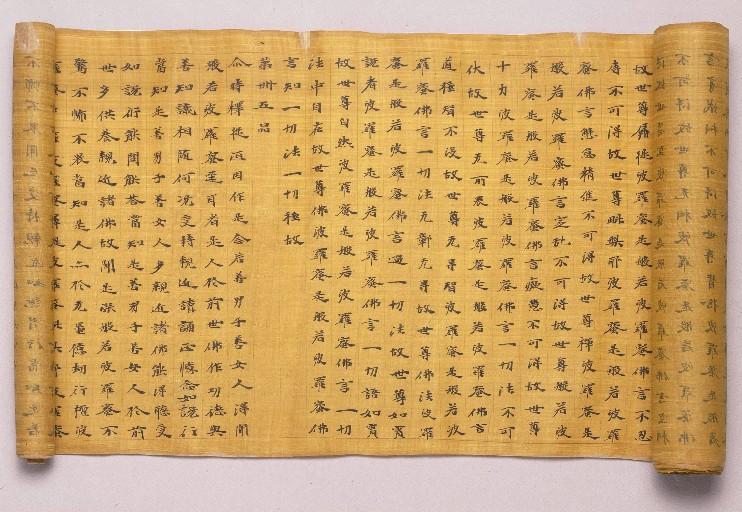
The profusion of paper in Dunhuang … makes it a perfect place to study the development of this often overlooked technology. Paper was developed in China, originally as a wrapping material, and only gradually spread west, first to Central Asia, then to the Islamic world, before finally arriving in Europe in the fourteenth century. The library itself may owe its existence to the scarcity and preciousness of the material. Researchers from Japan and Britain have recently suggested that its manuscripts were offerings, donations left to honor the memory of a notable monk. When the little room that held them filled up, it was closed, and then forgotten.

The paper items preserved in the Library also shed light on the origins of another information technology: print. The Diamond Sutra, one of the most famous documents recovered from Dunhuang, was commissioned in 868 A.D., “for free distribution,” by a man named Wang Jie, who wanted to commemorate his parents. In the well-known sermon that it contains, the Buddha declares that the merit accrued from reading and reciting the sutra was worth more than a galaxy filled with jewels. In other words, reproducing scriptures, whether orally or on paper, was good for karma. Printing began as a form of prayer, the equivalent of turning a prayer wheel or slipping a note into the Western Wall in Jerusalem, but on an industrial scale. This might be the most enduring lesson of Dunhuang: the whole “Gutenberg galaxy” of paper and print didn’t begin in Europe. Print was a Buddhist invention, and its aim was salvation, not profit.

(Image: 5th century Chinese manuscript via Wikimedia Commons)

A Physicist And His Faith

In a review of Newton and the Origin of Civilisation by Jed Buchwald and Mordechai Feingold, Jonathan Rée takes note of the scientist’s attitude toward religion:

Apart from trying to please his readers, Sir Isaac – as he became in 1705 – also sought to reassure them about his theological opinions. He was known to have ducked out of ordination in the Church of England, which was formally a condition of his professorship, and his reputation as a divine genius had a whiff of blasphemy about it. He had avoided any discussion of God or creation in the Principia (in the first edition, that is, where God is mentioned only once), and could not pretend to be interested in priests, rituals or religious ceremonies. On top of that there were well-founded rumours that he regarded the doctrine of the Trinity as a papist fabrication. But if his version of orthodoxy differed from that of the established church, there could be no doubt about his reverence for the Bible. To anyone wondering about the truest form of Christian worship, his advice was clear:

‘search the scriptures thy self,’ he said, with ‘constant meditation upon what thou readest, & earnest prayer to God to enlighten thine understanding’. He was convinced the Bible was, essentially, a sacred text, and he sought to honour his maker by studying it closely, every day, sometimes for hours on end. He read it repeatedly, in English, Latin, Greek and Hebrew, weighing every word, syllable and letter. ‘Mr Newton is really a very valuable man,’ as John Locke put it, ‘not onely for his wonderfull skill in Mathematicks but in divinity too & his great knowledge in the scriptures where in I know few his equals.’

Newton read the Bible with the same exactness he brought to his mathematical inventions or his experiments with prisms, and with the same disregard for tradition and common sense: he always refused, as one critic put it, to acknowledge ‘any one’s having ever consider’d the same Things before him’. He fled from controversy in religion as he did in mathematics, but he was convinced that his discoveries in the two domains supported each other, maintaining that the leading doctrines of the Principia – heliocentrism and universal gravitation – had formed part of the primitive biblical religion from which all others derived, and were explicitly endorsed by Moses before being passed to the Greeks and winning general assent in ‘the earliest ages of philosophy’. Mathematics could thus unite with the biblical narrative to proclaim the reasonableness of Christianity.

Demonology In Dixie

On the 40th anniversary of The Exorcist, Noel Murray ruminates on the film’s unique significance in the religious South, where he grew up:

The popularity of The Exorcist had the effect of popularizing exorcism itself—or at least that was what I heard around my school, where there were rumors of parents setting their children on fire because they thought their kids were possessed.

Give some credit (or blame) for this to [writer William Peter] Blatty’s studiousness, and [director William] Friedkin’s gifts for documentary like realism, which lent The Exorcist plausibility. Even though the demon in The Exorcist isn’t Satan—and isn’t even part of Christian mythology—the film does reinforce the idea that there are dark forces at work, requiring the righteous to remain vigilant. …

I’ve identified this mentality with the South, because that’s the part of the world I know best (and love, honestly). But The Exorcist is set mostly in Washington, D.C., and is heavily Catholic. The Catholic strain of devil paranoia differs from Southern Baptist devil paranoia. (Wine-drinking vs. teetotaling may have something to do with that.) Some religious people see The Exorcist as merely metaphorical, capturing the spiritual rootlessness of the 1970s, while others see it as much more black-and-white, and love it for that. Down here, we’ve worked “wariness of Satanic influence” into a way of life far removed from the more academic approaches of the fictional Father Karras and the real Father Gallagher. Down here, we stew in it.

How We Depend On Our Descendents

Philosopher Samuel Scheffler argues that, regardless of our individual views about a personal afterlife, we all have a stake in believing that others will live on after we’ve passed:

One thing that happens when you start to think about how you would feel if you knew that life would end shortly after your own death, lots of the things that you now do might come to seem pointless. Like, if you’re a cancer researcher, will you still find it meaningful or valuable to pursue cancer research? Quite likely not. I think we implicitly take it for granted that our activities belong to an ongoing temporal chain of human lives and generations, and that if we imagined that, you know, a giant asteroid were going to destroy the earth so there was no future for humanity, suddenly lots of what we now regard as valuable would seem pointless. …

Many people who believe in the afterlife as traditionally understood think that if there isn’t such an afterlife then the value or purpose or meaning of what we do here and now is diminished, or perhaps lost altogether.

I’m suggesting that if there isn’t an afterlife in my sense, that really would diminish the point and value and meaning of what we’re doing. The nice thing about my kind of afterlife is that we’re actually in a position to take steps to make it more likely that human beings will survive long into the future — or, unfortunately, less likely. …

I think we don’t take sufficiently seriously the importance of insuring that human life continues. And, you know, some people are trying to change that, but often they do it by appealing to some sense of moral obligation — “we owe it to our descendents.” I’m suggesting that it’s not just that they’re dependent on us — there’s also a sense in which we depend on them. Without them, if there are no future generations, the value of what we’re doing here and now is threatened.

When The Threat Of Apocalypse Fades

In The Sacredness of Human Life, David Gushee traces “the history of Christian pro-life thinking—and our failure to live up to it.” David Neff identifies the “the linchpin of his argument”:

The sacredness of human life as portrayed in the Bible and the church fathers is not anchored in any particular human quality. Philosophers have tried to locate our human essence in various things, from our ability to reason to our capacity for relationship. But in biblical thinking, humans are sacred only because the Creator-Redeemer God ascribes such worth to them. This theocentric view is vital because infants, those with mental disabilities, and many elderly lack key capacities, yet are still of ultimate worth to God.

How did the church lose its radical commitment to life? One key factor, Gushee writes, was that the apocalyptic framework of Jesus’ teaching faded. Jesus promised to come back soon to establish his kingdom. But centuries passed, the Christian population grew, and the kingdom of God became associated with a church endowed with state power and a state blessed by church leaders. Belief in the sacred worth of all people does not serve the interests of power. War shifted from a necessary evil to a divine command. “The Christian glories in the death of the pagan,” wrote medieval mystic Bernard of Clairvaux, “because Christ is glorified.”

A Good, Painful Death

dish_doctor

Passing in pain was long considered spiritually cleansing:

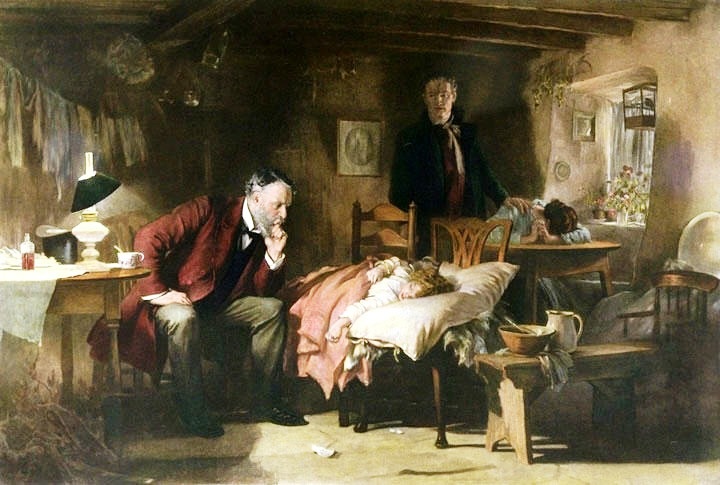
In earlier periods, many people believed that pain was a necessary component of a good death. Evangelical Christians, in particular, feared losing lucidity as death approached, as this would prohibit the person from begging forgiveness for past sins and putting his or hers worldly affairs in order before departing this life. For this reason, the physician rarely appeared at the bedside of a dying person because pain management was not required. Moreover, the general consensus was that it was inappropriate for a person to profit from another’s death. Caricatures depicting the greedy physician running off with bags of money after his patient had succumbed to his fate were not uncommon in the 18th and early 19th centuries.

Over time, however, religious sentiments faded, and physicians began to appear more regularly in the homes of the dying. Doctors also became more effective at pain management. At the start of the Victorian period, doctors typically administered laudanum drops orally to patients. This process was imprecise, and sometimes not effective at all. This changed in the 1860s, when physicians started to provide their patients morphine intravenously. As new techniques emerged, people’s attitudes towards pain management in treating the dying began to change. Soon, a painless death was not only seen to be acceptable, but also vital to achieving a “good death.” The doctor’s place at the bedside of the dying was now commonplace.

(Image: The Doctor by Luke Fildes, 1891, via Wikimedia Commons)

The Character Of God

Scott Adams ponders whether God has a personality:

The problem with the idea that God has a human-like personality is that human personalities are nothing but weaknesses and defects that we romanticize. For example, I might be kind to others because I want them to be nice to me, or perhaps I simply feel guilty when I’m not nice. God wouldn’t have feelings of guilt and he wouldn’t need a strategy just to be loved. He would have everything he needed all the time. Logically, God couldn’t have a personality in the sense that humans do because our personalities are expressions of our defects and our DNA and our neediness.


The Eastern Way Of Worship

Richard Madsen notices that, according to a recent Gallup poll, 47% of the Chinese population claims to be atheist – yet other surveys demonstrate that nearly 85% of the country “carry out rituals to honor ancestors, seek out good fortune, ward off evil, celebrate festivals, and accumulate merit for a good afterlife.” So what gives?

An answer is to be found in the social nature of indigenous Chinese religion—it is more about belonging than belief. The collapse of the commune and state industrial work unit systems has made the search for forms of community not controlled by the state more pressing than ever. These alternative forms are typically established through myth and ritual, which meaningfully anchor persons to families and communities. But participants in the myth-telling and ritual performance might understand them in very diverse ways, including skepticism about the truth of the myths that they tell and the efficacy of the rituals in which they engage. However, in order to remain members of the wider community, they practice them despite their doubts. If among the middle classes of the West it is now common for religion to take the form of “belief without belonging,” in China it may just as commonly take the form of belonging without belief.

If we see Chinese religion as a matter of community belonging rather than one of spiritual belief, we might gain a clearer perspective on how and why religion in China has been growing and transforming. Old forms of community are dying and new forms are yet to be born—a liminal situation reflected in the kaleidoscopic interplay of old and new forms of religion.


Relatedly, the Chinese Communist Party may be moving on from its longstanding treatment of religion as purely a threat to stability:


The view that religion represents a positive force in civil society is gaining ground, not only among religious believers, but also within the Communist Party itself, in part thanks to the patient and often courageous work of the epistemic community of Chinese scholars who have studied closely and objectively religious life and its evolutions, and who have focused in particular on the philanthropic activities of religious associations during the Republican period and among overseas Chinese communities.

The government’s facilitation of growing involvement on the part of religious organizations in philanthropy and disaster relief, including health care and poverty alleviation, indicates that the Party has listened to these scholars and understood the significance for society of religious adherents’ beliefs and values, and as a result has changed its approach to religion’s place in contemporary China. The Party increasingly looks at it as a resource not incompatible with progress and capable of contributing to social stability. Local government support for the rebuilding of Buddhist temples and for the expansion of the latter’s charities stand as a good example of this new appreciation. The newfound appraisal of traditional rituals known as popular beliefs represent another instance of this change of perspective in the state’s relationship with religion: dismissed until the 1970s as “feudal superstitions,” they are embraced today as a “national heritage” worthy of support.

The Muslim community in particular is making gains:

As one of China’s five official religions, Islam has gained much vigor in the three decades since the reform. In the process of urbanization, for example, rural Muslim migrants reenergized existing Muslim communities in cities like Guangzhou. New Muslim communities in urban centers have also grown at an unprecedented rate. The growing ties between Chinese Muslims and the heartland of the Islamic world are deemed useful within the framework of “building the religious/cultural stage to sing the economic opera” (文化搭台,经济唱戏). Hui Muslims, as the largest Muslim ethnic minority, have particularly benefited from the tide of religious revival and have played an important role in micro-level business activities in the China-Middle East trade because of their religious affinity and knowledge of Arabic.