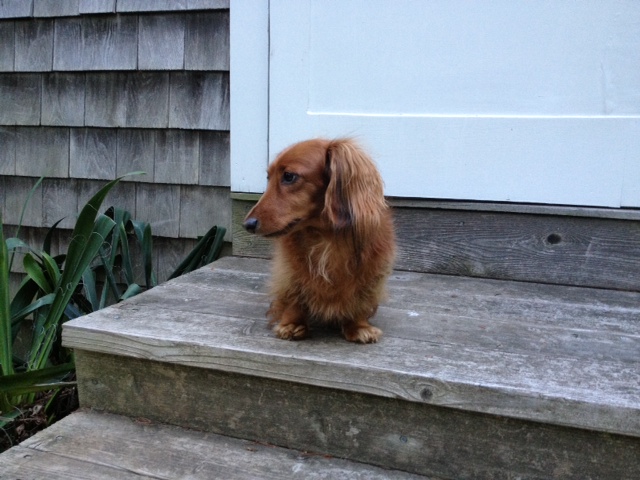
Now through the white orchard my little dog
romps, breaking the new snow
with wild feet.
Running here running there, excited,
hardly able to stop, he leaps, he spins
until the white snow is written upon
in large, exuberant letters,
a long sentence, expressing
the pleasures of the body in this world.
Created by Berlin-based artist Sebastian Bieniek, Doublefaced is an ongoing series of experimental portraits where a second (or third), rudamentary face is painted with makeup products on the side of a subjects face. While the idea seems ridiculously simple, the actual result is a super bizarre, off-kilter series of photos.
More of Bieniek’s work can be seen on his Facebook page.
Katie Roiphe digs into the saga of Colin McGinn, a philosophy professor (and multiple-time Poseur Alert nominee) who resigned this year from his tenured position at the University of Miami after a graduate student filed a report of sexual harassment against him:
One of the reasons I think people revel so much in the downfall of someone “like” Colin is that we like to hear news that the world is humming along just as we suspected, that all the prejudices and slights and wrongdoings we have always imagined are yet again proved to be real. Our fears that the “powerful” or “arrogant” are corrupt and abusive of the less powerful and less arrogant are confirmed. Our instinctive distrust of those who are stars, who have succeeded spectacularly, is vindicated by news of ugliness or corruption. We like, in other words, a good cliché.
What happened in the halls of the philosophy department at the University of Miami is much messier and more ambiguous and dingy and depressingly human than the glamorous black and white of the political language—sexual harassment. There is no arrogant, successful man sending dirty missives, no innocent, wronged victim to rally around; instead there is a whole complex swamp of motives and hopes and judgments and desires and ambitions, many conspicuously, spectacularly ill-advised, and there is a little bit of human warmth.
[S]ince McGinn resigned there was no “punishment” … If he was an adjunct that would be one thing; he had tenure and had due process rights. If the rules didn’t require him to resign he was free to make that argument within the university’s processes and in court if the university violated his contractual rights. He chose to resign rather than defend himself; this doesn’t entitle him to have his behavior interpreted with maximum charity.
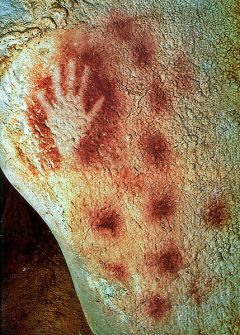
[Penn State archaeologist Dean Snow‘s new study] began more than a decade ago when he came across the work of JohnManning, a British biologist who had found that men and women differ in the relative lengths of their fingers: Women tend to have ring and index fingers of about the same length, whereas men’s ring fingers tend to be longer than their index fingers. …
[Snow] analyzed hand stencils found in eight cave sites in France and Spain. By comparing the relative lengths of certain fingers, Snow determined that three-quarters of the handprints were female. “There has been a male bias in the literature for a long time,” said Snow, whose research was supported by the National Geographic Society’s Committee for Research and Exploration. “People have made a lot of unwarranted assumptions about who made these things, and why.”
Archaeologists have found hundreds of hand stencils on cave walls across the world. Because many of these early paintings also showcase game animals—bison, reindeer, horses, woolly mammoths—many researchers have proposed that they were made by male hunters, perhaps to chronicle their kills or as some kind of “hunting magic” to improve success of an upcoming hunt. The new study suggests otherwise.
For Jenée Desmond-Harris, who contributes to The Root’s Race Manners column, the old-fashioned agony aunt can play an important role in the conversation on race:
I love [the advice-column format] because people write in with sincere questions and really want to understand something, help someone or do the right thing. And it’s so rare that we hear race and racism discussed in that context. Usually we don’t address it until someone has been attacked or offended, and then the public conversation is adversarial, and no one’s in the right state of mind to think critically or compassionately. I try to take the time to talk to experts, read up on history and write understanding responses that encourage empathy, so I hope Race Manners is refreshing in that way.
Recent columns have responded to “Annoyed Atheist” – a black woman tired of others assuming she’s Christian – and “Ready to Get Rid of Racism” – a white man, much like Cartman, who irrationally fears black people but isn’t sure how to stop.
Life can indeed be sad and lonely, but technology can bridge that gap when used “correctly.” Now you can see photos of your niece who lives on the other side of the country; you can feel as if you’re not completely missing out on her infant years. You can Skype your boyfriend who’s studying abroad and feel relieved once you look into each other’s pixelated eyes. Your friend from college—the one with whom you immediately clicked because his music taste was miraculously similar to yours—sends you a song through Spotify and you listen to it and of course you love it and you appreciate that there’s someone, somewhere who not only shares your taste but appreciates it, and you, enough to try to turn you on to a new band. Or perhaps you hate the song and you laugh as you recall spending countless hours getting high as a fucking kite with that person and debating which bands did and did not suck at that point in time and for what reasons. You might have disagreed, but you were just happy to have someone with whom to sit around with, to get high and listen to music with for hours at a time. Your friend sends you a Snapchat, a 10-second long video performance—and you and you alone are the intended audience. …
Technology does not necessarily advance or diminish people’s lives. Technology is an extension of life itself: it can be as lonely or happy as you make it. You can use it to get lost in an echo chamber of self-importance, or you can use it to make genuine connections with people.
Dish poetry editor Alice Quinn introduces this weekend’s poems:
The Pulitzer-Prize winning poet Mary Oliver has just published a new collection, Dog Songs, celebrating the love we feel for our faithful canine friends and the joy they bring to our lives. A New York Times feature by Dana Jennings this past Tuesday began, “Mary Oliver has spent most of her life with a mind ripe with poems —and with at least one steadfast dog by her side.” Mary is the author of more than twenty collections of poems as well as two books on the art of writing verse, A Poetry Handbook and Rules for the Dance: A Handbook for Writing and Reading Metrical Verse.
Today and over the weekend, we’ll run poems from Mary Oliver’s splendid new book alongside photographs of dogs cherished by Mary, Andrew, and myself.
The first selection is “Little Dog’s Rhapsody In The Night”:
He puts his cheek against mine
and makes small, expressive sounds.
And when I’m awake, or awake enough
he turns upside down, his four paws
in the air
and his eyes dark and fervent.
“Tell me you love me,” he says.
“Tell me again.”
Could there be a sweeter arrangement? Over and over
he gets to ask.
I get to tell.
I think one of your readers missed the point completely. Their example was: “It would not be acceptable for the US to waterboard fewer prisoners, a rapist to target fewer victims, or an abusive father to beat his children less often, and claim to be acting in a morally upright manner.” But we’re not talking about “fewer”; we’re talking about different. So interrogations with a waterboard are unacceptable, but other forms of interrogation are fine. Physically beating a child because they’ve misbehaved is unacceptable but disciplining them is fine.
Now if you have an absolutist view that we can not harm animals for our own needs, all of those absolute examples make sense. Any harm to any animal is unacceptable. If your view is that eating meat is a perfectly normal thing for a human to do, and what you wish is to do is spare animals unnecessary cruelty during their lives, then the “Sully Approach ™” is pitch perfect.
“First reduce or eliminate eggs, chicken, and turkey; and pork, ham, and bacon.”A healthy hen can produce 300-400 eggs in a lifetime, but only 3-4 servings of meat. So it would seem that removing chicken meat is 100x more effective in reducing the number of chickens affected by your consumption than eliminating eggs.
One of many more readers:
Eggs are actually the easiest to procure outside of the factory system. The backyard chicken coop used to be a staple of urban households; it really is not that hard to do.
Plus, besides eggs, chickens provide a good way to recycle kitchen waste, producing valuable fertilizer for the tomato plant. And a chicken is no more of a neighborhood nuisance than the average dog. It isn’t all roses and sunshine: there is still the problem of disposing of excess roosters and old, no-longer-productive hens … you can eat them, but to do that you still have to kill them. But raising chickens does put you in position to make your own moral decisions.
Another:
Don’t forget farmers’ markets whenever possible. We’re able to raise our own chickens and lambs and we barter with others for beef and pork. All of them are humanely (and even lovingly) raised and slaughtered. Those not so lucky should shop at local farmers’ markets and also talk to them about how they raise and dispatch their animals. Even in NYC, humanely raised protein is all around. Just don’t buy it at the supermarkets or in restaurants – especially fast food!
Another:
As a non-vegan, I would only add that more of us should be familiar with the Cornucopia Institute, which audits and rates dairy and egg producers on a wide range of ethical standards. They go far beyond “free range” or “organic” labeling and identify producers that really do avoid some of the worst practices, such as the debeaking of egg-laying hens. It was through them that I learned about Vital Farms, a genuinely sustainable (and national) egg brand that really does make an effort to ensure their hens live a good life. Their eggs are expensive as a result (about twice the going rate compared to typical organic), but I think it’s well worth the price.
Another:
I strongly second your moderate vegan reader’s recommendations on reducing the cruelty footprint of your diet. And whether you want to go vegan or just make reducing your meat consumption easier and tastier, I cannot recommend any vegan chef more highly than Isa Chandra Moskowitz. Her Veganomicon is my bible.
More recommendations:
As background, I have historically been someone who was very health focused, and I have tried various types of diets, including meat-centered ones such as the Paleo Diet. I have also toyed with vegetarianism in the past (mainly for health reasons), and I have read some other books on the broad topic (including Four Fish by Paul Greenberg and In Defense of Food by Michael Pollan, both excellent). But Jonathan Safran Foer’s book Eating Animals had a significant emotional effect on me that the others did not. It gave me the same sense of epiphany on the topic of vegetarianism that I received on the topic of religion from reading The God Delusion, and I felt that I could no longer consciously deny that eating meat led to a moral wrong.
Francine Prose considers the reasons we lose interest or appreciation in the art we once cherished:
We may also lose our early love for works that we only later realize are so marred by clichés, populated by stereotypes, and repulsively bigoted that we can no longer enjoy them, even if we make allowances for the attitudes of the period in which they were created.
Not long ago, I watched the 1943 film version of Somerset Maugham’s The Moon and Sixpence, a novel based loosely on the life of Paul Gauguin. As a child I’d loved the cinematic depiction of the painter’s romantic flight to—and tragic death in—the South Seas; I think it may have been one of the things that made me want to become an artist. But this time I noticed that the tag line on the cover of the DVD was “Women are strange little beasts,” and that the movie suggests that these little beasts need to be kept in line and properly subservient by whatever means necessary. Once our hero arrives in Tahiti, the depiction of the islanders and of the girl who is given to him as a wife is appalling.
I’m reminded of the fact that my enthusiasm for Gauguin crested around the same time as my affection for Magritte, while my admiration for Gauguin’s housemate, Van Gogh, has grown steadily over the years. For reasons I cannot explain—it’s the mystery of art—Van Gogh’s work seems to me more inspired, more beautiful and moving each time I see one of his canvases.
Someone at HHS must’ve been listening to your reader; the healthcare.gov site made a huge improvement today by implementing window shopping – allowing users to see different plans without having to sign up for the cumbersome accounts that have been causing the glitches on the backend. The premium calculator is very easy to use and it certainly looks like most people will see a wide range of options. My guess is that a lot of people will be surprised at the affordability and expect that the targets for enrollment will be hit.
While [the window-shopping feature] does give consumers a bit of new information, it’s still too bare bones to give consumers a sense of how different plans stack up.

 [Penn State archaeologist
 The Dish
