Taking Aim At Syria

Fisher analyzes the satirical Banksy video above:

If the video feels a bit awkward, it may be in part because the international leftist movement that Banksy so often speaks for has grappled with how to think about Syria. The idea of any Western intervention in the Middle East can carry, for them, echoes of imperialism – opposition to which is major tenet of the international left. Skepticism of religion also makes the Syrian rebels, a number of whom are Islamist, less than attractive. And the Bashar al-Assad regime has long claimed to represent a kind of anti-imperialist bulwark against the West and against Israel.

So there’s been a real hesitancy among leftists like Banksy to embrace the Syrian opposition, which is reflected a bit in his choice to skewer the rebels, portraying them as murdering beloved children’s cartoon characters. But no one – or virtually no one – can bring themselves to back the Assad regime, which has done and continues to do terrible things to its citizens. That’s led a lot of people in international leftist movements to talk around the conflict, to decry specific aspects of the West’s approach to the conflict without fully engaging in the conflict itself.

I have learned from my own crude generalizations in the past to avoid using terms like “leftists” the way Max does here. I don’t think you need to be a leftist to regard yelling “God is Great!” while trying to murder people as an obscene joke. It is an obscene joke. And the fact that the most potent opposition to the foul regime of Assad is a bunch of Jihadist fanatics says a lot about the Middle East, the whole ridiculous idea of a “nation”-state called Syria, and the total futility of getting engaged there. I can’t say I thought the video was even interesting. But as an expression of the absurdity of religious war, it wasn’t not cringe-inducing, which is what you usually get from artists making political statements.

The artist’s most recent NYC piece showed up in Greenpoint yesterday. Recent Dish on Banksy here.

Does Fact-Checking Deter Politicians?

New evidence points to yes:

During last year’s election, [Brendan] Nyhan and [Jason] Reifler picked nearly 1,200 state legislators in states with active affiliates of PolitiFact, the nonpartisan website based in Florida that seeks to evaluate politicians’ claims and rate their validity. To one-third of the lawmakers, chosen at random, Nyhan and Reifler sent a vaguely threatening letter. It alerted the lawmakers that PolitiFact was monitoring them and speculated about the potential consequences to their careers. … Another one-third of the legislators got a “placebo” letter: It told them they were part of a political-science experiment “studying the accuracy of the political statements made by legislators,” but no more. The final one-third got no letter.

At the end of the election, the researchers looked at the politicians’ record. How many had been called out for lying, either by their state’s PolitiFact affiliate or in a news story? The results were impressive: The politicians who didn’t get reminder letters were more than twice as likely to be criticized for inaccuracy than those who did. “Our results indicate that state legislators who were sent letters about the threat posed by fact-checkers were less likely to have their claims questioned as misleading or inaccurate during the fall campaign—a promising sign for journalistic monitoring in democratic societies,” the researchers concluded.

Is The Tide Turning?

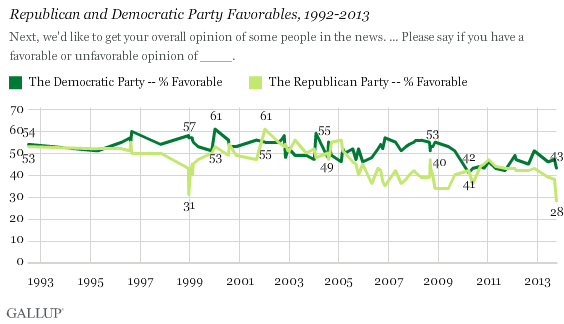
mmj6rr5b6kem323wnfrlvaThat last vertical line from a usually GOP-friendly polling outfit is one more factor in thinking that the GOP is isolating itself to a truly remarkable extent. No one is winning in this – Obama’s numbers are tanking too, though not as dramatically. The GOP is at their worst level in recorded polling. As Charlie Sheen would put it: “Winning!”

Then the Kochs are distancing themselves from the Cruz strategy that Boehner has adopted as his own, after welching on his deal on a sequester-level continuing resolution. And key business groups, suddenly aware that the GOP is no longer a pro-business party so much as a populist rage-machine, are lobbying hard to end the shutdown and lift the debt ceiling pronto:

The National Retail Federation joined other business groups like the U.S. Chamber of Commerce and the National Association of Manufacturers in asking House Republicans to relent.

“We strongly support passage of both a continuing resolution to provide for funding of the federal government into the next fiscal year and a measure to raise the nation’s debt ceiling,” the group’s president, Matthew Shay said in a letter to Congress that highlighted economic indicators showing that the shutdown has already hurt consumer spending and depressed consumer confidence.

Some are interpreting Paul Ryan’s op-ed today as some kind of olive branch. Sargent dispenses with that rather efficiently. The issue is not about how to balance the budget in the long term through a Grand Bargain. I’d love that, and would probably be more sympathetic to some GOP ideas on it than Obama’s. But the issue now is the economic terrorism that the GOP is using as an unprecedented lever to re-litigate the last election. Take the gun away from our heads, and lay it on the ground. Then we can negotiate – and if a bigger, better Grand Bargain comes from that negotiation, the Dish will cheer it on.

But first: put down your gun and leave it on the ground. And walk slowly away so we can see you have nothing left to harm the country or the world with.

Shutting Down Government Won’t Shrink It

Daniel McCarthy believes that the shutdown is doing serious damage to the cause of small government:

Reducing and restructuring government is going to take time and careful planning, but what we see from the Republicans—abetted by certain activist groups and entertainers who feed off over-emotional listeners, viewers, and donors—is a party whose leadership and record in power is big government and whose committed small-government faction is crippling rather than augmenting its appeal to the country as a whole. This is a recipe for defeat of the small-government faction in future presidential nominating contests—where the Republican Party has shown a longstanding preference for candidates who seem like they can win over centrist voters—and that means even if a Republican can win the White House again in the near future, he’s more likely to be a Republican in the Bush mold.

Larison nods:

Toying around with default threatens to impose greater costs on American taxpayers rather than reduce them. It is the perfect example of striking a symbolic blow against fiscal irresponsibility while adding to the country’s fiscal problems. If one seriously wants to control and reduce government debt, raising the debt ceiling ought to be the last thing that one worries about, since refusing to raise it simply makes paying off the debt that has already been incurred more expensive. Making useless “stands” of this kind not only make small-government conservative ideas unappealing to many other Americans and provoke backlashes against them, but they make even those that agree with many of those ideas conclude that their representatives are ill-suited to governing.

Would A Clean Bill Pass The House?

David Karol is unconvinced that moderate Republicans would deliver the votes required to pass a clean CR, even is Boehner allowed a vote:

In general, Congressional moderates are more closely aligned to their parties than is understood. Often their defections from party ranks occur when it is clear that their party does not need their votes to prevail on a given issue. Moderates frequently represent constituencies in which their parties are not very popular. This gives them a political incentive to create the impression of a certain distance between themselves and their party. Leadership understands this and does not punish legislators for such behavior.

John Dickerson agrees:

There’s a big difference between telling a reporter in your home district that you would vote for these measures and actually voting for them. To cast such a vote would expose these House Republicans to withering heat from their colleagues, the grass roots, conservative bloggers, and high-net-worth individuals willing to fund primary opponents. They would be responsible for a stunning defeat for Boehner and a victory for the president their constituents dislike.

Submarine Smugglers

Colombian soldiers guard a homemade subm

Jim Popkin marvels at the story of Mauner Mahecha, a high-school educated drug smuggler who recruited members of the Colombian navy to a build a fleet of subs:

Mahecha spared no expense. He had a fat R&D budget and spent millions of dollars building each submarine. These aren’t the crude semisubmersibles that drug runners have used for years to cruise just below the ocean’s surface. Those vessels can’t dive to avoid detection and are often just cigarette boats encased in wood and fiberglass. Mahecha’s Kevlar-coated submarines, by contrast, can submerge to 60 feet, go 10 days without refueling, and glide underwater for up to 18 hours at a clip. Unbelievably, they were made by hand in the mangrove swamps of Colombia and Ecuador, in desolate outposts with no access to electricity.

(Photo: Colombian soldiers guard one of the homemade submarines found in a rural southwestern Columbia. The submersible could transport up to 8 tons of cocaine at a time, the Colombian army said. By Luis Robayo/AFP/Getty Images)

Following In Romneycare’s Footsteps?

Stephanie Mencimer claims that “it doesn’t really matter whether many people enrolled in Obamacare last week”:

What happened in Massachusetts is pretty much exactly what’s happening right now with Obamacare. After the law went into effect in Massachusetts, state offices were totally overwhelmed by the number of people clamoring to sign up for insurance, or what the state’s Medicaid director dubbed the “stress of success.” Lost paperwork, computer glitches, confusion over who was eligible for what, and not enough staff to handle the workload meant that in those early days, consumers could wait several months after submitting an application to finally get coverage. So many people were trying to enroll in the expanded Medicaid program that the Medicaid agency ended up with a months-long backlog of applications. In the first two months, only 18,000 of more than 200,000 potentially eligible people had successfully signed up through the connector, according to Jonathan Gruber, an MIT professor who helped design the Massachusetts system and served on the Connector board. And all of that happened in a state with only 300,000 or so eligible applicants and without a well-funded opposition trying to derail the law at every turn.

But guess what? Eventually the kinks got worked out and people got covered. Enrollment opened in October 2006, and by the deadline for getting mandatory coverage, July 1, 2007, the Boston Globe reported, 20,000 more people had signed up for insurance on the exchange than the state had expected—12,000 of them in just the two weeks before the deadline.

What Kate Pickert is hearing:

They have one month. If the officials running the new Affordable Care Act insurance exchanges cannot fix crippling computer glitches by then, the health law’s future could be imperiled, according to a former high-ranking health care official.

The Abatement Of Cruelty

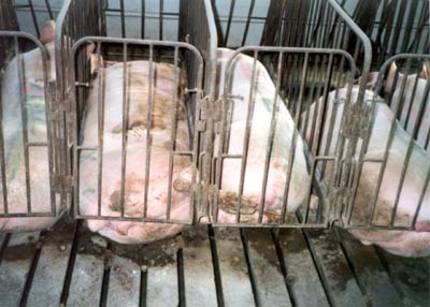
Matthew Scully has written a powerful, emotional and, to my mind, largely persuasive piece about the moral necessity of changing our collective treatment of farm animals. It is framed – somewhat relentlessly – as an argument designed to make pro-life conservatives look afresh pigs.jpgat the moral question of animal cruelty, which is, perhaps, a good thing if he wants to break through the noise. But it can alienate readers who may not share Matthew’s pro-life passion – which is a shame because the argument is worth a hearing in its own right – an urgent hearing about an urgent moral atrocity that many of us enable every day of our lives without even realizing it fully.

What I love about Matthew’s essay is that it refuses to let the reader off the hook. It made me deeply uncomfortable about my own eating habits, which I recognize are simply morally unacceptable. Some screeds are so screechy they make you more comfortable in your own position. This screed – though unnecessarily abrasive at times – doesn’t.

The great thing about the essay – apart from its splendid demolition of that preposterous bore, Anthony Bourdain – is its simplicity. What we do to pigs in factory farms is so morally wrong, so violating of even basic moral norms, that we have to stop it.

This week, we found new evidence that the brains of dogs, when examined under MRIs, react very similarly to human brains in terms of emotion, feeling, and suffering. Every dog owner knows this already, but the excuses that we cannot fully, scientifically, know that these animals are capable of feeling have now run completely dry:

Although we are just beginning to answer basic questions about the canine brain, we cannot ignore the striking similarity between dogs and humans in both the structure and function of a key brain region: the caudate nucleus. … In dogs, we found that activity in the caudate increased in response to hand signals indicating food. The caudate also activated to the smells of familiar humans. And in preliminary tests, it activated to the return of an owner who had momentarily stepped out of view. Do these findings prove that dogs love us? Not quite. But many of the same things that activate the human caudate, which are associated with positive emotions, also activate the dog caudate. Neuroscientists call this a functional homology, and it may be an indication of canine emotions.

The ability to experience positive emotions, like love and attachment, would mean that dogs have a level of sentience comparable to that of a human child.

Our deep familiarity with dogs makes this unsurprising. It is one reason we find dog-fighting or cruelty or mistreatment so abhorrent. But the brain structure of dogs is very similar to pigs, whose intelligence is close to identical. Which is why Matthew’s strongest paragraphs seem to me to be these:

Why is it right or fair to pamper dogs (the lucky ones) and torture pigs? In some corners of the world they torture and eat both, and by what coherent standard can we tell those savage people that they’ve got it wrong? In the underground meat markets of Thailand, Vietnam, and South Korea, as CNN reports, “a common belief is that stress and fear releases hormones that improve the taste of the meat, so the dogs are placed in stress cages that restrict their movement,” among many sufferings that end only when they “have their throats cut in front of other dogs who are awaiting the same fate.” If such practices are morally out of bounds, that’s news to American agribusiness.

It’s all just cultural preference, habit, and custom, as Asian connoisseurs of meat from dogs (or horses, monkeys, dolphins, whales, and on and on) will be quick to tell you. Morally, the differences between pigs and dogs, and between our treatment of them, are purely conventional, the technical term for meaningless. Appeals to convention may be well and good in matters of taste or social etiquette — there is no One True Way to greet guests or prepare party favors. But if we are being morally rigorous, then citing “custom” is just a tautology: We do it because we do it. In this case, you could switch the picture here in our own country all around — dogs to the abattoir, pigs on the couch — and convention and custom would be just as defensible. Or, more to the point, just as indefensible. We can be consistently kind or consistently cruel, but anything in between has the whiff of moral relativism, right and wrong decided by whim.

The main force against this, of course, is market capitalism. What Scully wants would mean much lower profits for Big Ag, a constituency well-tended to by the GOP, even as they slash food stamps for the poor (yeah, they really are compassionate, these conservatives, aren’t they?). And his argument is, at root, a moral and properly conservative critique of capitalism.

That’s why, by his account, Karl Rove simply gave him an arched eye-brow for bringing up the subject as something that might be included in a GOP platform some day. No party that would love Sarah Palin is ever going to sacrifice profits for animal welfare.

But I wish him well, even though I think he alienates liberals and pro-choice independents unnecessarily in his tone in parts. Perhaps given the raw partisanship that courses through what’s left of the right, it’s the most effective strategy for persuasion among Republicans. But what we are talking about here is an enlargement of human empathy – and slash and burn partisan rhetoric is not too helpful in that difficult endeavor.

He’s also rightly very, very defensive about working for a vice-presidential candidate, Sarah Palin, who has openly declaimed her utter contempt for animal welfare on multiple occasions and fought to kill wolves from helicopters leaving them to die excruciating, long deaths (Scully excuses her because of the pro-life testimony of the birth of Trig, the fantastic story of which he seems to take at face value). One obvious, glaring, unbelievable part of his essay is also his remaining inability to condemn the torture program of his former political masters – even to the point of citing torture advocate Andrew McCarthy in his defense. I’m sorry, Matthew. But no ringing condemnation of private sector cruelty against animals can stand without also acknowledging the horrifying treatment of humans that the Republican party still endorses, and even finds a subject worthy of foul, chuckling humor.

His recommendation – veganism – also seems to me a bit de trop. Yes, we can live without meat. But our species evolved as meat-eaters and we were once capable of husbanding animals humanely on traditional farms. It does not seem to me to be wrong to eat meat as such, but rather wrong to eat meat produced in the way almost all of it now is. Going vegan is an admirable choice in this context, but there are less drastic moves: to seek out meat from humane farmers as well as eating less of it. There are also types of meat. I think we can make distinctions of degree between, say, the emotional experience of a chicken and a pig. But the commodification of living beings is what troubles Scully, and it should trouble any Christian, and certainly any Catholic in a church headed by a man by the name of Francis.

In the larger sense, though, we are in Scully’s debt. His prose erupts at times with the righteous fury of the prophet. Because this is a great moral evil amidst us – and he is a true Prophet about that.

Update: This post prompted a reader thread.