
Chart Of The Day

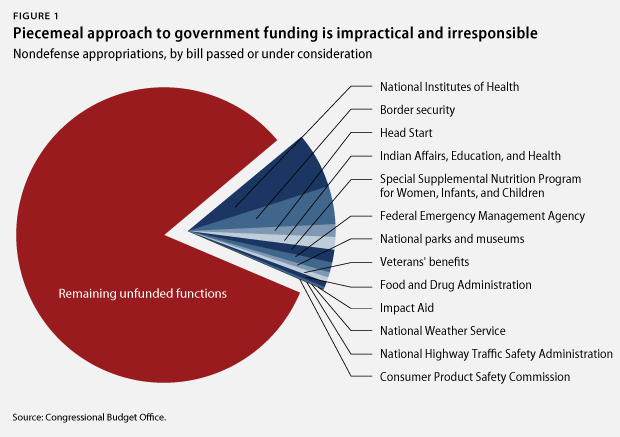
Michael Linden visualized the parts of government that the GOP wants to fund:

Piecemeal

Derek Thompson captions:

Obama wants to fund the whole pie below. The GOP, which would like to pair government funding with Obamacare’s defunding or delay, is asking him to fund the blue slices only. The White House’s logic is that passing the blue stuff makes it more likely that we go even longer without the larger, redder part of the pie.

But doesn’t the GOP actually want the entire government shrunk to that blue size? And isn’t this massive over-reach part of that completely delusional strategy?

Losing Judaism, Staying Jewish, Ctd

As American Jews puzzle over the future of their faith and identity, a new community center in London is trying to attract the secular-minded:

The launch of JW3, as the center is called, comes at a time when many of London’s 200,000 Jews have become disengaged from Judaism. Increasing secularization, dispersal and inter-marriage have played a part, along with a sense that “‘if I don’t live my life this way then I’m not Jewish,’” explains Raymond Simonson, the center’s enthusiastic chief executive. As a cultural center – and not a place of worship – JW3 aims to create a sense of community by reflecting the diversity of Jewish life in the city. “I think we’re offering Jews a way back in who may have been moving away,” he says. “They’ll say ‘I don’t want to go to synagogue, I don’t believe in God, I don’t fast on Yom Kippur, but hang on, you’re doing a Woody Allen festival.’”

A reader comments on our previous post:

I think the Holocaust has a lot to do with this.

When I light the Menorah or sit down for Passover seder, I am celebrating my history and my family and my gratitude that we’re even here. My grandmother came to this country from Poland as a child and she lost basically her entire extended family in the Holocaust. Many of the stories told during Jewish holidays are ones of displacement, persecution and perseverance, and they ring all too true for the Holocaust generation. These traditions are how we remember and honor our ancestry and the extreme hardship our past generations endured simply to survive. Their sacrifice and courage is sacred to me and inspires in me more faith and grace than any God.

Cyborg Bugs And Bioethics

If you’ve ever yearned to control an insect with your iPhone, you’re in luck: The first create-your-own-cyborg kits will be on sale just in time for the holidays. At $99, they’ll include live cockroaches, “microelectronic hardware” and “surgical kits geared toward students as young as 10.” The product, naturally, has sparked debate:

Gage and Marzullo, both trained as neuroscientists and engineers, say that the purpose of the project is to spur a “neuro-revolution” by inspiring more kids to join the fields when they grow up, but some critics say the project is sending the wrong message. “They encourage amateurs to operate invasively on living organisms” and “encourage thinking of complex living organisms as mere machines or tools,” says Michael Allen Fox, a professor of philosophy at Queen’s University in Kingston, Canada. “It’s kind of weird to control via your smartphone a living organism,” says William Newman, a presenter at TEDx and managing principal at the Newport Consulting Group, who got to play with a RoboRoach at the conference. …

The roaches’ movements to the right or left are controlled by electrodes that feed into their antennae and receive signals by remote control—via the Bluetooth signals emitted by smartphones. To attach the device to the insect, students are instructed to douse the insect in ice water to “anesthetize” it, sand a patch of shell on its head so that the superglue and electrodes will stick, and then insert a groundwire into the insect’s thorax. Next, they must carefully trim the insect’s antennae, and insert silver electrodes into them. Ultimately, these wires receive electrical impulses from a circuit affixed to the insect’s back.

Gage says the roaches feel little pain from the stimulation, to which they quickly adapt. … “I try not to downplay the fact that in science we use animal models and a lot of times they are killed,” Gage says. “As scientists, we do this all the time, but it happens behind closed doors.” By following the surgical instructions, he says, all students learn that they have to care for the roaches—treating wounds by “putting a little Vaseline” on them, and minimizing suffering whenever possible. Still, Gage acknowledges, “we get a lot of e-mails telling us we’re teaching kids to be psychopaths.”

(Hat tip: Annalee Newitz)

Mugged For Your Mugshot

David Segal recently reported (NYT) on sleazy mugshot websites:

The ostensible point of these sites is to give the public a quick way to glean the unsavory history of a neighbor, a potential date or anyone else. That sounds civic-minded, until you consider one way most of these sites make money: by charging a fee to remove the image. That fee can be anywhere from $30 to $400, or even higher. Pay up, in other words, and the picture is deleted, at least from the site that was paid.

Mark Kleiman wants more protections for those being blackmailed by such websites:

The Fifth Amendment forbids the deprivation of life, liberty, or property without due process of law. That innocent people should sometimes be arrested is inevitable unless we can equip police with powers of omniscience. But the existence of an arrest record, even without a conviction, has many bad consequences. By maintaining arrest databases and making them available to others, the state in effect continues to punish someone for a crime of which that person was not convicted by due process of law. Why shouldn’t that be ruled unconstitutional?

Mike Riggs adds:

If the best argument for keeping mugshots in the “public information” category is that they’ve always been in that category, or that they help people instantaneously vet their dates and children’s baseball coaches, then open records advocates (of which I’m one 99 percent of the time) need to rethink this issue. Mugshots are a tool that allow police and crime victims to identify and track suspects through the criminal justice system. Making them publicly available turns an investigative tool into a lifelong punishment.

Google is already working to limit the harm these websites inflict:

Google has now found that these sites apparently do not comply with a certain guideline, and has taken action to demote them since Thursday, rolling out an amendment to its algorithms that has led to mugshots being pushed back and listed beyond the first page.

Credit card companies also took action:

“We looked at the activity and found it repugnant,” MasterCard General Counsel Noah Hanft told Times reporter David Segal of the websites offering to remove mug shots for fees. In the course of reporting the article, Segal brought the websites to the attention of MasterCard, American Express, Discover, and PayPal, all of which subsequently decided they would sever their relationships with the sites, effectively crippling their business model.

I Can Haz Heresy?

The Internet’s favorite pet has come a long way:

Cats in medieval Europe mostly had a bad reputation – they were associated with witches and MIMI_72A24_313V_MINheretics, and it was believed that the devil could transform himself into a black cat. … Heretical religious groups, such as the Cathars and Waldensians, were accused by Catholic churchmen of associating and even worshipping cats. When the Templars were put on trial in the early fourteenth-century, one of the accusations against them was allowing cats to be part of the services and even praying to the cats. Witches too, were said to be able to shape-shift into cats, which led to Pope Innocent VIII declaring in 1484 that “the cat was the devil’s favourite animal and idol of all witches.”

Medievalist Irina Metzler theorizes about the longstanding link between cats and heretics:

Medieval people may have wanted to restrict cats to the function of animated mousetraps, for the very reason that the cat “stands at the threshold between the familiar and the wild.”… This causes a kind of conceptual tension. While the cat possesses the characteristics of a good hunter it is useful, “but as long as it does, it remains incompletely domesticated.”

Heretics, too, in a transferred sense, are not completely domesticated, since by challenging orthodox thought and roaming freely hither and thither in their interpretation of religious beliefs they resemble the bestiary definition of wildness. As symbolic animals, then, cats may be the heretical animal par excellence.

(Image: The devil appears in the form of a cat to St. Dominic of Calerueja. From Le Miroir Historial, 1400-1410.)

How Obamacare Is Good For Business

Surowiecki claims that the ACA “may well be the best thing Washington has done for American small business in decades”:

[S]mall businesses often face so-called “experience rating”: a business with a lot of women or older workers faces high premiums, and even a single employee who runs up medical costs can be a disaster. A business that Arensmeyer represents recently saw premiums skyrocket because one employee has a child with diabetes. Insurance costs small companies as much as eighteen per cent more than it does large companies; worse, it’s also a crapshoot. [John] Arensmeyer [who heads the advocacy group Small Business Majority] said, “Companies live in fear that if one or two employees get sick their whole cost structure will radically change.” No wonder that fewer than half the companies with under fifty employees insure their employees, and that half of uninsured workers work for small businesses or are self-employed. In fact, a full quarter of small-business owners are uninsured, too.

Obamacare changes all this. It provides tax credits to smaller businesses that want to insure their employees. And it requires “community rating” for small businesses, just as it does for individuals, sharply restricting insurers’ ability to charge a company more because it has employees with higher health costs. And small-business exchanges will in effect allow companies to pool their risks to get better rates.

The Pressures Of Prodigy

Catherine Tice chronicles her journey from virtuoso violinist to casual player:

By the time I arrived in New York, I had technical problems. My left hand had become inflexible – practically arthritic, atrophied, in fact. Consequently, I played very badly, so badly I couldn’t recognize myself in an audition for the college philharmonia. I began several pieces, including the Haydn concerto I’d played when twelve, couldn’t get through one, and was ashamed (and secretly relieved). I noted that the concertmistress of this outfit was studying with the very famous Ivan Galamian at Julliard, and was struck by how far I’d fallen behind. …

I became musically exceptional for a child, but I lacked an essential psychological immunity to the dark side of self-criticism. When essential support was withdrawn by degrees it became increasingly difficult for me to do and be what I initially had no intention whatsoever of doing and being. Moreover, it simply isn’t enough to be good.

There is still regret. I miss very much the feeling that I might express something beautifully in music, and I suppose when I listen to others play or sing, the experience is sometimes tinged with both envy and remorse.

Children of this generation have some extra tools, such as the one seen above:

Much like Guitar Hero, the Projected Instrument Augmentation system streams blocks of color down a screen to meet the correct key at the exact moment that it should be played, having you playing like a pro in no time.

The Nobel Albatross

Physicist Mark Jackson suggests that the prize can hasten the end of a productive research career:

Ironically, receiving the prize that recognizes a great accomplishment is often accompanied with a decline in scientific accomplishment. This is most likely due to the deluge of social demands placed upon the laureates, who are perceived not just as great scientists but also sages. French biochemist André Lwoff, winner of the 1965 physiology or medicine prize, speaking on behalf of his colleagues, observed, “We have gone from zero to the condition of movie stars. … When you have organized your life for your work and then such a thing happens to you, you discover that you are faced with fantastic new responsibilities, new duties.”

The most bizarre post-Nobel career is undoubtedly that of Brian Josephson, who shared the 1973 physics prize for devising the eponymous solid-state junction. Afterwards Josephson became a follower of the Maharishi Mahesh Yogi and attempted to reconcile quantum physics with transcendental meditation. He is now director of the Mind-Matter Unification Project at Cambridge University, working hard to keep Britain at the “forefront of research” on telepathy.

The Best Of The Dish Today

duluth-MN-12pm

It was another grueling, dispiriting day in Washington. What truly terrifies me is the almost Egypt-level of mutual incomprehension that is being displayed. I take it for granted, for example, that the deficit is falling fast, that the current continuing resolution that is now in suspension affirmed the sequester levels of spending that are far lower than most Democrats would like, that Obamacare is settled law that can only be repealed by the usual democratic process, and that no sane government would default on its debts. But none of this seems to be accepted by the spokespeople of the Republican “party”.

They argue that we are facing a Greece-like implosion because of the current levels of debt (and not because they have shut down the government and are refusing to pay our bills until they stop Obamacare), that the deficit is growing (according to Speaker Boehner this week), that Obamacare is such a destruction of the entire American economy that it must be stopped or delayed at even the cost of a default, that a default is impossible anyway, and that even if we defaulted it would be no big deal.

That’s where we are. We cannot agree upon basic empirical fact in order to have a conversation, let alone a negotiation. If we were for a moment to step outside this cognitive abyss, I’d simply defer to the view of almost every single expert on the subject that even thinking about a default could be a catastrophic event not just for the American but for the entire global economy. Whatever your view of the budget or healthcare reform or the debt, surely no responsible government leader would want that to happen. And yet one party seems openly prepared to threaten it, even to save face among their increasingly radicalized followers.

The Republicans, alas, have two advantages that stem from their radicalism (yes, in a classic piece of total projection, they are the real Alinskyites and Obama is the real conservative). To any neutral observer – say, anyone outside the US – they are easily the crazier ones.

And they are holding a gun to the head of the American government and the economy. Do I believe they would happily explode this country’s credit and economy rather than have to go through the difficult task of building an actual majority in the country for their agenda? Yes, I’m afraid I do. I’ve been waiting to see some scintilla of resistance to ever further radicalization, and I see none whatsoever.

More to the point, most of the public’s eyes glaze over when you explain that the budget – with sequester-level austerity – has already been agreed to and that we are discussing now whether the Congress, having set such a budgetary path, will keep the federal government open and pay the country’s bills. Instead, the GOP can simply switch the subject, claim we are in a perilous debt crisis already and that the debt ceiling is the last stand before we end up like Greece. There is no evidence for this, so far as I can see. But that doesn’t matter if you really live in your own mental universe. In that universe, when the default occurs and the economy crashes, and the stock market collapses, and the dollar sinks like a stone, you can simply state that it was all Obama’s fault. And there are enough true-believers out there who’ll actually buy it. Worse, an economic collapse will inevitably make Obama less popular.

So there are two choices, it seems to me. Obama can invoke emergency executive authority to protect the unquestionable credit of the United States and dare the Courts to over-rule him and the Congress to impeach him. Or Obama can give in to what is an unbelievably outrageous tactic – and try to salvage some kind of interim budget deal that will raise the debt ceiling in return for some kind of Republican trophy. That would be a surrender of profound implications for future presidents – yes, Republican ones too – and fundamentally alter our political system to reward the kind of blackmail we’re now witnessing. But it would end the immediate emergency and remove the blackmail – for a while, until the GOP insists that, even though they lost the last election, they have a right to run the country permanently, regardless of electoral outcomes.

Better perhaps for the president to act to save the economy and the world in a truly perilous self-induced crisis than to allow this rogue faction to concoct a Lehman-style collapse to the power of 10 and then blame him for it. It remains staggering and outrageous that this is where we are. But if one faction of one party controls the House, and it goes completely rogue, as it has, then what can a sane president do? Juan Linz, as Chait as noted, was onto something.

All I can offer at this point is some relief: my favorite post of the day – on the genius of octopus brains –; a jumping greyhound; an all-too relevant clip from a fantastic stoner apocalypse movie; a truly WTF tourism commercial; a really tough Window View contest; and for pure camp value, Michele Bachmann making me shit myself.

The most popular post? Still my take on the GOP’s core, evolving, contradictory, hysterical bargaining position: “There Is No There There”. The second? “What Moderate Republicans?”

See you in the morning, if I can get out from under the covers.

Window view: Duluth, Minnesota, 12 pm.
A Shutdown Outbreak?

The USDA reported last night that 278 people have fallen ill with salmonella, “likely” due to eating chicken from a California-based poultry firm. Maryn McKenna describes the outbreak as “the exact situation that CDC and other about-to-be-furloughed federal personnel warned about last week”:

As a reminder, a CDC staffer told me at the time: “I know that we will not be conducting multi-state outbreak investigations. States may continue to find outbreaks, but we won’t be doing the cross-state consultation and laboratory work to link outbreaks that might cross state borders.” That means that the lab work and molecular detection that can link far-apart cases and define the size and seriousness of outbreaks are not happening. At the CDC, which operates the national foodborne-detection services FoodNet and PulseNet, scientists couldn’t work on this if they wanted to; they have been locked out of their offices, lab and emails. (At a conference I attended last week, 10 percent of the speakers did not show up because they were CDC personnel and risked being fired if they traveled even voluntarily.)

While the USDA has yet to link the outbreak to a “specific production period,” Robert Gonzales notes that the shutdown has hampered the CDC’s ability to respond to such threats:

Foster Farms’ food safety chief Robert O’Connor insists that the USDA’s food inspection process “has not been affected by the recent government shutdown.” But according to the Associated Press, the CDC, which helps monitor multi-state outbreaks of food poisoning, “was working with a barebones staff because of the federal government shutdown, with all but two of the 80 staffers that normally analyze foodborne pathogens furloughed.” While the AP reports “it was not immediately clear whether the shortage affected the response to the Salmonella outbreak,” shutdown memos issued last week by the U.S. Department of Health and Human Services and the USDA both indicated staff relating to food inspection would be furloughed, further indicating that the government was ill-prepared to prevent and respond to a food-borne outbreak.