The Brittle Certainty Of Fundamentalism

dish_joy

Dreher reflects on it:

Fundamentalists don’t compromise. That is their strength. But it’s also their weakness. I went over a book the other day written by a theologically stout Evangelical (which is not the same thing as a fundamentalist). The book was about approaching culture. I found it hard to take, even though I found myself agreeing with the author on most general points. I couldn’t quite put my finger on what it was that irritated me so much about the book. What finally became clear to me was that it wasn’t so much the opinions the author held as it was the iron grip with which the author held them. It was as if nuance, irony, and complexity were the enemies of clear thought and pure faith. The worldview expressed in this book was pretty conservative, and as I said, I agree with much of it. But it was airless and highly ideological.

I have been critical of the fact that I didn’t have any doctrinal rigor in my religious education as a young person, and I am allergic to Andrew’s idea that just about any attempt to draw or hold to doctrinal lines makes one into a quasi-fundamentalist (“Christianist”). But I tell you, if I had been raised as a fundamentalist or an Evangelical who was taught to see the world through a narrow and severe idea of truth, I wonder if I would be a Christian today. It’s impossible to say. These things always are. Raise a kid with tap-watery religion, and don’t be surprised if he leaves it. Raise a kid with a religion as hard and cold as ice, and don’t be surprised if he leaves it. This is hard!

I do not believe that adherence to doctrinal lines makes one a Christianist. A Christianist, like an Islamist, cannot rest until his view of the world is enforced by law on others through political action. A Christian can be a rigid doctrinal enforcer in his own faith community without being a Christianist. Let me give Rod an example of a doctrinal line I would not cross: the Incarnation. Or, in fact, the entire Nicene Creed, which I recite at Mass with conviction. But I have no desire at all to impose that view of the meaning of the universe on anyone else whatsoever – let alone backed by the coercion of the state. That is where I differ from Christianists.

Where I differ from doctrinal fundamentalists is where the Pope differs. To wit:

If a person says that he met God with total certainty and is not touched by a margin of uncertainty, then this is not good. For me, this is an important key. If one has the answers to all the questions—that is the proof that God is not with him. It means that he is a false prophet using religion for himself. The great leaders of the people of God, like Moses, have always left room for doubt.

That means not making things like homosexuality and contraception the focus of our faith – turning matters of faith and morals into inviolable doctrine – but insisting on the very core truths and accepting mystery about so much else. In important things, unity; in doubtful things, humility; in all things, charity. But I take Rod’s point about upbringing – and its sometimes counter-intuitive effects. My elementary school – Our Lady and Saint Peter’s – was a wonderful Vatican II Catholic place of learning.

I discovered my faith as a joyful, wondrous, mysterious thing. When it came time for me to go to what Americans call high school, I was enrolled for a while at a Catholic Grammar school, until my parents took me for a visit. Its dourness, brutality, darkness and rigidity made me and my parents shudder and they mercifully placed me at a Protestant high school. I think I probably owe my faith to that decision. If I had been exposed more fully to the dark side of the Catholic church and its institutions – and you only have to look at the hideous history of the church in Ireland for how dark it truly was – then I almost certainly would have rebelled completely. I have authority issues, as some readers may have noticed.

Fighting for my faith in an alien space and climate made me own it more deeply – which is, perhaps, another reason why I have never really believed that enforcing religious beliefs in law helps religion at all. It is more likely to kill it.
The Final Frontier Of Archaeology

Sarah Parcak believes that “today is the most exciting time in history to be an archaeologist”:

Space archaeology refers to the use of space- and air-based sensor systems to discover ancient settlements, cultural remains, and natural features (like relic river courses) otherwise invisible to the naked eye, or hidden due to vegetation and water. Archaeologists use datasets from NASA and commercial satellites, processing the information using various off-the-shelf computer programs. These datasets allow us to see beyond the visible part of the light spectrum into the near, middle, and far infrared. These spectral differences can show subtle differences in vegetation, soil, and geology which then can reveal hidden ancient features.

Satellite datasets like WorldView can see objects as small as 1.5 feet in diameter. In 2014, WorldView-3 will be able to see objects a small as a foot. Another important sensor system is LIDAR (which stands for Light Detection and Ranging). LIDAR uses lasers to scan terrain in fine detail and even penetrate dense rainforest canopy, allowing archaeologists to see beneath the trees to reveal features of interest, from large monuments to small, subtle remnants of ancient homes and road systems.

(Video: LIDAR in action at Stonehenge and surrounding areas)

Face Of The Day

Hundreds Of African Migrants Feared Dead Off The Coastline Of Lampedusa

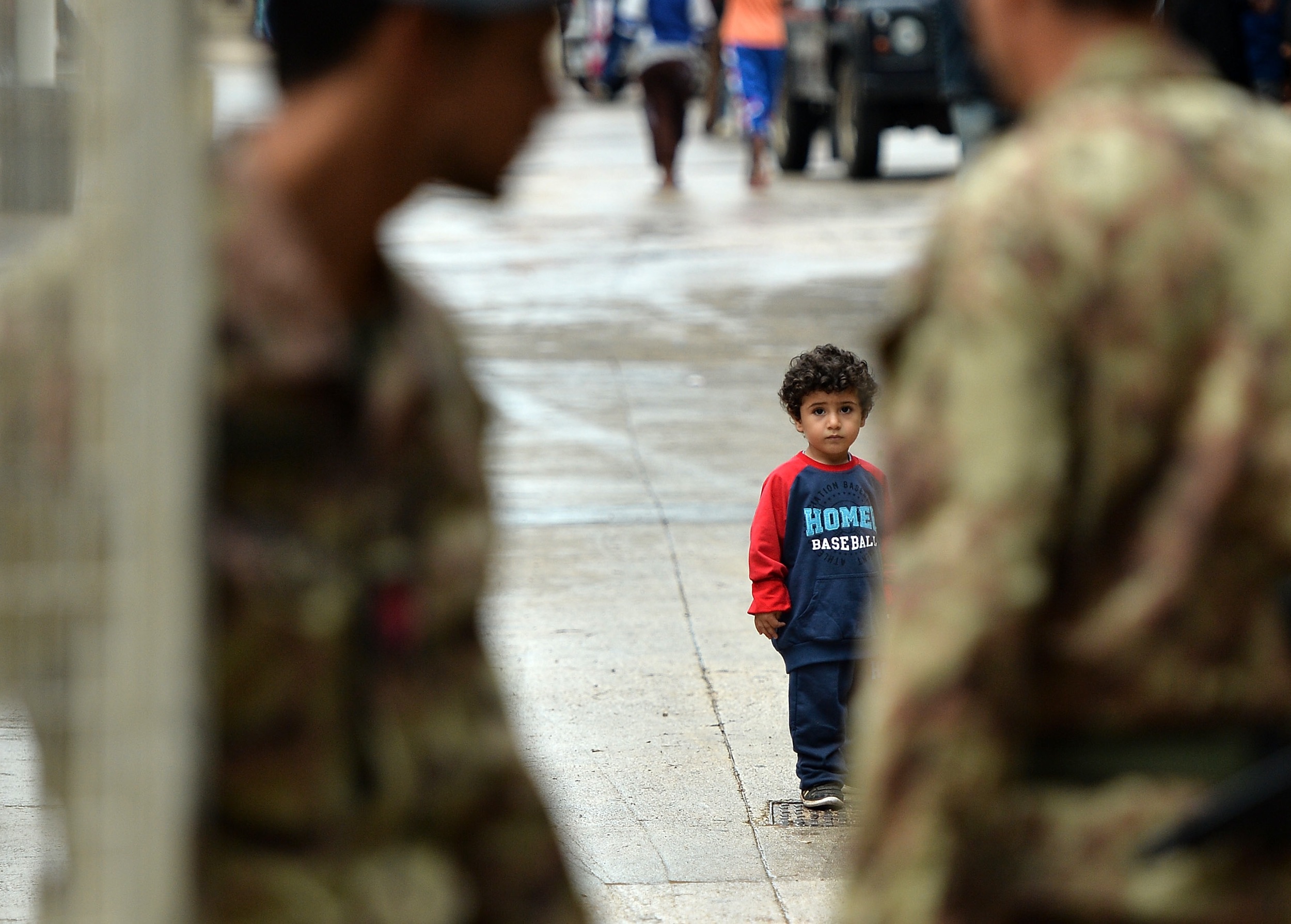
Immigrants are detained after their arrival in a temporary shelter center in Lampedusa, Italy on October 8, 2013. The search for bodies continues off the coast of southern Italy as the death toll of African migrants who drowned as they tried to reach the island of Lampedusa is expected to reach over 300 people. The tragedy has bought fresh questions over the thousands of asylum seekers that arrive into Europe by boat each year. By Tullio M. Puglia/Getty Images.

Reality Check, Ctd

Various polls on the shutdown find that American disapproval is highest for Congressional Republicans. Kilgore warns against over-interpreting these numbers:

[T]he big differentiator is that self-identified Democrats approve of Obama’s handling of the budget fight by a 77/21 margin, while self-identified GOPers approve of their congressional party’s positioning by a mere 52/45 margin. … What we know beyond the numbers is that despite John Boehner’s forced march towards Ted Cruz’s position on the government shutdown and Obamacare, quite a few conservative opinion-leaders don’t think GOPers have gone far enough. In particular, the Senate Conservative Fund and Heritage Action—along with RedState’s Erick Erickson—have been loudly unhappy with Boehner’s “watering down” of the bedrock “defund Obamacare” position on the continuing resolution.

So it’s entirely possible that a portion of the “blame gap” is represented by conservatives who wouldn’t side with Obama or congressional Democrats on the appropriations or debt limit issues if pigs learned to fly—just as a sizable portion of the people claimed by Republicans as “repeal Obamacare” fans actually favor a single payer system and wouldn’t back GOPers on health care issues if their lives depended on it.

Enten remains focused on the economy:

[T]he political arguments over the shutdown and debt ceiling fight may not matter that much at all.

As University of North Carolina political scientist Jim Stimson found (via Mark Blumenthal of the Huffington Post), it’s consumer sentiment that tends to have the greatest impact on approval ratings and hence elections.

After the last go-round on the debt ceiling, the economy had started to pick up by the end of October 2011, and Obama’s approval rating followed. But the lesson for Democrats who may be thinking smugly that the Republicans will take the biggest hit for the federal shutdown and government default angst is that if the economy goes south as a result, then it’ll likely be the Democratic president who sustains the most damage.

How Facebook Makes You Feel

A recent study suggests that spending time on the social networking site may darken your outlook:

[P]articipants initially completed a set of questionnaires, including one measuring their overall 1955_1336770061satisfaction with life.  Following this, participants were sent text messages 5 times a day for two weeks.  For each text, participants were asked to respond to several questions, including how good they felt at that moment, as well as how much they had used Facebook, and how much they had experienced direct interaction with others, since the last text.  At the end of the two weeks, participants completed a second round of questionnaires.  Here, the researchers once again measured participants’ overall satisfaction with life.

So, how does online interaction make us feel?

The researchers attempted to answer this question by examining the data in two different ways.  First, they looked at how the participant’s moment-to-moment feelings, or affect, changed between each text message.  The data showed that as participants reported using Facebook more often in between any two texts, the more their affect tended to change for the negative.  In other words, across the two weeks, increased Facebook use was associated with declines in affect.  Interestingly, this relationship disappeared when participants had very little direct social contact, and was much stronger when they had quite a lot of social contact.

In the second set of analyses, the researchers looked at whether each individual’s average amount of Facebook use over the course of two weeks was related to their overall life satisfaction at the end of the study.  People who tended to use Facebook more also tended to have larger declines in life satisfaction at the end of the study.

Previous Dish on Facebook here, here, and here.

Could The GOP Lose The House?

Relying on PPP’s latest polling, Sam Wang thinks it’s possible:

If the election were held today, Democrats would pick up around 30 seats, giving them control of the chamber. I do not expect this to happen. Many things will happen in the coming 12 months, and the current crisis might be a distant memory. But at this point I do expect Democrats to pick up seats next year, an exception to the midterm rule.

Nate Cohn throws some cold water:

Democrats aren’t yet poised to mount serious challenges to a clear majority of the Republicans running on competitive turf, let alone actually win. So you should probably take this morning’s PPP poll with an additional grain of salt: it’s about how House Republicans would fare against a “generic” Democrat, not the mediocre one they’ll face in 2014. Perhaps the shutdown will trigger a wave of GOP retirements and Democratic recruits. But without both, Democrats will probably crest short of 218.

Enten also tackles PPP:

This “generic” bias might have been balanced in vulnerable seats for Democrats, except PPP didn’t poll any. If PPP and MoveOn had any real interest in seeing what the state of the House was, they’d poll Democratic controlled seats too. After all, the Rothenberg Political Report finds a nearly equal number of Democratic and Republican seats in play.

Theodore Arrington explains why retaking the House is so difficult for Democrats:

To get half the seats, Democrats will have to garner about 53% of the two-party vote. This is not impossible, as they performed above this level in 2006 and 2008, but it makes the task of winning a majority of the House seats an uphill climb.

Kyle Kondik adds:

[I]f Republicans do open the door to the Democrats in the House, it’s not going to be the “Ted Cruz Republicans” who will pay the price. Rather, it’s the House Republicans in marginal districts who could see their ranks decimated, just like the House Democratic moderates whose anti-Obamacare votes couldn’t save them in 2010.

Meanwhile, Kornacki notes that Republican recklessness could create “fallout for the party in Senate races, where the excesses of Tea Party-ism have already cost the GOP winnable races in 2010 and 2012 and could do so again next year.”

Mental Health Break

A dog shows off his step-aerobics routine:

A YouTube commenter makes an all-too-true point:

Clearly, the owners are starving the dog so much he is literally jumping at his chance for survival… Just kidding. Every cute animal video on YouTube requires a ludicrous animal cruelty accusation that provokes a litany of replies, subsequently becoming the top comment and detracting from simple lovely moments in life like this.

On that note, here’s one of several disapproving emails regarding yesterday’s MHB:

Well, that otter video sure didn’t help my mental health at all.  It is a WILD ANIMAL.  One living in close proximity to people, and by a road, so sure, encourage it to do anything other than hide from people.  Actually, the fact that it was so willing to approach people already suggests something could well be wrong, which illuminates the particular stupidity of the “Did it bite you?”/”I think it bit me” exchange.  I hope if there was a bite, that the woman visited a doctor, because the otter sure as hell hasn’t. We have to keep wildlife wild.  Not use it for our entertainment.

How High Must The Ceiling Be Raised?

Unlike Chait, Noam Scheiber is wary of a short-term debt-ceiling solution:

The problem with a short-term debt limit increase is it muddies everything you’re trying to make clear. Suppose Congress reopened the government for six weeks under a temporary funding bill known as a continuing resolution (CR) while at the same time raising the debt limit for six weeks. Obama has said he’s happy to negotiate a fiscal deal once the government is reopened, even as he refuses to negotiate the debt limit. Under this scenario, how would he differentiate between the two? Even if the White House were absolutely scrupulous about not trading anything for the debt limit increase (that is, not making more concessions for a budget deal that includes a debt-ceiling increase than they’d make for a budget deal without one), Boehner could always turn around and tell his rank-and-file that some of the concessions came in return for the debt-ceiling measure. It wouldn’t matter if he were right or wrong. The mere belief among Republicans that they’d extracted concessions for raising the debt limit would encourage them to try again.

Creepy Ad Watch

A readers flags a total WTF:

This is from the Indian state of Kerala’s tourism board. It comes on TV here in the evenings, and gives you nightmares that night.

The Onion once had a joke about Lars Von Trier doing shorts for the Danish tourism board … this ad is even creepier than that parody. I don’t know who did this, but it seems to be the Malayalam version of David Lynch.

Can The Senate Save Us?

The Senate is attempting to pass a clean debt ceiling bill. Ezra hopes it will allow us to avoid default:

House Republicans don’t want to fold completely, of course. But it’s possible, given the beating they’re taking on the shutdown, that they won’t want to risk an actual default. One possible endgame with the debt ceiling, then, is that it gets lifted even as the shutdown continues, perhaps because Boehner and Ryan persuade House Republicans that the shutdown is their real leverage and a default is something Democrats want them to do because it will destroy the Republican Party for a generation. It’s possible to imagine the Senate’s debt-ceiling bill passing even as their reopen-the-government bill languishes.

Beutler adds:

House Republicans might be an ungovernable mess. But the people who control the floor understand the real dangers of breaching the debt limit. And Democrats don’t need more than 15 or 20 Republican votes to cut the right loose and increase the debt limit. As weak as John Boehner is, he’s not that weak. If we breach, it will be because he chose not to deliver them.