Octo-Brains

Two-thirds of an octopus’s “brains” are spread throughout its arms, which makes it an intriguing model for scientists studying the human brain:

The octopus’s unusual neuronal layout allows it eight individual, flexible arms to act and carry out instructions on their own — and in coordination with one another. That means the central brain doesn’t have to be bothered with small, continuous signals from and directions to each of the suckers. They’re operating on their own volition, a fascinating alternative to our own jointed, head-directed limbs.

And it’s not just brain researchers who are learning from octopuses; one scientist has advised the military about ways of replicating this capability for troop and command structures, and roboticists are trying to figure out how to instill this sort of “embodied intelligence” into their bots. As one researcher puts it, the octopus is like the Internet, whereas we are stuck with individual CPUs.

Previous Dish on the wonders of the octopus here, here, here, and here.

Can We Pay The Debt First?

Yglesias shakes his head:

Because payment prioritization is illegal, Treasury’s payment system is not designed to allow prioritization to happen. Cardiff Garcia has an in-depth roundup of coverage of this angle, but the best simple explanation comes from the Treasury inspector general, who explains that on a technical level, the systems “are designed to make each payment in the order it comes due.” Of course systems could always be changed. But look at all the problems Health and Human Services is having in getting the Affordable Care Act computer systems to work. They can’t just whip up an entirely new computer system in the next two weeks. (And, of course, given the government shutdown, it would be illegal for them to hire someone to try.)

Caroline Baum disagrees:

The Treasury makes 100 million payments each month, but the idea that it has no ability to determine what it pays to whom doesn’t pass the smell test.

… The Government Accountability Office has said the Treasury secretary has the authority to prioritize payments. Former budget Director David Stockman says it can be done. Former Treasury Secretary Paul O’Neill tells me Treasury “could prioritize, and it’s a lot easier today than when people were doing payrolls in advance.” But any such actions “would start eating into things that would cause a revolution,” he says.

Felix adds:

[W]hile the systems are designed to make payments in the order they come due, they have also been designed so as to effectively insulate bond repayments from all other payments. Bond repayments are made through a system called Fedwire, while all other payments are made through the standard banking ACH system. Logistically, it’s entirely possible to keep up to date on all Fedwire payments without making any ACH payments at all. … Could Treasury decide to prioritize Fedwire payments, and then turn on the ACH payments sporadically, only insofar as they didn’t eat up enough cash to endanger bond repayments? I don’t see why not.

Even if we can avoid default, Plumer cautions against hitting the debt ceiling:

So it’s possible, though not certain, that the Obama administration could avert a default and complete meltdown of financial markets in the event of a debt-ceiling breach. But avoiding a recession would be extremely difficult. And markets would likely react badly in either case: A recent note from Deutsche Bank’s David Bianco estimates that if we blow past the debt ceiling and Treasury starts prioritizing payments, the S&P 500 could lose 10 percent of its value … And that’s without an actual default on the debt

I do not understand who anyone calling himself a conservative would be willing even to entertain this kind of risk. But then “conservative” does not mean what it used to mean any more, does it? It now means revolutionary risk-taking and brinksmanship.

Obama’s Presser

It’s scheduled to begin at 2pm. You can watch it live here (Update: the presser is now over but you can still watch it below; it begins around 34:27):

How Chait advises Obama to tweak his messaging:

Yesterday, reporters asked Obama adviser Gene Sperling if he would accept a short-term debt-ceiling hike. Sperling replied that yes, he would. Reporters — okay, Politico reporters — portrayed this as a crack in the wall of Democratic unity. …

Opening up the issue of a short-term debt-ceiling hike solves Obama’s messaging problem by giving him something to negotiate over. Do Republicans want to negotiate the length of a debt-ceiling increase? Let’s talk! He’ll negotiate how much to increase the debt ceiling, he’ll negotiate when the vote takes place, he’ll negotiate what snacks are served when they meet. So much to negotiate. Just no concessions. But the point is, this is a different public message: Yes, let’s negotiate the debt ceiling itself, but let’s not hold it hostage. Sperling probably didn’t mean to make news any more than John Kerry did when he proposed eliminating Syria’s chemical weapons. In both cases, an unplanned offhand comment is the perfect lifeline.

What Moderate Republicans?

A Surabaya Zoo health worker checks the

Barro believes they’re all talk:

If you look at members’ actions and votes instead of their statements, the number of Republicans in the House who favor a clean CR and oppose the Cruz-driven strategy of shutdown and hostage-taking is not 21. It’s 0. The entire House Republican caucus is responsible for its shutdown-based legislative strategy. The only difference among the members is that Tea Party conservatives have the decency to admit what they’re up to.

Elias Isquith piles on:

If [Peter] King were half the maverick the media’s made him out to be, he’d have more to show for himself than a handful of headlines from liberal outlets cheering at the sight of internal GOP dysfunction. He’d have some votes to back it up. But as Brian Beutler has demonstrated, tangible evidence of real opposition to the Tea Party order is exactly what Peter King lacks. At nearly every critical juncture, at almost every moment when he could’ve taken a stand against his party’s recklessness, Peter King did exactly nothing. Take away the media spotlight, the salacious pull-quote, and the hard-eyed glare. Leave the legislative record — both before and during the shutdown crisis. Stop and take a gander at what’s left to see. You’ll find one procedural vote of dissent: little to look at, much less to praise.

The purge has worked, hasn’t it? There is effectively no Republican party any more. There is a radical movement to destroy the modern American state and eviscerate its institutions in favor of restoring a mythical, elysian, majority-white, nineteenth-century past. This crisis is proving that more powerfully than even watching Fox. We need to see what is in front of our nose: a cold civil war has broken out between those properly called conservatives, defending the credit of the government, empirical reality, and adjustments to modern life and those properly called radical reactionaries declaring our current elected president and Senate as illegitimate actors, bent on the destruction of America, and therefore necessitating total political warfare, even to the point of threatening to destroy the global economy.

There is a really tough choice for the president to make – almost as tough as the choices Lincoln had to make.

Does he try to negotiate with those who simply wish to nullify his election or does he reluctantly declare war in return in order to save the republic from an economic catastrophe? I’m glad I’m not president at a moment like this. But I sure hope the president reads Sean Wilentz today and listens to former president Bill Clinton from last July:

He pointed to an obscure provision in the 14th Amendment, saying he would unilaterally invoke it “without hesitation” to raise the debt ceiling, “and force the courts to stop me.”

Would this lead to impeachment? Surely it would in the House. Which would make it a historical fact that the GOP has impeached the last two Democratic presidents who dared to get a second term. I have a feeling that reasonable Americans in the middle – if there are any left – would regard that as clear evidence that we have a rogue element in the polity that needs to be drummed out of office in 2014.

But I remain queasy about this, as anyone who cares about preserving the regular order of things should. But when one party is threatening an economic catastrophe because it lost the last election, the regular order of things has clearly already come unglued.

(Photo: Getty Images.)

What’s Ailing Healthcare.gov?

Suderman is unsatisfied with the administration’s excuses:

Despite repeated promises that the implementation process was on schedule and the exchange system would be ready on time, it wasn’t. It wasn’t fixed within a few hours, or a few days, or most of a week—even with hours of offline time for retooling. And the massive traffic volume that was supposed to be responsible for the site problems was, at most, only one part of the problem.

So if the administration knew that the problems were due to more than just traffic, and that they would not be resolved in the first week, then they weren’t telling the truth. And if the administration did not know, then that suggests they may lack the understanding or capability to easily resolve the technical flaws with the exchanges. Either way, at this point, it’s hard to avoid the conclusion that the administration is either intentionally misleading people, or incompetent, or both.

Allahpundit worries about the errors that are harder to see:

Eventually, someone in the federal brain trust will figure out how to tweak the site so that it’s capable of processing basic vital information about the enrollee and creating an account for him/her, just like every privately-run commercial website in the world does every day. The hard part, which has already forced some of the state exchanges to partially suspend website operations for awhile, is accurately calculating the subsidies that each enrollee is entitled to under the law. If the coding is so poor that it can’t create accounts for people, how will it handle a higher-end function like that?

Dan Mangan reported late last week that as “few as 1 in 100 applications on the federal exchange contains enough information to enroll the applicant in a plan”:

Experts said that if Healthcare.gov‘s success rate doesn’t improve within the next month or so, federal officials could face a situation in January in which relatively large numbers of people believe they have coverage starting that month, but whose enrollment applications are have not been processed.

Jyoti Bansal, the founder of a company that specializes in keeping essential functions of websites up and running, argues that high traffic was not a good excuse for the problems:

In sites like these there’s a very standard approach to capacity planning. You start with some basic math. Like, in this case, you look at all the federal states and how many uninsured people they have. Out of those you think, maybe 10 percent would log in in the first day. But you model for the worst case, and that’s how you come up with your peak of how many people could try to do the same thing at the same time. Before you launch you run a lot of load testing with twice the load of the peak , so you can go through and remove glitches. I’m a very very big supporter of the health-care act, but I don’t buy the argument that the load was too unexpected.

Tom Lee weighs in:

It is much more likely that Healthcare.gov’s problems are due to more expensive operations related to the insurance application process itself. Checking users’ eligibility and filing their applications requires integration with a separate and more complex set of systems–ones that have little to do with your web browser. Fixing those sorts of bottlenecks can be easy or difficult; the boring truth is that it’s hard to say definitively from outside the system. Much harder than carping about uncompressed Javascript, at any rate.

The View From Your Window Contest: Winner #174

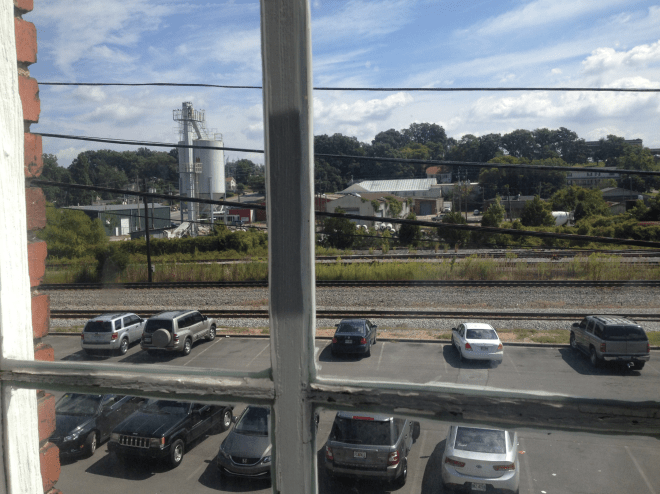
vfyw_10-5

A reader writes:

Based on the types of cars in the parking lot and the shape of the license plates, it’s got to be the US. And I’m just taking a wild guess here, but the proximity of the railroad tracks simply reminds me of a business trip I took a few decades ago to Cedar Rapids, Iowa. The city had a large cereal plant in the center of town and you could always tell from the smell, which breakfast cereal they were making, so we renamed Cedar Rapids – whose slogan is “the City of Five Seasons” – the City of Five Smells.

Another:

Hensall, Ontario, Canada? Sure looks like Canadian license plates; train tracks seem like the town of Hensall.  I was there many years ago.  They had a grain silo in town.

Another:

Battle Creek, MI? As a native Michigander, I recognize the landscape of trees and shrubs. Additionally, Battle Creek is along the railway with numerous small factories nearby. (Battle Creek is home to Kellogg’s Cereal and the trains come through frequently). Also, notice how the cars don’t have front plates? It’s not required in Michigan.

Another:

This VFYW contest is hard. I think I make out both Florida and Georgia license plates. Neither state requires front license plates. I’ll choose Valdosta, GA because Valdosta has railroad tracks. And cars. And sun. That’s the best a parent of two small children can do at this time.

Another:

No idea. I was going to ask my brother-in-law (who works in law enforcement) as a favor to run the personal information off the two clearly visible plates.  I figure “Cowgirl” would be thrilled to have a random dude call her to see if I could get her e-mail address, send her a picture of her car I got on a public website, and have her tell me where exactly she parked. Instead I decided not to risk the offer of tagging along on a meth lab raid next time my brother-in-law gets the opportunity.

Another gets on the right track:

I am thinking that this outside a major city of Georgia based on the GA license plates that on the cars in the lot. Too bad I can’t run them without paying. I am also thinking that this place is near a Walking Dead film site. (The show premiers October 31, as usual.) Did you know there’s a WD Google Map?

Screen Shot 2013-10-08 at 1.27.21 PM

In fact there a several, and they were WAY too detailed for me to spend time looking for nondescript buildings. I’ll choose Grantville because it’s one of the main sites for filming, but I can’t spot dual train tracks near there.

Another:

That is small town Georgia, for sure. Somewhere along the CSX line. One is right behind our home. Let’s see, Lee county is using PH in its tag sequence. Your submitter shows a PIA, so must be in Southern, or SW GA. The county name is large, so a few guesses there. I have seen a couple of readers from Tifton and from Tallahassee, so must be from somewhere around there.

Another quotes one of our grand champions:

What are the most common red herrings?

Mike: License plates.

There are so many, and they change so quickly. It’s easy to look at a plate and think you know where it’s from (or even to look it up on a license plate site), only to discover that it hasn’t been used for years, or even worse, that the same design is used in myriad countries or states.

But I’m no expert and the license plates are all I got here. I followed the red herring to a license plate site. These look like Georgia, which, according to the possibly-outdated plate site, also does not use front plates. I say this is Georgia. I have no idea where in Georgia so I’m saying Atlanta. Some very specific window in Atlanta.

Another:

I’m pretty sure at least three of those license plates are from Georgia. And it certainly looks like Georgia, specifically one of the towns centered along the railroads radiating from Atlanta (I should know, since I grew up in one of them).  In other words, one of about a hundred towns in the northern half of the state that look more or less exactly alike. Aw, what the hell …

Another:

This one was ridiculously difficult. I could narrow it down to the state of my birth, Georgia, because most of the cars have Georgia plates and it looks like a typical small Georgia town. The presence of the Range Rover from Florida made me think it’s in South Georgia near the Florida line, except the hill with the large red brick building threw me. South Georgia isn’t very hilly. It’s impossible to read the name of the business in the building with the red facade, and all I can make out about the billboard to the far left is the word “Pain,” which this contest certainly is.

So, for no good reason I’m going with Tifton, Georgia because Tifton is a small town and I’ve decided that the red building on the hill is part of Abraham Baldwin Agricultural College, otherwise known as ABAC. It’s located at 119 Love Ave. It’s in need of a paint job, but establishments like those are struggling these days, especially in small towns.

Another:

I got Georgia from the license plates and Calhoun because it came back in the first page of search results for both “cement plant Georgia” and “Oxycodone Georgia” (note billboard with the word “PAIN” in the background).

On the other hand, “The sign advertising pain (bread) and the cars point me to the province of Quebec.” Another reader:

I’ve viewed every cement depot in Georgia (number plates) that is within a mile of a railway line, going over the same ones twice if they were within 50 miles of a KIA dealership and 10 miles of a McDonald’s, and short of making enquiries of the DMV, I’m completely out. I’ll go with College Park, Georgia, although it could have been any number of towns. Would love to know *how* the pro-bowl VFYW players get this one.

Another gets this one:

I thought this week’s contest would be easy because of the Georgia license plates on the cars and railroad tracks.  Well, it turns out that there are lots of railroad tracks in Georgia to search and the contest took longer than I thought it would.  But I have the time.  I’m furloughed.

This week’s photo was snapped in Dalton, Georgia.  The window could be in one of several neighboring brick buildings in downtown Dalton to the west of the railroad tracks.  I think the window is most likely in the upper floor at the rear of 222 North Hamilton St.

Another notes the place of business:

That’s 3 Divas in the Attic, and I even creeped a photo of their building off their Facebook page to verify their address. It’s of their ribbon-cutting earlier this summer, the submitter is probably even pictured in this photo:

3 Divas front

Internet, you scary.

Another:

As a long-time reader, subscriber and lurker on the VFYW pages, I am happy to jump in this week. I believe that the picture is taken from the back of the 3 Divas in the Attic interior design shop in Dalton, Georgia. Exact address is 222 N Hamilton St Dalton, GA 30720. I believe that it is taken from the 2nd floor middle rear window.

One other thing: I have been meaning to write to you about After Tiller. It is kind of an amazing feeling to have two disparate parts of ones life come together. My partner and I did the post-production sound for the documentary. It is a project that we have loved and championed in our own tiny way. I can remember talking to Lana and Martha when we mixed the film and hearing their disbelief that the film would get into Sundance or have much of a life. So, as an avid reader of the Dish and Andrew’s writing, I was so happy to see Martha and Lana on the Dish. After Tiller really is a special and wonderful film.

Another:

This is one of those weeks where random knowledge comes to the rescue. I spent much of my early search near Georgia’s major cities but I wasn’t finding much. Then, while focusing on the railroad tracks, I remembered that during the Civil War there was a major rail line between Chattanooga and Atlanta which became the central axis of Sherman’s march. A quick look at the state’s northwest corner not only found the rail line, but our location as well: the 2nd floor of 222 N. Hamilton Ave.

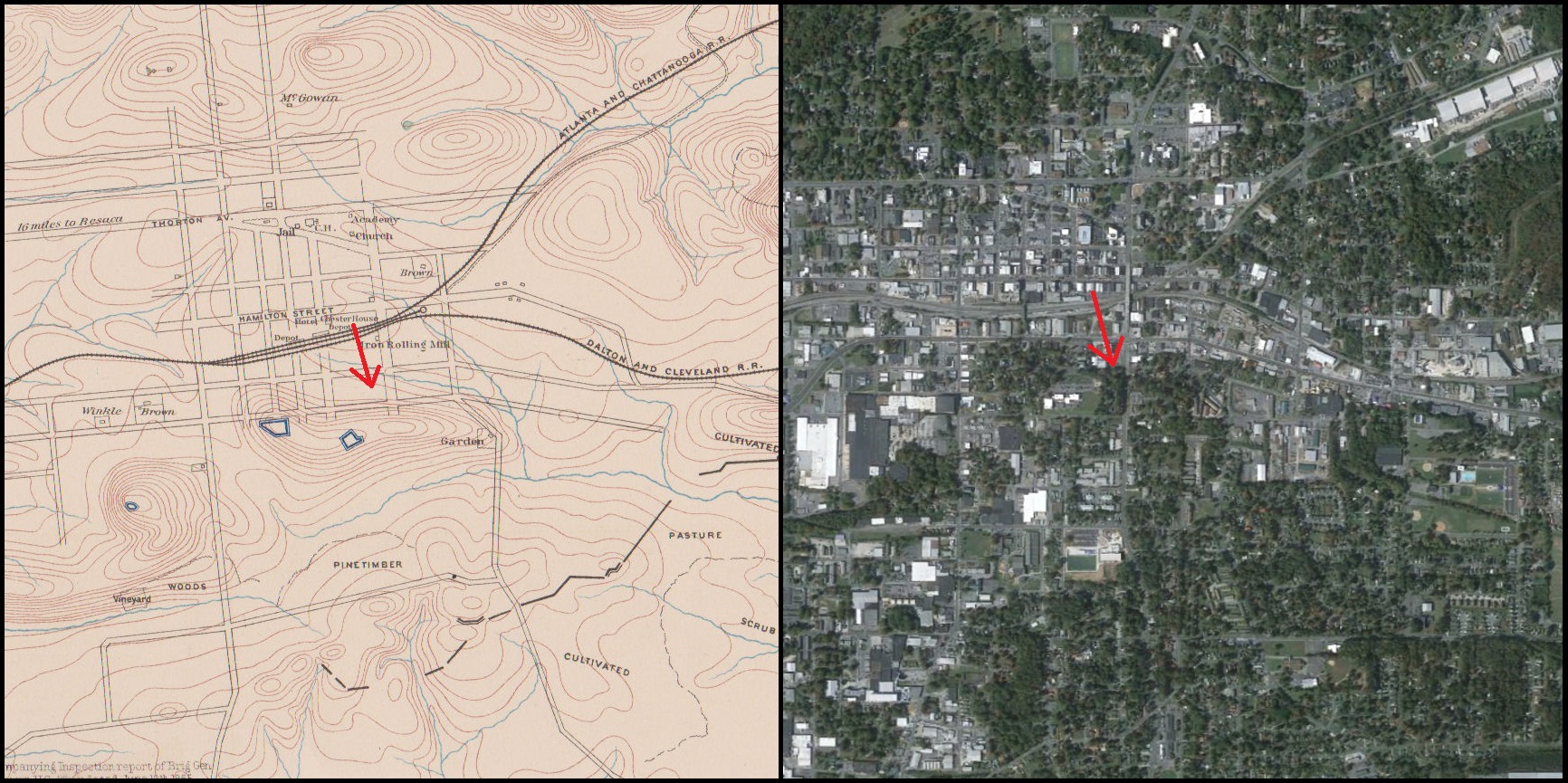
I’ve attached an image that compares an 1865 map of Dalton to a present day satellite image:

VFYW Dalton Comparison - Copy

The red arrows not only point in the direction your viewer was looking, but also roughly in the direction of a Confederate attack which took place on August 14th, 1864. The Second Battle of Dalton, as it is called, was one of the final battles in Sherman’s Atlanta campaign. Despite the Confederate desperate and repeated cavalry attacks on the Union fortifications to the east of town (visible as the blue boxes in the civil war map), the Union positions held; two weeks later Sherman’s troops marched into Atlanta.

Today there’s not much left of the Union fort, but its location can be seen in the upper right of your viewer’s image, where a red brick junior high school sits on the same hilltop site.

Another bit of history:

The stretch of tracks in the photo lay on the Atlanta to Chattanooga line that was the scene of the Great Locomotive Chase in 1862 when Union soldiers captured a passenger train and damaged telegraph wires, bridges and tracks as they travelled north towards the Union lines in Tennessee. They ran out of fuel and didn’t make it to Chattanooga.

About a half-dozen readers correctly guessed 222 N Hamilton, but the following reader breaks the tie because he has entered the most contests without yet winning:

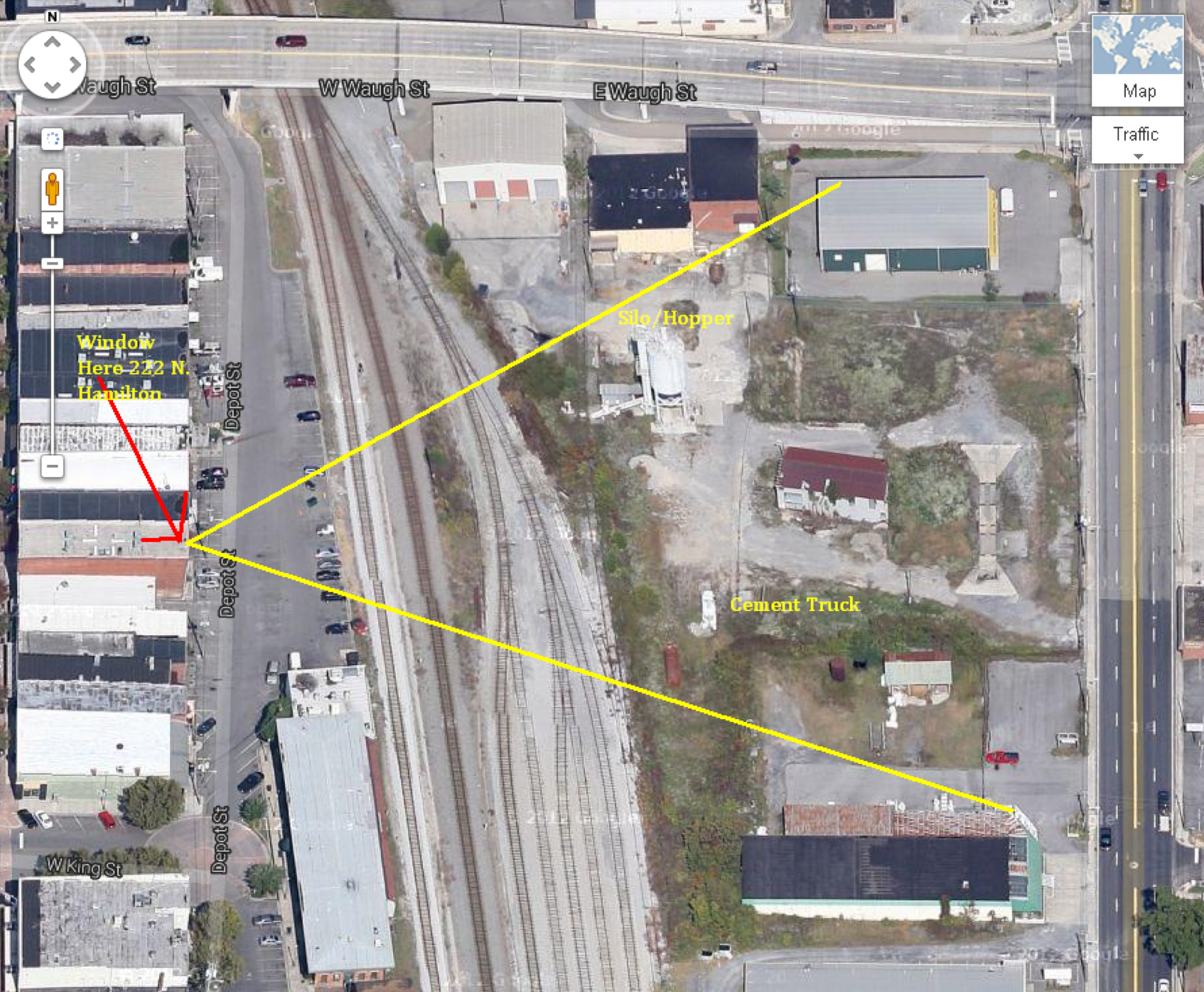
Wow. This might be my finest moment in Contest history. Well, luckiest anyway. I got this window on my first random, semi-blind stab, despite the fact that I’ve never even been within 500 miles of the locale. First the license plates. The orange blob in the middle, plus the alphanumeric sequence, plus the fact that they are rear only plates put me in Georgia. On a railroad track. With nothing else to go on. So I pulled up a railroad map. There are a lot of railroads going through a lot of small towns in Georgia. Because there seems to be several tracks here, I decided to start with places where two or more lines share the same right of way. So I started at the top of the map. Dalton, Georgia. BINGO! There was a big white hopper or silo, there was a parking lot right on the tracks, there was a white cement truck. First try. A semi-educated stab in the dark!

The StreetView of the town is very low quality. I can’t get a good image of the area to find a street number. I can’t even make out business names in the shots to help zero in, so I’ll go with StreetView’s best estimate of the address: 222 N. Hamilton St. Dalton, GA 30720. Second story rear window. I’ve made a picture to help:
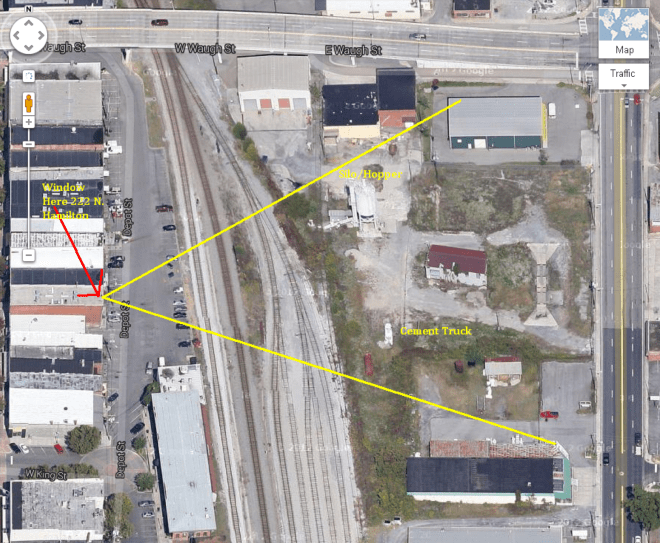
Screen Shot 2013-10-08 at 1.07.16 PM

Details from the photo submitter:

The address is 221 Depot Street, Dalton, GA. The GPS coordinates are 34.773016, -84.967386

222 N. Hamilton Street could also be considered accurate as it does identify the correct building but the wrong entrance. The window and entrance to access the window are on the rear of the building. The correct address for that rear entrance is Depot Street, but many people are unaware of the rear entrance or the name of the street. The front of the building is 222 N. Hamilton St.

I am always amazed at how precise the winning entries are, so here is a shot of the window (circled in red) courtesy of Google Earth:
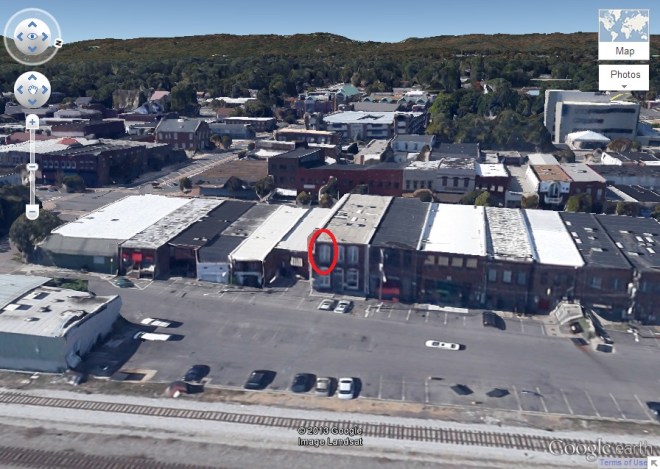
221DepotAerial

You can also see downtown Dalton and Rocky Face Ridge in the background. Thanks for using my photo!

(Archive)

From The Annals Of Spousal Pride

“The Bloomingdale’s model stops to buy a frozen yogurt. I hover several yards behind her. Behind me two men stop and stare. I can’t help but notice: they are staring at my wife’s rear end. ‘Can you believe that shit?’ one says loudly to the other. ‘That should be illegal,’ says the second. It’s as if they belong to some sort of sexual tour group, and she is a stop on their itinerary,” – Michael Lewis, from a TNR piece published in 1994 and now part of the magazine’s mini-pseudo-anthology of sex writing. I confess to being the editor who somewhat rashly published it. But then I also published “The Joys Of Presbyterian Sex.” Good times.

Another recent example of spousal pride here.

Is Negotiation Possible?

Obama pointed out yesterday that the Democrats have already compromised:

He’s having a presser today at 2 pm. Stay tuned. Meanwhile, Douthat thinks the president’s refusal to negotiate is a mistake:

It makes it sound like the very idea of negotiating around the debt ceiling is unprecedented (which it isn’t) and a threat to the constitutional order (which it hasn’t been), and makes it seem like the Republican Party’s grave sin is the politicization of the debt ceiling per se (even though both parties have regularly politicized it), rather than the fact that the G.O.P. is trying to enter into debt ceiling negotiations in pursuit of politically-impossible goals.

Chait counters:

Douthat proceeds to argue that debt-ceiling extortion would be fine if Republicans had attainable policy demands. It’s somewhat of a characteristic flaw of Douthat’s style that he dwells inordinately on the imagined world in which the sane, technocratically reasonable Republican Party he wishes existed actually exists. … Ultimately, Douthat is not grappling with any of the structural problems inherent in leaving the weapon of default lying around the political system, waiting to be picked up by any sufficiently ruthless actor. He’s subsuming the problem in a fantasy world in which nobody would ever use such power irresponsibly.

I’m waiting for Ross to unload on the GOP, which he should, given the rationale of his post. But he appears to be rhetorically lying low – the position “reasonable” Republicans have taken as their party has become more and more galvanized by the crazy. In my view, the cowardice of Republican elites and Republican moderates is at least a big a problem as the fanaticism of the Republican base. George Will, for example, has gone from being a calm conservative to being a climate change denialist who is now going to work for Fox News. And people wonder why we are in a deep crisis of governance. First Read suggests a compromise:

[H]ere is a POTENTIAL resolution to this entire stand-off: Congress could pass a clean debt-ceiling for a few months, meeting the president’s requirement of doing it without negotiating. But after that, there’s a negotiation over a longer raise (or ending the debt limit altogether), with the sequester, entitlements, etc. thrown in. Everybody wins: The president gets to say he got Congress to act without negotiating; Boehner can claim he got Obama to the negotiating table.

Some in the GOP are now proposing yet another super-committee along those lines. Dickerson sees the rationale:

House would pass a “clean” debt limit increase and clean continuing resolution to keep government funded, which is what the president wants. Then there would be a side agreement cooked up by Senate Majority Leader Harry Reid and House Speaker Boehner that would include something that Republicans want. That agreement would name budget conferees to debate the big issues of spending, taxes, entitlements, and economic growth, and it would include some guarantee—probably in the form of a stick—to make sure the conferees did their work. …

Both sides need an escape hatch. When Boehner has told members he won’t allow a breach of the debt limit, this is the kind of jerry-rigged deal he’s envisioning. Such an agreement would also allow President Obama to stand firm on his position that he won’t negotiate, but it also rescues him from the potential downside of looking like he’s refusing to act during a crisis that could cripple the economy. In return, House Republicans could tell their supporters that they earned a real chance at future reductions in government spending.

Ezra doubts that yet another budget commission would produce anything of value. But it could be a way out of the current crisis:

The White House’s view is that they’ll compromise on process but not on policy. A new commission counts as a process compromise. If that’s enough for Republicans to save face, then it’s a low-cost way out of this mess. But it’s hard to believe anyone in Washington will buy the idea that yet another budget commission has even a shadow of a chance at success. And even if they do, what happens when the commission fails, and the next CR and debt-ceiling increase needs to be passed?

Steinglass urges Obama to stop being so damn reasonable:

The problem Republicans are having right now is an outgrowth of a longer-term issue they’ve had ever since the 2008 elections: the GOP does not really have much of a policy agenda. For the past five years, the party has been defined almost entirely by everything it is against. ….

When Mr Obama stops speaking as a partisan advocate of ambitious liberal goals, adopts his mature school-principal voice, and demands simply that political players adhere to reasonable norms of democratic governance, Republicans are left with nothing to oppose except the reasonable norms of democratic governance. At the moment, Republicans need to be reminded that Democrats do not want the government to reopen and the interest on our debt to be paid. They want the government to reopen, double its infrastructure spending and guarantee pre-school from age three to poor Americans; they want to pay the interest on our debt, then borrow more to run larger deficits right now and for the next couple of years, and lock in higher taxes five to ten years down the road to handle the long-term deficit problem. A fight between Democrats and Republicans over whether or not those are good ideas is a fight America can survive and even thrive with. A fight over whether or not to default on our debt isn’t.

If You Wonder Why I’m Shitting Myself

“President Obama waived a ban on arming terrorists in order to allow weapons to go to the Syrian opposition. Your listeners, US taxpayers, are now paying to give arms to terrorists including Al Qaeda. … This happened and as of today the United States is willingly, knowingly, intentionally sending arms to terrorists, now what this says to me, I’m a believer in Jesus Christ, as I look at the End Times scripture, this says to me that the leaf is on the fig tree and we are to understand the signs of the times, which is your ministry, we are to understand where we are in God’s end times history. … Rather than seeing this as a negative, we need to rejoice, Maranatha Come Lord Jesus, His day is at hand,” – Michele Bachmann, a sitting member of Congress.

The Debt Ceiling Denialists

Bouie watches their ranks grow:

No one knows exactly what would happen if the United States breached its debt ceiling—an artificial limit on what the Treasury can borrow to pay its bills—but almost everyone agrees it would be disaster. I say “almost” because a growing chorus of Republicans insist the opposite, that hitting the debt limit wouldn’t cause a default, and even if it did, it’s no big deal for the nation or the world.

Some of the current GOP delusions: the deficit is rising (it isn’t); the debt is currently unsustainable (it isn’t); the public wants Obamacare ended (it’s split on even delaying it); climate change has nothing to do with human-produced carbon emissions (it is, according to almost every single reputable scientist examining the issue). Why are we surprised that the people who predicted a Romney landslide a day before he was trounced might actually be prone to believing in things that simply are not true by any empirical, objective standard? That’s the true danger here. Their epistemic closure is now not just threatening them, but all of us.

Bruce Bartlett has a must-read on the whole topic here. It’s exhaustive and careful and irrefutable. The GOP is currently threatening not just the core stability of the American economy but of the entire global economy. And the ultimate sign of their craziness is that they deny that – against universal agreement among economists for whom the word “catastrophe” keeps popping up – there is any threat at all. A reality check from Bruce:

Wells Fargo Bank economist Scott Anderson has said of a default, “It would be an earth-shattering event. It’s taken as given that U.S. Treasuries are a safe asset. Once you question that assumption, it shakes the foundations of global finance and the way it’s been established over the last 50 years.”

University of California, Berkeley, economist Barry Eichengreen, a world-renowned expert on the international monetary system, warned that a debt default could lead to a run on the dollar if foreigners come to feel that the U.S. is being run by irresponsible leaders. As he put it:

“If there is a threat to the dollar, it stems not from monetary policy, but from the fiscal side. What is most likely to precipitate a dollar crash is evidence that U.S. budgets are not being made by responsible adults. A U.S. Congress engaged in political grandstanding might fail to raise the debt ceiling, triggering a technical default. Evidence that the inmates were running the asylum would almost certainly precipitate the wholesale liquidation of U.S. Treasury bonds by foreign investors.”

A “wholesale liquidation of US Treasury bonds by foreign investors.” This is becoming a national emergency of economically existential proportions. Weigel identifies a source of this delusion:

[Republicans] were told for years that a shutdown would be a disaster for the economy and their party. They were told the same thing about sequestration. Neither crisis has really lived up to the end-of-times hype, especially not in their districts. … Republicans have a new, cold confidence that the president, and the press, are lying to them about the downsides of these crises.

As an example, here’s Hannity downplaying the danger of hitting the debt ceiling:

It sounds a little bit like sequestration. Predictions of doom and gloom, and none of it ever happened. The world isn’t collapsing … I’m really not that afraid of it.

And here is a list of other debt-ceiling denialists. Krugman frets:

Given all the forms of debt denial, I really wonder about the confidence many people still have that there will be an 11th-hour resolution.

I don’t believe there will be. American pseudo-conservatism is about to achieve its paramount goal: the wholesale destruction of the American government and economy. It is, indeed, the only way to return to the nineteenth century. And that, after all, is what they want.