How Bad Was Kathleen Sebelius Last Night?

Screen Shot 2013-10-08 at 11.00.51 AM

It is hard to find the words to describe it. On The Daily Show, talking to a critical demographic with respect to Obamacare, the HHS secretary was so incoherent, so incapable of even basic reasoning, so tied to exhausted talking points, so unable to concede, let alone explain, error, that she would be fired if she were a spokesperson for a minor member of Congress. And yet she is allegedly in charge of the most important domestic policy initiative of this administration and has presided over a rolling disaster in terms of its critical first week.

Dish readers have done a better job at explaining the huge snafus on the various Obamacare websites. (And The Daily Show – see above – might want to get in a defensive crouch on malfunctioning websites since its own clip of Sebelius is currently as unavailable as Obamacare’s). Today we got a better explanation:

The technical problems that have hampered enrollment in the online health insurance exchanges resulted from the failure of a major software component, designed by private contractors, that crashed under the weight of millions of users last week, federal officials said Monday.

Why was she incapable of saying that?

Why was she incapable of explaining the huge crush of demand or the fact that 32 states refused to cooperate, making the feds’ task that much more difficult? Why could she offer no plausible reason for why corporations with over 50 employees got an extra year to comply, while individuals don’t? This was a very friendly media environment, and she was given acres of time to give even a small explanation. And she was worse than useless.

Part of an official’s job is to be able to be accountable to the public for failures, to help explain them, to give an idea of how they are going to be addressed. She failed. Another part of an official’s job is to make sure that critical programs under her jurisdiction run smoothly – especially when they are as critical as Obamacare. She has failed at that as well. Why is the president content with that kind of grotesque incompetence and lack of accountability? And when will she be fired?
Detonating An Economic Nuclear Bomb

Daniel Gross warns that the impact of a default would be massive:

A U.S. debt default, or the whiff of one, would be a much more significant financial event [than the Lehman disaster]. As Yalman Onaran of Bloomberg noted, “The $12 trillion of outstanding government debt is 23 times the $517 billion Lehman owed when it filed for bankruptcy on Sept. 15, 2008.” True. But the increase in damage wouldn’t be arithmetic, it would be exponential—Lehman to the 10th power rather than Lehman times ten.

A debt default, even if momentary and partial, wouldn’t be like blowing up a much bigger stick of dynamite. As Warren Buffett suggests, it would be like detonating a nuclear bomb.

Why would a default be so much worse than Lehman Brothers? It has largely to do with who owns U.S. government debt and how much debt those companies and institutions have. Lehman caused a company to fall, a sector to fall, and stocks to fall a bunch. A U.S. government default—or again, even the whiff of one—would cause all that to happen, plus it would bring down a bunch of governments and possibly ignite a revolution and a couple of wars.

One Month, Many Causes

What happens when at least 11 advocacy and awareness campaigns fall on the same month? Competition:

Rita Smith was watching football in 2009 when she noticed – as if it were possible not to – that the players were newly outfitted in pink socks and gloves. Her heart sank. “I was pretty sure we were toast,” she says. “There was no way we were ever gonna match them.” Smith is executive director of the National Coalition Against Domestic Violence, which also claims October as its awareness-raising month.

Why it’s hard to compete with cancer:

Breast cancer is, as many critics have pointed out, the perfect issue for corporate-funded cause marketing. It’s got an unambiguous villain (CANCER) and a natural constituency (women). Saving boobies is a friendly cause that everyone – even frat boys and NFL players – can get behind. A straightforward health issue.  By comparison, domestic violence is downright controversial. It touches on complicated issues like power, rape culture, victim-blaming, and gender roles, and stirs up uncomfortable emotions. …

One in eight women will suffer from breast cancer in her lifetime. One in four will experience domestic violence. Good luck finding that statistic on a yogurt lid this month.

Update from a reader:

Cancer can’t even compete with cancer! Breast cancer does not kill as many women in the US (41,000) as lung cancer (70,000), but you never hear about this from the pink ribbon brigade

Blinded By The Fight

Ilya Solmin, who just came out with Democracy and Political Ignorancenotes that “high-information” voters aren’t necessarily well-informed:

Just as there are sports fans who love to follow their favorite teams even though they can’t influence the outcomes of games, there are also “political fans” who enjoy following political issues, and cheering for their favorite candidates, parties, or ideologies. I am a political fan myself, as are many of the people who read blogs like Balkinization or the Volokh Conspiracy. So too are most of the people with an unusually high level of knowledge of politics, in the general population. The single most powerful predictor of political knowledge – more important even than education – is interest in politics.

There is nothing wrong with being a political fan. But if you are seeking out political information for the purpose of enhancing your fan experience, that objective is often inimical to the goal of seeking out the truth. Much like sports fans, political fans tend to evaluate new information in a highly biased way. They overvalue anything that supports their preexisting views, and undervalue or ignore new data that cuts against them, even to the extent of misinterpreting simple data that they could easily interpret correctly in other contexts.

The Manliest Compromise

Can the mustache come back? I’ve always had a thing for the seventies’ porn stache myself but it doesn’t quite seem to work these days, despite John Hodgman’s fearless pioneering. In an excerpt from Paddle Your Own Canoe, Nick Offerman extols its moderate virtues:

The straight dope is: If we’re TRUE to our natures, then we grow a robust beard. That is what was intended by the ORDER OF THINGS. Society has put a spin on us, making a “clean-shaven” countenance the social “norm,” which, from Ma Nature’s point of view, is bullshit. But then, so are air-conditioning and Saran wrap and Cap’n Crunch and a bunch of other cool shit that allows us to “rise above” nature at times. A moustache is a socialized way to say, “Okay, look, I’ll let you see most of my face, since that’s what we’re all doing right now, but if you would kindly direct your gaze to this thornbush above my mouth, you will be reminded that I am a fucking animal, and I’m ready to reproduce, or rip your throat out if called upon, because I come from nature.” In this way the moustache can be considered a relief valve of sorts, for the buildup of animal preening that most people completely repress. That’s what makes a man with a good stache so cool, calm, and collected.

The key thing is not to buzz it. You have to let it grow so that the hairs that start just beneath your nose go all the way down to the upper lip in a waterfall cascade. That means only trimming the bottom border with scissors to enable eating and drinking without a straw. I favor a slight downturn at the crease of the mouth – but that’s obviously a matter of taste.

A Midlife Crisis At Any Age

Psychologist Oliver Robinson runs through them:

In your 20s, crises tend to be about whether you are making the correct decisions for the rest of your life, namely in your job and relationship. In your 30s, work-related issues and break-ups feature prominently. In your 40s, for women bereavement is often an issue, most likely for a parent. For men, it is still to do with their job but it has moved to “Holy crap, I’ve got a lot to do.” In your 50s, you get features of both early and later life crises—bereavement and ill health. This may be why late midlife is so potent. And that continues in your 60s, with retirement-related issues and heightened awareness of mortality.

Contemplating Cool

The genesis of the classic American term:

Cool has come a long way, literally. In a 1973 essay called “An Aesthetic of the Cool,” art historian Robert Farris Thompson traced the concept to the West African Yoruba idea of itutu—a quality of character denoting composure in the face of danger, as well as playfulness, humor, generosity, and conciliation. It was carried to America with slavery and became a code through which to conceal rage and cope with brutality with dignity; it went on to inform the emotional textures of blues, jazz, the Harlem Renaissance, and more, then percolated into the mainstream. [Scholar Peter] Stearns argues that cool’s imperatives of flexibility and fluidity helped Americans escape rigid Victorian morality into modernity and developed along with mass production and mass media as a new individualist ethos.

Carl Wilson continues with a meditation on its meaning:

To be cool is to have cultural and social capital, and most urgently it is to be not uncool—a hang-up most of us pick up in adolescence that’s damnably hard to shake even if it mellows with age. Cool is an attitude that allows detached assessment, but one that prizes an air of knowingness over specific knowledge. I think that’s why it doesn’t become dated, unlike hotter-running expressions of enthusiasm like groovy or rad. As Stearns says, cool is “an emotional mantle, sheltering the whole personality from embarrassing excess. … Using the word is part of the process of conveying the right impression.”

Slate continues its month-long series on the meaning of cool with Mike Vuolo delving deeper into the etymology and Mark Joseph Stern focusing on the coolness of Cary Grant.

Who’s Responsible For Bad Code?

Jane Chong takes a look at efforts to make software developers liable:

[S]oftware insecurity can be likened to a public health crisis. The fact that a single vulnerability can give rise to untold numbers of compromised computers and harms that are difficult to cabin makes dumping costs entirely on end users unreasonable as a policy matter. To borrow the words of law professors Michael Rustad and Thomas Koenig, the current paradigm is one in which “[t]he software industry tends to blame cybercrime, computer intrusions, and viruses on the expertise and sophistication of third party criminals and on careless users who fail to implement adequate security, rather than acknowledging the obvious risks created by their own lack of adequate testing and flawed software design.” A more reasonable and balanced system should be possible.

On the other hand, any attempt to systematically hold vendors accountable for vulnerabilities must build in realistic constraints, or risk exposing the industry to crushing liability.

Where Republicans And Democrats Agree

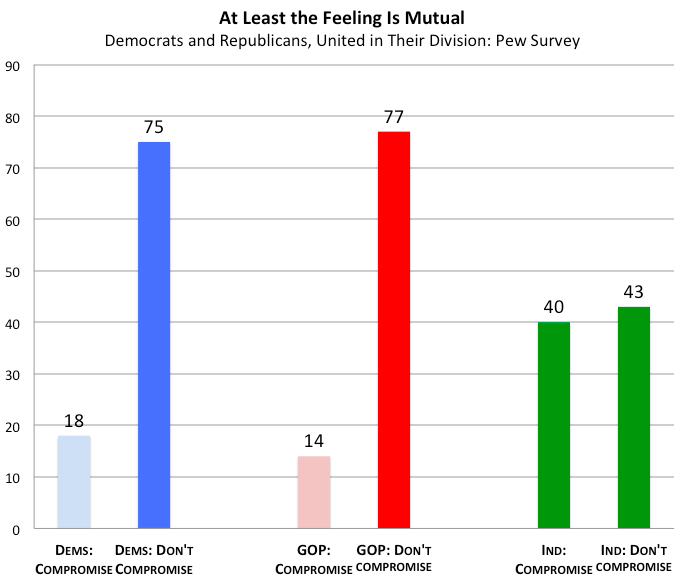
Neither want to back down to end the shutdown:

Don't Compromise

Derek Thompson sees it as “another reason why this shutdown isn’t likely to end any time soon”:

As Molly Ball reported today, Democrats told pollsters for The Economist that they value compromise, much more than Republicans conceded. But in this specific debate, at least one poll has Americans practically perfectly divided on the issue of compromise.

Collender bets that the shutdown will continue for some time:

I see the shutdown lasting at least another week…and two or three more weeks after that are becoming increasingly likely. I’m also raising the likelihood of the debt ceiling not being raised by October 17 — the date Treasury says it will be needed — to 1 in 3 instead of my previous estimate of 1 in 4.

Betting On The Nobel

Zach Schonfeld checks in with the bookies monitoring the literature contest:

The critically acclaimed Japanese writer Haruki Murakami currently leads the pack, boasting projected odds of 3/1, while American author (and frequent tweeter) Joyce Carol Oates follows closely behind with 6/1 odds. (Bob Dylan, if you’re wondering, drags behind with a 50/1 chance of winning, by Ladbrokes’ count.)

Recent Dish on Dylan’s chances here. In a come-from-behind twist, the odds for Norway’s Jon Fosse has shot from 100/1 to 9/1:

What gives? As we’ve previously covered, the bookmakers’ methods have little to do with the actual quality of the literature.

They’re just thumbing through blogs and mainstream media outlets in a mad dash to figure out which authors are getting the most buzz in the weeks leading up to the announcement. This method, however unscientific and fraught, has provided Ladbrokes with an impressive accuracy rate in past years. … Fosse’s temperature is pretty hot right now. Ladbrokes cut its odds on the playwright dramatically after noticing several surprisingly large bets on him in his home country of Norway. According to the company, “Fosse has come from out of nowhere to become the hottest writer, and it’s not inconceivable that he could become favorite to win before the announcement is made.”

Track the latest odds here.