Mental Health Break

An otter that thinks it’s a dog:

But Doug Barry gets an uneasy feeling:

If you take a closer look at this video (which appears to feature a jaunty otter playing with some people), you’ll realize that the otter is no ordinary otter — it is a scout otter, sent from the great Otterman Empire to ascertain the relative strength of human warriors. The report? Humans are trusting and weak — they shall be easy to conquer.

Be on the lookout for ostriches on the horizon.

DFW’s Other Half Of The Story

Adam Plunkett reviews the first book by Karen Green, the widow of David Foster Wallace:

Bough Down is the story of Green’s mourning, first and foremost. But a layer of it challenges the sensibility she mourns and may partially blame. “Honey, you smell agathokakological,” she writes, that word meaning made of both good and evil. I think that she cares less to lay blame than to define her husband’s streak of moral absolutism, a sensibility restlessly upset about the dross in himself. Green is both despondent and funny, both hopeful and desperate, both out of control and contained. She is comfortably unsure, and she goes through the vicious cycles that characterize so many Wallace protagonists without pushing the reader away or being undone by her own introspection. She takes apart the pieces of her thought, as does Wallace, but not to fleece herself for bad habits by obsessing over her own motivations. He would “[name] the impulse mistaken or accidental”; she doesn’t. He was famous for the either/or of ironies—either I love you or need you, either I’m selfish or able to care for you not just to make myself feel better, either I’m free or I serve a false god—stretched out from sentences to meganovels. Where his sensibility was either/or, hers is both/and, and a celebration of imperfect life.

How Your Neighbor’s Insurance Covers You

Kurt Eichenwald argues that – even if you have health insurance – if “more people in your community are uninsured, your care will be worse”:

Hospitals don’t have poverty wards; if a patient comes in the door in bad shape, they don’t do a wallet biopsy before deciding what care that person should receive—everyone at a hospital receives the same quality. But if a community has a higher number of uninsured, that means the latest and greatest technology and treatments will drive up the amounts of unreimbursed care. In essence, hospitals that provide the best, most modern, and most expensive treatments in an area with lots of uninsured will be forced to pass unsustainable amounts of cost to their prices. Insurance companies won’t pay it, local governments won’t finance it, and the hospitals will go out of business.

The only option then? Don’t provide the top-quality care to anyone—insured or not. That keeps the cost of uncompensated care down and lets the hospital stay in business.

This is not something I have just dreamed up. Repeated studies over the past decade have showed a consistent relationship between the number of uninsured in an area and the quality of care available for all residents there.

The Tea Party Doesn’t Want Compromise; It Wants Surrender

Supreme Court Hears Arguments On Constitutionality Of Health Care Law

Christopher Parker, co-author of Change They Can’t Believe In: The Tea Party and Reactionary Politics in Americaexplains why the Tea Party caucus is immune to compromise:

They refuse to compromise because, to them, compromise is capitulation. If you go back to [Paranoid Style of American Politics author Richard] Hofstadter’s work when he’s talking about when the John Birch Society rode high, he talks about how conservatives would see people who disagree as political opponents, but reactionary conservatives saw them as evil. You can’t capitulate to evil.

McKay Coppins makes related points:

From its genesis in 2009, the Tea Party movement has been fueled by the rhetoric of revolution. True believers attend rallies unironically dressed in colonial garb.

Their early organizers preached earnestly from Saul Alinsky’s left-wing activist handbook Rules For Radicals — a book that advises just the sort of procedural disruption they’ve imposed this week. And while Nevada Senate candidate Sharon Angle outraged mainstream political observers when she suggested people may start looking for “Second Amendment remedies” to the country’s problems, one recent survey showed that nearly half of Republicans believe armed insurrection might be necessary “in the next few years.”

Data points like those have long been Democrats’ bread and butter as they work to cast the Tea Party as “extreme.” But they also show just how extreme conservatives consider America’s current peril to be. To believe an armed revolution could realistically be on the horizon is to live with the genuine suspicion that your government could, at any point, be overtaken by tyranny. In that context, some temporary furloughs seem like a small price to pay.

Kilgore adds:

71% [of Tea Party conservatives] think Obama is “destroying the country.” Wow. So is it any great surprise that these same people, and the House members who identify with them, are willing to go to dangerous lengths to mess up Obama’s signature policy achievement and force a significant change in the federal government’s direction? Who cares about the risk of destroying the economy if the destruction of the country itself is the current trajectory?

(Photo: Wearing what she calls ‘war paint,’ Susan Clark of Santa Monica, CA rings a bell while demonstrating against Obamacare outside the U.S. Supreme Court on March 28, 2012 in Washington, DC. By Chip Somodevilla/Getty Images)

How Race Informs The Obamacare Fight

Nancy Folbre digs up an AP survey on racial attitudes taken just before the 2012 election:

28 percent of respondents believed that [Obama’s] policies had made black Americans better off, compared with only 15 percent who believed they had made white Americans better off.  I don’t know of any analysis of the president’s economic stimulus program – or any other policy – purporting to show that blacks benefited more than whites. …

Respondents predisposed to believe that a black president will try to benefit blacks more than whites are likely to view the Affordable Care Act through a racial lens, which helps explain the results of a recent Pew survey showing that almost 91 percent of blacks currently approve of the law, compared with 29 percent of whites.

Relatedly, TNC recently argued that the ACA is likely to benefit African Americans less than other groups:

When President Obama leaves office there will almost certainly be efforts to ascertain the impact of our first black president on the black community. Defenders of the president’s record will likely point to Obamacare as the kind of program that expanded the safety net for everyone but specifically for those in need — a class in which African Americans are overly represented.

I have, of late, been anxious to add an asterisk to this accolade. As I’ve noted before, black people are also disproportionately represented in many of the states which are refusing the Medicaid expansion. Thus the idea that Obama has aided poor black people through a broad race-blind expansion of the social safety net deserves some scrutiny.

How The Shutdown Hurts Our Museums

US-POLITICS-ECONOMY-BUDGET

Federally-funded museums receive about 30 percent of their funds from private sources, but as Katherine Boyle notes, the shutdown may cause those donors to be less generous in the future:

This week, the National Gallery of Art turned away the prime minister of Greece, Antonis Samaras, and Adrienne Arsht, the philanthropist who underwrote the gallery’s most recent blockbuster exhibition, “Diaghilev and the Ballet Russes.” Samaras was supposed to view a Byzantine art exhibit co-sponsored by groups from his country. Arsht was set to throw a large party for patrons who wanted to visit “Diaghilev” one last time. Both were canceled due to the government shutdown.

And therein lies a lesson about why the shutdown is even worse for Washington’s museum sector than you might think. In short: The Smithsonian and other federally funded museums rely in significant part on private funding – but the shutdown inhibits their ability to raise even the private funds. … One of the big selling points at the Smithsonian and the National Gallery is that these museums are funded by the federal government, and because of that, will always be free and open to visitors who otherwise couldn’t afford an entrance fee of $15 or more. Shutdowns are a reminder that there are drawbacks to federal reliance, and that Smithsonian leadership is beholden to the whims of Congress. Prolonged closure could lead some patrons to send their gifts to the Met or MoMA …

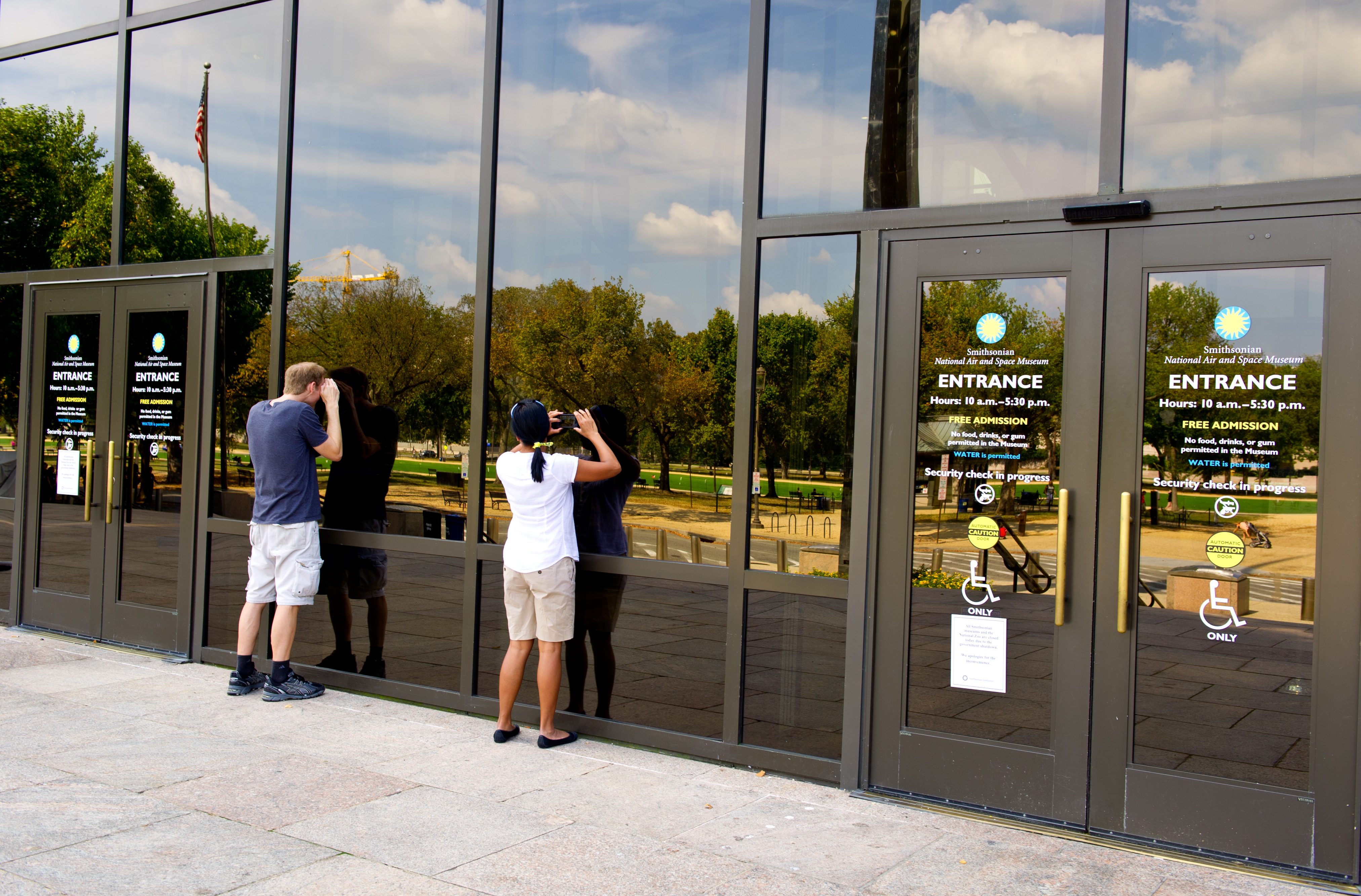
(Photo: Tourists peer into the closed Smithsonian National Air and Space Museum on October 5. By Karen Bleier/AFP/Getty Images)

Default Isn’t The Only Danger; A Global Depression Is

Markets Watch As Government Shutdown Continues

If the debt ceiling isn’t raised, a Goldman Sachs paper argues that the Treasury could probably prioritize debt payments and avoid default. Krugman is not reassured:

They don’t sound too confident. But even if they’re right, the government would still go into arrears on many other payments, from contractor bills to medical bills. And it would be forced into savage spending cuts, around 4 percent of GDP, that wouldn’t just cause hardship (Surprise! No Social Security for you this month!) but amount to a severely contractionary fiscal policy, sending us into recession if it lasted any length of time.

I think this is important. Lots of people have been focusing on the possibility of a mega-Lehman event, but even if we somehow avoid that, this will be a catastrophe.

Neil Irwin cautions against finding comfort in the relative calm of the financial markets:

Market sentiment can barely move for a very long time — and then take a dramatic shift all at once.

There were warnings that Lehman Brothers could collapse throughout the summer of 2008, but only after its bankruptcy on Sept. 15 of that year did the financial world come unglued.  In 2011, the warnings that the debt ceiling negotiation could get ugly had been sounded for months — but only turned into an extraordinary bout of volatility about a week before the bill came due for the U.S. government.

Markets are prescient, in other words, except when they’re not.

Ezra’s take:

Analogies between the finances of families and government are typically pretty flawed. But there’s one worth drawing here: That moment when a family realizes it’s broke and stops paying their mortgage, credit card bill, etc? It’s not a good moment for them. It’s a moment that wrecks their credit score and makes it harder for them to be “not-broke” ever again. To try and improve the U.S.’s finances by sharply and permanently increasing its borrowing costs is like trying to prove to your sister that her house is a firetrap by actually setting it on fire.

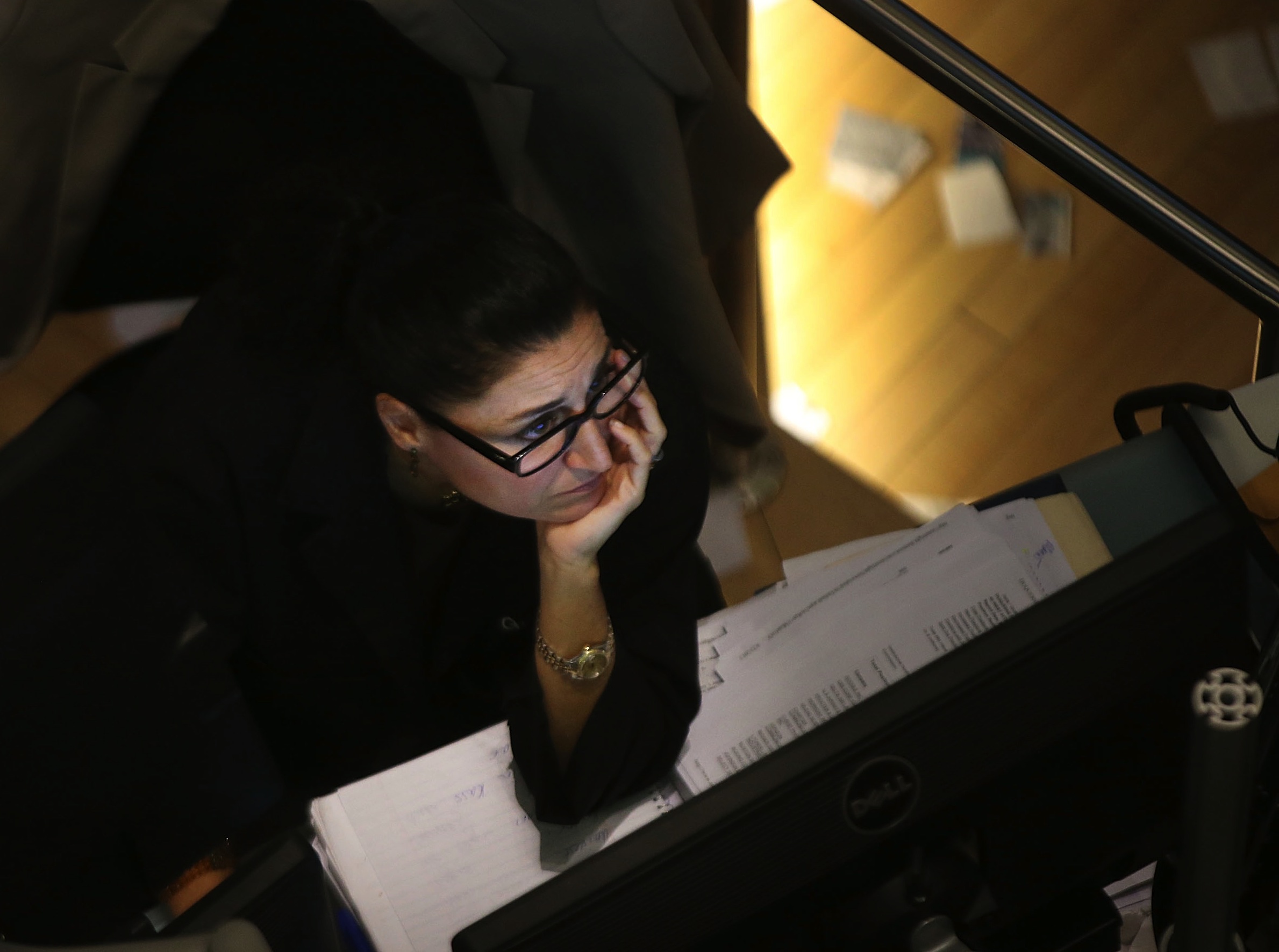
(Photo: A trader works on the floor of the New York Stock Exchange on October 7, 2013. As the impasse continues between the Republicans and Democrats in Washington, the Dow Jones Industrial Average, the S&P 500, and the Nasdaq all dropped by nearly 1% Monday. By Spencer Platt/Getty Images)

This Revolutionary Pope

Screen Shot 2013-10-07 at 3.19.07 PM

My take on the very latest – even more astonishing – interview with Pope Francis is here. With every passing day, the radicalism and ambition of his papacy deepens. My view from last year on why Saint Francis is one key to reviving Christianity in the modern world is here.

Update from a reader:

I read your selections from the Pope’s interview, and something struck me very, very deeply about many of the passages.  Pope Francis seems rather like a Quaker.  First of all, he talks about God’s light being everything, in everyone, and that goodness is universal.  This concept is at the core of Quaker theology.  In addition, his mystical experience before accepting the papal seat seems rather like what Quakers seek, often in vain, every single Sunday.  He cleared his head, calmed himself, and listened for God.  In return, God filled him with a sense of purpose and holy light.

Another:

Just as remarkable as the interview is the letter the Pope composed in response to an open letter that Scalfari wrote in the editorial pages of La Repubblica.  The 89-year-old Scalfari holds a very unique place in Italian culture; he’s been a journalist, a publisher, and even, briefly, a parliamentarian – in the public eye for more than 60 years.  Repubblica is definitely on the left-wing side of the Italian newspaper spectrum, probably the most left-wing non-communist paper.

Pope Francis is definitely reaching out. This agnostic Jew continues to be astonished.

(Image to commemorate last Friday’s Feast Day of St. Francis of Assisi via Xt3.com)