What Would The NRA Say About Tombstone?

Lisa Hix highlights a key part of the violent history of guns in the American Old West:

“The gunfight at the O.K. Corral, which is a very well-known event, was something that had social, political, cultural ramifications,” [museum curator Jeffrey] Richardson says. “You had two sides. One was Northern Republicans; one was Southern Democrats. They had conflicting mining interest, and there was a love triangle. All of these things led up to the gunfight at the O.K. Corral. The actual shootout, which lasted 30 seconds, was ostensibly over gun control: The Earp faction, which was representing law and order, asked the cowboys to disarm as they were making their way into town at Tombstone. Well, the cowboys did not do so, and that ostensibly led to the fight.”

That’s right, the West had gun control. In the early days, the West was largely populated with rowdy young men working as miners or cowboys. But as more families flooded into the West, people started to be concerned about safety. Starting in the 1880s, many Westerners towns started to post gun-control ordinances that required anyone coming into town to check their guns at the local law-enforcement office or the hotel. “As they became civilized and people brought their wives and families out, they didn’t want a lot of gunplay,” [True West editor Bob Boze] Bell says.

Did Our Ancestors Have ADHD?

In Back to Normal, psychologist Enrico Gnaulati considers the over-diagnosis of conditions like ADHD, biopolar disorder, and autism spectrum disorders. Amanda Schaffer finds some of his arguments “compelling” but sees in Gnaulati “a tendency to reach beyond the evidence”:

In particular, he resurrects an old evolutionary claim, popularized in the 1990s. The idea is that “A.D.H.D. traits such as distractibility, impulsivity and aggressiveness,” which today can be maladaptive, helped our hunter-gatherer ancestors to survive. “Restlessness, constant visual scanning, and being amped up for quick and aggressive action happen to be attributes of fine hunters,” Gnaulati writes. “If Ritalin had been around 150,000 years ago and taken in mass quantities, our survival as a species might have been uncertain.”

Well, maybe. Speculating about what life might have been like for our ancestors, what traits aided their survival and whether the genetic underpinnings of those traits remain in tact today is a dicey proposition.

Gnaulati does cite one study of Kenyan men, some of whom have a particular genetic variant associated with A.D.H.D. Among the men who were nomadic, having this variant was linked to being “more physically nourished.” Among the men who were recently settled, the reverse was true, which Gnaulati interprets to mean: “A.D.H.D. actuality gives you a leg up under nomadic conditions when you have to forage and hunt but acts as a hindrance when you have to slow down and plow the soil.” The gene variant in question, however, is only weakly linked to A.D.H.D. In fact, most people with this variant do not have the disorder, according to Joel Nigg of Oregon Health and Science University. That makes it tough to generalize about A.D.H.D. based on these men.

Also, as far as common sense goes, doesn’t hunting actually require patience, planning and self-control? Would you trust the survival of the species to an A.D.H.D. kid armed with a spear?

The Advantages Of Growing Old In America

elderly

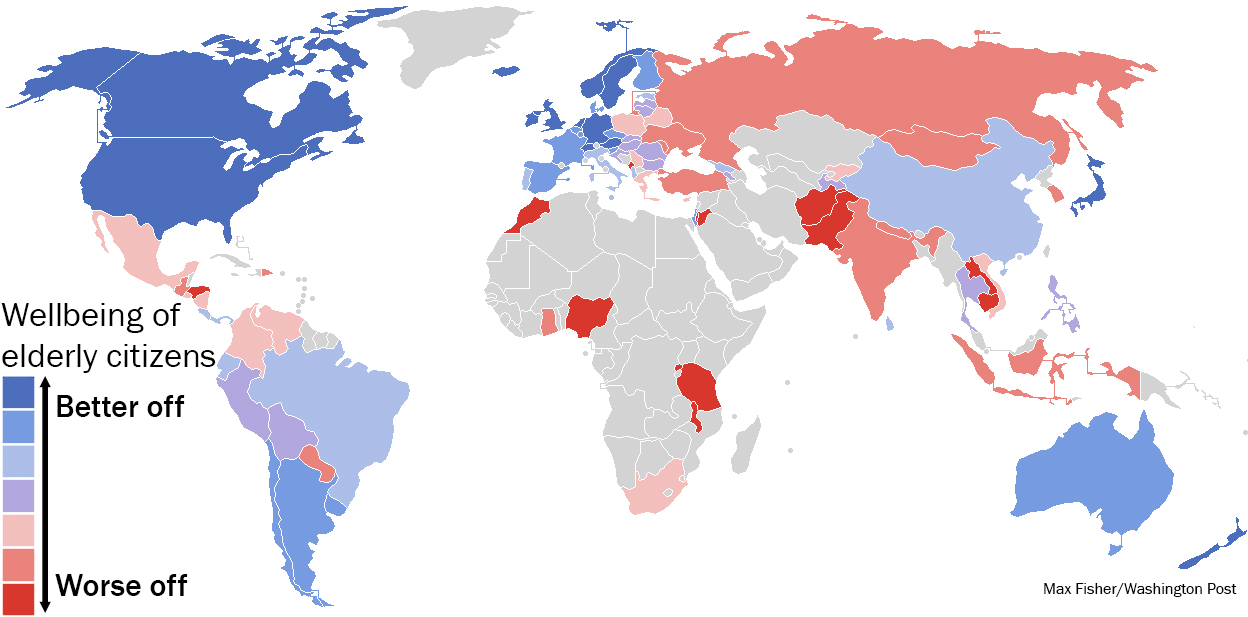
Fisher flags a new study that ranks America “eighth in the world for the wellbeing of the elderly.” Why America scores so high:

[E]ducation and employment opportunities for elderly Americans are some of the best in the world. Actually, second-best, behind only Norway. As the report explains, “Older people value their capacity to work” because they “wish to maintain social contacts and self-worth” as well as remain self-sufficient. In most countries, people start getting locked out of the labor market once they get older. The United States is unusual in that the elderly face less age discrimination and have an easier time getting the education and skills to remain competent members of the workforce. That’s not just good because it means they can work if they want to, but because it allows them to be active and self-sufficient, which go a long way toward promoting health and happiness.

Paradoxically, this may also partly be a product of the United States’s relatively weak social safety net; the report finds that elderly in the United States have “the lowest levels of dependency on public transfers” of wealth in the world.

Our Dreams Of Immortality Are Timeless

Adam Leith Gollner cracks open the history books:

Each time technology attains a new paradigm, some of us start imagining we’ll live forever as a result. When Craig Venter created the first synthetic genome in 2010, newspapers claimed science had “officially replaced God.” After CERN’s particle accelerator seemingly established the existence of the Higgs boson in 2012, journalists announced that we’d soon be traveling around the galaxy at light speed. Each small step for science becomes a giant leap for immortalists.

We’ve always been like this. As soon as frozen food became standard in grocery stores, cryonicists began staging demonstrations in front of funeral parlors, carrying placards saying why die? you can be immortal. Our ability to program computers filled us with more of the same hopes. If we can make motherboards, we assured ourselves, why, surely we can code our own DNA to attain immortality!

Examples of such thinking still abound today. Larry Ellison, the CEO of Oracle Corporation, gives out more than $40 million a year through his foundation dedicated to ending mortality, or at least to “understanding lifespan development processes and age-related diseases and disabilities.” His biographer Mark Wilson notes that Ellison sees death as “just another kind of corporate opponent he can outfox.”

Recent Dish on Google’s initiative here. Previous Dish on immortality here, here, and here.

The Best Of The Dish This Weekend

Like many of you, I bet, I took cover this weekend, after a politically terrifying week. Except there is no cover, as today, Speaker Boehner insisted he’d keep the entire federal government shut down and default on the nation’s debt unless the president agreed to suspend universal healthcare and agree to some kind of entitlement reform with no new revenue. He seemed to think this was a routine kind of thing, rather than a completely unprecedented act of economic terrorism to subvert our system of government. But, hey, he’s not in charge is he? No one is.

Meanwhile, Bibi Netanyahu tried to reach out to Iran’s people – who all want a nuclear program – with his trademark charm. His money quote:

“If the people of Iran were free, they could wear jeans, listen to Western music and have free elections.”

For the general response, see above, and here. Does Netanyahu know that Iranians have Twitter? Or does he really believe it’s 1938 again?

Meanwhile, several gems from the weekend: this face; Oakeshott’s description of religion; why Kubrick is so much greater an artist than King (Aaron and I watched The Shining and Room 237 last night); the joy of poetry for children.

The most popular post? Why They’ll Die On This Hill, made more relevant by this chilling piece in the NYT. The second? The Nullification Party, amplified today by the great Colbert King.

See you in the morning.

This Revolutionary Pope

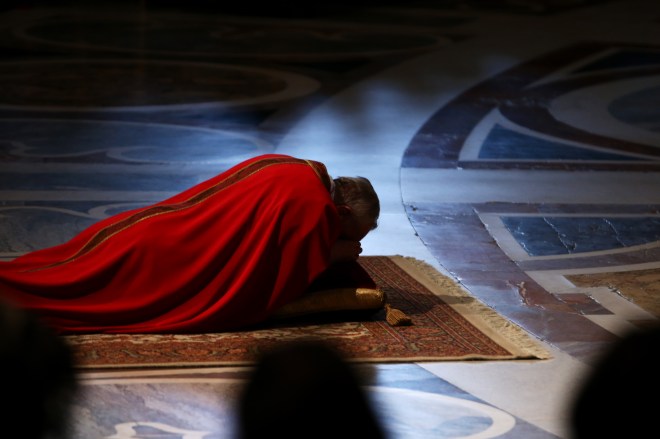
Pope Francis Attends Celebration Of The Lord's Passion in the Vatican Basilica

Last week, as the House Republicans held a gun to the country’s head, I failed to address yet another remarkable interview by Pope Francis, this time to the Italian journalist Eugenio Scalfari, who is an atheist, in La Repubblica. Like his America interview, I urge you to read it, whether you are an atheist, an agnostic, a believer or anything in between. I tried to absorb it all this weekend, and found it difficult. Difficult because it was so overwhelming in its power, and because I need time to pray and think some more about what he said. I mean, what can one say immediately about a Pope who can say:

Proselytism is solemn nonsense, it makes no sense. We need to get to know each other, listen to each other and improve our knowledge of the world around us.

Or this:

Heads of the Church have often been narcissists, flattered and thrilled by their courtiers. The court is the leprosy of the papacy.

Or this:

A religion without mystics is a philosophy.

Or this:

I say that politics is the most important of the civil activities and has its own field of action, which is not that of religion. Political institutions are secular by definition and operate in independent spheres.

It is as if the Catholicism that has been forming and re-forming in my own mind and soul for years suddenly became clearer, calmer, simpler. This Catholicism, like Saint Francis’, is about abandoning power and all the trappings of power; it is about leaving politics alone in an independent sphere, in stark contrast to Christianism which is primarily politics and ultimately about power; it is a faith rooted in mystery and mystics; about love and mercy; about the core teachings of Jesus again – made fresh.

I would say that it is a miracle. Francis’ emergence as Francis is a miracle. Literally:

Before I accepted I asked if I could spend a few minutes in the room next to the one with the balcony overlooking the square. My head was completely empty and I was seized by a great anxiety. To make it go way and relax I closed my eyes and made every thought disappear, even the thought of refusing to accept the position, as the liturgical procedure allows. I closed my eyes and I no longer had any anxiety or emotion. At a certain point I was filled with a great light. It lasted a moment, but to me it seemed very long. Then the light faded, I got up suddenly and walked into the room where the cardinals were waiting and the table on which was the act of acceptance. I signed it, the Cardinal Camerlengo countersigned it and then on the balcony there was the ‘”Habemus Papam”.

Made every thought disappear. And what appears when thought has been left aside? Light!

God is the light that illuminates the darkness, even if it does not dissolve it, and a spark of divine light is within each of us. In the letter I wrote to you, you will remember I said that our species will end but the light of God will not end and at that point it will invade all souls and it will all be in everyone… Transcendence remains because that light, all in everything, transcends the universe and the species it inhabits at that stage.

This is a Pope speaking to an atheist as an equal and in love. Which is where the church must begin again. It’s sad to me that so many orthodox Christians in America cannot yet see this.  Here’s Dreher, in an otherwise positive response to the interview, finding the remarks “incoherent from a Christian perspective”:

I don’t get the universalism behind encouraging people to “move towards what they think is Good.” What the Wahhabist thinks is Good is not the same thing as what the secular materialist thinks is Good, and is not the same thing as what the Amish farm woman thinks is Good. I mean, obviously there will be some overlap, but if the Pope believes there is no reason to insist on Christian particularity, if Jesus is true for him, but not for everyone, then why evangelize at all?

Was Rod reading? “Proselytism is solemn nonsense.” No wonder Russell Moore, a conservative Southern Baptist, calls the interview “a theological wreck. No wonder, at First Things, Mark Movsesian argues that

Some things he said in the interview are a frankly a little shocking.

He told the interviewer, Eugenio Scalfari, “Proselytism is solemn nonsense.” That’s a rather dismissive way to treat millennia of Christian apologetics. The pope’s views on conscience were also odd, from a Christian perspective. “Everyone has his own idea of good and evil and must choose to follow the good and fight evil as he conceives them,” the pope said. “That would be enough to make the world a better place.” With respect, “do what you think is right” is not the Christian view of conscience. That sounds more like Anthony Kennedy than St. Paul. And would the world really be a better place if everyone did what he thought was right? How about jihadis?

Always with the Jihadis, those lost, damaged souls. K-Lo, of all people, defends what Francis said about conscience:

This isn’t “anything goes,” but it’s an exercise in mercy and justice.

What it is is an exercise in engagement, rather than power. This was Saint Francis’ genius, and Paul’s and Augustine’s. They were in their world as well as not of it. Pascal-Emmanuel Gobry has the best take:

[W]hen the Pope says “Everyone has his own idea of good and evil and must choose to follow the good and fight evil as he conceives them”, that could be interpreted as a brief for moral relativism. Of course, the only problem with that interpretation would be that it would be arrant nonsense. Because, you know, he’s the Pope, and also an orthodox Catholic, as he has demonstrated on countless occasions…

The problem here, as always, is pride. We think like politicians. We parse words for whether they help the Republican Party of the Church or the Democratic Party of the Church, whereas we should be humbly receiving the teachings of the Vicar of Christ. When those teachings seem shocking to us, common sense alone dictates that, instead of rending our garments, we should, with humility and charity, check ourselves to see what we can learn.

That’s what I’m still doing. But what leaps out of the interview is a scoop, as John Allen noted and few others did. The scoop is that this Pope has undergone a mystical spiritual awakening – after that great silence and great light before he accepted the papacy. Allen remembers interviewing the new pope’s sister in April, who said “that something was different about her brother since he took over the church’s top job.” He continues:

Recently, I spoke to one of the cardinals who elected Francis (not an American, by the way), who had been received by the pope in a private audience. The cardinal told me he had said point-blank to Francis, “You’re not the same guy I knew in Argentina.”

According to this cardinal, the pope’s reply was more or less the following: “When I was elected, a great sense of inner peace and freedom came over me, and it’s never left me.”

In other words, Francis had a sort of mystical experience upon his election to the papacy that’s apparently freed him up to be far more spontaneous, candid and bold than at any previous point in his career.

One should never doubt the mystical imprint upon the contours of a papacy.

Isn’t it interesting that this story got largely ignored, while a sentence or two that allows Christianists to complain about “relativism” got so much attention? Why not simply examine, and take to heart, what Francis said about his namesake? Here’s what he said:

[Francis] is great because he is everything. He is a man who wants to do things, wants to build, he founded an order and its rules, he is an itinerant and a missionary, a poet and a prophet, he is mystical. He found evil in himself and rooted it out. He loved nature, animals, the blade of grass on the lawn and the birds flying in the sky. But above all he loved people, children, old people, women. He is the most shining example of that agape we talked about earlier…

Francis wanted a mendicant order and an itinerant one. Missionaries who wanted to meet, listen, talk, help, to spread faith and love. Especially love. And he dreamed of a poor Church that would take care of others, receive material aid and use it to support others, with no concern for itself. 800 years have passed since then and times have changed, but the ideal of a missionary, poor Church is still more than valid. This is still the Church that Jesus and his disciples preached about.

This is still the church we can rebuild today.

Read the recent Dish thread on Pope Francis here.
Fighting Autism With Avant-Garde

John Thompson describes harnessing raw sound, and eventually experimental music – such as the monotonous Krautrock seen above – to cope with a high-functioning developmental disorder:

Eventually, I learned to self-medicate through sound. Repetitious and regular sound is best for this purpose: laundry machines, police sirens, ticking clocks, ceiling fans. Sometimes I would hide in the dark of the crawlspace behind my bed and hold my enormous Manx cat to my ear as he purred himself to sleep. … Since that time my most beloved music has been characterized by revolving motifs and pointillism, from Can and kosmische to the rigid corners of dance music to its strains that felt more pure. Disabused of its human elements and compartmentalized into patterns, music presented itself as bare scaffolding that I could drape myself over. This music is what I’d been waiting to hear in that crawlspace, the order I’d been seeking all my life.

It was like this that I discovered there was a socially acceptable side to stimming, that I wouldn’t always have to pace, or torture my fists. Sound in a certain orderly placement exerts the same curtailing force on my mind that movement used to, and my headphones are a leash that keeps me in check. I wear them constantly, and although I’m aware that their constant presence can be seen as strangely hostile in some environments, they are a safety net I can’t afford to forfeit. Music is my sensory diet and also my self-care kit.

Recent Dish on the therapeutic quality of music here.

A Poem For Sunday

photo (26)

From “The Children’s Hour” by Henry Wadsworth Longfellow (1824—1884):

Between the dark and the daylight,
When the night is beginning to lower,
Comes a pause in the day’s occupations,
That is known as the Children’s Hour.

I hear in the chamber above me
The patter of little feet,
The sound of a door that is opened,
And voices soft and sweet.

From my study I see in the lamplight,
Descending the broad hall stair,
Grave Alice and laughing Allegra,
And Edith with golden hair.

A whisper, and then a silence:
Yet I know by their merry eyes
They are plotting and planning together
To take me by surprise.

A sudden rush from the stairway,
A sudden raid from the hall!
By three doors left unguarded
They enter my castle wall!

(Photo from a reader)

The Paradox Of A Well-Preserved Ruin

8434540710_13cd46cc50_c

Meagan Day mulls it over:

Bodie, California is a ghost town. Or rather, it was a ghost town—now it is a historic park and tourist destination. It endures in a state of “arrested decay,” meaning that nothing can be newly constructed onsite, but neither are its standing buildings permitted to deteriorate any further. The state of California has suspended the town in its process of ruination, stabilizing its entropy and halting its decline. If its decay is forestalled, its grounds rigorously maintained and its aesthetic carefully cultivated, can it be called a ghost town any longer?

(Photo by James Gordon)

Trading Obsessions For Rituals

Matt Bieber describes how adopting Buddhism helped him overcome his obsessive-compulsive disorder:

OCD often feels like a Choose Your Own Adventure novel, except that all the choices suck and all the adventures hurt. However, as I’ve begun to learn through Buddhist study and ritual, those ‘choices’ are illusory, and there’s no one being hurt. In fact, there’s no one there at all. The attempt to attain pleasure or avoid pain, to stay consistent with a storyline, to ensure some kind of outcome, to be somebody — this is what causes so much suffering.

That’s a hard message to hear, in part because our culture places such a heavy emphasis on the construction of an integrated self with a coherent story in life.  We believe that deep down, there is some kind of solid, stable bedrock to our identity, some unshakable foundation that provides us with the capacity to control significant portions of our experience: to be who we really are, to be true to ourselves. Much religious ritual is designed to reinforce this view — to convince us that it’s possible to keep ourselves together, and to provide a method that promises to help us do so. And while there are important differences, OCD and its rituals are built on a similar worldview.

But that worldview isn’t true. It isn’t possible to keep ourselves together, because we aren’t one coherent thing. Instead, we are a kind of flux, a series of patterns and surprises, inextricably interwoven into the larger field of phenomena that we call reality.