Vivaldi in vino:
Month: October 2013
Where Is The Modern War Novel?
“[W]hy hasn’t the classic novel of the wars in Iraq and Afghanistan appeared?” asks Michael Lokesson. Maybe, he guesses, “the recent wars just don’t lend themselves to great literature”:
For the soldier fighting an insurgency, life is reactionary in nature: one is always waiting to be attacked — with IEDs, mortars, rockets, ambushes — by a force which fights on its own timetable, its own terrain, its own choosing. This instills in those fighting the insurgency a deep frustration, as one has no choice but to remain in a constant state of anticipatory readiness. A soldier’s day-to-day life is filled with activity — patrol, watch, meetings, construction, weapons maintenance — and still one waits.
In warfare of this nature, the soldier is passive to a startling degree, and even the war effort itself is built on passively securing the population rather than actively defeating the enemy. Molding passivity into great literature is never easy, as the current harvest of soldier’s novels attests, and the novelist who sets him or herself to the task is forced to climb a very steep mountain indeed. Can a truly classic novel arise under such conditions? I’d like to say yes, but I have my doubts. Great soldier’s novels are devilishly difficult to write, and the nature of modern war makes the road that much harder.
Face Of The Day

One of the two baby red pandas born on June 22, named Ying and Yang, stands in an enclosure at the Cerza Zoo in Hermival-les-Vaux. By Charly Triballeau/AFP/Getty Images.
Tackling A Giant Of Social Sciences
Christopher F. Chabris pans Malcolm Gladwell’s new book, David and Goliath, writing that the author “excels at telling just-so stories and cherry-picking science to back them”:
One thing “David and Goliath” shows is that Mr. Gladwell has not changed his own strategy, despite serious criticism of his prior work. What he presents are mostly just intriguing possibilities and musings about human behavior, but what his publisher sells them as, and what his readers may incorrectly take them for, are lawful, causal rules that explain how the world really works. Mr. Gladwell should acknowledge when he is speculating or working with thin evidentiary soup. Yet far from abandoning his hand or even standing pat, Mr. Gladwell has doubled down. This will surely bring more success to a Goliath of nonfiction writing, but not to his readers.
Michael Bourne agrees:
[D]espite his classical essay structure and all the charts and graphs and interviews with eminent scientists, Gladwell isn’t interested in science. He isn’t interested in facts. He’s interested in stories. Gladwell’s books shouldn’t be read as arguments based in evidence, but as parables based in neo-liberal orthodoxy. … Stories are easy. Facts are hard. I want facts.
In an interview with Gaby Wood, Gladwell explains his intentions, saying his books are “gateway drugs — they lead you to the hard stuff”:
“[A]s I’ve written more books I’ve realised there are certain things that writers and critics prize, and readers don’t. So we’re obsessed with things like coherence, consistency, neatness of argument. Readers are indifferent to those things. My books have contradictions, all the time – and people are fine with that.
“They understand that you can simultaneously hold two positions. Blink was the same way: we have this faculty – it’s good sometimes, it’s bad sometimes. That’s what the book was about.” He chuckles boyishly. “But it’s still really interesting! It’s just, I can’t resolve it – what am I, Sigmund Freud?”
Gladwell further emphasizes his position in an interview with Oliver Burkeman:
“If you’re in the business of translating ideas in the academic realm to a general audience, you have to simplify … If my books appear to a reader to be oversimplified, then you shouldn’t read them: you’re not the audience!”
Tyler Cowen recommends the book:
Quite possibly it is Gladwell’s best book. His writing is better yet and also more consistently philosophical. For all the talk of “cherry picking,” the main thesis is that many qualities which usually appear positive are in fact non-monotonic in value and can sometimes turn negative. If you consider Gladwell’s specific citations of non-monotonicities to be cherry-picking, you’re not understanding the hypothesis being tested. Take the book’s central message to be “here’s how to think more deeply about what you are seeing.” To be sure, this is not a book for econometricians, but it so unambiguously improves the quality of the usual public debates, in addition to entertaining and inspiring and informing us, I am very happy to recommend it to anyone who might be tempted.
An extract from David and Goliath is here. Previous Dish on Gladwell here, here, and here.
King vs Kubrick
As Stephen King releases a sequel to The Shining, entitled Doctor Sleep, Laura Miller defends the longstanding grudge that King and his fans hold against Kubrick’s adaptation:
A key difference between the two versions is the prominence of alcohol, which is more or less incidental in the film. In King’s novel, booze is the key that unlocks the monster inside a regular guy, and the beast’s first victim is the regular guy himself. The most significant thing about any character in King’s fiction is how he or she responds to such monsters, whether they come from within or without. That’s surely the chief reason why he detests Kubrick’s portrayal of Wendy as a gibbering victim; King’s Wendy chooses to be a heroine.
King is, essentially, a novelist of morality. The decisions his characters make — whether it’s to confront a pack of vampires or to break 10 years of sobriety — are what matter to him. But in Kubrick’s “The Shining,” the characters are largely in the grip of forces beyond their control. It’s a film in which domestic violence occurs, while King’s novel is about domestic violence as a choice certain men make when they refuse to abandon a delusional, defensive entitlement. As King sees it, Kubrick treats his characters like “insects” because the director doesn’t really consider them capable of shaping their own fates.
Jason Bailey, taking on King’s criticisms in the above video, emphasizes the creative differences between film and print:
[I]n defending King, Salon’s Miller accidentally makes the more interesting point: “The two men represent diametrically opposed approaches to creating narrative art. One is an aesthete and the other is a humanist. Kubrick was a consummate and famously meticulous stylist; King’s prose is workmanly and his novels can have a shambolic bagginess.”
King’s great novels work because they put us into the heads of his characters, because they convey psychological as well as external struggles, because their inner monologues can pour forth out of his prose. It’s part of what makes him a great writer. It’s also why there have been so many lousy films based on Stephen King books — because all of that is lost in the translation. And Kubrick would have been a lousy novelist, his meticulous detachment resulting in, we could presume, so pretty turgid and lifeless writing. But luckily, he was a filmmaker, and his gifts as an aesthete are what made him such a singularly fine one.
Previous Dish on the gulf between the book and the film adaptation here.
Hijacking The Bard?
Matthew Reis covers the ever-raging debate between scholars over whether to leave Shakespeare in his time or harness his plays for the ideologies of today:
Shakespeare is such a vast cultural icon in the English-speaking world that every new school of critical analysis and jargon soon gets applied to him, so we’ve had lots of Christian and Marxist Shakespeares, psychoanalytic, deconstructed and postmodern Shakespeares, and postcolonial and queer Shakespeares. At the same time, more traditional scholars continue to bring to bear Elizabethan or Jacobean social history on the plays, which can run the risk of turning Shakespeare into something antiquarian, requiring prior knowledge of the rhetorical handbooks, property law or theological disputes of his times. …
“What I am bothered about”, [scholar Brian Vickers] explains, “is looking at a historical phenomenon through a present-day lens. The lens is a distorting glass focusing in on some issues in a particular play and totally excluding others. The plot of Othello is set in motion by the jealous and resentful Iago, who hates Othello and sets out to destroy him using Desdemona as the tool. The first generation of feminist critics seized on the play as an instance of Shakespeare’s misogyny and started with Act Three. That seems to me a partial, distorting reading of the play: if you can’t register the presence of Iago, who creates all the destruction and ends up destroying everybody, including himself, you are not reading, you’re imposing a particular scheme, only interested in the harm that men do to women – not who causes it, not the anguish and agony Othello goes through.”
The View From Your Window Contest

You have until noon on Tuesday to guess it. City and/or state first, then country. Please put the location in the subject heading, along with any description within the email. If no one guesses the exact location, proximity counts. Be sure to email entries tocontest@andrewsullivan.com. Winner gets a free The View From Your Window book or two free gift subscriptions to the Dish. Have at it.
Animal Agents
Tom Vanderbilt explores Cold War-era CIA practices that relied on nonhuman operatives:
It is striking that even as the television program “Flipper” was making dolphins popular with American children, the creatures were becoming embroiled in the cold war arms race. As a partially declassified 1976 CIA document on naval dolphin training notes, the Soviets were “also assessing and replicating U.S. systems while possibly developing countermeasures to certain U.S. systems.” …
Even bugs—the kind with legs—were considered by the military establishment. “The Use of Arthropods as Personnel Detectors,” a 1972 report by the Army’s Limited Warfare Laboratory in Aberdeen, Maryland, summarizes research on the possibility of exploiting the “sensory capabilities of insects”—bedbugs, mosquitoes and ticks among them—“for the detection of people.” Scientists ruled out lice (“in a preliminary test they simply crawled about at random”) but saw “feasible” promise in the mosquito Anopheles quadrimaculatus, which “is normally at rest and will fly at the approach of a host,” and so might be used “to detect the approach of people during darkness.”
A Poem For Saturday

Dish poetry editor Alice Quinn writes:
The first poems I read and loved were in Volume Nine of a set of books called The Children’s Hour given to me by my mother when I was about five. I can summon up the opening lines of all of them – Longfellow’s “The Children’s Hour,” itself, naturally, “The Barefoot Boy” by John Greenleaf Whittier, Robert Browning’s “The Pied Piper of Hamelin,” Edward Lear’s “The Owl and the Pussy-Cat,” and “The Things I Miss,” attributed by me to Emily Bronte for most of my life but actually the work of Thomas Wentworth Higginson, most widely known now as an encourager and correspondent of Emily Dickinson.
Today and over the weekend, we’ll feature a few of these poems in tribute to my mother and to all parents who instill in their children a sustaining love of poetry because they love it themselves.
We begin with “The Barefoot Boy” by John Greenleaf Whittier (1807-1982):
Blessings on thee, little man,
Barefoot boy, with cheek of tan!
With thy turned-up pantaloons,
And thy merry whistled tunes;
With thy red lip, redder still
Kissed by strawberries on the hill;
With the sunshine on thy face,
Through thy torn brim’s jaunty grace;
From my heart I give thee joy,–
I was once a barefoot boy!
Prince thou art,–the grown-up man
Only is republican.
Let the million-dollared ride!
Barefoot, trudging at his side,
Thou hast more than he can buy
In the reach of ear and eye,–
Outward sunshine, inward joy:
Blessings on thee, barefoot boy!
(Photo by Zev, aka Fiddle Oak)
A Century Of Slumming It
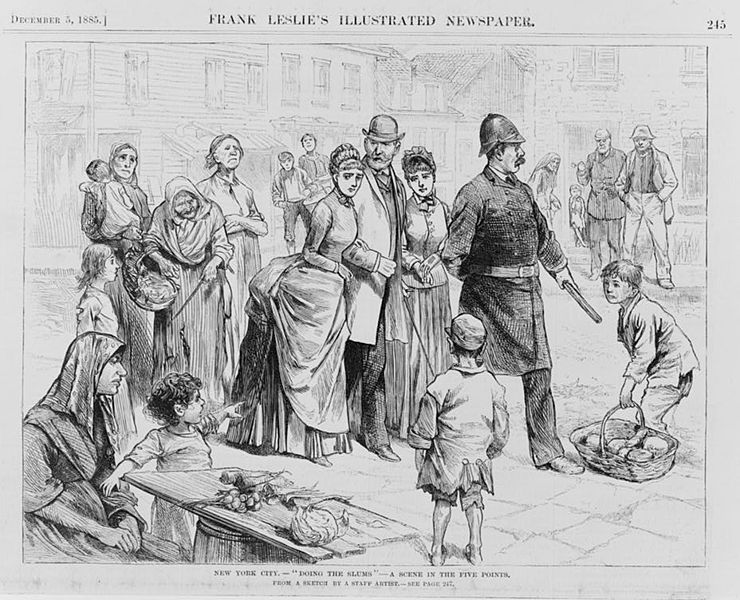
Slum tourism has taken off in recent years, but as Sonia Tsuruoka shows, the practice dates back to the Victorian Era:
“How the other half lives” has been a topic of perverse fascination for the upper and middle-classes even prior to Jacob Riis’ groundbreaking photojournalistic study of Manhattan’s tenement- and sweatshop-ridden Lower East Side in 1890. Consider the loaded, etymological origins of the word slumming, and its earliest citation in the Oxford English Dictionary in 1884. Around this time hordes of blue-blooded Londoners – leaving their lavish abodes in Mayfair and Belgravia – were rumored to flood London’s squalid East End for everything from amusement to philanthropy. This “fashionable London Mania” found its way from Victorian-era England to the streets of New York City, as wealthy foreigners increasingly engaged in “slumming parties,” which typically entailed “a tour of the Bowery winding up with a visit to an opium joint or Harry Hill’s.” A recognizable tension between slumming as reform enterprise and twisted voyeurism emerged, blurring the boundaries between slum tourism as a form of entertainment for the privileged class and a spirited call to action for well-intentioned missionaries, social activists, politicians, journalists, and philanthropists.
(Image: 1885 engraving “New York City – ‘Doing the Slums’ – A Scene in Five Points”)
 The Dish