How Do We Reduce Gun Violence?

Gopnik recommends a recent book on the subject:

The book, just out from the Johns Hopkins University Press, is an anthology of studies, condensing and summarizing the actual state of our knowledge about the subject of gun violence in this country—what real, tested social science shows, not the “three million marauders have been stopped just by the sight of my revolver!” anecdotes. It also makes some simple recommendations.

In particular, there are four ideas agreed to by all the academic researchers involved in the project. First, fix the background-check system by doing small things such as giving the F.B.I. ten days, instead of three, to complete them; prohibiting “high-risk” individuals from getting their hands on guns (anyone with a restraining order filed against him for a threat of violence, for example); and accelerating federal legislation to keep the violent and mentally ill from having guns. Second, make the A.T.F. more effective through such simple measures as getting the agency a director. Third, encourage research on “personalized” guns and gun triggers. Fourth, ban assault weapons, carefully defined, and with them magazines that fire more than ten rounds. And finally—radical idea—fund research on what actually works to end gun violence.

The Best Of The Dish Today

You think I could resist that visual metaphor of the GOP and America right now? “House of Turds” indeed.

The day careened with the GOP-created crisis of the American polity. Boehner tried to change the subject; Obama kept up the pressure; a Republican congressman berated an unpaid Park Ranger for doing her job; and you told us your stories from the shutdown as it affected you.

I took some time to write a review of Breaking Bad’s political theory and the fatal flaw in Machiavelli’s worldview. Oh, and better airplane safety videos! Top post: The Nullification Party. Second? “We Must Not Negotiate With Economic Terrorists.

I also wanted to say a personal thanks to those of you who have subscribed this week. We knew you were out there and wanted this experiment in new media to succeed. And when real political fights loom, you come through for the site every time. We’re biased as well as, we hope, balanced. But we’re biased in fighting openly for what we believe in and not shying from the arena. And these next few months, I suspect, will be the truly critical ones for Obama’s legacy. We’re all in – and hope you are too.

This site has never been just about media; it’s been about America and the world and the chance to make things a little better. I make no apology for supporting this president broadly, while whacking his goofs and errors and misjudgments from time to time. I believe as firmly now as I did when I first saw him out there that this president matters, that his success is vital, and that the Dish can be a small but vibrant part of making it happen. So thank you for helping us. And if you haven’t yet, please [tinypass_offer text=”subscribe”]. It takes two minutes tops for just $19.99 a year or $1.99 a month. And you’re the only business model we’ve got.

See you in the morning.

The View From Your Shutdown

More readers share their stories:

Yup, I’m a federal employee who was furloughed.  And because of it, I can’t afford to keep paying my husband’s home health aid (he’s a 30-year paraplegic and 4-year stroke survivor).  Not only will I be home to tend him, but I won’t have the income to pay this good, hard-working young lady.  And because she has lost HER income, she will have to let go her child’s babysitter.

Update from a reader:

About the woman who “can’t afford to keep paying” her husband’s personal health aide.  It’s three days into the shutdown.  She will almost certainly be reimbursed.  Does she have no personal savings whatsoever?  If so, shame on her.  I find that those on the Democratic side often pay lip service to the idea of individual responsibility, but I wonder sometimes what they think it means.  A federal employee with full health benefits and a good federal savings plan really has no excuse for not having, at the very least, six months of living expenses saved up.  That is basic personal finance.  No doubt, some people are hurting from the sequester and the shutdown, but this knee-jerk helplessness is frankly annoying.

Update from another:

Excuse me? No excuse for not having six months of living expenses saved up? How about having a paraplegic spouse and all the costs that entails? Does this person realize how many people in this country are living paycheck to paycheck? Having six months of living expenses is a luxury to millions in this country.  To judge someone with a disabled spouse for struggling immediately from this shutdown, when the whole point of the shutdown is to stop a healthcare bill that will keep people from going bankrupt because of medical bills … just stunning.

Another reader:

I work at the National Science Foundation. As you can see from the photo, we shut down photo-29completely. So, I’ve been furloughed. I had hoped it’d be a day, perhaps two at most, but by the looks of it now, it might last into next week and beyond.
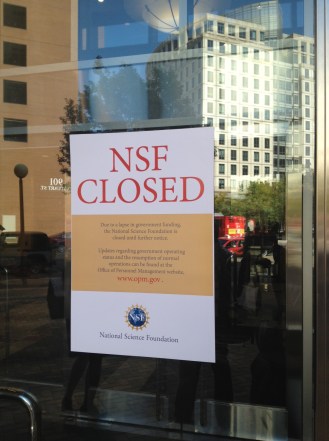
This is costing a fortune. Part of my work is planning and organizing very needed collaborative meetings between scientists. I have several coming up. If the shutdowncontinues another week, those will be postponed or canceled with the attending loss of monies that were sunk into flights, rentals, etc. In my event alone, dozens of scientists and educators will have to cancel flights and plans and NSF will have to eat the cost. Of course this doesn’t take into account the hundreds of man hours of preparation it took to get this meeting off the ground, which now will have been for naught.

And I’m not getting paid. I can handle a few days, but the further this goes on, the more likely it is this will turn into a hardship. I absolutely love my job. I believe it is a huge benefit to our nation and to people. I love it because I truly believe that. I go into every day of work with a purpose that benefits the nation and mankind, and I work with amazing people. What more could a man want?

And yet I am not even allowed to work with no pay during the shutdown. It’s actually against the law. I honestly wish I could.

Fiscal conservatives? Surely not.

Another:

I’m an attorney for nonprofits and small businesses.  Because of the shutdown, it’s impossible to get an Employer Identification Number (EIN), which in most cases is required in order to open a corporate bank account.  Without a bank account, my startup clients simply cannot begin operating.  (Before someone raises the idea, using a personal bank account can lead to personal liability – something we never recommend.) Talk about grinding business to a halt.  Any Republican who says the shutdown is just a “slimdown” clearly isn’t trying to start a business.

Another:

My 18-year-old daughter was supposed to start a year of community service in AmeriCorps on Oct. 7 in Denver, where one imagines they could use some young, barely paid idealists to help with the flood damage.  She was very excited to get started on this adventure, and deferred her college start date for a year in order to serve.  What message have we sent her and all those who work for lower pay and lower appreciation in public service?

While the Neo-Confederate toddlers stamp their feet and hold their breath, it is America that is turning blue.

Many more stories below:

First of all, I promise to [tinypass_offer text=”subscribe”].  I’ve just been too busy to pull out the credit card, but I will do so now after I send this note. Anyway, the view from my shutdown is this:

I am the Chair of the Board of a non-profit organization that does a great deal of work on a variety of science issues.  I would say that about a quarter of our effort is with federal partners.  We scheduled a small conference for this month about two years ago and the staff of the organization spent a considerable amount of time and money in putting it together.  It is looking more likely that we will cancel the event, since many of the participants cannot attend now.

In addition, we work with our federal partners on a number of science issues and all of this work is looking like it will be delayed  considerably and the staff of our organization is having to jump into other projects, only to likely jump back when the government becomes sane again.  Some of this work is rather time sensitive and will require starting experiments over.

As the chairman of the board of this organization, I am starting to strategize how we can better align our resources so we do not have to work with an increasingly erratic and anti-science federal government.  We also work with a number of state and local governments and they are very easy to work with and do not have these insane battles.  It is looking increasingly like state and local governments are the adults in the overall governance of our nation.

Another:

I’m a medical research scientist focused on developing therapy for ALS (aka Lou Gehrig’s disease). Half of my funding comes from private foundations such as the ALS Association; the other half from the National Institutes of Health. With the shutdown, we’ve been told that we are permitted to proceed using the funds already disbursed, but not to expect any further funding until the shutdown is over. We will be OK for a few weeks and then the programs will begin to rapidly degrade. The consequences of the shutdown will be amplified by the way NIH funding is a rolling system.

I also review grant applications to the NIH on ALS research. I’m not paid to do this; it’s a service many of us do out of scientific citizenship. About 1 in 11 of these grants get funded typically, but it will be awhile before any new grants are processed because the entire system is shut down. For every day this system is shut down, it will take 2-3 days to get through the backlog in addition to the new work.

Another:

I think that this is a very important thread because it brings to life the very real consequences created by a very small group of wack-jobs.  Next week I was planning to take my family on a vacation to see the Grand Canyon for the very first time.  We have been excitedly planning this trip for the past 8 months.  My daughters have been learning about the Grand Canyon and surrounding areas and we were excited to finally be able to see this amazing place with our own eyes.  I cancelled the trip this morning.

It’s unfortunate that we won’t be seeing the Canyon, but what’s more important is that a handful of restaurants, hotels, gas stations and gift shops will not be getting my money.  We had planned on around $2000 for the trip for hotels, food, gas gifts and sight seeing.  I know that this doesn’t sound like a lot but it adds up when hundreds if not thousands of others are being forced to do the very same thing.  The funniest part about this is that the congressman who represents Northern Arizona is one of the Republican wack-jobs responsible for this shutdown, so in a way I’m happy my money will not be supporting his district.

One more reader:

My best friend’s brother is a park ranger in Utah in charge of making sure no one enters a national park in Southern Utah, which is closed while the government is shutdown. Yesterday he spent the day being cursed at, cried to, and even spit at (seriously, people?) for having to turn visitors away at the gate. It’s unfortunate and not right, but it’s not the first time that people take out their anger and frustration on the messenger.

But similar reprehensible actions coming from a US Representative, in public, to a government worker? Unconscionable. Not much showcases the Beltway bubble more than seeing and hearing a congressman shaming a government worker for doing her job, whose current duties are a direct ramification of that very congressman’s neglect to do his own job. They’re so insulated within their echo chamber they’re completely divorced from reality. And these are the people threatening the entire world economy without even knowing their own demands.
Medicinal Music

Performing organ transplants on mice, Japanese researchers tested the effects of different musical genres and artists in improving the outcome of medical procedures. The choice of artist is no small thing:

[T]he mice placed in the silent or the single-frequency rooms suffered from acute graft rejection, as their immune systems rejected the foreign cells from the transplants. Those who had been listening to either Verdi or Mozart showed significantly improved survival outcomes, living an average of twenty days longer. The Enya listeners were not as fortunate: they did little better than the mice who had listened to nothing at all, living just four days longer, on average, than the mice exposed to noise or silence. The authors speculated that what might have been at play are the particular harmonies and musical features of a piece of music.

The human auditory cortex—the part of our brain devoted to hearing and listening—can differentiate between extremely specific frequencies of sound. In fact, single neurons can adjust to barely noticeable frequency shifts at a level that exceeds almost all other mammals (bats are the exception). Music with a four-four tempo, which corresponds closely to a normal heart rate, can help regulate heart rate, circulation, and breathing. Lyrical melodies and rhythms of about sixty to eighty beats a minute, which is common to much classical music and bird song, can stimulate relaxation and alpha brain waves, a type of pattern associated with wakeful relaxation. Yet music that departs from either of those tempos confers none of the benefits.

Previous Dish on the therapeutic uses of music  here and here.

How Many Have Enrolled In Obamacare?

Suderman wants to know:

The administration, which has been quick to tout its web traffic figures as evidence that the exchanges are in high demand, could end any uncertainty about enrollment in the federal exchanges by releasing enrollment figures for the federal exchanges. But they haven’t yet. Is that because the numbers so far are so low that they would undermine the administration’s argument that Obamacare is valuable because it is in high demand?

 Christopher Flavelle also requests enrollment numbers:

Sure, an exceedingly small number of applications — in the low thousands, say — would spark early criticism of the law’s long-term prospects. But Democrats never promised a surge of early applicants, so whether the number of people signed up so far is 10,000 or a million, the administration has grounds to claim a win. After all, the enrollment period lasts six months because it will take people time to adjust to a new benefit and a new system for getting that benefit.

Maybe it seems reasonable from the government’s perspective to avoid taking chances. The Obama administration, and in particular HHS, has been so thoroughly buffeted by criticism over this law that it’s adopted a mindset of sharing only the information that it must — and even then, delaying that information as long as possible. If that’s the explanation, it’s time for the agency to start emerging from its bunker mentality.

Update from a reader:

Are they kidding? This isn’t buying an iPhone that can be used that very day. This is purchasing insurance that will begin in THREE months, and if purchased today, will have to be paid for today. Who in their right minds will pay for something today that doesn’t start in three months?

Another:

The fact or speculation that few people have actually signed up for insurance immediately is not indicative of anything. Insurance is complicated and expensive and we should not expect newcomers to rush into any decisions immediately. At my workplace during open enrollment, we have several weeks to sort through all our options and many of us wait until the late day to decide which plan to choose. Those who are just itching to call the ACA a failure should be forced to wait at least a few weeks before anyone should pay any attention to them.

The Words That Don’t Get Written

In an interview, the comic poet Aaron Belz describes how his work as a critic and teacher have improved his poetry:

Writing essays and teaching composition have helped me immensely in writing poetry, because they’ve forced me to focus on the structure of ideas. I tend to think of my poems now as being thesis-driven. My poems are also very sentence-oriented, rarely employing fragments or other grammatical curiosities.

That’s not to say the sentences are always logical. In fact, they are often illogical, but illogic is the Mr. Hyde to logic’s Dr. Jekyll. They’re really the same person, just like saying something and not saying something both imply speech in some sense. Negative space is important. When I teach students to read critically I advise them to look for what the author isn’t saying just as carefully as for what he or she is. I’m sure most teachers do this.

For me, it plays out in my writing, because I’m thinking of all the possibilities of what a sentence or stanza or poem might say, within the context it has established, and then saying only a few of them. Really we’ve only written about .00000000001% of great poems possible to be written.

Too Poor For Subsidies, Too Rich For Medicaid

medicaid_eligibility_by_state

Today the NYT reported on the millions of impoverished Americans who will suffer because they live in states that refused Obamacare’s Medicaid expansion:

Those excluded will be stranded without insurance, stuck between people with slightly higher incomes who will qualify for federal subsidies on the new health exchanges that went live this week, and those who are poor enough to qualify for Medicaid in its current form, which has income ceilings as low as $11 a day in some states.

Paul Waldman created a chart (above) that shows state-by-state Medicaid eligibly:

The bars in red are the states that have rejected the Medicaid expansion, and as you can see, almost all of them are clustered at the lowest end of the eligibility spectrum. That means that the states where the Medicaid expansion would have done the most good for the most people are precisely those states where Republican governors and legislatures have told their poor citizens that they’re out of luck.

Yglesias blames this state of affairs on Supreme Court Justice John Roberts:

A couple of the states that don’t expand Medicaid in 2013 will, I think, change their minds fairly soon. Perhaps right after the 2014 midterms. And in a place like Texas that’s superconservative but much too large for Democrats to ignore, the expansion issue will give the party a shot in the arm and a good issue to talk about. Expansion won’t win right away, but it should win soon enough. But Mississippi? Alabama? There are going to be pockets of the country where poor people continue to lack insurance for quite a long time, all thanks to Roberts and the stubborn intransigence of conservative politicians.

Drum thinks this unfair to Roberts, noting that the “vote against the Medicaid provision was 7-2”:

The basic holding was simple: given our federalist structure, states can’t be forced to help fund new federal programs like Obamacare’s Medicaid expansion. They have to be given a genuine choice. If rejecting the program merely means losing the benefits even though your state’s income tax dollars are helping to fund it, that’s a tough choice, but still a real one. Conversely, if you’re threatened with losing not just the funds for the expansion, but your entire existing Medicaid program, it’s not a real choice at all. Nobody could even dream of doing that. In practical terms, you’re being forced to accept the expansion and you’re being forced to pay for it with state dollars.

Washington Does Something Right

Congress has extended the Special Immigrant Visa program. Packer cheers:

This means that the door to immigration hasn’t completely shut on Iraqis who worked with Americans and as a result have no future in their own country. (I wrote about the shameful abandonment of interpreters and others last week.)

With this reprieve, it’s now up to the Obama Administration to determine how many of the remaining seventeen thousand visas, out of an original twenty-five thousand, will be issued. The Afghan visa program is due to expire next September 30th. The record on both has been abysmal up to now, but suddenly, with everything else in Washington gone dark, a light is shining on this injustice.

Earlier Dish on the subject here.

The Digital Black Market Goes Dark

silk_road_seized

The founder of the Internet drug marketplace Silk Road has been arrested and the website seized:

According to the indictment, Silk Road was bigger than anyone had suspected: It boasted over $1.6 billion in sales from 2011-2013, which resulted in $80 million in commissions. (Researchers had previously estimated that Silk Road was doing about $22 million in total sales per year.)

Though Silk Road was a massive part of the Bitcoin marketplace, which is now fluctuating wildly, Kristin Salyer thinks the marketplace’s demise could benefit the currency:

Bitcoin no longer needs Silk Road. For one thing, there are other online marketplaces where Bitcoin could be used illegally. Perhaps more important, as Reuters reported yesterday, in the three months ended in June, Bitcoin startups raised almost $12 million from venture capital investors. Bitcoin may still be high-risk, but a customer base of legit startups and fewer drug lords probably bodes well.

Felix Salmon agrees that, if “Silk Road is now shut down and if no one else manages to enter the vacuum caused by its disappearance, then the FBI will at a stroke have managed to remove the single skeeviest aspect of bitcoin, and the main reason why people like Chuck Schumer are so suspicious of it.” However, he still thinks Bitcoin interest will eventually fade regardless:

Bitcoins are a fad, and they’re a fad which will pass, a bit like Beanie Babies. There was no one thing which caused the market in Beanie Babies to implode, it was more that people just moved on to other things. Bitcoin’s the same: newer, shinier virtual currencies will arrive, the techno-utopians will latch onto something else, and eventually the people holding bitcoins will understand that if an asset doesn’t throw off any cashflow, the only way to make money from it is to sell it at a higher price than you bought it. In other words, bitcoin is the ultimate speculative vehicle, one which you might be able to trade in and out of, but one which has no value at all as a buy-and-hold investment. Which is something to bear in mind when you read the next big Bloomberg article on bitcoins as an asset class.