A Safety Net For Starving Artists

That’s one way Alyssa sees Obamacare:

[T]he Affordable Care Act matters to artists–just as it matters to a lot of entrepreneurs–because it makes it easier to take chances and carve out the time that makes it possible to pursue an artistic career. These aren’t folks who are demanding instant success, or a lot of money for their art, or even consistent rather than seasonal or contract employment. Instead, they’re people who want to lower their overall level of risk, and are more than willing to pay to afford to do so.

… If you can buy yourself a safety net, it’s much easier to go out on the road as a musician and accept that your level of income is going to be fairly low, or quit your job to finish writing the novel your publisher has purchased from you and take the chance that it’ll do well enough for you to get the next contract. In other words, the Affordable Care Act is offering artists, musicians, and writers–and a whole lot of other people–an opportunity to be economically mobile. It makes it easier to be brave, and take risks, not just in the art that you’re creating, but in deciding to make art at all.

What Will Fuel The Future GOP?

Waldman ponders national politics after the GOP has learned to live with Obamacare:

The question is, if eventually they have no choice but to accept that the argument over the ACA is settled, what on earth will Republicans do with themselves? Because over the last four years, opposition to Obamacare has taken on such an extraordinary power within the movement that all other issues have paled before it.

Sure, they could revert to the old standbys—Cut taxes! Cut regulations! Strong defense! But those are just positions you can take. Obamacare was a war to be fought. And nothing galvanizes, energizes, and defines us like our wars. That’s particularly true of the zealots who are driving the Republican party and form such a key part of its base. And if they aren’t fighting Obamacare, who will they be?

Kilgore doesn’t accept Waldman’s premise:

I think Waldman is wrong to assume that Republicans will “forget” a lost war or totally concede defeat. Conservatives “lost” on Social Security and Medicare, after all, but that hasn’t kept them from continuing to make rearguard efforts to “reform” or otherwise radically change these programs, as they continue to do today.

Dedicated To The Desperate

In today’s video from After Tiller‘s Martha Shane and Lana Wilson, they explain how the political backgrounds of the doctors are much more diverse than you might think:

Martha and Lana also note how, much like the readers who contributed to our “It’s So Personal” series, the patients who agreed to participate in After Tiller did so in the hope that sharing their ordeal could help others facing the same situation:

This embed is invalid


The film is now playing in New York, and will open tomorrow in Los Angeles and Toronto as well, followed by many more cities across the country. Trailer here. Martha and Lana’s previous videos are here.

The GOP Just Took The Pressure Off Iran

Rogin and Lake point out that, with the shutdown underway, the offices that enforce our sanctions on Iran are empty:

Mark Dubowitz, executive director of the Foundation for the Defense of Democracies, said Iran could capitalize on the lack of monitoring and sanctions enforcement to replenish its coffers and advance its nuclear program while no one is looking.

“If the lights are not on, then the Iranians will engage in massive sanctions busting to try to replenish their dwindling foreign exchange reserves,” he said. “If you don’t have the resources to investigate, identify, and designate the tens of billions of dollars of Iranian regime assets, then you’ve extended the economic runway of the Iranian regime and increased the likelihood that they could reach nuclear breakout sooner rather than later.”

Shooting At The Capitol

More updates at the Guardian live-blog. Update: confirmation from Reuters regarding Twitter reports on the fate of the suspect:

A woman suspected of being involved in a car chase across central Washington was shot and killed by police outside the U.S. Capitol building on Thursday, a U.S. official said. The incident, which sparked a lockdown of Congress, began when the woman tried to ram through security barricades outside the White House. The official said a Capitol policeman was injured when the car driven by the suspect crashed outside the Capitol.

Where’s Boehner’s Backbone? Ctd

A reader tries to get into the Speaker’s head:

I believe Boehner is looking towards the debt-ceiling, which he recognizes as potentially catastrophic. He has said more than once that he “will not risk the full faith and credit of the federal government,” and I actually believe him.

Right now he is letting the cabal of far-right nuts slowly hang themselves while at the same time maintaining wacko-bird cred. When it comes time to either raise the debt ceiling or go over the brink, I predict that Boehner, having exposed the true insanity of the crazies, will suspend the Hastert Rule and let the debt ceiling be raised in a bill that includes the McConnell Rule as permanent law. This way he truly breaks the Tea Party fever, keeps his Speaker-ship via grateful Democrats and sane Republicans, and goes down as the hero of the whole debacle.

And then I woke up.

Netanyahu’s Move?

Benjamin Netanyahu Chairs Weekly Israeli Cabinet Meeting

The far right government of Bibi Netanyahu has found itself somewhat isolated recently as it demands not just a monopoly of nuclear weaponry and near-monopoly of chemical weapons in the Middle East, not just continued illegal settlement of the West Bank, not just military aid from the US, but also regime change and war against Iran for enriching any uranium at all. The demands are so out of line with the NPT and with the Obama administration the Israeli government must surely fear it is losing the initiative for another war in the Middle East.

This is particularly so, it seems to me, because the Syria chemical weapons episode revealed how difficult it would be to get any clear American support for a pre-emptive war against Iran over allegations of potential WMD development. The Congress was clearly about to veto any such war against Assad even after the use of chemical weapons and after the deaths of 100,000 civilians. What chance is there that Israel and its proxies could easily authorize a new war against merely alleged nuclear weapon development in a regime that has recently declared itself eager to cooperate with the West? AIPAC has a lot of influence, and fear-mongering about Iranians is a rich vein to mine in the American psyche, but the odds of a war against Iran must look lower to Netanyahu right now, as his desperate and utterly exhausted speech at the UN revealed.

So what to do? Launch a war and deny it. Openly assassinate Iranian nuclear scientists, assuming no one in the West will even call you out. And now, a new provocation:

Mojtaba Ahmadi, who served as commander of the Cyber War Headquarters, was found dead in a wooded area near the town of Karaj, north-west of the capital, Tehran.

Five Iranian nuclear scientists and the head of the country’s ballistic missile programme have been killed since 2007. The regime has accused Israel’s external intelligence agency, the Mossad, of carrying out these assassinations.

Ahmadi was last seen leaving his home for work on Saturday. He was later found with two bullets in the heart, according to Alborz, a website linked to the Revolutionary Guard Corps. “I could see two bullet wounds on his body and the extent of his injuries indicated that he had been assassinated from a close range with a pistol,” an eyewitness told the website. The commander of the local police said that two people on a motorbike had been involved in the assassination.

It seems to me that the American president should forcefully condemn the assassination – and whoever ordered it. Governments that assassinate individuals in other countries are violating international law and setting a brutal precedent. If another country were to assassinate America’s head of cyber-warfare, would we regard it as something we should just ignore and move on from? Of course not. This is a blatant attempt to interfere with the diplomacy of the United States by using assassination as a provocation. Any government that acts in that way is no true ally of the United States.

(Photo by Abir Sultan – Pool/Getty Images.)

The President Sharpens His Tone

He’s finally starting to lose patience with House Republicans:

This embed is invalid

David Corn encourages Obama to take the gloves off:

[I]magine this scenario: the president meets with congressional leaders, allows television cameras into the room for a brief press opportunity, and then on live television says, “John, can you explain to Americans why you and your fellow House Republicans think it is fair to shut down suicide prevention programs for our vets just because you don’t like a health care law that was passed by Congress and approved by the conservative-led Supreme Court?  Is this the decent thing to do?”

Of course, Rush Limbaugh would accuse the imposter-in-chief of sandbagging a dedicated public servant. But is there a way for Obama to disrupt the narrative that the shutdown is the product of Washington dysfunction and to position Boehner as a renegade outlier who is more extortionist and fabulist than legislator? That might be a task beyond anyone, even a president. But so far Obama, who has stuck to his will-not-negotiate-with-hostage-takers stance, has been playing by the rules of acceptable political discourse. Perhaps he needs to bend them.

My view is that his best line should be about jobs. How many jobs is the GOP risking today with the shutdown? How many jobs it is already jeopardizing by its threat of catastrophic default? This job-killing shutdown must end and the job-killing threat to default must end. We will not negotiate with economic terrorists. We will be happy to negotiate with Congressional partners. End the blackmail as an act of patriotism. And start the negotiations the day after.

“Breaking Bad” By Niccolo Machiavelli


In some ways, Breaking Bad was, for me, a hymn to Machiavelli. Walter White – in order to secure his honor as well as his survival – leaves traditional morality and virtues in the desert to seek power and money and respect. And he does so with such brilliance and fortitude and elan that Old Nick himself would have marveled at the spectacle of untrammeled evil and empire building. If a man is truly a man through force and fraud and nerve, then Walter becomes the man he always wanted to be. He trounces every foe; he gains a huge fortune; he dies a natural death. Compared with being a high school chemistry teacher? Niccolo would scoff at the comparison. “I did it for me.”

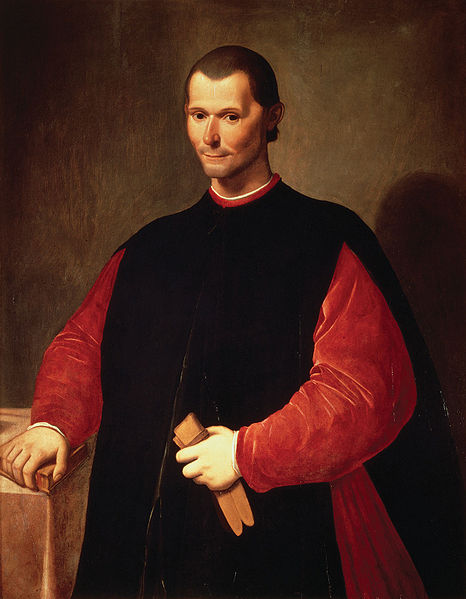
Like Richard III or Richard Nixon, Walt is consumed all along by justified resentment of the success others stole from him, and by a rage that his superior mind was out-foxed by unscrupulous colleagues. He therefore lived and died his final years for human honor – for what 466px-Portrait_of_Niccolò_Machiavelli_by_Santi_di_TitoMachiavelli calls virtu, a caustic, brutal inversion of Christian virtue. And there is some worldly justice in this – he was cheated, he was diminished, his skills were eventually proven beyond any measure in ways that would never have happened if he had never broken bad. And breaking bad cannot mean putting a limit on what you are capable of doing. What Machiavelli insisted upon was that a successful power-broker know how to be “altogether bad.” You have to leave a woman choking on her own vomit to her death. You have to murder a child on a toy scooter.
But the script cheats. Why? Because Walter is already dying. The calculations you make about your future do depend very much on how far you can see ahead. And the cost-benefit analysis of “breaking bad” when the alternative is imminently “dying alone” is rigged in favor of the very short term, i.e. zero-sum evil. If Walt had had to weigh a long, unpredictable lifetime of unending fear and constant danger for his family and himself, he would have stopped cooking meth. As, indeed, he did, when finally given the chance – only to be yanked back into the life of a mobster by his brother-in-law, bored, sitting on a john. Nice Shakespearean touch that, I thought.

And was he happy? Yes, but in a way that never really reflects any inner peace. He is happy in a way that all millionaires and tyrants are happy. His will is done. But we know that this does not lead to actual, enduring happiness. Which is why, for me, Machiavelli’s great flaw is that the life of such a brutally powerful figure, ruling by force and fraud, is a mug’s game. Isn’t the consequence of his proud immorality a never-ending insecurity? Do not most mob bosses live in fear every day and die by the same methods they employ? Did we not see that happen to Gus? Even to Mike? Did Saddam have a happy ending? Or Richard III? These are lives mesmerizing in action but miserably, existentially insecure. Remember Mike’s face as he took a last look at his grand-daughter. You call that happiness?

So for me, Breaking Bad should be taught alongside Machiavelli – as a riveting companion piece.

It should be taught because it really does convey the egoist appeal of evil, of acting ruthlessly in the world, of becoming a man in a battle of wills and lies, of seeing even a murdered innocent child as a necessary unpleasantness. It should be taught because it reveals the power of nerve, of deception, and of courage. But it should be taught also because it reveals Machiavelli’s fundamental, soul-destroying, life-hollowing emptiness.

The benefits only work if your life is nasty, brutish and short. The costs are seen in the exhausted, broken eyes of Skyler, the betrayal of an only painfully faithful son, the murder of a brother-in-law, the grisly massacre of dozens, the endless nervous need to be on the alert, to run and hide and lie and lie and lie again, until life itself becomes merely a means to achieve temporary security. In the end, this is not living. It is running, running, in the end, from yourself. There is no resting place there, no peace, no day after. There is only always the day before. The day before you are killed by the forces you unleashed to kill others.

Stewart Patrick explains further:

Machiavelli differs from later realists like Hobbes—and more contemporary “neorealists” like the late Kenneth Waltz—in recognizing that human agency matters as much as the structural fact of international anarchy in determining both foreign policy behavior and ultimate outcomes in world politics. Through historical examples of successes and failures, Machiavelli reminds us that individuals matter. Yes, the world is perpetually changing, buffeting the state in all directions. But even if “there’s a Providence that shapes our ends”—as Shakespeare’s Hamlet observes—a leader’s choices can have a pivotal impact on politics, both domestic and international.

Machiavelli explores the interplay between material forces and human agency through the concepts of fortuna and virtu.

All princes (and indeed, all people) are subject to societal and natural factors larger than themselves. Still, “free will cannot be denied,” Machiavelli insists. “Even if fortune is the arbiter of half our actions, she still allows us to control the other half, or thereabouts.” Though fortune be capricious and history contingent, the able leader may shape his fate and that of his state through the exercise of virtu. This is not to be mistaken for “virtue”, as defined by Christian moral teaching (implying integrity, charity, humility, and the like). Rather, it denotes the human qualities prized in classical antiquity, including knowledge, courage, cunning, pride, and strength.

Walter possessed all in abundance. And he used them to destroy countless bodies and souls, including the only ones he truly loved, including, in the end, his own.

Recent Dish on Machiavelli here and here.

UPDATE: Reader feedback on this post here.