Securing The Sounds Of America

Jack White and the National Recording Preservation Foundation are on a mission to digitally preserve and distribute American music that’s been lost or forgotten:

“Less than 18 percent of commercial music archives are currently available” through iTunes, Spotify and other legal portals, [NRPF executive director Gerald] Seligman says. “We’re concerned with the other 82 percent languishing out there somewhere, that’s culturally important while maybe not commercially viable.” Take Maine country music recorded in the 1920s with a regional Down East accent. “Now most people singing country music affect a kind of southern drawl even if they’re from Canada or Australia,” says ethnomusicologist Clifford Murphy. “People forgot about regional country music recorded before Nashville became the power center of the genre.”

The NRPF is hunting down recordings taken off of local radio stations during the 1960’s civil rights protests, which could offer lost glimpses of that era, Seligman says. In New Orleans after Hurricane Katrina, Massenburg helped save recordings from heritage radio station WWOZ, some of which were underwater or in the muck. Those that were not beyond recuperation were baked in a “pie oven” at a low temperature and then could be played back only once. But on that one play many were successfully saved to digital media.


Can You Get Axed For Loving A Kids Show?

Yesterday the Internet lit up with the story of a man who claimed he was fired for being a “fairly big fan” of My Little Pony (making him a Brony). Corey Robin looks at the law:

Most people seem to think that First Amendment-ish freedoms – the freedom of not merely My-little-pony-friendship-is-magic-brony-you-make-rainbow-dash-sadspeech but of expression, of personal style, etc. – apply in the workplace. They don’t. And while there are a host of protections for protected categories of workers, those constitute a limited number of cases. The vast majority of cases of workplace coercion are simply not covered by federal or state law (though see this article by Eugene Volokh for a counterpoint; his focus, however, is on exclusively political speech). Unless you have a union, which ensures that you can only be fired for just cause, you’re often screwed.

Here’s the bottom line: in most American workplaces, the boss can fire any brony who loves My Little Pony. It’s totally legal. And that’s the problem.

(Image from MyLittleBrony.com)

Obamacare Is Experiencing Technical Difficulties, Ctd

Drum yawns at the ACA’s first-day glitches:

Before long, the sites will all be working pretty well, with only the usual background rumble of small problems. By this time next month, no one will even remember that the first week was kind of rocky or that anyone was initially panicked.

I might be wrong. I’ve been involved in a few rollouts that featured really serious bugs that took a long time to work out. It’s certainly possible that one or two states will fall into this category. But I doubt it. Technologically speaking, nothing that happened yesterday surprised me, and I don’t expect anything in the next month to surprise me much either.

Yglesias isn’t as forgiving:

[L]iberals shouldn’t fool themselves. This was an embarassing failure. What’s more, it’s genuinely true that projects of this nature and scope are hard to pull off. That means errors are forgiveable but also that errors are potentially hard to fix. People who believe in the underlying goal here should be a bit nervous.

The Real Star Of The Shutdown

9785650044_eb17e5e4bd_c

This adorable fuzzball, of course. Why did the plight of the Panda Cam receive so much attention these last few days? Megan Garber suggests it all comes down to office politics: 

When it comes to actually talking about the news – one of the big motivators for news consumption in the first place – coworkers tend to shy away from politically tendentious topics. Which is understandable: The workplace tends to collect people who might otherwise have little in common into close quarters. Why rock the boat? But it’s also a tendency that has significant implications for the kind of news consumption – and news sharing – that people actually do at and from work. The desire to avoid political confrontation, as [communications researcher Pablo] Bocszkowskiput it, “tends to steer people away from the consumption of politically sensitive topics, and move them towards consumption of sports stories, stories celebrity stories — topics that are more innocuous, and lighter in terms of workplace conversations.”

But the need to publicly appear politically neutral also explains the mass appeal of polarizing talk shows:

Discussing politics with your colleagues or neighbors comes with the fear of saying something unacceptable, and subsequently being excluded from the next barbecue or water-cooler conversation. In contrast, “the comfort zones provided by the shows we studied present no such risk,” [sociologist Sarah] Sobieraj and her colleagues write. “In fact, they offer imagined and, in some cases, tangible social connections.”

But why is their pull apparently stronger among conservatives, who gravitate to such programming in much greater numbers than liberals? Based on their interviews, the researchers believe the answer lies in the fact those on the right have more to fear in terms of social condemnation for their views.

(Photo: The giant panda cub born at the Smithsonian’s National Zoo August 23 was given a clean bill of health following her first veterinary exam September 16. By Courtney Janney, Smithsonian National Zoological Park)

“Hostage Taking 101”

Torture cheerleader Marc Thiessen gave a lesson on it earlier this week:

I’m all for taking hostages. Both sides do it all the time. But one of the first things they teach you in Hostage Taking 101 is that you have to choose a hostage the other side cares about saving. Obama and the Democrats don’t care about stopping a government shutdown. … By contrast, when it comes to the debt-limit showdown, they do have leverage; while Obama can let the government close and blame the GOP, he cannot allow the United States to default.

Galupo rightly calls Thiessen a thug. Chait worries that Republicans buy their own spin:

Conservative discourse on the debt ceiling is a chorus of cheering belligerence. I’ve seen no conservatives consider the possibility that Democrats actually believe their stated position, which is that giving in to debt-ceiling extortion would pave the way for endless future extortion and an eventual debt breach. They assert over and over that Democrats will fold, and seem to believe this.

Yglesias urges the president to hold firm:

[F]rom the standpoint of the country as a whole, a debt ceiling breach in 2013 is no more disastrous than a breach in 2017 or 2022. And the problem with “cutting a deal” with Republicans is that it essentially makes an eventual breach inevitable. If the hostage-taking gambit works, then it will be used over and over again until it goes wrong.

And Kilgore hopes Obama will pass a message on to Boehner:

Now I don’t know anything about the president’s relationship with Boehner. But it’s becoming a matter of national security for him to find some way to take him aside, maybe give the Speaker a cigarette from his secret stash, and say: “I will see you in Hell before I negotiate over the debt limit. And if you let a default happen, I will devote the rest of my presidency to making sure you, personally, bear the blame, and go down in history with our most despised traitors and criminals. For generations, little school children in Ohio will cross themselves and make hex signs when your name is mentioned. So do not, do not, go back and tell your crazy people they can win if they just stick together.”

The Republican Rift, Ctd

Dickerson delves more into the GOP’s divisions:

In most epic battles with a Democratic president, Republicans would swallow their own internal differences and close ranks against their common foe. But that’s not the case in this showdown: Many Republicans are personally invested in their previous argument that the party was headed toward ruin if it shut down the government over Obamacare. Put it this way: If Republicans emerge victorious from this struggle, McCain will have to admit Sen. Ted Cruz was right.

Jonathan Cohn emphasizes the Democrats’ unity:

That [unity] reflects effective leadership, for sure. But it also reflects something else: a shared sense of disdain and outrage over what the Republicans are doing. So add this to the list of ironies about the shutdown: By pushing so hard, Republicans have offended all Democrats, from both houses and both ends of the ideological spectrum. Republicans, in other words, have made their own job even harder.

Earlier Dish on Republican disunity here.

The Passion Of Anti-Abortion Protesters

In our latest video from the young indie filmmakers behind After Tiller, Martha and Lana recall the most memorable reactions from people opposing their project:

The film is now playing in New York, and on Friday it will open in Los Angeles and Toronto, followed by many more cities. Trailer here. Martha and Lana’s previous videos are here. A reader responds to yesterday’s dissent:

Is abortion ever immoral? This pro-choice advocate says: Of course it is.

But there are many immoral things that are not illegal, and imposing the blunt instrument of the law on a complex moral decision is not going to help people make better choices. The sooner pro-life activists take legal bans off the table, the sooner we can have productive talks about effective programs to help people make better moral choices about abortion and reproductive issues generally.

The Rise Of The Tech Villain? Ctd

Felix Salmon rips into Dave Eggers’ “dystopian fantasia about social media,” The Circlewhich was just featured in the NYT Magazine:

The mag’s editor, Hugo Lindgren, gushes about how the book walks “the line between satire and bracing details that feel all too real” – but the fact is that, at least judging by the excerpt, Eggers strays so far away from verisimilitude that his book barely even feels like satire. Instead, Eggers is preaching to a group of people which has already made up its collective mind that social media is dangerous, and who love to one-up each other when talking about where the slippery slope might lead.

One problem? Too much villainy:

There are problems with Silicon Valley and with technology – don’t get me wrong. But they’re invidious, rather than being overt … The Circle is a malign organization; you can almost see its CEO, Eamon Bailey, stroking a white cat in his suburban Palo Alto lair, dreaming of Global Domination. In reality, however, the open protocols of the World Wide Web led naturally and ineluctably to our current loss of privacy. Tim Berners-Lee is no evil genius; he’s a good guy. And the Eggers novel I’d love to read is the one dominated by the best of intentions. Rather than the one which thinks that if technology is causing problems, then the cause must always be technologists with maleficent ulterior motives.

Recent Dish on tech villainy here and here.

Where’s Boehner’s Backbone?

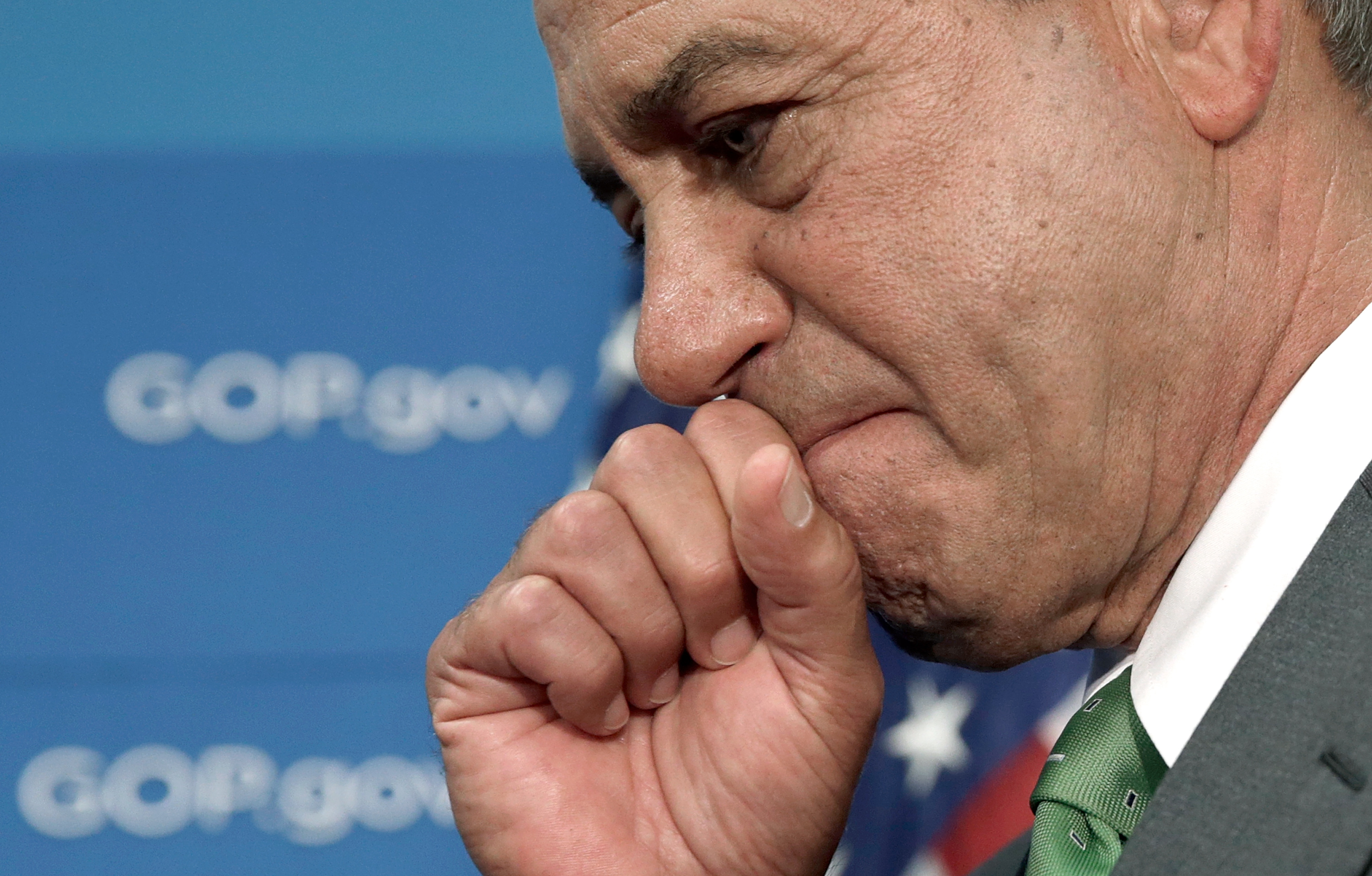
Boehner, House Leaders Speak To Press After Republican Conference Meeting

A reader writes:

Why is there not more coverage of the Hastert Rule? The speaker chooses to be bound by this rule – which explicitly makes compromise unwelcome – when a full majority of the House would be happy to pass the clean CR and move on. Boehner could lift the Hastert Rule and move the CR to the floor, where Democrats and many members of his own party would pass it.  If he were challenged as Speaker, he could conceivably extract support from the Democrats – especially Democrats in safe districts – to support him against a Republican challenge as Speaker.  Surely the Democrats would rather have Boehner than someone to his right?  The Speaker is elected by the full House!

But Boehner lacks creativity and is trapped in a cage made from his own cowardice.

Another scenario from a reader:

What if John Boehner were a man of principle – well, let’s pretend – and when it came time to raise the debt ceiling and his very right-wing party members refused, he does the truly unexpected. Instead of giving up on the Hastert rule and having to have Democrats come to his rescue, fueling more right-wing scorn, what if he resigned?

That would allow the extreme right wing Tea Partiers to take the blame for the ramifications – whatever they might be – of not raising the debt ceiling. Who would they point their fingers at then?  I’m assuming, of course, that there would be considerable fallout to going over the cliff, but most every reasonable person I have read expects some kind of negative impact on the economy. This might lance the boil that has infected the Republican Party for too long.

If he is so afraid that he won’t be re-elected Speaker that he is giving into demands that he knows are wrong – not just bad politics, but plain wrong – it might be the only way he could regain any sense of being a man with a conscience.

From that Costa interview we linked to earlier:

EK: This may be a bit of an odd question, but why does Boehner want to do his job like this under these circumstances? From the outside, it seems like a miserable existence. 

RC: I think John Boehner is frustrated by leading the Republicans in the House but I think he very much loves being speaker. To understand him you have to understand that. He gets to the Capitol early. He relishes the job and the position but he doesn’t relish being at odds so often with his members. He loves being a major American political figure, but he’s not a Newt Gingrich-like figure trying to lead the party in a certain direction. He’s just trying to survive and enjoy it while it lasts.

(Photo from Getty)