Facing Up To Cancer

In spite of increasing rates of survival, George Johnson argues for “learning to expect less from the war on cancer”:

Whether you look at the incidence, mortality, or survivability of cancer, most of the progress has come from simpler solutions: smoking prevention, pap smears, HPV vaccines. The high-tech approaches — the targeted drugs like Herceptin, Perjeta, Kadcyla, and the experimental immunotherapies so much in the news — have yet to prove themselves, particularly with metastatic cancer, which accounts for almost all cancer deaths. …

No matter how effective any of the new therapies or their successors might turn out to be, there is not going to be a complete victory in the war on cancer. We have to die of something. For every success in combatting other diseases, more people will be left to ultimately succumb to the breakdown of cellular functions that we call cancer. That is a number that can still be reduced but only somewhat.

My doc reminded me this week that as a long-term HIV survivor, my own likelihood of cancer is about 25 percent more than the average bear. I get my colonoscopy soon. For some reason, after surgery, after a battery of tests, fear returned today – fear of dying too soon, fear of having too much left to do, fear of leaving those I love. It hovers again at you around the edges after so many years of keeping it confidently and aggressively at bay,

And so it stays just on the edge of vision,
A small unfocused blur, a standing chill
That slows each impulse down to indecision.

And then decision.
Face of The Day

The Conservative Party Annual Conference

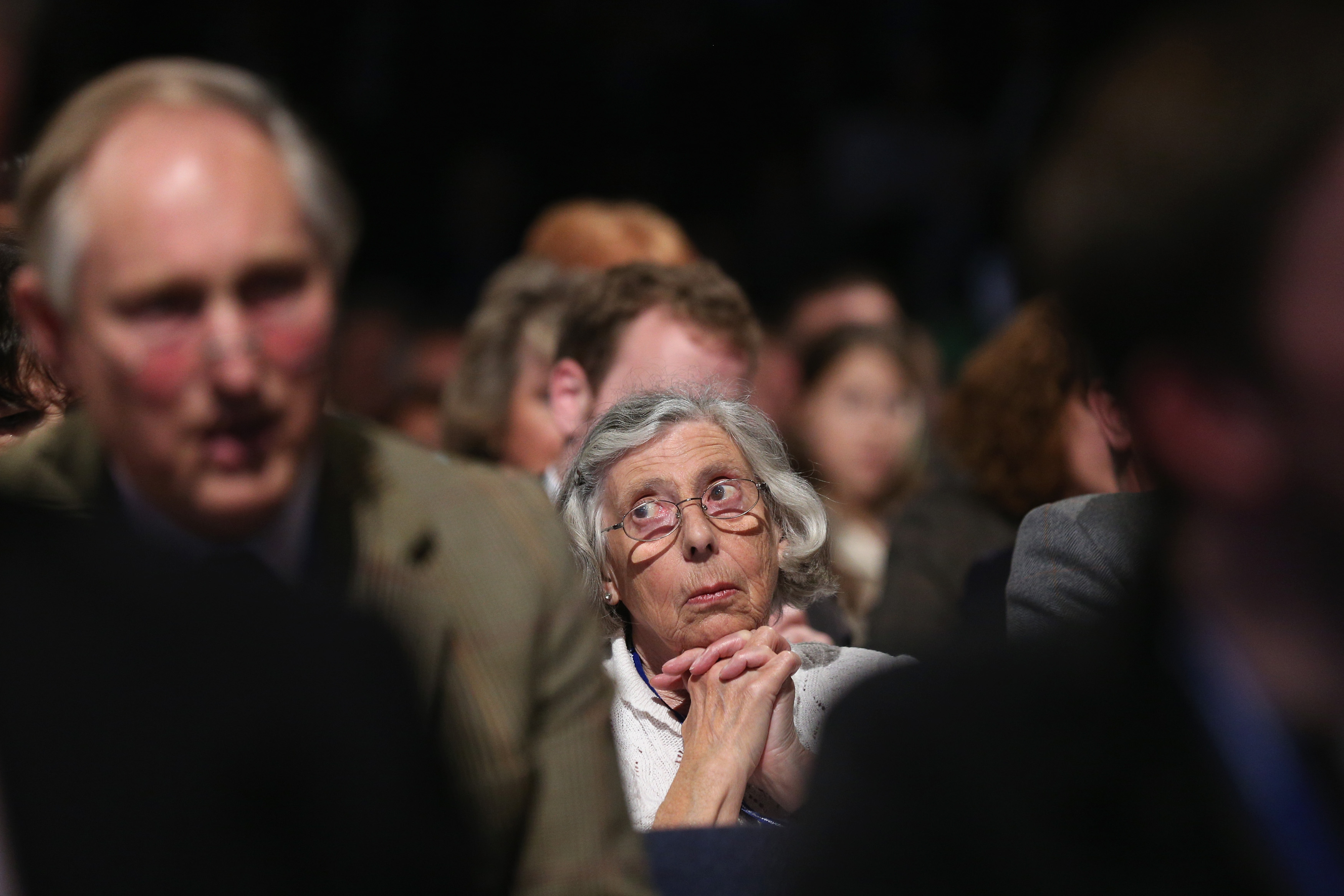
Delegates listen to speeches in the Main Hall of Manchester Central on the third day, and penultimate day, of the Conservative Party Conference on October 1, 2013 in Manchester, England. On the same day that America’s Republicans shut down the entire government to deny millions of uninsured people access to basic healthcare insurance, David Cameron unveiled a new Government pilot scheme for General Practitioner surgeries to open from 8am until 8pm seven days, backed by 50 million GBP of funding. By Oli Scarff/Getty Images. Update from a reader:

Why is Mitch McConnell in Manchester when he’s supposed to be solving our shutdown crisis?

Martially Modified Debates

According to linguistics professor Guy Cook, author of Genetically Modified Language, debates over genetically modified food “often use words commonly associated with war in which battles are fought with attacks and assaults”:

Interestingly, the two topics–GMs and war–might not be separate. Instead, they may be part of broader international debate involving recurring themes and ideological differences. This point is supported by a study examining the coverage of GMs by the British press and public reactions to it during the 2003 invasion of Iraq. At times, GM coverage was displaced in order to focus on Iraq. However, at other times, the two topics became interrelated through the use of parallels, emotive epithets, and metaphors. Using corpus linguistic analysis, expert and non-expert interviews and focus group discussions, the study found: “Both in the press and in public reaction, the issue of GM was found to be intimately associated with other political events of the time, notably the invasion of Iraq.”

Previous Dish on genetically modified food here, here, and here.

Obama Goes On The Offensive

Saletan registers the change in rhetoric:

This is a political fight, and it will end when the GOP decides to cut its losses. Speaking from the Rose Garden today, Obama signaled that he’s ready to bring the pain … [Obama repeatedly called] the standoff a “Republican shutdown.” That’s language he has never used before. His slam at “what the Republican Party stands for these days” was his broadest indictment of the GOP ever. He’s escalating the pressure on the entire party in a big way.

Waldman observes that the people gathered around Obama had pre-existing conditions and can now get insurance thanks to Obamacare:

Presidents (and other politicians) use the stories of ordinary people to illustrate political points all the time. What’s a little different here is that Obama is presenting these ordinary people as victims of his political opponents. He’s pointing to them and saying, Republicans are trying to hurt Jane here. They’re trying to stop her from getting insurance. It happens to be true. Is it going to be persuasive? It just might be.

The Dance Of The Man-Beetle

Laura Marsh lauds the Royal Ballet’s new adaptation of Kafka’s Metamorphosis, singling out lead Edward Watson’s performance as the gigantic insect:

Watson evokes the nightmarish experience Kafka describes—of a man who wakes up one morning to find himself transformed into a giant insect—through the vocabulary of ballet. Here you can see his leg turned out at the hip and his foot arched. But what he is doing with his toes makes the whole posture hideous. They wriggle like a millipede’s legs, as though beyond his control, and Watson looks at them in horror.

Watson has developed a wide range in this idiom. The role was choreographed on him: he makes his acutely articulated muscles look like arthropodic armor, and he has said that he has a tendency to “stretch things” so that they “don’t look right” in classical ballets. Yes, there is disgust and fear, but he also shows compassion toward his family, which is more than they show him. Despite his redeeming qualities, Gregor and his surroundings only get more squalid. Once he starts to get used to the idea of being an insect, the set, designed by Simon Daw, tilts up and backwards, so that he can scurry up the walls. Soon, brown gunge starts to spread over the white walls, the bedclothes, and the dancers.

Maps Of The Day

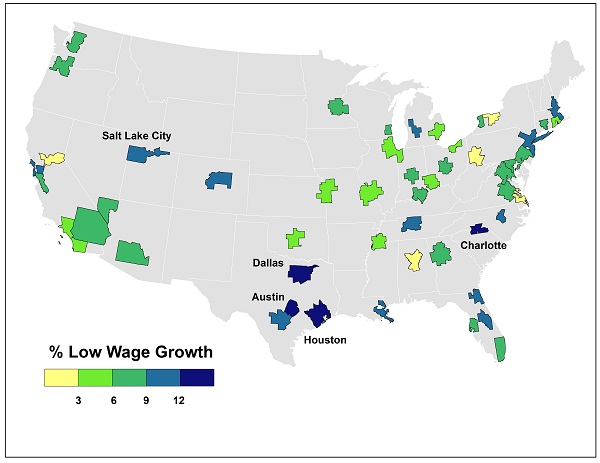
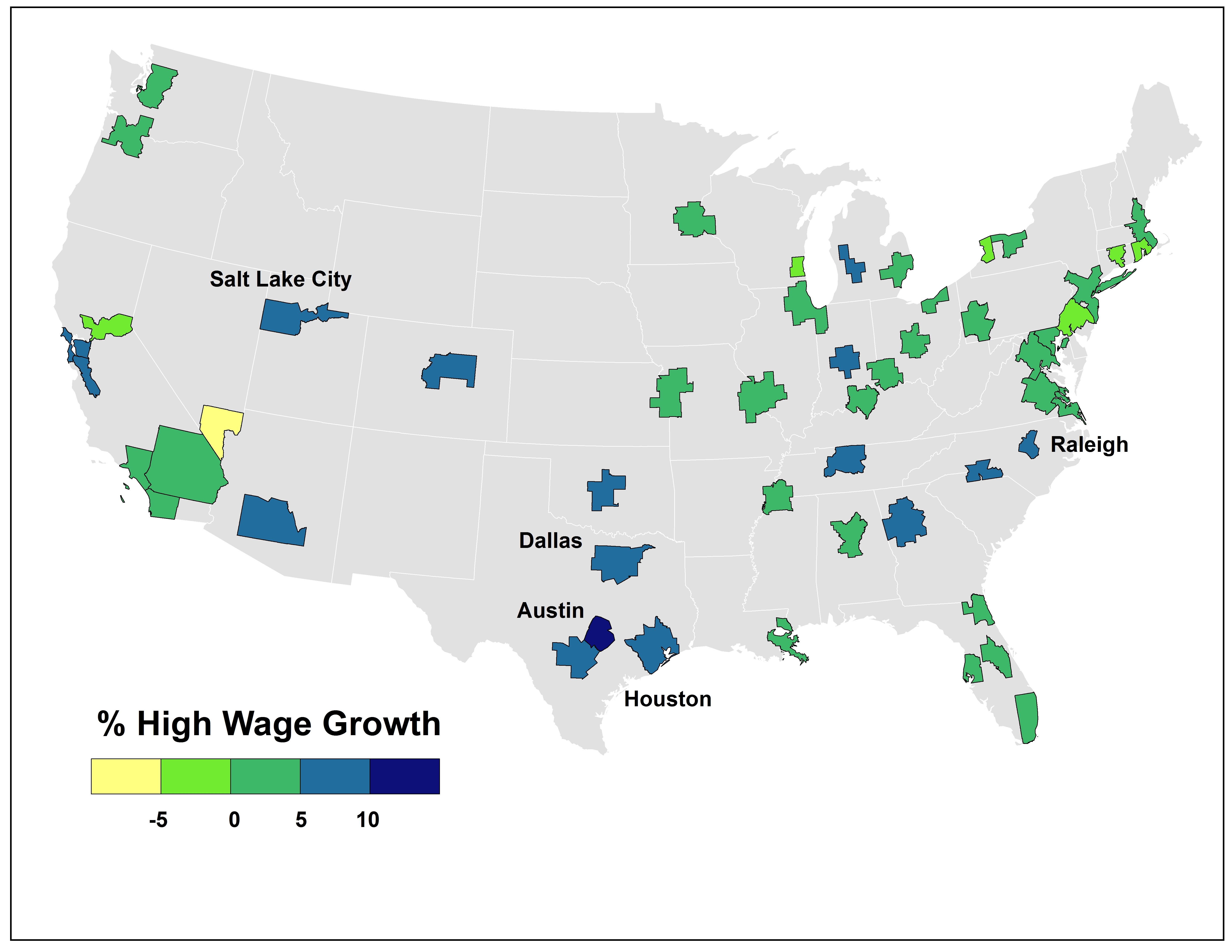
share_low_wage_growth_ share_high_wage_growth

Richard Florida analyzes the growth of high- and low-wage jobs in metro areas across the country:

Taken together, these maps illustrate the underlying reality of America’s post-recession economy. The recovery — if we can call it that — has been driven largely by low-wage jobs. Nationwide, low-wage jobs have grown at a 6 percent clip, roughly double the rate for overall job growth (3.1 percent) and the growth rate in high-wage jobs (3 percent). 

What’s worse, the geography of job growth is uneven. In major knowledge-economy centers like San Jose, San Francisco, and Washington, D.C., high-wage jobs made up roughly half or more of all job growth. These places have also seen the creation of a large number of low-wage jobs as well. At the other end of the spectrum, there are many metros like St. Louis, New Orleans, Riverside and Rochester where low wage jobs have made up the bulk of new job creation. Even in Houston, the supposed center of America’s booming energy economy, growth in low-wage jobs has outpaced the metro’s overall employment gains.

Stamping Out Fraud

A reader quotes Yglesias:

“Why give poor people grocery vouchers when it would be simpler, easier, cheaper, and more helpful to give them money instead?” What a ridiculous question with an obvious answer: Cash is fungible. It can be used to buy anything, and not just the car repairs Yglesias suggests might be more helpful to some. Cash can be used to buy drugs, alcohol, tobacco, and a host of other things that government assistance should not be supporting the use of.

In fact, the major reason the USDA switched the program from paper scrip to the SNAP debit card system is to prevent the kind of fraud in which retailers were accepting food stamps for purchases of alcohol and tobacco. The modern grocery scanner automatically prevents non-SNAP eligible products from being charged to card, so it now requires a complicated work-around (ringing up a six-pack of beer as a six-pack of iced tea, for instance) to get a non-eligible product paid for with SNAP benefits.

If Yglesias wants the government to help with other typical household items (non-food groceries or repairs), he should be advocating for a return to a more generous welfare program, not making benefits intended for food capable of fraud and abuse.

Another reader:

I support SNAP as the best way to get food to kids. I stand behind the SNAP recipients in the grocery line so I know them in my rural area. I also stand behind some of them while they are buying lottery tickets. SNAP keeps our taxpayer dollars buying food for kids, and fewer cigarettes and lottery tickets for their parents. Is it perfect? No, of course not. But Yglesias is living in a dream world if he thinks SNAP is so generous that you could eat so cheaply that you could save enough money for anything substantial beyond, perhaps, a new microwave.