Big Businesses That Benefit From Food Stamps

Yglesias poses a provocative question: “Why give poor people grocery vouchers when it would be simpler, easier, cheaper, and more helpful to give them money instead?”

[L]egally restricting SNAP benefits to apply only to grocery purchases is weirdly punitive to the thrifty. Want to dine on lentils and brown rice for six months to save up money for car repairs? Well, you’re out of luck. Unless, that is, you come up with some scam to trade your extra benefits for money. The poor can end up either condemned for irresponsibility or condemned for fraud.

The only real winners from focusing this keystone anti-poverty program on groceries are agribusiness interests. As long as those interests were delivering the goods – in the form of conservative votes for spending money on the poor – that was a reasonable enough compromise. But now that today’s more partisan Republicans aren’t interested in the deal, it’s time for liberals to scrap it, too.

Food industry groups are keeping quiet about the cuts:

Although all grocery stores and supermarkets that accept SNAP payments – there are more than 231,000 stores nationwide – stand to benefit extremely from continued SNAP funding, many of the same organizations are large Republican Party backers. …

[For example,] General Mills, the parent company of Betty Crocker, Yoplait and Pillsbury, among others, has spent more money on Republican candidates than Democratic candidates in every election cycle between 1990 and 2012. The National Grocers Association lobby spent $23,800 on Republican house members in 2012, and $4,000 on Democratic candidates.

The grocer associations and food companies face a political conundrum. They can advocate publicly for businesses benefitting from SNAP funding, and thus ally themselves with the White House and liberal advocacy groups against Washington Republicans. Or they can stay mum on the topic and continue to back Republicans who generally support their agenda on trade, labor, tax, and regulatory issues.

Carmel LoBello offers a theory for Big Grocery’s reticence:

Another reason may be that the bill isn’t expected to get very far in the Senate – and even if it somehow did, Obama would likely veto it – so businesses can keep their hands clean and appear politically consistent without any risk to their bottom lines.
Recent Dish on food stamp cuts here and here.

Chart Of The Day

Climate Opinion

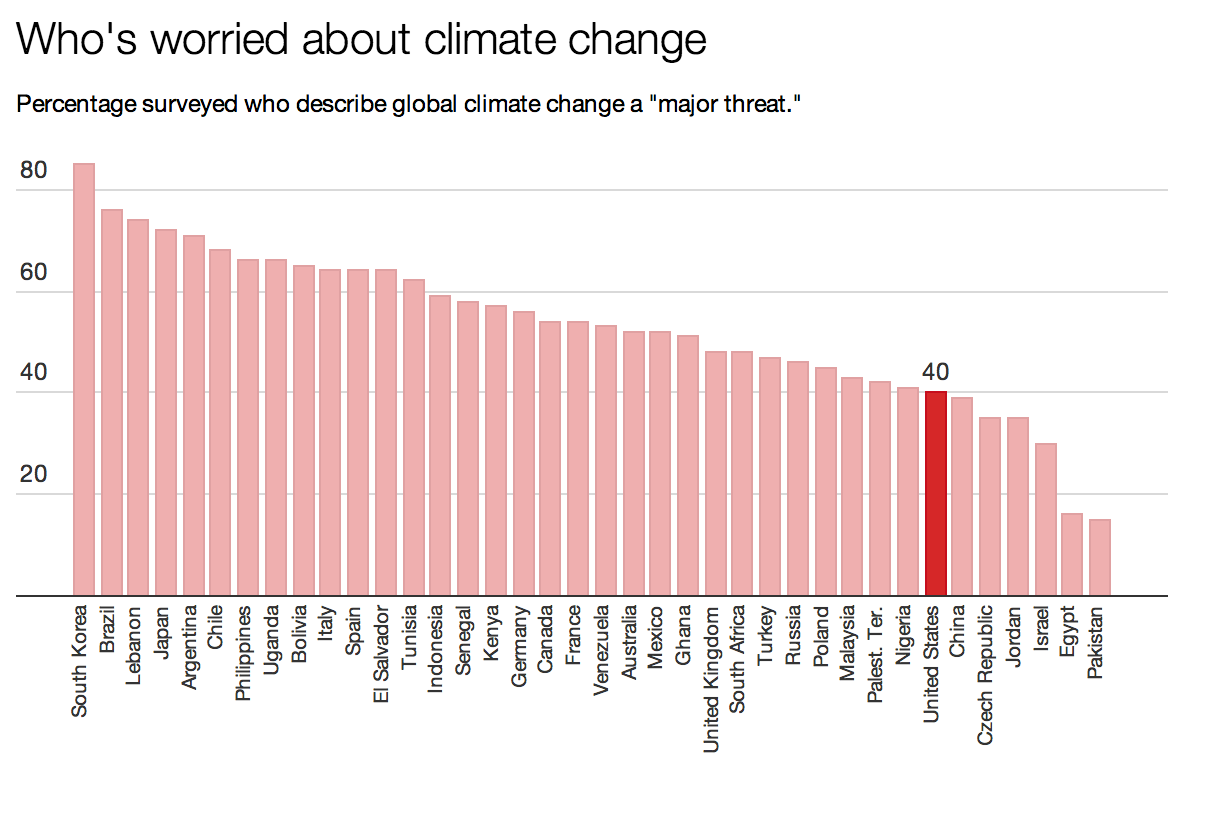
Sadly, America is home to far more climate skeptics than the global average:

According to Pew, 40 percent of Americans call climate change a “major threat.” The people most concerned about climate change are the Greeks, 87 percent of whom call it a major threat; so do 85 percent of South Koreans, 76 percent of Brazilians and 74 percent of Lebanese. The average, among the surveyed countries, is 54 percent.

Americans divide closely along partisan lines on the issue. According to Pew, only 22 percent of self-identified Republicans call climate change a major threat, but the number among self-identified Democrats is 55 percent, just above the survey’s global average. In comparative terms, Democrats are about as likely fear climate change as do Canadians and Germans; Republicans’ views are more akin to Egyptians or Israelis.

The End Of Esperanto?

The Economist spells doom for the would-be universal tongue, despite “some 87,000 users, far and away the most among invented languages”:

Esperanto will probably never become the world’s lingua franca. Why not? Well, one reason is simple: It hasn’t yet, in almost 130 years. Esperanto isn’t quite as old as The Economist, but it’s older than, say, Norway or Stanford University. Yet it remains thin on the ground. This is partly because language, more than any other tool, benefits from network effects. The more people who speak a language, the more desirable that language will be. This is of course why Esperanto speakers play up the biggest possible numbers for their community—the hopes that others will join, for the benefit of being able to use Esperanto with more people. …

People may learn English or German or Chinese to get a job. But they also learn languages to experience travel, food, film, music and literature. Look at the cover of a language textbook and you’ll find an attractive person strolling down a stereotypically picturesque street from the country in question, or maybe a famous landmark. “That,” thinks the learner, “is what I want.” What would that picture be for an Esperanto textbook?

Starving In The Spring

food-price-index

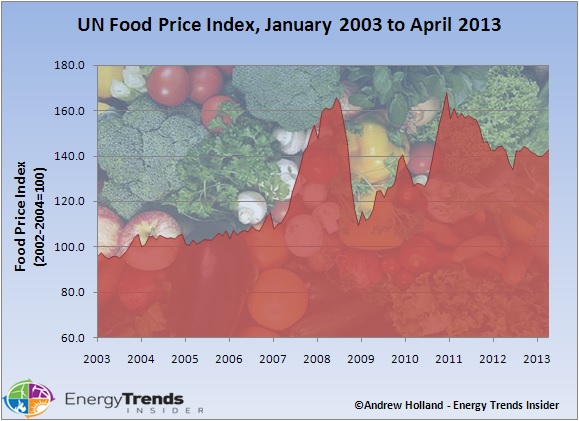
The Arab Spring nations, such as Egypt and Syria, have struggled with food security:

The food import dependence and lack of foreign exchange is all the more worrying as the global food crisis of 2008  [seen above] has shown a diminished reliability of global food markets. Not only did prices skyrocket, some agricultural exporters like Argentina, Russia, and Vietnam announced export restrictions out of concern for their own food security. Naturally this sent shock waves through the Middle East, which imports a third of globally traded cereals.

The oil rich Gulf countries reacted by announcing investments in farmland abroad to secure privileged bilateral access to food production. Only a fraction of these investments has gotten off the ground, yet they have been controversial as they have been mostly announced in developing countries like Sudan or Pakistan that have severe food security issues themselves.

Lily Kuo has more details on the buying of foreign farm land:

Saudi Arabia, South Korea, the United Arab Emirates, Britain, the US and other countries have been buying up foreign farmland, especially after the global food price spike of 2007 to 2008 that spurred global riots. According to a report last year by the nonprofit Grain, the main target of these purchases has been Africa but also Eastern Europe, Latin America and Asia. Between 0.7% and 1.75% of the world’s farmland is being transferred from locals to foreign investors, another study in January found.

(Chart via The American Security Project)

The Search For An Ironic Typeface

Popova surveys the many failed attempts:

IronysorryThis raises the necessary question of what it is, exactly, that makes representing irony typographically so catastrophic. As someone who finds even the use of italics for emphasis, with very limited exceptions, a mark of weakness of style — if a writer can’t wield language in a way that produces organic emotional crescendos, how pitiful to try forcing those typographically — I see the answer as obvious: Irony thrives on an implicit juxtaposition of contextual intention and literal meaning, so as soon as we make it explicit, it stops being ironic.

Perhaps ironically, a separate crusade for a textual signifier of irony comes precisely in the form of a script — a reverse-italics typeface called Ironics, attributed to the iconoclastic journalist H. L. Mencken, who believed Americans were unable to recognize irony and thus needed a special typeface to indicate that the writer was being facetious.

Recent Dish on Shady Characters, the book that inspired Popova’s post, here.

(Image via The Narrative Breakdown)

Grieving Godlessly, Ctd

Many readers are responding to this quote from Tiffany White:

Expressing concern and condolence over death and illness has always been a confusing linguistic contortion for me, a life-long atheist living in the Deep South. I’ve since settled for variations on “You’re in my thoughts”. Though I myself am at-peace with the concept of the end of life being the end of existence, so many people believe otherwise. “They’re at peace now” works well for condolences; it lets me be comforting without having to be disingenuous.

Another reader:

I faced this recently when a friend of mind suddenly lost her husband.  Instead of “I’ll pray for you” there’s “I’m thinking of you” – logically they are the same thing and yet they feel different.  On the other hand I feel that the loss of “I’ll pray for you” is as a whole a positive thing.  Atheists know that prayer doesn’t help the recipient and yet makes the person praying feel like they’d done something to help the grieved.  The atheist is forced, if they do care for the person, to do something that actually does help the grieving person – bring them food, help them give stuff to Goodwill, some actual thing to help.  So in the end the loss of “I’ll pray for you” forces us to do more, and give more and be of personal help to the grieving person, and that is a good thing.

Another:

Oy vey. Tiffany White needs to get over herself. First, she’s not talking about grieving godlessly; she’s talking about being supportive of a friend (whose religious views she doesn’t disclose) who is grieving. Second, she’s assuming her lack of theism somehow limits her expression of consolation far more than it must.

I have been an agnostic for about 40 years, which – for the purposes she’s describing – is not that different from being an atheist. But more important, for about 20 years, I have been a Unitarian-Universalist – that is, I choose to belong to a religious community that works with its members to support them (and others) through life’s joys and sorrows, even though it eschews creedalism. A lot of UUs serve as chaplains. (Try listening to this podcast about Kate Baestrup, a UU chaplain with the Maine Warden service. )

When you are with someone who is grieving, it is your job to be present – physically, emotionally, and intellectually – and to focus on that person and her pain. It is not your job to worry about the finer points of your theology and what your theology says. Suppose you believed in the god of the Catholics. Could you say nothing comforting to a Baptist? To a Jew? To a Hindu? What happens to people when grief washes over them? Do they sit around like theology professors gauging the doctrinal nuances of what people say? C’mon.

Here’s what you can say: “I hear you.” “I brought you some supper.” “I’ll put it in the refrigerator.” “I’ll help you with the acknowledgement notes” “Yes.” “You’re right.” “Let me give you a hug.” “I know she loved you.” “I know she knew you loved her.” What the bereaved says and the bereaved needs determine what you say, not your religious beliefs.

Another:

Whenever I comfort anyone who’s lost a loved one, family member, or friend, I say the same thing, which I believe to be true for atheists like me or for believers: “I am so sorry.  I know, though, that the depths of your grief equal the heights of your love.”

Another:

When my first husband died, just about everything other than “I am sorry for your loss” – in its many forms – set my teeth on edge because no one could really understand just what I was feeling because to do that they needed to be me. People worry too much about this anyway. Just showing up or just acknowledging the loss, in even the smallest way, is better than a mass market sympathy card or straining your creative side trying to find a unique way to acknowledge a pain that never really goes away and is something that we will all know sooner or later and is a human reality that scares most of us witless.

Personally, I am waiting for the day when we can say, “Damn, this fucking sucks.” But that probably won’t happen.

The Government Shuts Down: Tweet Reax