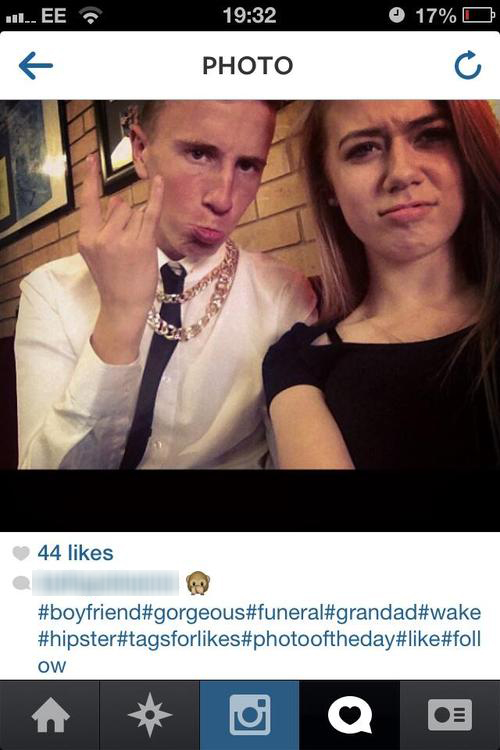
John Ganiard defends the the much-maligned teenagers of Selfies At Funerals:
Inevitably, a funeral does make you think about yourself, about being alive and about being dead. … [I]sn’t vanity a defense against death? And isn’t dismissing a selfie as purely “vain” also dismissing this form of nascent inquiry and self-preservation? In the New York Times, Jenna Wortham wrote, “Rather than dismissing the trend as a side effect of digital culture or a sad form of exhibitionism, maybe we’re better off seeing selfies for what they are at their best – a kind of visual diary, a way to mark our short existence and hold it up to others as proof that we were here. The rest, of course, is open to interpretation.”
The face you send out from a funeral is just your face again, and still, a reminder to others of our self’s current aliveness is – somehow, no matter the circumstances, and perhaps at a funeral, uniquely so – a denial of the inescapable, a refraction of the dark light of death. At the least it’s a way of saying, “If I have to see this, then everybody else has to see it too.”
PJ Vogt scolds the blogosphere for jumping on the story:
It’s obvious how you’re supposed to feel about this. You’re supposed to laugh at the kids. The joke is that they’re so relentlessly narcissistic that even the death of a loved one is just another chance to post their pictures online. Gawker published a clickbait piece grabbing the photos and appending commentary:
Selfies at Funerals is the last tumblr you see before you die because your body will simply shut down once it realizes it’s being forced to share the same plane of existence with the kind of people who think it’s completely normal to snap selfies at funerals and upload them to social media sites with the caption ‘love my hair today, hate why I’m dressed up’ and the hashtag “#funeral.”
I’m exhausted by the practice of mining social networks for supposedly ignorant or narcissistic utterances by children and then publishing them online for adults to judge. Yes, the kids are speaking publicly, and in doing so they’ve somewhat disavowed their right to privacy. But is this the kind of adult you wanted to be? A person who is completely astounded that the younger generation doesn’t share their values. A person who has no curiosity about why young people might do things in a new or different way from you.
 The Dish