Rachel Nuwer drops some knowledge gleaned from Octopus! The Most Mysterious Creature in the Sea, a new book by Katherine Harmon Courage. She addresses the cephalopods’ allure:
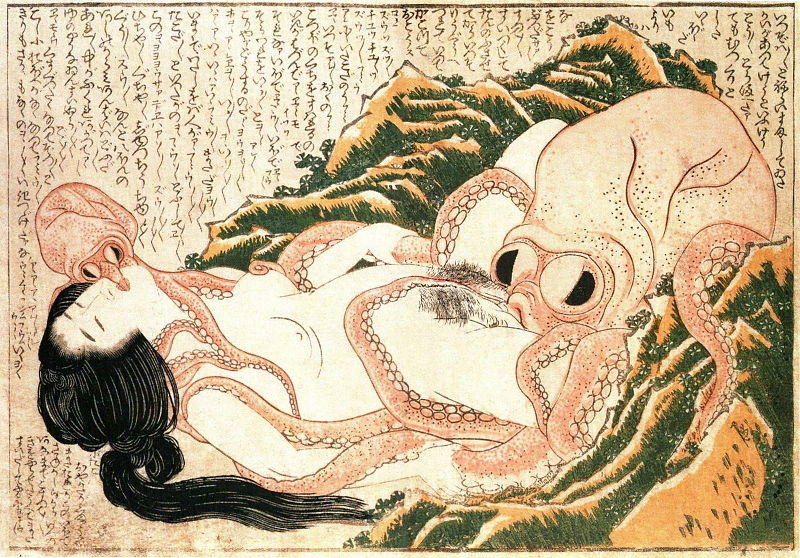
Octopuses, to some, are erotic muses. Japan’s notorious “tentacle erotica” traces back to an 1814 woodblock print (potentially NSFW [pictured above]) titled Tako to Ama, or “Octopus and the Shell Diver.” According to Courage, the image takes inspiration from a legend about a female shell diver who is chased by sea creatures, includ[ing] octopuses, after attracting the eye of a sea dragon god.
For real octopuses, sex is tragic:
Mating and parenthood are brief affairs for octopuses, who die shortly after. The species practices external fertilization. Multiple males either insert their spermatophores directly into a tubular funnel that the female uses to breathe, or else literally hand her the sperm, which she always accepts with one of her right tentacles (researchers do not know why). Afterwards, males wander off to die. As for the females, they can lay up to 400,000 eggs, which they obsessively guard and tend to. Prioritizing their motherly duties, females stop eating. But she doesn’t starve to death–rather, when the eggs hatch, the female’s body turns on her. Her body undertakes a cascade of cellular suicide, starting from the optic glands and rippling outward through her tissues and organs until she dies.
One more money quote:
The plural of octopus is octopuses. The world “octopus” comes from the Greek, októpus, meaning “eight foot.” The word’s Greek roots means it’s pluralized as a Greek word, too, which depends on both a noun’s gender and the last letter it ends with. In this case, an -es is simply tacked on. So no octopi, octopodes or octopussies …
Update from a reader:
I am sure I am only the millionth-or-so Dishhead to point this out, but Rachel Nuwer’s statement about the plural of “octopus” is entirely wrong. I don’t know how they do things in Greece today, but in classical Greek, the plural of ὀκτώπους is ὀκτώποδες. The etymologically “correct” plural of octopus is therefore octopodes. (This is true even if you take the source language as Latin, since like many borrowings from the Greek, octopus was a third-declension noun.) Here is a mildly entertaining Language Log post about the different plurals of “octopus”.
Previous Dish on all things octopus here, here, here, and here.
(Image of Tako to Ama via Wikimedia Commons)
 The Dish
