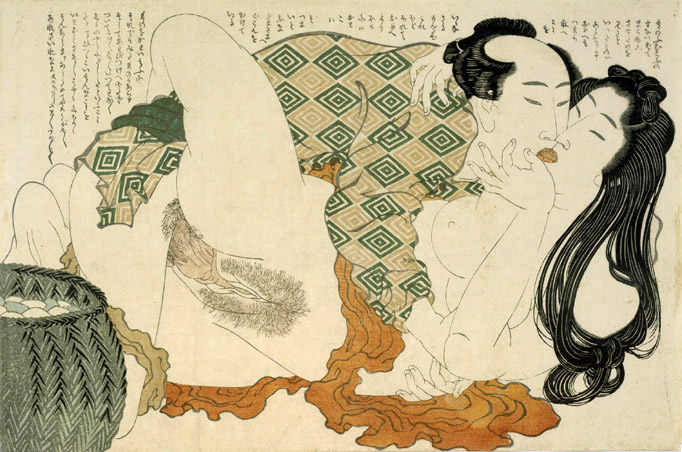
James Polchin visits an exhibit on shunga, a form of erotic art that flourished centuries ago in Japan:
Throughout these works bodies are minimally rendered with undulating lines and a flat, paleness of flesh. Instead, it is the fabric that attracts the attentions, the flows of color and details of patterns that dominate many of these works, often done with vibrate colors or golden paints. It is the actions and gestures that matter, the settings and stories that the images tell. The nakedness of the bodies — what was so concerning to Western viewers at that time — was just another form of dress. The erotic qualities emerged not from the flesh, but from what is hidden and what the artists let us see. Like a striptease, the pleasures of looking are wrapped up in the flow of fabric and flesh. …
Consider Katsushika Hokusai, most famous for his series of wave paintings that have become iconic of Japanese art of the 19th century. Hokusai’s works are often seen as major influence on trends in 19th century France, influencing the works of Gauguin, Toulouse Lautrec, and Degas among others. But Hokusai also produced nearly 20 shunga books and a number of large woodblock prints. His series “Adonis Flower” (c. 1822-3) captures closely pictured scenes of couples entangled in on another, the flow of bodily outlines contrasting with the undulating fabrics and flow of curtains and screens. Unlike his waves paintings with their expansive perspective, these works are tendered with concentrated intimacy, and, like [Torii] Kiyonaga’s horizontal scrolls, present the couples movements, their contorted bodies, crammed into the confining space of Hokusai’s frame.
The Dish recently featured another example of shunga here.
(Image of a print from Hokusai’s series “The Adonis Plant” via Wikimedia Commons)
 The Dish
