Ross Douthat hopes so:
Ever since the Second Vatican Council, the church has (as most people know) been locked in a kind of low-grade institutional civil war, between a liberal/progressive/modernizing viewpoint that had its moment in the 1960s and 1970s, and the more neoconservative perspective that set the tone for John Paul II and Benedict’s papacies. (I say neoconservative because this was essentially a quarrel over the meaning and implications of Vatican II’s liberalizing reforms, between factions that had both supported them, with critics of Vatican II confined to the sidelines and the fringe.)
For my generation of Catholics, wherever our specific sympathies lie, this inheritance of conflict has created a hunger for synthesis – for a way forward that doesn’t compromise Catholic doctrine or Catholic moral teaching or transform the Church into a secular N.G.O. with fancy vestments, but also succeeds in making it clear that the Catholic message is much bigger than the culture war, that theological correctness is not the only test of Christian faith, and that the church is not just an adjunct (or, worse, a needy client, seeking protection) of American right-wing politics. This desire has been palpable in the Catholic blogosphere for some time, and I think you can see it percolating in many of the publications in whose pages the old intra-Catholic battles were so often fought.
Me too. And that is why Francis’ insistent emphasis on the faith as a way of life – and not an ideology – is so brilliant a way out of this debilitating conflict. And that way of life demands a humility that is simply not consonant with the harsh rhetoric of, say, Cardinal Dolan, over comparatively trivial matters, or, for that matter, the iconoclastic over-reach of some reformers in the wake of the Second Council. Would a humble faith like Saint Francis’ be aligning with the Republican right in a culture war? Is the calm gentleness of Jesus compatible by the rigid enforcement of total obedience to a set of increasingly detailed doctrinal non-negotiables that we are somehow supposed to will ourselves into believing, even when our own lives belie them? The questions answer themselves.
I see Francis increasingly like Jesus in the Gospel story of the woman caught in adultery. I wrote about this last year in this way:
She is about to be stoned. Does Jesus uphold the law he came to fulfill against the woman? No. He demands that those without sin cast the first stones. And he forgives the woman – while insisting she not sin again. Actually, he does more than forgive. He says: “Neither do I condemn thee: go, and sin no more.”
This is the Christian model of sexual morality, it seems to me, as it is of morality in general. Jesus poses an impossible standard and then refuses to condemn an actual tangible human being who fails to reach it. Since we are all completely ridden with sin, we equally have no right to condemn anyone else, even if we are living the most upright lives according to the law.
Forgive us our trespasses, as we forgive those who trespass against us.
And in this classic scene in which religious authorities stand ready to deploy their power to punish sin, Jesus does something strange. He physically defuses the dynamic. She is cowering; they are threatening; they demand he uphold the law. What does he do? He sits on the ground and doodles in the dust. He is neither condemned nor condemner. He breaks that circle. He does not condemn. He forgives.
So I am a sinner.
Francis is defusing the binary dynamic and the authoritarian dynamic. His first words in the America interview were: “I am a sinner.” In the standing-only battle lines of the church’s civil war, Francis has sat on the ground, breaking the cycle, neither condemned nor condemner, just a sinner.
And it is increasingly clear this is not just public relations. The Papal Nuncio to the US just told the US bishops the following:
Pope Francis, Vigano said, “wants bishops in tune with their people.” The pope “is giving us by, his own witness, an example of how to live a life attuned to the values of the gospel. While each of us must take into consideration our adaptability to the many different circumstances and cultures in which we live and the people whom we serve, there has to be a noticeable life style characterized by simplicity and holiness of life. This is a sure way to bring our people to an awareness of the truth of our message.” Vigano quoted liberally from Pope Paul VI’s Evangelii Nuntiandi, which, he noted, Francis has called “the greatest pastoral document written to date.” It was promulgated in 1975.
“The first means of evangelization,” Paul VI wrote, “is the witness of an authentically Christian life, given over to God in a communion that nothing should destroy and at the same time given to one’s neighbor with limitless zeal. As we said recently to a group of lay people, ‘Modern man listens more willingly to witnesses than to teachers. and if it does listen to teachers, it is because they are witnesses.”
Or in the words of Saint Francis: “Preach the Gospel everywhere. If necessary, with words.”
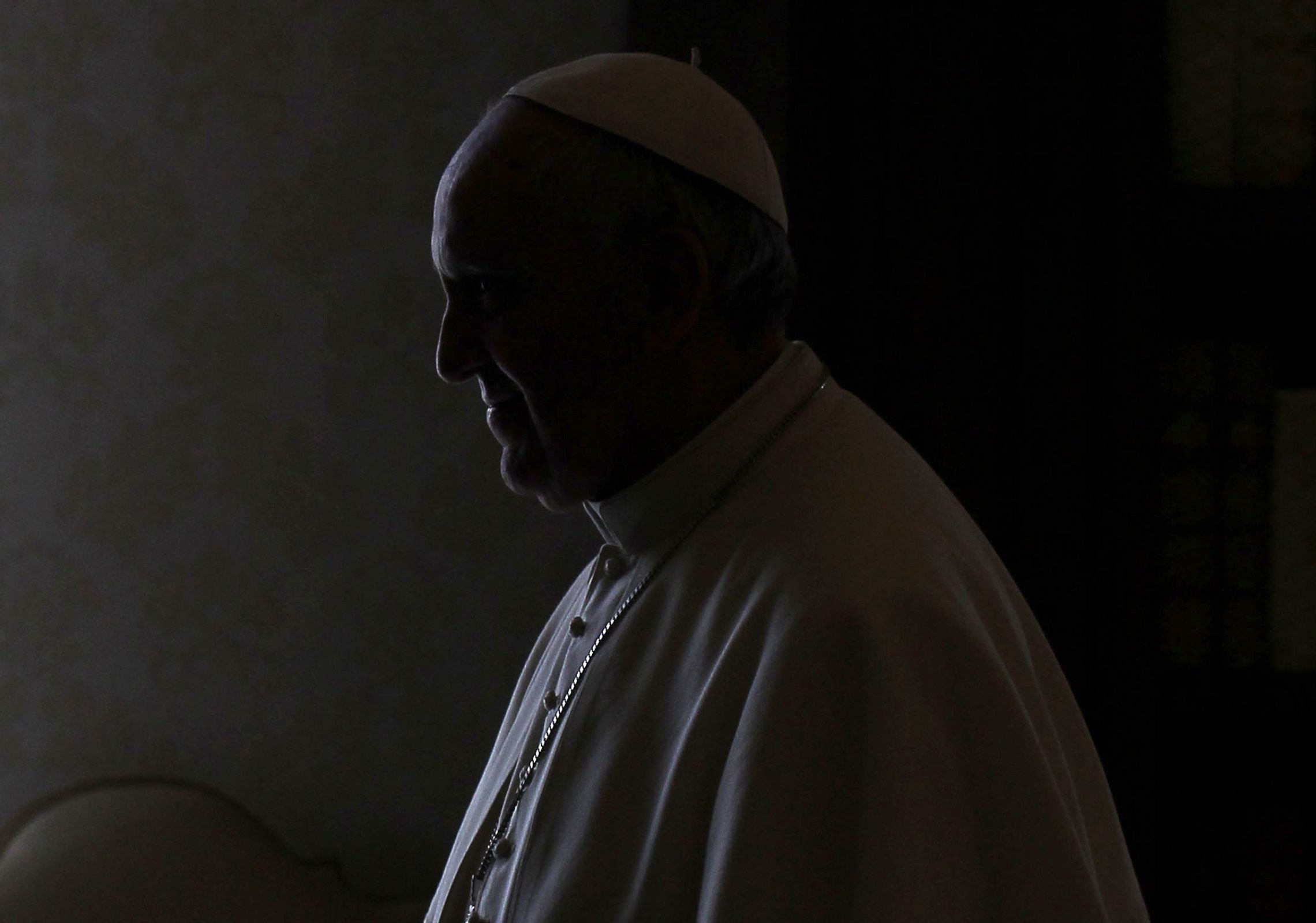
(Photo: Alessandro Di Meo/AFP/Getty Images)
 The Dish