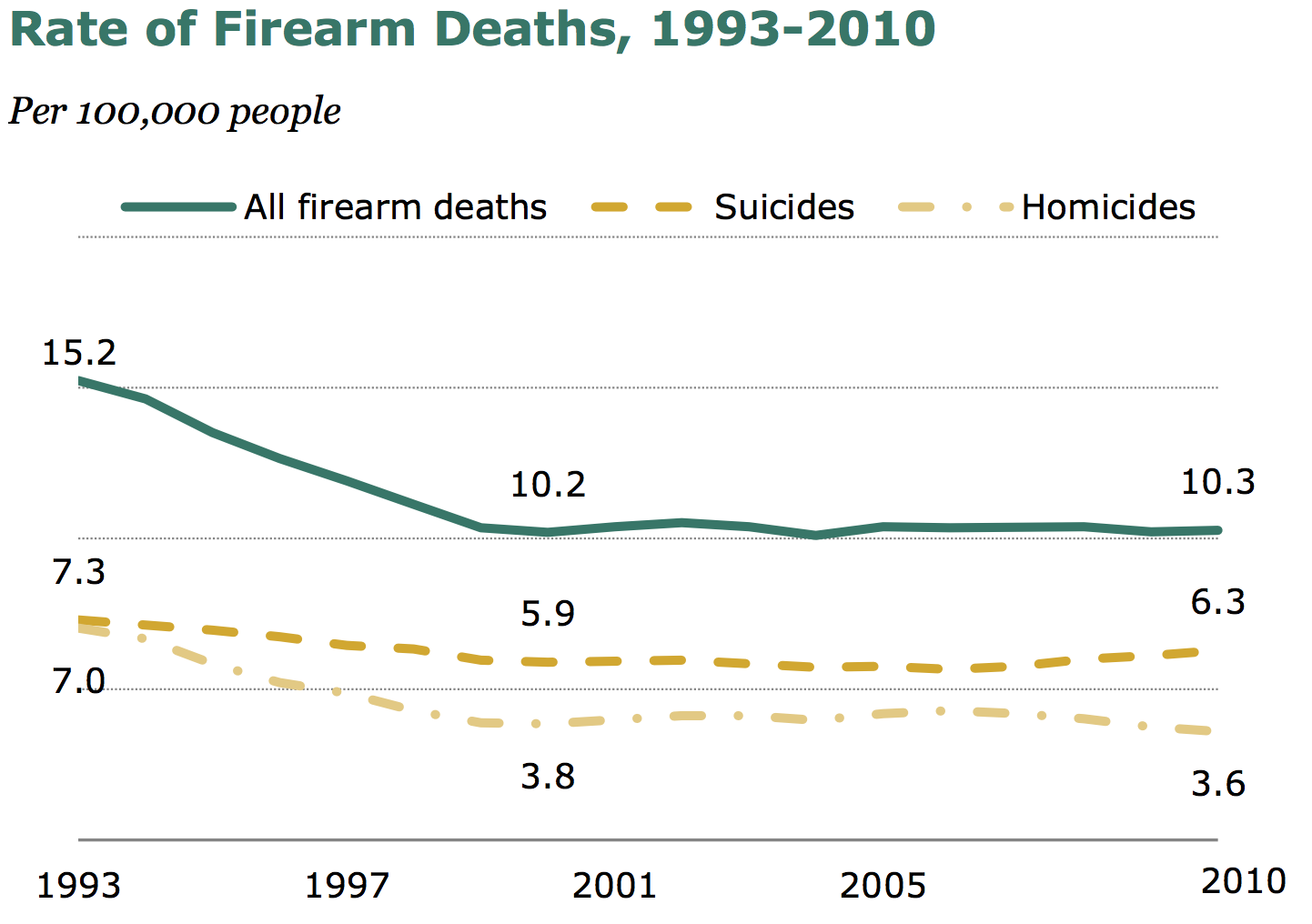
McArdle urges people with depression to “exercise their Second Amendment right not to have a gun in their home”:
[M]any people who attempt suicide are possessed by a transient impulse. In one landmark study, the majority of people who were prevented from jumping off the Golden Gate Bridge were either alive years later or had died of natural causes …. So people who have had major depressive episodes in the past might be well advised to avoid gun ownership or put their guns in the care of a trusted friend. And folks who have recently gone through a horrible life event (job loss, bad breakup or the death of a loved one) would be well advised to get the guns out of the house until they’ve recovered from the blow.
In a recent study, Alex Tabarrok found that each 1-percent rise in gun ownership rates is correlated with a .5- to .9-percent increase in suicides. And it appears the former causes the latter:
If suicides and gun ownership were being driven by a third factor, we would expect gun ownership to be correlated with all suicides – not just gun suicide. What we find, however, is that an increase in gun ownership decreases non-gun suicide. From an economics perspective, this makes perfect sense. … Substitution among methods is not perfect, however, so when gun ownership decreases we see a big decrease in gun-suicide and a substantial but less-than-fully compensating increase in non-gun-suicide – so a net decrease in the number of suicides.
Our econometric results are consistent with the literature on suicide which finds that suicide is often a rash and impulsive decision – most people who try but fail to commit suicide do not recommit at a later date. As a result, small increases in the cost of suicide can dissuade people long enough so that they never do commit suicide.
Previous Dish on guns and suicide here, here, and here.
(Chart from Pew.)
 The Dish