The Timeline On A Final Iran Deal

It’s more relaxed than the press reports would have you believe:

Most news stories cite Obama and Kerry as saying Geneva is a six-month arrangement. However, the text of the agreement notes that the deal is “renewable by mutual consent.” And lest that line is viewed as a throwaway to placate Tehran, the text specifically notes that the parties “aim to conclude negotiating and commence implementing” the final agreement “no more than one year after the adoption of this document.”

In other words, negotiators did not agree on a hard deadline to reaching agreement on the final deal, approving just an aspirational goal that it will be achieved a year from now. The administration probably welcomed this additional wiggle room to avoid a situation in which negotiations are deadlocked and it is cornered into admitting that the diplomacy had failed, forced the White House to consider unattrative alternatives.

On the surface, it stands to reason that Iran has an interest in getting a final deal as quickly as possible. After all, the most punishing economic sanctions remain in place under the “first step” deal and Obama promised renewed vigilance in sanctions enforcement when he announced the Geneva accord. But with the signing of this deal, the perception of leverage will begin to tilt away from Washington and toward Iran, which may want to see how this deal improves its regional standing before it heads into talks for a final agreement.

Meanwhile, Fisher analyzes a new Khamenei letter:

What makes this letter significant is not just that Khamenei is blessing the deal, but that he’s giving Rouhani some political cover in Tehran. This suggests, and is surely meant to broadcast as much, that Khamenei not only supports the deal so far but that he supports it sufficiently that he’s willing to publicly pressure Iranian hard-liners to get behind it.

It can be easy for Americans to forget that Iranian politics are complicated and noisy. Khamenei is the ultimate authority but only when he’s willing to use that power, which is only true sometimes.

Healthcare.gov Is On The Mend

Ezra checks in on the administration’s progress:

The worry, at this point, is that the site is working in ways that are visible but broken in ways that are harder to see. The Obama administration won’t answer direct questions on the percentage of “834s” — the forms insurers need to sign people up for the correct policies at the correct prices — that are coming through with errors. Robert Laszewski, a health-industry consultant with deep contacts among the insurers, told the National Journal the problem is getting better, but that his clients are still seeing a five percent error rate. That’s still too high.

The systems that determine whether applicants are eligible for insurance are also improving. But inside the administration there’s a recognition that it was error-ridden in the first six weeks of Obamacare — and so the question is how to handle the many people who unknowingly received an eligibility determination that can’t be trusted.

Still, it’s clear that HealthCare.Gov is improving — and, at this point, it’s improving reasonably quickly. It won’t work perfectly by the end of November but it might well work tolerably early in December. A political system that’s become overwhelmingly oriented towards pessimism on Obamacare will have to adjust as the system’s technological infrastructure improves.

Garance rattles off some of Healthcare.gov’s remaining problems:

• Ongoing site outages. The site had outages both this week and last week. It turns out that fixing one part of the site can crash other parts of it, and CMS says it expects intermittent site outages to continue in the weeks ahead.

• Capacity issues. At the height of interest in Healthcare.gov, as many as 250,000 people were on the site at once—five times more than the site is expected to be able to manage on November 30 under the best-case scenario.

• The return of the dreaded waiting room. “There will be times that volume on HealthCare.gov will exceed … demand, and we are preparing for that,” Bataille said. “If we experience extraordinary demand, consumers may not be immediately able to complete the application. They will be queued, in order to ensure a smoother process, and will experience some wait time.” The new online version of “your call will be answered in X minutes” is being touted as better than the last version, an “online waiting room” in which people had no idea how long they’d need to wait.

• Novel glitches. New bugs will continue to be discovered and need fixing, especially since every new fix risks causing trouble downstream.

Drum prematurely declares victory:

Republicans have run out of time, and they know it. Their fixation on Obamacare already looks sort of balmy—this weekend’s deal with Iran was designed to draw attention away from Obamacare? Seriously?—and it’s only going to look loopier as time goes by. Getting Obamacare to the end zone wasn’t easy, and Obama almost fumbled the ball at the one-yard line, but he’s finally won. There’s nothing left for conservatives to do. Love it or hate it, Obamacare is here to stay.

The Banality Of Gaming

Liel Leibovitz explores the Orwellian effect of Papers, Please, a simple online game that establishes the player as “a bureaucrat at a border-crossing in a fictional totalitarian state”:

The metal gate goes up. Your station is open for business. People come streaming in. The rules, communicated by the government in the beginning of each level, are simple, telling you just who is to be let in and under what circumstances. The reality of your job, however, is infinitely more complex: What, for example, would you do with the mother whose papers are not in order but who begs you to let her in so that she could reunite with her long-lost son? Or the woman who begs for sanctuary from persecution in a neighboring state? The married couple, he with his papers in order and she without?

The questions aren’t just theoretical.

Each transgression from protocol will cost you dearly: With every act of kindness comes a steep fine, which means that heating bills go unpaid and medicine for loved ones unobtained. Each level ends with a short statement of your personal finances and their consequences. Without heat and medicine and food, children and spouses and parents get sick and die.

But for many, I suspect, such deprivations will never come to pass. The most terrifying thing about Papers, Please is the temptation to excel in it, to be the best border guard possible, the most well-oiled cog in the machine. This, after all, is a game, and like most games it invites its players to gradually hone their skills. By the time you get very good at examining passports for forgeries, work permits become mandatory as well. You learn to read different kinds of documents. An elaborate handbook is on hand to offer guidance. Mastering the technicalities is a tedious and time-consuming affair, but its rewards are immense—in the game, as in life, control brings with it a sense of order and peace.

Previous Dish on morality-based gaming here.

Might Israel Act Alone?

Micah Zenko takes their threats at face value:

The recognition of Israel’s nuclear capabilities will continue to matter over the next six months because, if we are to take Tel Aviv seriously, Israel could undertake a unilateral military attack against Iran’s known nuclear facilities. Should the IAEA’s outstanding questions about the possible military dimensions of Iran’s nuclear program go unaddressed, or access to sensitive sites remain restricted, there are intentionally ambiguous undefined conditions under which Israel might attack Iran, with or without the United States.

Steinglass warns Israel against such actions:

American Jews are largely liberal, and largely support Barack Obama; Mr Netanyahu’s relentless baiting of Mr Obama over the past five years has already tested their willingness to take Israel’s side. Now, Mr Netanyahu’s threat to stage a unilateral attack on Iran risks creating an unprecedented schism.

In every previous conflict between Israel and its regional enemies, even when Israel initiated the military action (as in the 1956 and 1967 wars, and to some extent the invasions of Lebanon and Gaza), American Jews have accepted Israeli assessments of the threat. This time, many of them won’t. An Israeli attack on Iran that resulted in Iranian and regional Shiite attacks on American targets and interests, against the wishes and best judgment of most Americans and many American Jews, could lead to an irreversible break. The fact is that Mr Netanyahu is wrong about the deal signed on Sunday: it reduces, rather than increases, the risk of an Iranian nuclear bomb. But even if Mr Netanyahu were right, an increase in the risk of an Iranian nuclear bomb poses nowhere near as great a threat to Israel’s security as losing the solidarity of American Jews.

Waldo’s Whereabouts

Waldo Trick

Ben Blatt dishes on how best to find the striped loiterer:

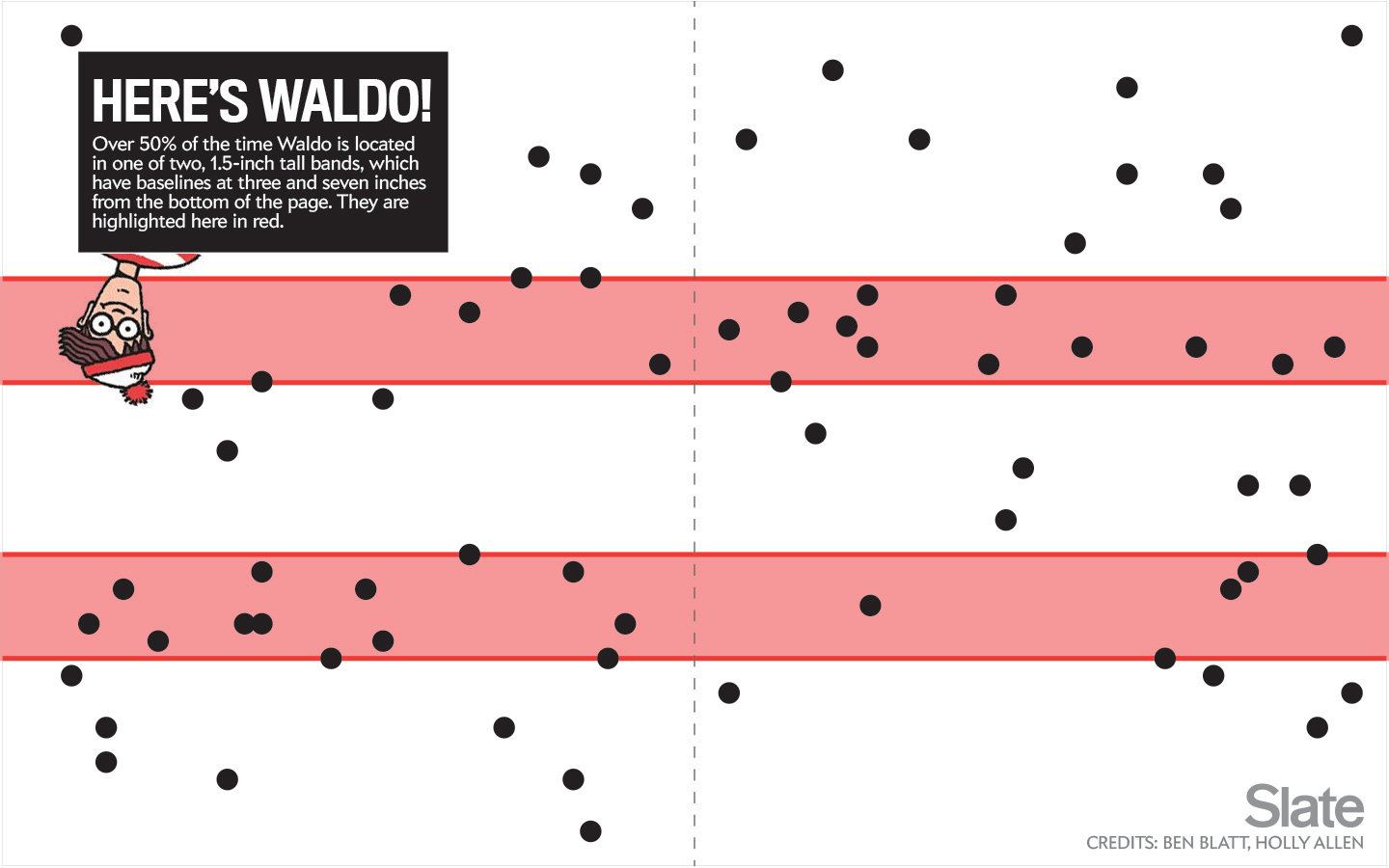
[Creator Martin] Handford generally shies away from putting Waldo near the bottom or top of a page, which leads me to theorize that Waldo placement is largely a function of two factors: aversion from extremes and aversion from the middle. While we would expect Waldo to be hidden within an inch-and-a-half of the spread’s top or bottom borders almost 25 percent of the time if Handford were placing him randomly, in practice he is there only in 12 percent of all pages. More surprising is the fact that Waldo is also unlikely to be in the middle of the page. … It’s possible that Handford avoided the edges and centers of the pages out of concern that they may not print clearly. However, Waldo is placed in these locations occasionally, which weakens this hypothesis. I think it’s more likely that Handford was trying to avoid locations that might be construed as too obvious—i.e. the centers or the corners, where children and adults alike might begin their search. But while this might make Waldo harder to find for the reader whose eyes immediately dart to the center or edge of the page, once you know your quarry is unlikely to be in those places, it actually makes him much easier to find.

Obama’s Keep Your Doctor Promise

Alex Altman expects it to come back to bite the president:

“No matter how we reform health care,” Obama said in 2009, “we will keep this promise: if you like your doctor, you will be able to keep your doctor. Period.” It’s not that simple. In order to participate in health-insurance exchanges, insurers needed to find a way to tamp down the high costs of premiums. As a result, many will narrow their networks, shrinking the range of doctors that are available to patients under their plan, experts say.

Chait counters:

The main difference between Keep Your Plan and Keep Your Doctor is that Obamacare’s disruption of the individual insurance market was a conscious policy choice. Obamacare creates regulations that, by design, phase out health-care plans that are based on skimming healthy people off the insurance pool. It does not create regulations designed to force people out of existing doctor-patient relationships. Keep Your Plan has been a political disaster for Obama because it was a broken promise. Keep Your Doctor is not even close to a clear-cut broken promise.

Cohn argues that Obamacare isn’t to blame for limited network plans:

[A]ccording to nearly every source inside and outside the industry I’ve consulted, the primary reason carriers are offering so many small-network plans in the exchanges is that they believe consumers want them. Their marketing research suggests that, when forced to choose between paying higher premiums for wider networks or lower premiums for narrower networks, the majority of people will go for the cheaper insurance. The one survey I’ve seen on this question, by Morning Consult, suggests the carriers may be right: In that survey, nearly 60 percent of respondents said they’d opt for plans with fewer provider choices if meant saving on premiums.


Cutting Through The Saudi Spin

SAUDI-IRAN-NUCLEAR-MEDIA

Simon Henderson assesses Saudi Arabia’s public and private reactions to the deal with Iran:

Saudi princes and officials often cast Israel as the villain of the Middle East, implying and often saying outright that if it were not for the Israeli-Palestinian dispute, everything in the region would be fine. Prince Alwaleed skipped this line of argument completely, instead saying, “For the first time, Saudi Arabian interests and Israel are almost parallel. It’s incredible.”

Incredulity is also a good word to sum up the feelings at a roundtable in Washington D.C. that I attended a few days earlier, when U.S. officials, military officers, and think tankers questioned another prominent Saudi personality. Asked what the kingdom would do if Israeli aircraft flew over Saudi Arabia on their way to bomb Iranian nuclear facilities, the Saudi, whose remarks were off the record, replied: “Nothing. Why would we do anything? They would be doing what we want to happen.” Of course, after a pause, he added, “But we would issue a strong public note of condemnation for the intrusion into air space when it was all over.”

Despite the rhetoric coming from Riyadh, Keating is skeptical that the Saudis will express their displeasure by obtaining a nuke:

First, as Steve Cook wrote last year, Saudi Arabia “has no nuclear facilities and no scientific infrastructure to support them,” so building a bomb from scratch could be a long and daunting process.

But what if Saudi Arabia simply bought itself a nuke? A BBC Newsnight report earlier this month suggested that “nuclear weapons made in Pakistan on behalf of Saudi Arabia are now sitting ready for delivery” should the Saudis decide they want them.

In the midst of negotiations, the report seemed awfully conveniently timed to provide ammunition to the deal’s critics. Moreover, as Zachary Keck pointed out in the National InterestSaudi interests aside, it’s not really clear what Pakistan would get out of this other than enraging its major source of military aid—the United States—as well as what it hopes will be a major energy supplier—Iran.

Walt’s read on the Saudi and Israeli freak-outs:

[T]he real issue isn’t whether Iran gets close to a bomb; the real issue is the long-term balance of power in the Persian Gulf and Middle East. Iran has far more power potential than any of the other states in the region: a larger population, a fairly sophisticated and well-educated middle class, some good universities, and abundant oil and gas to boost economic growth (if used wisely). If Iran ever escapes the shackles of international sanctions and puts some competent people in charge of its economy, it’s going to loom much larger in regional affairs over time. That prospect is what really lies behind the Israeli and Saudi concerns about the nuclear deal. Israel and Saudi Arabia don’t think Iran is going to get up one day and start lobbing warheads at its neighbors, and they probably don’t even believe that Iran would ever try the pointless act of nuclear blackmail. No, they’re just worried that a powerful Iran would over time exert greater influence in the region, in all the ways that major powers do. From the perspective of Tel Aviv and Riyadh, the goal is to try to keep Iran in a box for as long as possible — isolated, friendless, and artificially weakened.

Photo: Saudi newspapers headlining the deal made with major powers over Iran’s nuclear program are seen on November 25, 2013 in the capital Riyadh. By Fayez Nureldine/AFP/Getty Images)

The End Of DIY DNA Testing?

The FDA is going after DNA testing company 23andMe. The FDA’s reasoning:

The FDA says it is concerned that consumers would misunderstand genetic marker information and self treat. For example, the agency cites the company for testing for versions of the BRCA gene that confers higher risk of breast cancer worrying that women might get a false positive test leading “a patient to undergo prophylactic surgery, chemoprevention, intensive screening, or other morbidity-inducing actions….”

Ronald Bailey rejects that logic:

What the test results would actually lead patients to do is to get another test and to talk with their physicians. The FDA also cites the genotype results that indicate the sensitivity of patients to the blood-thinning medication warfarin. Again, such results would be used by patients to talk with their doctors about their treatment regimens should the time come that they need to take the drug. In fact, in 2010 the FDA actually updated its rules to recommend genetic testing to set the proper warfarin dosages for patients.

Razib Khan’s take:

23andMe has been moving aggressively to emphasize its medical, as opposed to genealogical, services over the past year. But this isn’t the story of one firm. This is the story of government response to very important structural shifts occurring in the medical delivery system of the United States. The government could potentially bankrupt 23andMe, but taking a step back that would still be like the RIAA managing to take down Napster. The information is coming, and if there’s one thing that can overpower state planning it is consumer demand. Unless the US government wants to ban their citizens from receiving their own genetic data they’re just putting off the inevitable outsourcing of various interpretation services. Engagement would probably be the better long term bet, but I don’t see that happening.

Alex Tabarrok weighs in:

The FDA wants to regulate genetic tests as a high-risk medical device that cannot be sold until and unless the FDA permits it be sold.

Moreover, the FDA wants to judge not the analytic validity of the tests, whether the tests accurately read the genetic code as the firms promise (already regulated under the [Clinical Laboratory Improvement Amendments (CLIA)]) but the clinical validity, whether particular identified alleles are causal for conditions or disease. The latter requirement is the death-knell for the products because of the expense and time it takes to prove specific genes are causal for diseases. Moreover, it means that firms like 23andMe will not be able to tell consumers about their own DNA but instead will only be allowed to offer a peek at the sections of code that the FDA has deemed it ok for consumers to see.

Alternatively, firms may be allowed to sequence a consumer’s genetic code and even report it to them but they will not be allowed to tell consumers what the letters mean. Here is why I think the FDA’s actions are unconstitutional. Reading an individual’s code is safe and effective. Interpreting the code and communicating opinions about it may or may not be safe–just like all communication–but it falls squarely under the First Amendment.

The View From Your Window Contest: Winner #181

vfyw_11-23

A reader writes:

My first thought was the Caribbean, so I searched for soil types, mountain profiles, street signs, checking who drives on right/left. My first choice was Cuba, and the mountains were similar, but not quite the right profile from the Vinales valley.  I checked other red soil countries around the Caribbean, near mountains, tiny bit of Mexico, Guatemala, Honduras, right-hand-drive Caribbean islands.  No joy.  Dominican Republic is a possibility, but again, not the right config of mountains. Not even the little blue sign at the far right was a help. Africa? Seems too lush. Indonesia? Not lush enough. So I finally went back to my original guess: Vinales, Cuba.

Another:

I can’t spare the time this weekend to give this contest its due, but the view reminds me of certain coffee-growing locales, so I’ll take a wild swing and say this is in Haiti. I’m probably wrong. It’s probably Sumatra or something.

Another:

Now that’s a challenging VFYW!  I’ll be gobsmacked if anyone nails the precise location.  Aside from it being tropical, I haven’t much else to guide me, so given it’s prominence in the news lately, I’ll go with somewhere in the Philippines, someplace that was spared the recent wrath of a typhoon.

Another:

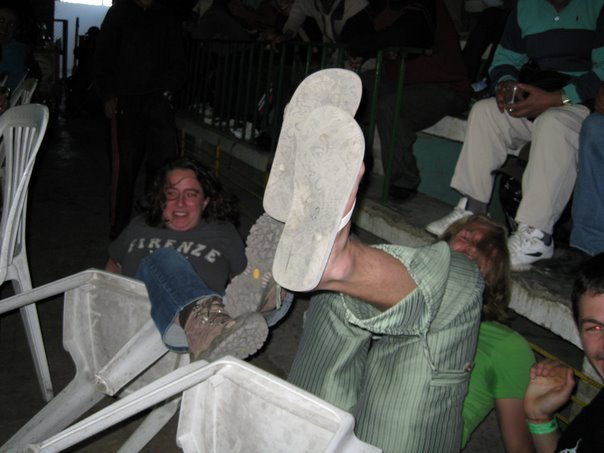
This reminds me of the view from the outskirts of La Paz.  I found myself there in November 2009, while going to see Cholita wrestling.  The evening culminated in me getting knocked out of my chair when one of the lucha libre fighters threw another into the crowd. Photographic evidence attached:
Cholitas

Another:

I think this is in Darjeeling, India. I’ve never been there, but at first glance, the pic reminded me of India. My mom, who is Indian, is always telling me about hill stations, so I googled a few. Am I close?

Not very. Another gets on the right continent:

Definitely Africa. Looks very much like an area of northeast Tanzania I visited a number of years ago called the Usambara Mountains. So I’d guess it’s somewhere in the main city of that area, Lushoto.

Another:

This looks like a scene from Mbarara, Uganda.  I could be wrong, but I’m in Mbarara now and it looks like the view from my window!

Another:

Baffling.

I believe that the mountain in the right background is Table Mountain which overlooks Cape Town, South Africa. This photo is obviously at elevation, but I can’t put together the distance and population on Google Earth. At first, I thought it was north of Cape Town, but I’m now convinced it is actually southeast. My best guess is in the foothills above Somerset West.

Another:

Can’t be South Africa, because it was South Africa last week. Nevertheless, I see a Toyota Yaris, which is common in South Africa. The Yaris appears (hard to say) like it may be right-hand drive, as I can’t make out a steering wheel on the left side. South Africa maybe. The multi-colored paving slabs in the parking lot below us are also typical of South Africa. I even found a company that makes them in Cape Town. The chairs too! They appear to be of a kind made by ISA Group in South Africa – from their web site, I’d say these chairs are “The Snapper” model. Regardless of last week, I’ve got to go with South Africa again. But where in South Africa?

Well, then you’ve got the two dirtbags, er, I mean, backpackers outside the cafe below, the one with the chairs. These two have a decidedly “Motorcycle Diaries” look about them. And if I know my comrades, they would desperately love to see Kruger National Park, but wouldn’t be caught dead in the company of fellow tourists (travelers, I mean, these guys are clearly travelers). So my guess is that the travelers are NEAR South Africa’s prime tourist target – Kruger – but spending as much time as possible in a shanty town so as to maintain their cred. Which leads me to: Kanyamazane, a township near Nelspruit. Can’t find any landmarks to confirm, but it’s a plausible theory. Final answer.

Another:

I can’t tell you the exact place, but this feels very much like some of the places I have seen up along the lower boundaries of the Aberdares range or Mount Kenya, although really it could be anywhere in tropical African highlands.  I will take a guess and say it’s Chuka on the eastern side of Mount Kenya.

Another:

I saw this photo and it brought me back to the three years I spent living in Guinea in West Africa.  But after looking at the photo a little longer, I don’t think it is Guinea. It’s too small to be a capital city, so must be some upcountry town, but there’s a lake in the distance and possibly a volcano – not things Guinea has. So I’m thinking it might be looking at the lakes in central Africa. I’m going with Bunia, DRC, which seems to be just far enough way from a lake and the mountains on its shore. It looks like it’s taken from a small guesthouse. You can tell by the clean courtyard and the well cared for bushes.  But I don’t know which one.

Another:

I give up. There’s pretty much nothing I can identify to indicate a precise city. I’m resigned to this week’s prize going to a flagstone-colourist or garden furniture distributor, or someone doing a doctorate in global windshield sticker formations. My first instinctive thought was Caracas, but the single-story shanty towns aren’t built up enough for the Latin American conurbations. Looks from the fencing like it could be East Africa, but given Uganda, Kenya and Tanzania all drive on the left, I’m inclined to say Rwanda, “the land of 1000 hills”. Given that the hills are all I have to go on, and I can’t see the shape for the clouds, I’m going to punt at Kigali, but am resigned to knowing I can’t find the actual window this week.

Another gets the right country:

This has got to be Addis Ababa, Ethiopia.  Eucalyptus trees, tin-roofed huts, the standard school structure on the hill to the left.  The thing that gives me some pause are the motorcycles in the parking lot; there just aren’t as many scooters or cycles as I’ve seen in other developing countries, but there are some.  As for specific location, I’ll go with Mount Entoto, looking south. I submitted a VFYW photo from Addis a few months ago, but I’ve since left, so this brought back some fond memories.

Another:

It looks like Addis to me; I was there for a week three years ago when we were adopting two children.  Of course, that’s the only African city I’ve ever been to, and since this looks like Africa, I’m shooting in a dark a bit.

Another:

Looks like Addis Ababa to me, more specifically a view from somewhere north of the city, Entoto or Gulele.

Another:

Addis? I’m always way wrong.

No one got the right city in Ethiopia. Details from the submitter:

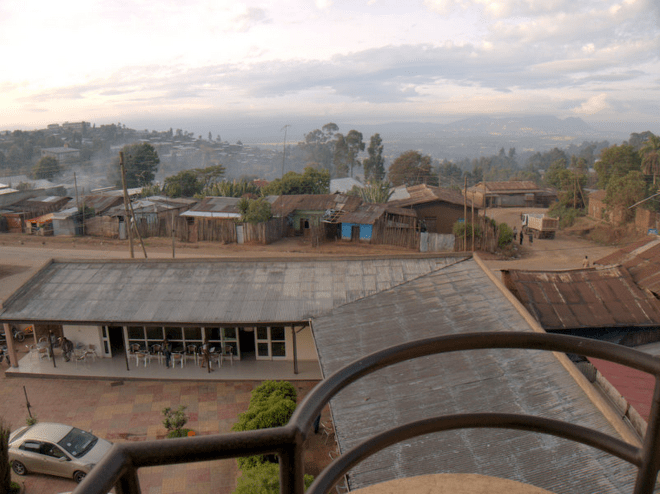
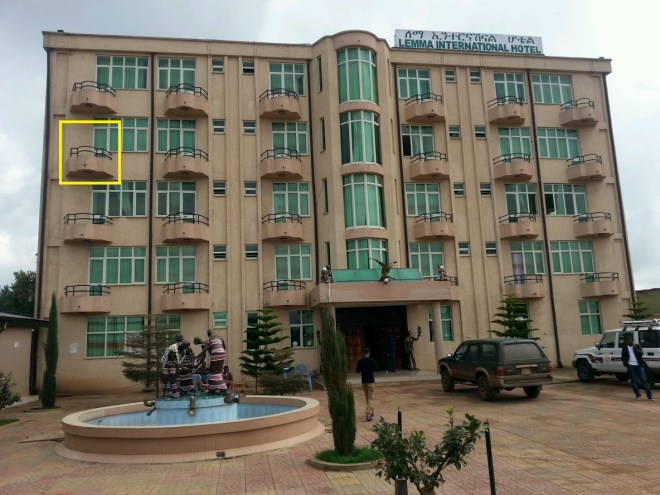
Lemma Hotel, Room 301, Hossanna, Ethiopia, taken 11/15/13

Of the four readers who guessed Addis Ababa, none of them are correct guessers of previous contests. The first two Addis entries posted above are from first-time guessers, while the second two are both from second-time guessers, making a tie-breaker very difficult. But since the second-to-last entry guessed “somewhere north of the city, Entoto or Gulele”, and Hossanna is actually south of Addis, the winner this week goes to the last entry, from the reader who is no longer “always way wrong.”

Update: A last-minute entry from our grand champion, prior to the deadline:
VFYW Hosaena Bird's Eye Marked - Copy

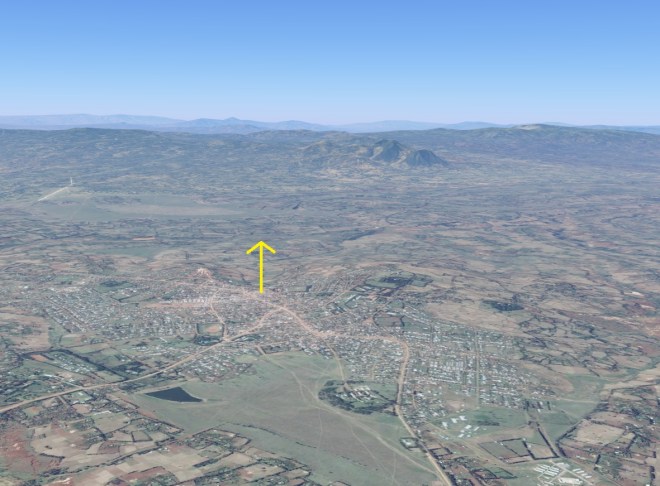
A few months ago a Dish reader mocked your choice of Addis Ababa for VFYW #161 because they thought it was too hard.  I can only imagine how they’re gonna feel about this week’s location. One thing’s for sure though; views are much harder to find when the satellite imagery shows an empty lot instead of the hotel the picture was taken from.

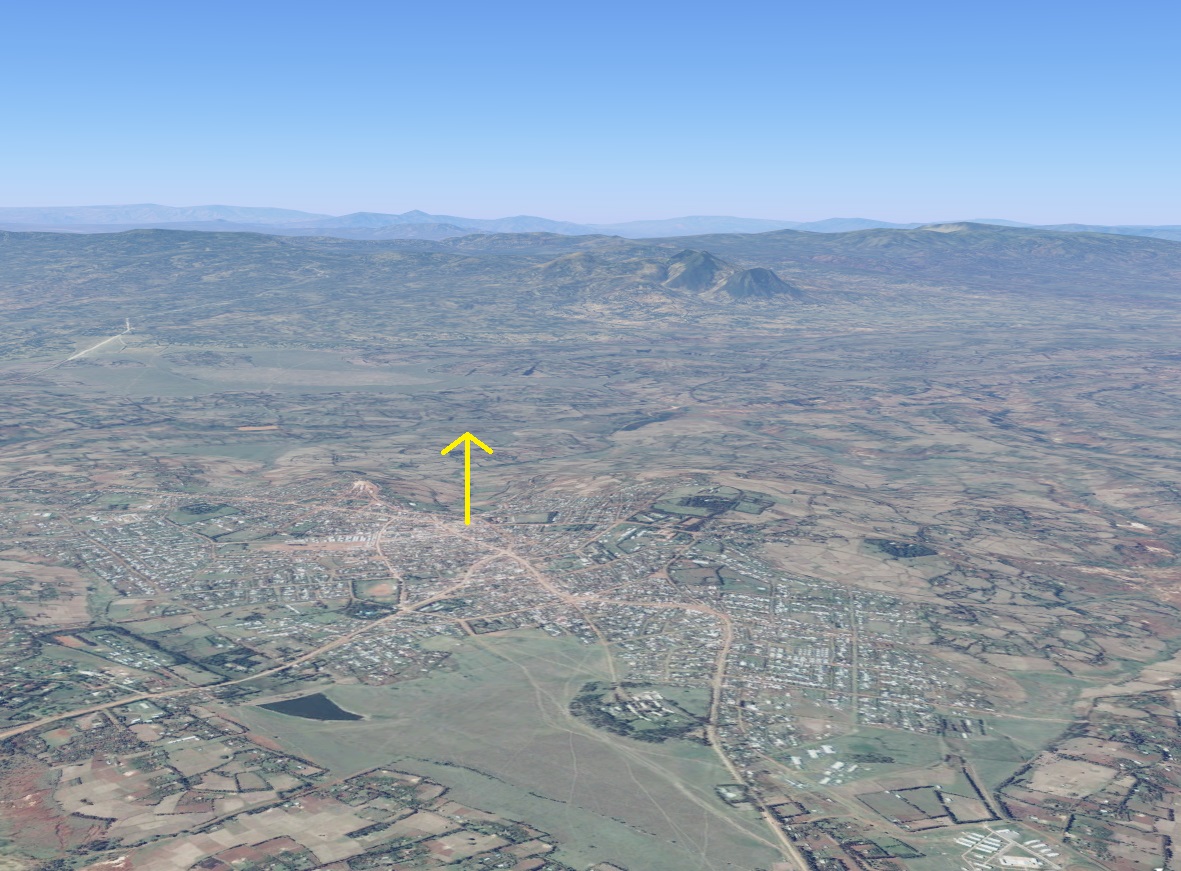
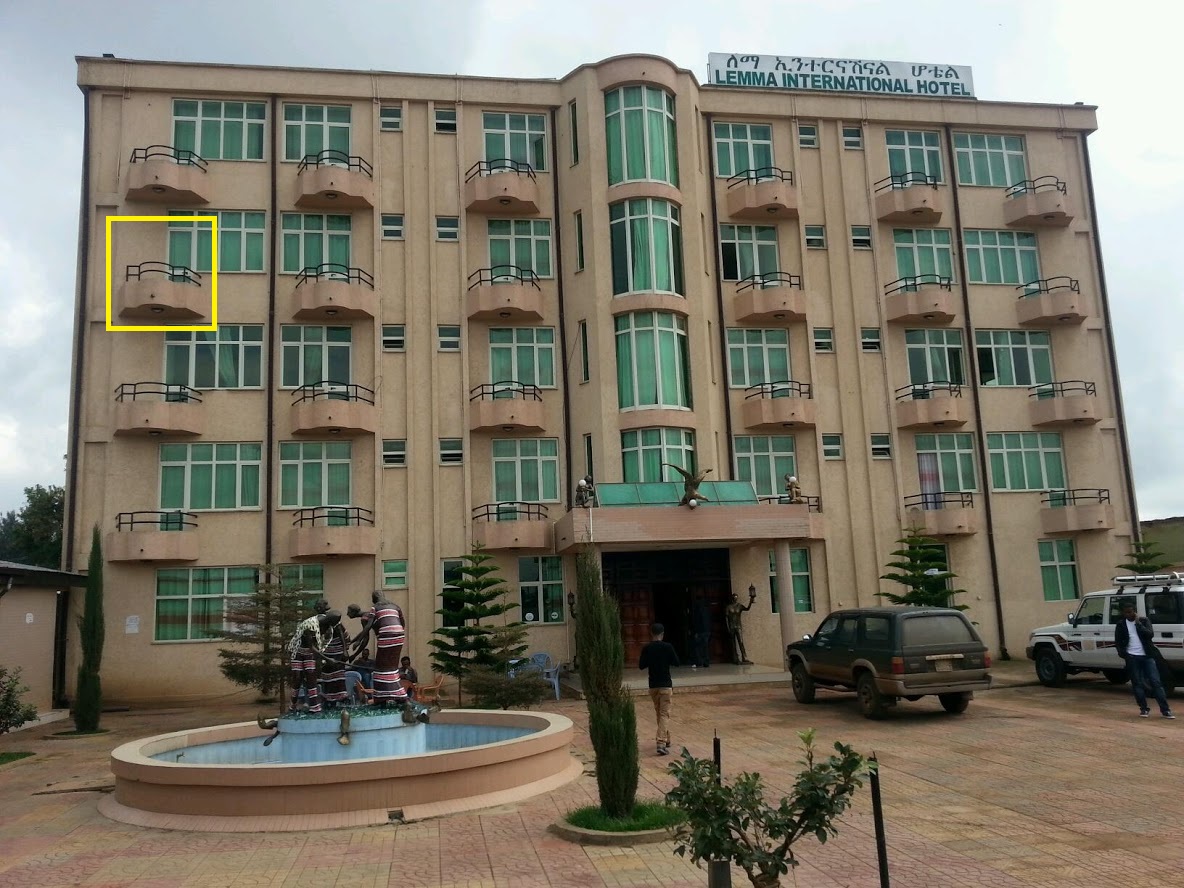
This week’s view comes from Hosaeana, Ethiopia, a small city located approximately 120 miles from Addis Ababa. The view looks south by southwest from the Lemma International Hotel along a heading of 208.42 degrees towards the hills just above Jajura. The exact coordinates are  7°32’40.76″N 37°51’3.00″E, and the picture was likely snapped on the fourth story (third numbered floor) of the hotel:
VFYW Hosaena Balcony Marked - Copy

Incredible.

(Archive)