Quote For The Day

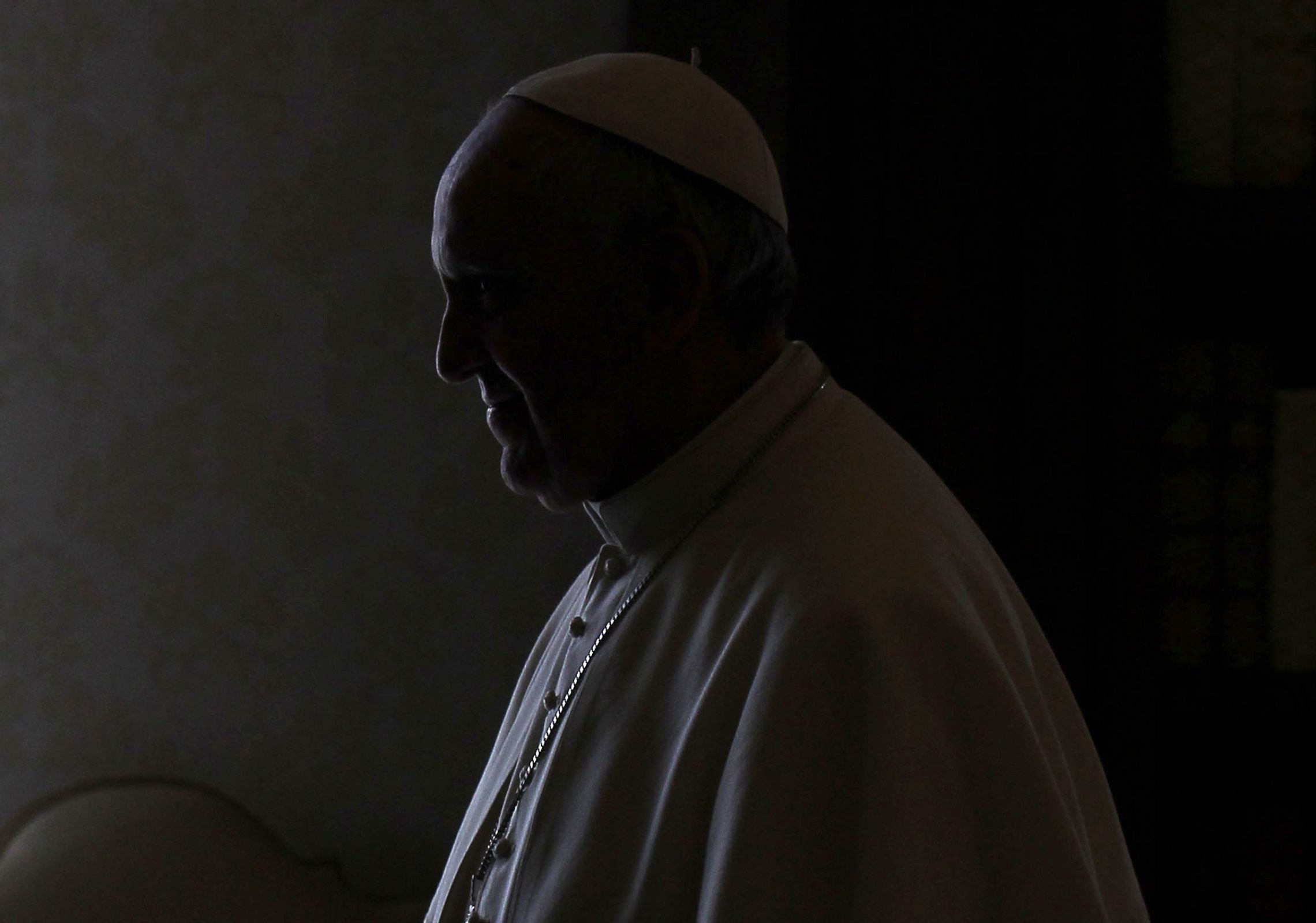
francisshadow

“I prefer a Church which is bruised, hurting and dirty because it has been out on the streets, rather than a Church which is unhealthy from being confined and from clinging to its own security. I do not want a Church concerned with being at the center and then ends by being caught up in a web of obsessions and procedures … In her ongoing discernment, the Church can also come to see that certain customs not directly connected to the heart of the Gospel, even some which have deep historical roots, are no longer properly understood and appreciated. Some of these customs may be beautiful, but they no longer serve as means of communicating the Gospel. We should not be afraid to re-examine them. At the same time, the Church has rules or precepts which may have been quite effective in their time, but no longer have the same usefulness for directing and shaping people’s lives,” – Pope Francis, whose radical call to renewal and reform seems to be deepening still further.

It’s worth noting that the Pope has reaffirmed the church’s teaching on abortion, but left other “rules and precepts” in more ambiguous territory.

Know hope.

The Party Of No, No, No, No And Never

Dana Milbank destroys Ari Fleischer this morning – and deservedly so. Fleischer’s instant reaction to even the news of an agreement – without any knowledge of its details – was to denounce it. Dana calls the faster-than-a-jerking-knee response “mindless.” And how could one argue against that? To denounce something before you even know what it is … well, what else do you call it?

It is indeed mindless to denounce a temporary agreement for a six month negotiation to end the possibility of Iranian nuclear bombs without offering any feasible alternative. The one proffered – to actually tighten the sanctions that have already brought the Iranian regime to its knees – cannot work to achieve the desired result. Such sanctions would destroy Rouhani’s standing and credibility, split apart the global coalition on sanctions, help cement in Khamenei’s mind that no deal is possible with the West without national humiliation and regime change, and do nothing to, actually, you know, stop Iran’s nuclear program. It is a de facto argument for war as the only acceptable policy toward Iran.

So their policy is effectively another pre-emptive Middle East war on a country with no nuclear weapons with unknowable consequences and without any allies that would only delay, at best, an Iranian nuclear program. Does any of that sound familiar to you? Such a war would, moreover, strengthen the regime, dis-empower the opposition and all but guarantee that any Iranian regime would try even harder to get a nuclear deterrent.  You will find nothing, nothing in the GOP analysis that even begins to absorb the fact that the Iranian opposition also supports a civilian nuclear program. So they are also intent on picking the one fight with Iran that would unite the regime and the people.

Yes, Dana is right. The word for this is mindless. It is an attitude – a nasty, belligerent, impulsive attitude, the kind of attitude that gave us the Iraq war and Abu Ghraib, and made the world less, rather than more safe. Or consider Syria. The GOP was determined to stop a military strike and also denounced the UN-Russian deal to secure and destroy Syria’s WMDs! So that’s a no and a no. And the last no was to a policy that has been remarkably successful in ending a major source of WMD worry in the region. They opposed a policy that made Israel more secure.

As for healthcare, words fail.

They are running for Congress next year entirely on a platform of repeal and sabotage. They have offered nothing faintly serious to grapple with the dysfunctional socialized system America now labors under – no program to end the free rider problem or the pre-existing conditions problem or the uninsured problem or the costs problem. None, none, none and none. One reason I’ve been grateful for Ramesh Ponnuru and Yuval Levin’s proposals is that at least they exist, have some real merits and might be an alternative. But what’s staggering is how lonely their position is within the actual GOP.

This total nihilism on policy and nullification strategy toward the president, whatever he does, is also mindless for another reason. It is not good for the GOP. At some point, they will not get back the White House without an alternative, and the prospect of ending the insurance the ACA would provide without any alternative is a fool’s errand. It will backfire in the end, even though it may feel very good at the beginning. They are setting themselves up once again to appear as callous, intemperate and denialist. In the end, the American people will pick the party and the president with the constructive ideas rather than the destructive attitude. In this, the Republicans have entrenched Obama’s legacy and done nothing to shape it to more conservative ends. Again: mindless.

I care about this not just because I care about the country, but because I also deeply believe in a strong conservative force in politics. We don’t have that right now, whatever they say. We have a nihilist force. And it is cloaking itself in a political tradition they have long ago left in the dust.

An Ad Critic At Buzzfeed Doesn’t Work

Copyranter claims that one of the reasons he was fired from Buzzfeed was blowback from advertisers:

Because BuzzFeed had grown so big so fast, they didn’t want some loose cannon highlighting the shitty ads of potential or current big name advertisers. Yeah, that’s a pretty good reason to fire enhanced-buzz-11511-1378148297-13 (1)me. Being a visionary, I brought this point up in my initial interview with Ben Smith. He said, more or less, “You don’t worry about that, that’s my problem.” Boy oh boy did it become his problem. Ben Smith made me delete a post I did on Axe Body Spray’s ads, titled, “The Objectification Of Women By Axe Continues Unabated in 2013” (it was initially called something to the effect of “Axe Body Spray Continues its Contribution to Rape Culture,” but I quickly softened it). Get this: he made me delete it one month after it was posted, due to apparent pressure from Axe’s owner Unilever. How that’s for editorial integrity? Ben Smith also questioned other posts I did knocking major advertisers’ ads (he kept repeating the phrase “punching down”), including the pathetically pandering, irresponsible Nike “Fat Boy” commercial.

Ben responds:

We parted ways with Mark in because his tone and vision are really different from ours. In particular, it’s important to him to make charges — and in one case, imagine dialogue — without the reporting to support them. That’s something he is perhaps doing with me here. Our editorial team operates independently of advertisers, and I’ve never based a decision about reporting on an advertiser’s needs. In fact, if you glance at his page, you’ll see any number of unflattering posts about businesses, some advertisers and some not (and I’m not always in the loop on which is which); in both cases, I took the angry calls and emails and usually didn’t tell him about them, which is what I think an editor is supposed to do.

You can keep up with Copyranter at his new perch at Vice and his own blog.

What’s So Wrong With “Sucks”? Ctd

Many readers pounce on this post:

If your reader concerned about the use of “sucks” worries that he sounds like a queer studies major, then his worries are founded. By his logic, we should think about ceasing to use “jerk” (from the fuller “don’t be such a jerk-off!”). The British “tosser” has to go too. So does “ass-kisser”, which seems a perfect description of someone who sucks up to the boss – but ‘”suck up” probably has to go too, as well as “brown-noser” obviously. More generally, we should probably consider dropping “fuck” and its infinite permutations (certainly “this fucking sucks”), for we don’t want to suggest that there is anything wrong with fucking. Or are we allowed to keep “motherfucker” because we still disapprove of incest? What about “asshole” – isn’t that just a body part like all the others? Does the use of “asshole” as an insult display a certain puritanical revulsion at the body? I could go on indefinitely …

Another:

I’ve never considered “sucks” – as in “this broccoli sucks” – to be referring to a sex act. To me, it means the thing in question sucks the joy out of the situation. “This broccoli sucks the joy out of eating.”  Nothing derogatory about it.  Maybe it’s a guy thing to automatically jump to the sexual?

Another:

“Sucks” can actually be traced back to a phrase common among farmers during the Great Depression, who would remark that something “sucks hind tit.” This is because pigs, dogs, etc feed from their mothers, and from the perspective of the farmers the rear one was the least desirable (I’m not sure if there’s a reason for that, or just the general proximity to the rear end of the animal).  From there, the phrase was shortened and has certainly be considered low and offensive for a long time.  But that might speak more to the dirty minds of the censors than those who actually came up with the term.

Several more:

A quick Google search reveals that there is an ongoing debate as to the origin of the word.

According to the Urban Dictionary, it comes from jazz musicians.  A great musician on the horn could really “blow.”  Someone who was horrible sounded like they were “sucking” on the horn.  A recent defense of the word on Slate offered other sources, like farmers using the phrase “sucks hind teat” or British schoolchildren using “sucks to you” with no sexual connotation. And even if it does have a sexual origin, who cares at this point?  Your reader should just suck it up and let it be.

Another:

Back when I was a kid, I was able to convince my very skeptical father that I should be allowed to wear a “Boston Sucks” T-shirt (I’ve been a lifelong Yankees fan) because it was plausibly “Boston Sucks Eggs” rather than “Boston Sucks Shit”, which was how he interpreted it.  I seem to remember “Go suck eggs” was a relatively common insult (the functional if less inflammatory equivalent of “Eat shit and die”), even showing up in cartoons. I’m pretty convinced that that’s the etymological line that leads to everything sucking these days.

Another:

In 1986 or ’87, when I was a naive 6th-grader (maybe 7th), on the first day of class my science teacher laid down the rules.  She was a tough, progressive, feminist, four-Swatch-on-one-wrist-wearing bitch. Not butch, but maybe a lesbian – I don’t know.  I liked her right away.  In addition to saying things like, “This classroom is not a democracy, it is a monarchy, and I am the monarch,” she also said:

I will not tolerate the phrase “you suck.”  Do you know where that term comes from?  It comes from the root word “cocksucker” meaning one who sucks cocks, and in no instance is it appropriate in my classroom.  It is derogatory and offensive and will not be tolerated.

Holy Handjobbers!  I’d never heard such a thing, but boy did it stick with me.

Another:

So we have a word that may or may not have originally referred to a homosexual act and that is usually not used to refer to a homosexual act. I fail to see the problem. Etymology is not destiny. Just because the origin of the term is fellatio does not mean that’s what it means now.  Lots of words are secretly vulgar. “Pencil” shares a root with “penis”. “Avocado” is an Aztec word meaning “testicle”. “Scumbag” means condom. I will give you the pleasure of looking up the etymology of “pumpernickel” on your own. Words change. Usage matters more than history.

(I can’t believe I just spent half an hour researching “suck”. This is why I read your blog.)

Tweeting For Tradition

The Herdy Shepherd isn’t your typical social media star: 

Our shepherding work in the English Lake District is all about continuity and being part of a living cultural tradition that stretches back into the depths of time. Our work is often little changed from the way things were done when the Vikings first settled these valleys. Even our dialect is peppered with Norse words. I like old things, old ways of doing things, old stories, old places, and old people. I’m deeply conservative with a small ‘c’. Ask any half decent economist and they’ll tell you that most new ideas are a waste of time, most new ideas fail. Our way of life results in fairly conservative people suspicious of pointless chatter and new technologies for the sake of newness. I am, in short, about as unlikely to get excited by something like Twitter as anyone alive.

And yet, when he “reluctantly” accepted a cell-phone upgrade, he found that he “could now defend the old in my own quirky and probably misguided way”:

Tweeting is kind of an act of resistance and defiance, a way of shouting to the sometimes disinterested world that you’re stubborn, proud, and not giving in as everywhere else is turned into a clone of everywhere else.

I’m not alone, there are some amazing people tweeting about their lives on Twitter. They are fascinating unique lives that were often invisible before the ability to self-publish on social media. I’d like to think that Twitter has given people that had disappeared from view – obscured and crowded out by the loud noise of modernity – the chance to raise their voice, tell their stories, share their lives, and to say “Hey, we didn’t go away, we are still here, and you might just be interested because what we do is important to everyone.”

Being able to share your life enables other people to see you for the first time, to see past clichés and stereotypes. And since the 1960s farming has had a rather poisonous image for some people. Now, for the first time, lots of folk following us on Twitter actually know a farmer. They know what we do each day and that we are essentially decent people doing our best sometimes against the economic and natural odds. They see that we have a love of what we do, and a deep respect for the landscape and wildlife around us. … Most new ideas may fail, and most new ideas might be rubbish – but sometimes a new idea, a new technology, empowers you to defend the old against the new, and some old things are worth defending.

Will Marriage Equality Come To Israel?

Despite Israel’s progressive policy when it comes to gays, Liam Hoare doubts it will join the growing list of countries with marriage equality:

Marriage is an exclusively religious institution in Israel, with separate religious authorities for Jews and Muslims, Christians and Druze. For Israeli Jews, marriage policy is dictated by the Chief Rabbinate, which is under the exclusive control of the Orthodox—and firmly opposed to gay marriage. Since the country has no civil marriage, gay couples seeking to marry within the borders of Israel are out of luck (as are any Jewish Israelis seeking a non-Orthodox marriage ceremony).

This arrangement—whereby marriage is in the control of the Orthodox rabbinate—is part of what Israelis call the status quo: an understanding between secular and religious Jews regarding the balance between religion and state. The status quo affects not only marriage, but also the education system, family law, supervision of kosher restaurants, and the opening of shops and public transportation on shabbat.

Altering the status quo, particularly concerning something as delicate as marriage, is the third rail of Israeli politics. This is not only because of the power and importance of ultra-Orthodox parties in the Israeli political system, but also due to a fear that changing the status quo would lead to the encroachment of secular values upon the religious—and vice-versa. Among Israel’s many political parties, only Meretz—a left-wing, social democratic faction—proposes to upend the status quo entirely by separating religion from state and legalising civil marriage.

A Sinking State

10706932715_9075899f74_c

Goldberg reports from the South Pacific island nation of Kiribati, a “flyspeck of a United Nations member state” where locals are nervously eyeing the rising waters:

If scientists are correct, the ocean will swallow most of Kiribati before the end of the century, and perhaps much sooner than that. … Before the rising Pacific drowns these atolls, though, it will infiltrate, and irreversibly poison, their already inadequate supply of fresh water. The apocalypse could come even sooner for Kiribati if violent storms, of the sort that recently destroyed parts of the Philippines, strike its islands. For all of these reasons, the 103,000 citizens of Kiribati may soon become refugees, perhaps the first mass movement of people fleeing the consequences of global warming rather than war or famine.

This is why [Kiribati’s president Anote] Tong visits Fiji so frequently. He is searching for a place to move his people. The government of Kiribati recently bought 6,000 acres of land in Fiji for a reported $9.6 million, to the apparent consternation of Fiji’s military rulers. Fiji has expressed no interest in absorbing the I-Kiribati, as the country’s people are known. A former president of Zambia, in south-central Africa, once offered Kiribati’s people land in his country, but then he died. No one else so far has volunteered to organize a rescue.

More bad news for the I-Kiribati: New Zealand recently denied a Kiribati citizen’s high-profile bid f0r refugee status.

(Photo: A scene in South Tarawa, the capital of Kiribati. By Australian Aid)

The Abatement Of Cruelty, Ctd

Readers revive a recent thread:

Okay, I know it’s been a little while since you discussed this topic, but you might want to pay more attention to what you feed Eddy and Bowie. I’ve been a vegetarian since college and thought I didn’t really have to worry about “cruelty free” beyond buying the occasional cage-free eggs. However, this thread has forced me to admit that the dog food and cat food I’m dishing out to my pets is probably coming straight from the worst of the factory farms. Searches for cruelty-free dog food on the web only come up with pet food that hasn’t been tested on animals, or vegan dog food that doesn’t seem to be a realistic option for carnivores. My local pet store has some frozen food that comes directly from local farms, so I might end up going with that (incredibly expensive) route. Still, it could be worth putting it out to other Dishheads – any humane dog or cat food that doesn’t need to be cooked and is only moderately expensive?

Update from a reader:

We have been feeding our critters Sojos and they freaking love it. Sojos original mix is a blend of dried grains and veggies. You add your own meat and water to the dry mix. This way you can choose ground meat from locally sourced, humane producers. Hate to do a plug for a product in general, but this stuff is great.

Another:

I feed my dog a dry food called Orijen, which is made by a Canadian company and uses only free-range protein sources. It’s a little more expensive than other dog foods (I pay around $70 for a 28.6 pound bag) but it feeds my 65-pound dog for almost two months, and he loves loves loves it.

Another shifts gears:

I am concerned that your reader who gave up eating meat solely to reduce his carbon impact is missing a holistic understanding of how necessary animals are to the healthy functioning of an ecosystem. This TED talk by Allan Savory explains it far more powerfully than I ever could, but I will summarize by saying that healthy ecosystems require grazing animals. Healthy ecosystems also happen to be huge carbon sinks. Conversely, desertification in particular, and ecosystem destruction in general, may well contribute more to global warming than the burning of fossil fuels.

Your reader is certainly correct that, from a carbon standpoint, as measured in grain consumption, eating unprocessed, industrially produced plant foods is far preferable to eating industrial meat, especially cattle (I am not so certain about all processed, plant-based foods). However, that we are even measuring their relative efficiencies in terms of grain consumption illustrates the false dichotomy presented. Cattle did not evolve to eat grain. Feeding cattle grains, which is difficult for them to digest, is the cause of the virulent strains of E. coli bacteria, rampant abuse of antibiotics, and a host of other problems. Cattle evolved to eat pasture, which humans are unable to digest. Thus, properly employed, cattle are a method of making the energy and nutrients contained in pasture bioavailable to humans.

Cattle is fed grain because it is cheap (due to mass subsidization by taxpayers), because it makes cattle fat, and because it is easily transported. To the last point, when you mass animals together in industrial feedlots, not only do you create serious knock-on problems with disease and excrement, but you require external feed inputs. You also have serious knock-on problems on the land the cattle leave behind, in terms of a broken nutrient cycle and the loss of the beneficial disturbance which results from well managed rotational grazing.

More to the point, even plant-based industrial agriculture is causing us to strip-mine the fertility of the soil. We do this, year after year, with mono-cropping, stripped bare soil, and broken nutrient cycles leading to corresponding pest and disease infestations, top soil loss, nitrogen run off (leading to ever expanding dead zones in the ocean), and lost soil fertility.

Another continues that line of discussion:

Your reader cited that NYT story quoting that it takes 2-5x (and up to 10x in the USA) more grain to produce the same amount of calories of beef than were available in the original feed.  You also tied this to the amount of arable land in the USA, with the implied conclusion that if we just stopped raising cattle and used the land to grow grain for human consumption, then we would actually have more food.

I’m neither a farmer nor a rancher, but I’m skeptical of this simple analysis.  For starters, not all cattle are raised on grain; many are grazed on public lands, eating scrub and natural grasses.  Putting aside the fact that humans cannot consume those things (meaning that the cattle are essentially eating “free” calories), the last thing we’d want to do would be to convert those lands to farming.  The Bureau of Land Management lands that they are grazed on are often scenic forest or grasslands that hunters, campers, hikers, etc. use for recreation, and at least in states like Colorado they are often high mountain areas that with climates inappropriate to growing grains.  I don’t know the proportion of cattle raised in this way, but a quick Google search leads to this page, which claims that 40% are.  That’s a huge proportion.  The Wikipedia page on cattle feeding states:

In fact most beef cattle are raised on pasture from birth in the spring until autumn (7 to 9 months). Then for pasture-fed animals, grass is the forage that composes all or at least the great majority of their diet.

Moreover, though I’m sure some cattle are fed only grain, my (admittedly limited) experience with western ranchers has been that the cattle are generally pastured and then only switched to grain as the final fattening step in feedlots before being slaughtered.  Of course, feedlots are an entire story of cruelty in and of themselves, but my point is that the “calories from grain” story is leaving that part out and thereby overestimating how much benefit we’d gain from switching to eating the grain ourselves instead of first converting it into beef.

Finally, there’s the issue of the kind of grain that we’re talking about.  Corn makes up a lot of that, but the corn raised and fed to cattle is not something you’re going to be enjoying on your dinner plate anytime soon; it’s been specifically developed over years for hardiness in the climates where it is grown and high yields, among other things, not for taste.  In fact, it tastes pretty bland and starchy.  Now, you might ask, could we grow things that humans might like, instead of that starchy corn?  Probably.  But now we’re comparing apples to oranges: yields would be different (and not necessarily higher), cultivation methods might have to be changed, storage methods would undoubtedly be different, etc.

So like anything else, the full story is more nuanced than the one implied by those simple quotes. Nevertheless, I’m 100% in favor of reducing cruelty to animals, myself.  Although not a vegetarian, I only eat fish when I do eat meat, and only fish from sustainable wild fisheries.  It gives me some cheer to see via your blog posts that other people are thinking about these things and considering the ethics of meat consumption.

In the above video, Charles Camosy addresses how Christians should approach the carnivorous nature of humans. In the following video, he extends that line of thought to evolution:

Watch all of his videos here.
Should Private Donors Have To Pay For Poor Parks?

Benjamin Soskis explores an escalating debate:

[New York state senator Daniel Squadron’s bill proposed this summer] targeted the city’s best-endowed park conservancies, the private nonprofit organizations formed to manage and raise funds for public parks. Those with operating budgets greater than five million dollars—the Central Park Conservancy (fifty-eight million dollars) and the Prospect Park Alliance (nine million dollars) were in his sights—would be required to donate twenty per cent of their budgets to a Neighborhood Parks Alliance, which would redistribute the money to the city’s underfunded parks. … [S]ome within the philanthropic community worried that de Blasio’s support for Squadron’s bill would have a “chilling” effect on major benefactions. It represented a dire threat to the voluntarist premises of American philanthropy: the idea that donors can do whatever they wish with their money, and that this freedom is precisely what makes philanthropy so vital to American democracy. …

Others grew concerned that the private funding of certain flagship parks would sanction the erosion of public stewardship, leading to a two-tiered system in which certain green spaces flourish while the majority of the city’s nearly two thousand parks languish. These concerns were roused again last year, when the hedge-fund manager John Paulson pledged a hundred million dollars to the Central Park Conservancy—the largest-ever gift to a public park. Paulson often ran or biked in the Park (which his Fifth Avenue apartment overlooks) and said that he wanted to make sure it would be preserved as an “urban oasis.” His gift won its share of plaudits, but it also provided an exceptionally large target for those who sought to highlight the associations between philanthropy and inequality.

Last spring, Alex Ulam reported at length on the role of philanthropy and its discontents:

In extreme cases, some city parks can become privatized to the point where the public is shut out for most the year.

Damrosch Park, for example, a New York City park run by Lincoln Center for the Performing Arts, is closed off for seven to ten months every year for private events, such as Big Apple Circus and New York City’s Fashion Week. In addition to being regularly closed to the public, Damrosch Park has had 57 trees cut down and its distinctive granite benches removed to accommodate such events, which help raise money for Lincoln Center. Park closings have also had a significant impact on the public experience in other cities. In Chicago, the Lollapalooza Festival takes over Grant Park during summer every year, and although the festival only lasts a few days, it often results in damage and extended delays to reopening sections of the park. One factor driving the increasing privatization of new state-of-the-art parks is their stratospheric maintenance costs. The pressure to pay for the upkeep of the High Line, which is considered to have the highest per-square foot maintenance costs in the city, has forced the Friends of the High Line into taking positions supporting commercial developments that create the very types of conditions that public space is supposed to mitigate. …

According to [director of New Yorkers for Parks Holly] Leicht, high-profile gifts such as Paulson’s have prompted discussion in New York City between park advocacy groups and city officials about putting donors on notice that in the future, a certain percentage of their gifts will be have to be allocated to a fund that would provide aid to less affluent areas. “It raises the question: Are parks somehow inherently different than other cultural institutions?” Leicht says. “I would argue that as public space they are, and that this probably is a model that should be piloted and tested. And let’s see if donors are truly frozen in their actions.”