Fake And Painful

Jonathan Mahler notes that pro wrestling has had its problems with brain injuries:

Wrestling may be staged, but that doesn’t mean it’s an optical illusion. When a wrestler gets hit in the head with a chair — which became routine during the extreme era — he really is getting hit in the head with a chair. This is not exactly salutary for the brain. At the time, there may have been little scientific evidence that seemingly minor head trauma could lead to progressive brain degeneration, but was it really so difficult to surmise that all these body blows might end badly? …

For years, pro wrestling denied any connection between violence inside the ring and medical trauma outside it. Like NFL commissioner Roger Goodell, McMahon focused on protecting his product. He not only downplayed the role of CTE in Benoit’s death, he erased Benoit from wrestling’s history, editing his matches out of DVDs and redacting his name and numerous “championships” from the record books. (You can do this when your sport isn’t actually a sport.)

But even a fantasy world can deny reality for only so long. In recent years, pro wrestling has taken steps to protect its employees. When one of the WWE’s emerging talents, Dolph Ziggler, suffered a concussion earlier this year, he was prevented from wrestling, or even traveling, for six weeks. Chair shots to the head have been banned. Wrestlers themselves are now much more willing to tell opponents before a match what moves are off-limits.

The long-running Dish thread on brain injuries in pro football is here.

The Drug Double-Standard, Ctd

Several readers join the conversation:

As a recovered alcoholic with almost four years of sobriety (I’m 31 and luckily caught my disease early), this post truly hit home with me. When I initially sought treatment for my drinking at the behest of my then fiancee (now wife – thankfully!), I was one of those individuals who had never done anything other than drink a lot and occasionally smoke pot. I knew I had an addictive personality and wouldn’t be able to just dabble in cocaine, as some of my friends did in college. When I received details of the Intensive Outpatient Program (IOP) that I would be going through for three months for my drinking, I learned that I would be in the program with people suffering from all substance based addictions, including heroin, cocaine, meth, alcohol, etc. and in many cases a combination of two or more.

I was initially very distraught about this, as I did not put alcoholism on the same level as cocaine addiction and definitely nowhere close to heroin. It was unthinkable to me that I’d have anything in common with individuals who suffered from those maladies. Admittedly, I was passing judgement on them when I myself had absolutely no foundation to do so. But society as a whole conditions us that way and the war on drugs only reinforces this stigma. Upon entering the program and successfully graduating, I found out just how wrong I was. Addiction is addiction – period.

Regardless of what substance my peers were addicted to, we could all speak candidly about our experiences, struggles, mistakes and breakthroughs, and we all completely understood each other. I grew closer to many cocaine and meth addicts in that program than I did to even many of the other alcoholics. Even in recovery circles such as Alcoholics Anonymous, there exist “closed” meetings where only those suffering from alcoholism are welcome. I’ve heard men boast of kicking out cocaine addicts who mistakenly came to a closed AA meeting. I never understood that.

I am hopeful that as society begins to normalize around the recreational use of marijuana, and as more and more stories pour into the public domain about otherwise respectable people (Rob Ford may be excluded from this group) struggling with all types of addiction, we can start realizing that there is absolutely no difference between these substances, just the degree to which each individual become enmeshed by them and how deep or shallow their respective “bottom” is. I genuinely wish Congressman Radel the best in his recovery … regardless which substance he is in the process of recovering from.

Another responds to a related post:

I have to weigh in on “Worrying Over a Wonder Drug.” Alec MacGillis writes, “The fact is, there is no silver bullet for the country’s growing opiate addiction problem.” But there is. You’ve posted about it before – it’s called ibogaine. It’s an instant cure for a variety of addictions, including opiate addiction. Obviously it doesn’t guarantee that users won’t return to addiction afterward, but it does remove the need for constant doses of opiates and opiate substitutes to be administered.

Another reader on that post:

I have two people very close to me who were addicted to opiates, and Suboxone (buprenorphine) worked very, very well in helping them get off the stuff.  Financially it just about killed us, because the drug is expensive, and you have to take it for 3-6 months, although they do taper the doses as time goes on.  My insurance didn’t cover it.

Watching addicted people using Suboxone get through the terrible opiate withdrawal symptoms made me a true believer. The benefits vastly outweigh the risks. I think the Times is looking for a big problem where only a small one exists. It would help if Suboxone was cheaper and more widely available. It truly is a wonder drug for many.

Update from another:

I’d just like to push back against the claim that ibogaine is an instant cure for addiction. From my experience, it is not.  My heroin addiction muscled past its ibogaine encounter.  I wanted it to work and payed more than my daily fix, which at the time was a several hundred dollar a day, to take the drug.  In all honestly, ibogaine just made me feel really really sick to my stomach. After a long and mildly hallucinogenic trip I found myself perhaps more in thrall to opioids than before.  I can guarantee you that was not the expected outcome.

I’m certain it works for some -I have friends who had other more positive experiences with ibogaine – but for me it didn’t do a thing.  And of those friends who had better outcomes, I don’t think any of them would claim ibogaine was a wonder drug.  Not that it matters, but I quit getting high when it became like a full time job working for a super shitty boss.  In the end, it was just easier to quit than to keep showing up.  I can say that in my case being a lazy man probably saved my life.  I quit cold turkey, which felt like getting beat up while you had the flu, and it sucked.

I tried bupe later, after a narcotic relapse, and realized that for me the only way to quit getting high was to just quit getting high. That’s just me though, and I’m not gonna judge anyone who manages to stay sober regardless of the means.

Uncovering The Book Business

In an excerpt from his new memoir My Mistake, Daniel Menaker reflects on the publishing industry:

Publishing is an often incredibly frustrating culture. If you want to buy a project—let’s say a nonfiction proposal for a book about the history of Sicily—some of your colleagues will say, “The proposal is too dry” or “Cletis Trebuchet did a book for Grendel Books five years ago about Sardinia and it sold, like, eight copies,” or, airily, “I don’t think many people want to read about little islands.” When Seabiscuit first came up for discussion at an editorial meeting at Random House, some skeptic muttered, “Talk about beating a dead horse!”

To make matters worse, financial success in frontlist publishing is very often random, but the media conglomerates that run most publishing houses act as if it were not. Yes, you may be able to count on a new novel by Surething Jones becoming a big best seller. But the best-­seller lists paint nothing remotely like the full financial picture of any publication, because that picture’s most important color is the size of the advance. But let’s say you publish a fluky blockbuster one year, the corporation will see a spike in your profits and sort of autistically, or at least automatically, raise the profit goal for your division by some corporately predetermined amount for the following year. This is close to clinically insane institutional behavior.

A Poem For Saturday

sink

In recent weeks, we’ve posted poems by all the nominees for this year’s National Book Award in Poetry. This past Wednesday, Mary Szybist was announced the winner for her book, Incarnadine.  The judges’ citation read, in part:

In her gorgeous second collection Mary Szybist blends traditional and experimental aesthetics to recast the myth of the Biblical Mary for this era…. Szybist probes the nuances of love, loss, and the struggle for religious faith in a world that seems to argue against it. This is a religious book for nonbelievers, or a book of necessary doubts for the faithful.

This weekend, we’ll post two poems from the book. In an interview on the National Book Foundation, Szybist said that the scene to which Incarnadine continually returns “portrays a human encountering something not human; it suggests that it is possible for us to perceive and communicate with something or someone not like us. That is part of what I find most moving about the scene: how it plays out the faith, the belief that that can happen—and can change us.”

We open with one of her most compelling poems evoking this encounter in a contemporary setting, “Annunciation Overheard from the Kitchen”:

I could hear them from the kitchen, speaking as if
something important had happened.

I was washing the pears in cool water, cutting
the bruises from them.
From my place at the sink, I could hear

a jet buzz hazily overhead, a vacuum
start up next door, the click,
click between shots.

“Mary, step back from the camera.”

There was a softness to his voice
but no fondness, no hurry in it.

There were faint sounds
like walnuts being dropped by crows onto the street,
almost a brush
of windchime from the porch—

Windows around me everywhere half-open—

My skin alive with the pitch.

(From Incarnadine © 2013 by Mary Szybist. Reprinted by kind permission of Graywolf Press. Photo by Rachel Zack)

Face Of The Day

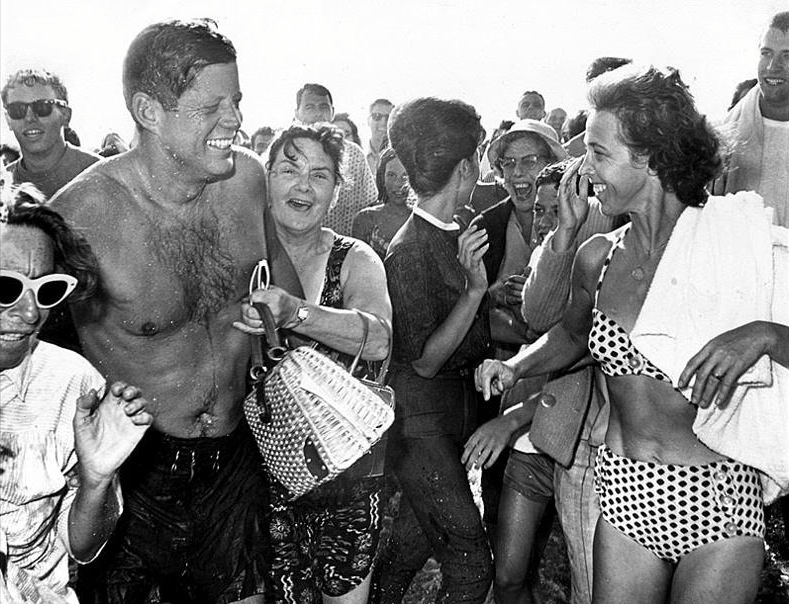
jfk beach

A reader writes:

This photo is a family heirloom. Our family friend Ruth is the woman right of center with the glasses and hat, and the arm in the tan sweater behind the woman in the bikini is our recently lamented Aunt Dorothy. The picture was taken in Santa Monica after the 1960 election, before JFK’s term began.  He’s just out for a swim at the beach. In the context of modern security, this scene is astounding.

Update from a reader:

I instantly recognized that JFK photo from the beach in Santa Monica. It’s an L.A. Times photograph from 1962. The photog, Bill Beebe, talks here about how he got the shot. The woman JFK is smiling at spoke to the paper in 1962. So I guess the term “heirloom” just struck me as odd – considering the picture’s history – and I felt I needed to share.

Thanks for doing so. And major props to Bill Beebe.

A Short Story For Saturday

This week’s selection is the late Breece D’J Pancake’s “Trilobites,” published in The Atlantic in 1977, when he was just 25 years old. It begins:

I open the truck’s door, step onto the brick side street. I look at Company Hill again, all sort of worn down and round. A long time ago it was real craggy, and stood like an island in the Teays River. It took over a million years to make that smooth little hill, and I’ve looked all over it for trilobites. I think how it has always been there and always will be, least for as long as it matters. The air is smoky with summertime. A bunch of starlings swim over me. I was born in this country and I have never very much wanted to leave. I remember Pop’s dead eyes looking at me. They were real dry, and that took something out of me. I shut the door, head for the café.

I see a concrete patch in the street. It’s shaped like Florida, and I recollect what I wrote in Ginny’s yearbook: “We will live on mangoes and love.” And she up and left without me—two years she’s been down there without me. She sends me postcards with alligator wrestlers and flamingos on the front. She never asks me any questions. I feel like a real fool for what I wrote, and go into the café.

Continue reading here. For an overview of Pancake’s brief, troubled life and writing career, go here. Peruse his only collection of stories, The Stories of Breece D’J Pancake, here.  The Dish recently featured other short stories here and here.

The View From Your Window Contest

vfyw_11-23

You have until noon on Tuesday to guess it. City and/or state first, then country. Please put the location in the subject heading, along with any description within the email. If no one guesses the exact location, proximity counts.  Be sure to email entries to contest@andrewsullivan.com. Winner gets a free The View From Your Window book or two free gift subscriptions to the Dish. Have at it.

How Many Agree With You?

Liberals and conservatives are both wrong about how mainstream their views are – but in different ways:

It isn’t just that liberals are more divided and conservatives are more united, it’s also that liberals believe they’re more divided, and conservatives believe they’re more unified, even when it’s not necessarily true. The study asked people about their opinions on a range of questions on both political and non-political topics, then asked them to guess what proportion of people who shared their general ideology agreed with them on that particular question. The results showed that liberals displayed a “truly false uniqueness effect”—they were more likely to think that their views were different from those of their peers, even when they weren’t—while conservatives displayed a “truly false consensus effect,” believing that their views were the same as their peers, even when they weren’t.

The authors also found evidence that the liberal false uniqueness effect has at least part of its origins in liberals’ personal desire to feel unique, as measured by a “need for uniqueness” scale. In other words, liberals who were more likely to see themselves as the type of person who’s different and special were more likely to think their opinions were unique as well.

America On The Move

dish_travels

For his “Restless America” project, pictured above, Chris Walker drew on data from the Census Bureau’s American Community Survey to illustrate the migration patterns of Americans. Walker explains how it works:

The visualization is a circle cut up into arcs, the light-colored pieces along the edge of the circle, each one representing a state. The arcs are connected to each other by links, and each link represents the flow of people between two states. States with longer arcs exchange people with more states (California and New York, for example, have larger arcs). Links are thicker when there are relatively more people moving between two states. The color of each link is determined by the state that contributes the most migrants, so for example, the link between California and Texas is blue rather than orange, because California sent over 62,000 people to Texas, while Texas only sent about 43,000 people to California. Note that, to keep the graphic clean, I only drew a link between two states if they exchanged at least 10,000 people.

Explore an interactive version of the graphic here. Update from a reader:

I live in Austin, Texas and drive downtown to work everyday, and during my commute I play a game with myself: if I don’t see a California license plate, I allow myself to stop by the taco truck near my office for a breakfast taco. I always lose, and I never buy tacos. Since I’m on a diet, it’s probably a good thing that there are so many Californians in Austin.

(Hat tip: John Metcalfe)