Liberalism Won’t Be Destroyed By Obamacare

extrapolation falicy

Earlier this week, Todd Purdum claimed “that the future of the Democratic Party’s plausible agenda, and of liberalism itself, is on the line.” Nyhan counters Purdum and other journalists engaging in similar hyperbole:

[T]hese journalists are falling victim to the same extrapolation fallacy that pervades so much political coverage. In these sorts of stories, reporters identify a current trend and spin out a story in which it continues to implausible extremes. Consider two recent examples: the decline in President Obama’s standing in the polls after his first debate with Mitt Romney and the surge in Democrats’ standing in the generic House ballot during the government shutdown. In both cases, journalists extrapolated wildly from a short-term trend, hyping Romney’s “momentum”and the damage to the Republican brand and suggesting that the trends would continue in the direction indicated by the arrows in the graphs below.

But as the graphs show, any shifts in public opinion around those events were transitory. … Romney’s standing in the polls stabilized soon after the first debate. Likewise, the GOP quickly shifted from defense to offense after the media’s attention shifted from the shutdown to the healthcare rollout. While it is possible to imagine alternative scenarios (see, e.g., the breathless reporting in the 2012 campaign retrospective Double Down on how Obama narrowly averted a disastrous second debate), the reality is that national politicians and parties rarely self-destruct on the level that these predictions require. Democrats now face a policy challenge that is more difficult than overcoming a poor debate performance, but it is likely that the administration will fix enough problems to maintain party cohesion and prevent repeal, particularly once they can highlight benefits from the law that will become available in January.

Trende makes a version of the same argument:

This isn’t to say that a collapse of Obamacare would be without consequences. It would probably ruin the Democrats’ chances in 2014, perhaps leading to truly significant Republican gains in the Senate. Given that that chamber tends to be a natural Republican gerrymander, it would probably take Democrats some time to recover. But also given the current makeup of the House, further liberal legislation was likely going to have to wait for quite some time anyway.

And even if Obamacare does collapse, the most liberal aspects of the American health care system — Medicare and Medicaid — will still be around. Democrats have already been pretty straightforward about what their “Plan B” will be: Medicare/Medicaid for all. Both programs are still very popular, and the Democratic standard-bearer in 2016 would almost certainly campaign on expanding them, perhaps to those over 55 for Medicare and under 25 for Medicaid. I’m not sure that would be a losing issue, even with an Obamacare collapse. In 10 years, I think it’d be a winner.

I’ve written along these lines dozens of times regarding various attempts by commentators to bury conservatism or the Republican Party. But it is no less true of liberalism and the Democratic Party. The American electorate is not intensely ideological, and is more motivated by things such as the state of the economy, whether there is peace abroad (or whether we’re winning a war), and whether the president is suffering from a major scandal. Obamacare’s collapse wouldn’t be a good thing for liberalism. It wouldn’t even be neutral. But it wouldn’t be the end of the liberal ideology, either.

Killed For Knocking At The Door

Two weeks ago, a drunk teenager, Renisha McBride, got into a car accident in suburban Detroit and sought help at the nearby house. Homeowner Theodore Wafer cracked open his door and shot her in the face with a shotgun – and then called 911. A full news report here. Jelani Cobb examines the state of self-defense in the US:

It is entirely reasonable to be alarmed by an unexpected knock in the middle of the night, and it’s not difficult to imagine someone nervously answering the door with a weapon nearby. But the Rorschach moment is what happens next: Is it possible to look through a cracked-open door and register [Glenda] Moore or [Jonathan] Ferrell or McBride as something other than an amalgam of suspicions? The raging debates over racial profiling forced police departments to confront the question of what constitutes reasonable suspicion, but at a time when the lines between police authority and that of the common civilian are increasingly blurred, those concerns have been partially privatized. Self-defense is now a matter of interpretation, divining the truth of what we see when we look at another person.

But how much blame lies with Michigan’s Stand Your Ground law? Wafer has already been charged with second-degree murder and manslaughter. Bridgette Dunlap argues that SYG – while a “terrible law” – still doesn’t allow people to shoot first and ask questions later:

The right to self-defense allows a person to use deadly force if she reasonably believes it is necessary to prevent an imminent use of deadly force by an aggressor – but she has a duty to retreat rather than use force if it is safe to do so in most states. What Stand Your Ground laws do is remove the duty to retreat when attacked. That’s it. They do not give you a right to attack when you are not in imminent danger.

In the McBride case, the law that would apply is technically not Michigan’s SYG but the state’s “Castle law,” which authorizes the use of force without any duty to retreat at one’s home. (Not having to retreat in one’s home has long been the standard; almost all states have Castle laws.) However, the Castle law will also be to no avail if Wafer did not have a reasonable fear of imminent death, severe bodily injury, or sexual assault. The facts are unclear and may never be known, but it is hard to imagine any jury would believe that a 5’4” woman knocking on a locked door would cause a reasonable fear of imminent death. So it was unreasonable to suggest SYG would apply to those facts.

The Nation has claimed that “due to similar Stand Your Ground laws in Michigan as in Florida, it’s possible [McBride’s killer] may never be charged with any crime.” Actually, we should have expected the shooter would be charged. This demonstrates a misunderstanding of SYG laws generally, and Michigan’s specifically. … Stand Your Ground is relevant here to the extent that it has exacerbated the general gun-carrying culture in the United States and altered the public understanding of self-defense. Multiple studies have shown that states that pass SYG laws experience significant increases in homicide. They do not see significant increases in justifiable homicides. This suggests that the problem is what people think SYG does more than what it actually does, which is provide a defense to homicide.

Healthcare.gov’s Missing Pieces

A government official estimated yesterday that 30 or 40 percent of Healthcare.gov still needs to be built:

Apparently, the accounting systems and payment systems that protect taxpayers against waste, fraud, and abuse—systems that also ensure that insurers get paid, and that premium subsidies are accurately doled out—have not yet been built.

It’s worth noting that, technically, you haven’t enrolled in a health insurance policy until the insurer has collected the first premium from the beneficiary. If the payment systems have not yet been built, it’s not clear how many people, then, have actually enrolled on the exchanges. Last week, the Obama administration claimed that 26,794 people had enrolled on the federal exchange, though HHS did not specify whether or not insurers had been paid.

How is this possible on November 19, when the Obamacare exchange was ostensibly launched on October 1?

Laszewski adds:

Healthcare.gov is not ready for what could come in just two weeks when, between December 1 and December 15, everyone expects massive pressure on the federal Obamacare enrollment and administration site so people can get coverage by January 1. My independent survey of health plans also matches comments by CMS Deputy Chief Information Officer Henry Chao [yesterday] at a House hearing that 30% to 40% of the IT systems needed to support Obamacare still must be built.

Sarah Kliff has more details:

The systems to send subsides to insurers haven’t been built. When someone does shop with a subsidy, the federal government is on the hook to pay part of their premium to the health insurance plan. Medicare deputy chief information officer Henry Chao testified before Congress today – and [Spokeswoman Julie] Bataille confirmed – that the system that will send those subsidies has not yet been created.

“My understanding of the system is we do not need that online until the middle of January, given how the payment schedule works,” she said. “It’s a back end system necessary to process information directly to issuers.”

In other words: Subsidies don’t start going out the door until 2014, so there is no need for the system to exist right now. Whether it exists in January 2014–that’s one area where we’ll have to wait and see.

Our Neglect Of The Mentally Ill

Mental Health Services

Austin Gus Deeds was unable to get the help he needed:

The day before he apparently stabbed his father at the family’s home in rural Bath County, the son of Virginia state Sen. R. Creigh Deeds underwent a psychiatric evaluation but was not admitted to a hospital, because no bed was available. Deeds was listed in fair condition late Tuesday after his son, Austin, stabbed him in the face and chest, then shot himself in what investigators suspect was an attempted murder and suicide.

Suzy Khimm puts this tragedy in context:

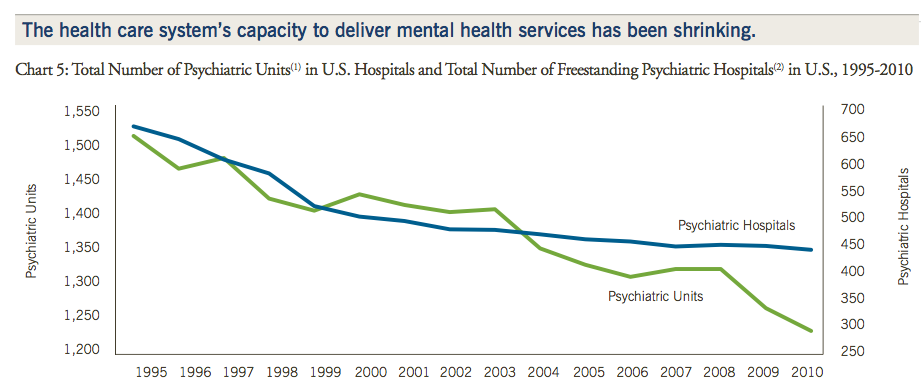
Across the country, the number of psychiatric beds has been steadily declining as hospitals moved away from institutionalizing patients and budget cuts have taken hold. The number of hospital beds in freestanding psychiatric hospitals has dropped 13% between 2002 and 2011, according to the American Hospital Association.

But the need hasn’t declined as quickly, and there haven’t been adequate alternatives to pick up the slack. Between April 2010 and March 2011, about 200 Virginia residents were deemed to be “in imminent danger to themselves or others as a result of mental illness or is so seriously mentally ill to care for self and is incapable or unwilling to volunteer for treatment.” But they were nevertheless released from custody because mental facilities didn’t have the capacity to admit them, according to a 2011 report from Virginia’s Inspector General.

In many major US cities, bed shortages have prompted emergency rooms to “warehouse” the mentally ill in holding rooms and hallways, where they languish without treatment. One Seattle woman who tried unsuccessfully to commit her mentally disturbed son in 2011 was told there were no beds available; he killed himself days later.

Tomasky weighs in:

Try this statistic on for a shocker. The per capita state psychiatric bed population in 2010 in the United States was identical to the figure for 1850. Yes, 1850, around when the very idea of caring for mentally ill people first started! Then and now, the number 14.1 beds per 100,000 population.

Between 2009 and 2012, states cut $4.35 billion from mental health services, which eliminated nearly 10 percent of all beds in just those three years. This is while 10 percent more people have been seeking services. I remember when I covered state and local politics in New York, mental health services were always among the first things on the chopping block. No constituency with any political power at all, just a bunch of do-gooders pleading for officials to do the right things. Which in fairness a lot of them want to do, but most don’t end up doing.

Toying With The Nuclear Option

Sargent reports that Reid intends to reform the filibuster:

With Senate Republicans blocking a third Obama nomination to the powerful D.C. Circuit Court of Appeals, a senior Senate Democratic leadership aide tells me Reid is now all but certain to move to change the Senate rules by simple majority — doing away with the filibuster on executive and judicial nominations, with the exception of the Supreme Court – as early as this week.

Kleiman cheers Reid on:

I’m on record as saying that a mid-session change in the filibuster rule made by simple majority vote is a breach of the Senate rules. So be it. Extraordinary abuses demand extraordinary remedies. A asymmetric political process, where one side respects convention and the other systematically abuses whatever power it has, is not sustainable.

Chait assesses the situation:

Ideally, the Senate would find some mechanism that would be strong enough to allow the minority to block unusually extreme judges from the bench, but weak enough to prevent the minority from issuing a total blockade on even qualified judges. That would require the creation of some sort of creative power-sharing arrangement that gives formal definition to the devilishly ill-defined concept of “advice and consent.” But the trend in American government has been that power does not get shared, and instead flows to whichever party has the will to seize it. Senate Republicans have seized new powers by imposing a judicial blockade on the D.C. Circuit, and the only available Democratic response appears to be seizing back more power still.

David Harsanyi suspects Reid is bluffing:

[W]ould Reid really going to blow up the Senate for some D.C. Circuit Court of Appeals judges? It seems improbable. But if he does, the GOP, should they ever return to power, will have the justification it needs to undo Obamacare – or pretty much anything they please – with their own majority. If the filibuster is neither sacred nor a check on power, there is no reason for legislation or cabinet nominees to be immune from the up-or-down vote. It’s going to mean a lot less stability in DC, a lot more seesawing legislation, and more severe partisanship than anyone in the Senate could possibly desire.

Beutler also considers how the GOP would respond:

Republicans know they’ve given Reid practically no choice. And if he goes nuclear it might prove to be an even better outcome for them. It will provide them a plausible rationale for taking things a step further if they win back the Senate in 2014. Getting Democratic fingerprints on the nuclear rule-change precedent, will provide Republicans the cover they’ll need to eliminate the filibuster altogether in January 2015.

They aren’t just testing the limits of Constitutional norms for fun. They’re testing Reid’s faith in the durability of his majority.

The Pity Of War

IRQ: City Of War

A reader writes:

If I read/listen to nothing else on The Dish in the next year, the conversation with Mr. Piro would make my subscription a bargain. Thank you.

Another writes:

As an Iraq vet, I have to say thanks and well done on the Mike Piro interview. These are exactly the kinds of things needed to address the suicide stigma.

If you want a glimpse of the intense conversation, below is Mikey’s account of grappling with the aftermath of a suicide bombing in a marketplace, as Iraq descended into anarchy:


And if you want to understand the challenges of witnessing that kind of horror and then returning to America to take up daily life again, this clip may help:


To listen to the full, wrenching conversation, click here. If you haven’t subscribed yet and want to hear more, [tinypass_offer text=”subscribe”] for full access to everything all the time. It takes a couple of minutes and costs as little as $1.99 a month. Read more about Mikey on the Dish here.

(Photo: A grave of a Sunni who was killed by Shia militiamen, on March 6, 2008 in Adhamiya, Baghdad, Iraq. Locals started burying their killed relatives in a patch of grass behind a mosque two years before, but by March 2008 it contained more than 3000 graves of victims of sectarian violence. By Ghaith Abdul-Ahad/Getty Images.)

Live By The Anecdote, Die By The Anecdote

A woman Obama touted as an ACA success story has soured on the law:

Her problem is both simple and complicated. Read this Washington State Wire post for the complicated part. The first erroneous premium quote was due to — surprise — the feds and the state not having their act together in calculating subsidies. The feds were expecting each applicant’s annual income; the state gave them each applicant’s monthly income. That led to a massive overestimate of how much taxpayer money each applicant was entitled to. The second bad quote came from poor advice given by the state itself: They encouraged her to enroll her son, who has ADHD, in the state Medicaid program, but they didn’t tell her that that meant he couldn’t be counted towards her federal subsidies for her ObamaCare plan. After the second adjustment, she was entitled to no subsidy at all. The Kafkaesque result, per CNN: “Now I have been priced out and will not be able to afford the plans you offer. But, I get to pay $95 and up for not having health insurance.”

Suderman piles on:

It’s worth highlighting the fact that this occurred in one of the 15 state-run exchanges that is supposed to be working better than the federally facilitated system covering 36 states. Indeed, Washington state’s exchange has frequently been touted as one of the systems that works the best among the state-run exchanges. But those reports tend to focus on the consumer experience—the ability of a user to smoothly navigate from start to finish in the insurance enrollment process. Yet as Sanford’s story shows, a smooth process can still be frustrated by inaccurate pricing and subsidy information. The same, naturally, would be true of incorrect enrollment data being sent to insurers, another problem that’s apparently pervasive in the federal system.

Give This To Alec Baldwin

Anna Nicole Smith Appears In PETA's "Gentlemen Prefer Fur-Free Blondes"

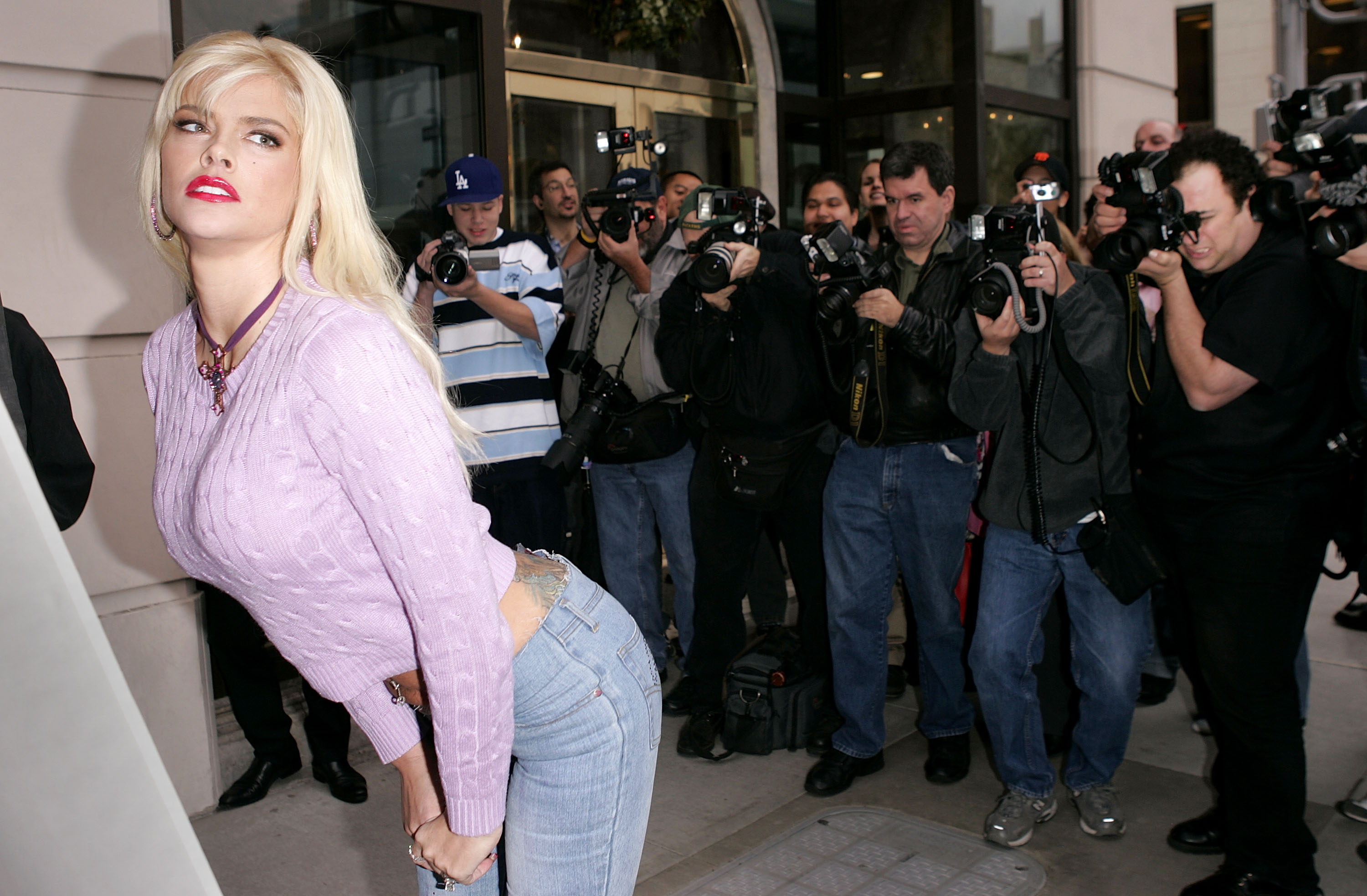
The paparazzi suck. However, Baldwin wants to use the law to rein them in:

[T]he press never turns the camera around on themselves. Least of all the tabloid press. My wife is a young mother with a newborn child. Yet reporters harass and hector her and our baby outside our home in ways that approximate a hockey brawl. It is shameful. And it should be illegal.

It is shameful – even vile. But it’s a free country. Alyssa sympathizes with Baldwin but has the same worry as me:

[A]s unpleasant as I find the conduct of very, very many celebrity photographers, I’m not sure Baldwin makes the case (or that anyone has, really) that inconvenience to celebrities justifies laws restricting the press, especially when other legal remedies are available for many of the concerns he expresses. New York City has laws making available restraining orders, handing out driving violations, and governing permitting for shooting film on city streets, all of which are potential avenues Baldwin and his peers could explore to make their lives more livable.

Among her other suggestions:

It’s undoubtedly unpleasant and anxiety-provoking to be pursued this way, but Baldwin is pursued not simply because he is famous–there are New Yorkers more famous than he–but because celebrity outbursts are a commodity. And if you provide them regularly, as Baldwin does, and as Jude Law and Kaney West have in the past, you become a reliable source of income. If Baldwin, who as a trained actor has better tools to put on false emotions than most of us do, simply went inert at the sight of a photographer, or if he and his wife traveled primarily by car and driver, they would almost certainly diminish their value to the people who presently harass them.

The AC360 Later panelists and I tackled the latest Baldwin blowup the other night – watch here. A reader’s two cents:

I was listening to a recent episode of Alec Baldwin’s podcast, Here’s the Thing, and was struck by his own statements about his relationship to papparazi and why he engages in the fights in the first place. It was in the episode with Jerry Seinfeld (which is an interesting one for a lot of reasons). I’ve run out of time to find you the timestamp for the part where Alec explains his outrageous behavior, but you’ll know it when you hear it. He really feels that he is on the side of justice. Nothing in there about why a person would need to use gay slurs in the line of perceived duty, but still, I think the man is a fascinating and complicated person.

(Photo: Model Anna Nicole Smith poses on Rodeo Drive as she unveils a poster to promote a new ‘Gentlemen Prefer Fur-Free Blondes’ ad for People For The Ethical Treatment of Animals in Los Angeles, California on December 7, 2004. By Carlo Allegri/Getty Images.)

The Sheer Size Of Healthcare.gov

In October, the NYT reported that the ACA site has around 500 million lines of code. David Auerbach took issue with the number, noting that he’s “seen nearly identical segments of code written in 10 lines or in 50.” Regardless, Healthcare.gov is a massive undertaking. If you want to envision just how massive, take a look at this eye-popping chart, which puts the alleged 500 million lines of code in context.

And the Obamaites thought this didn’t need constant, early and repeated testing? Are they on another planet or another solar system?