How Cleaning Eggs Can Contaminate Them

Ever wonder why most people around the world don’t refrigerate their eggs? Robert T. Gonzales provides the surprising explanation:

[E]ggs run the risk of getting feces on them. Whether that feces contains traces of Salmonella or not, it stands to reason that if an egg gets poop on it, you should wash it off. And, in America, that’s exactly what we do. In an elaborate automated process involving in-line conveyor belts, massive egg-scrubbing machinery, high-volume air-filtration systems and – last but not least – chlorine misters, American eggs are washed, rinsed, dried, and sanitized in an effort to remove as much dirt, poop and bacteria as possible, all while leaving the shells intact. (Read the details in the USDA’s Egg-Grading Manual.)

Or rather, almost intact. When a hen lays an egg, she coats it in a layer of liquid called the cuticle. It dries in just a few minutes, and is incredibly effective at protecting the egg from contamination, providing what European egg marketing regulations describe as “an effective barrier to bacterial ingress with an array of antimicrobial properties.” America’s egg-washing systems strip eggs of this natural protection. “Such damage,” the EU guidelines note, “may favor trans-shell contamination with bacteria and moisture loss and thereby increase the risk to consumers, particularly if subsequent drying and storage conditions are not optimal.” Washing eggs is therefore illegal throughout much of Europe.

Plus, America is home to some sick-ass chickens:

The other reason Americans tend to refrigerate their eggs: our risk of Salmonella poisoning is often significantly higher than it is overseas, because our chickens are more likely to carry it. In the UK, for instance, it is required by law that all hens be immunized against Salmonella. This protection measure, enacted in the late 1990s, has seen Salmonella cases in Britain drop from 14,771 reported cases in 1997 to just 581 cases in 2009.

There is no such law in the United States, and while more farmers are electing to immunize their hens in the wake of a massive Salmonella-related recall in 2010Salmonella infection remains a serious public health issue. Even in spite of our egg-washing and our refrigeration habits, FDA data indicates there are close to 150,000 illnesses reported every year due to eggs contaminated by Salmonella.
Selfie; A Noun

The Oxford Dictionaries have made it their neologism of the year. Defined as:

a photograph that one has taken of oneself, typically one taken with a smartphone or webcam and uploaded to a social media website.

Its usage has increased 17,000 percent in the last twelve months. Did you know it came from Down Under?

Oxford Dictionaries revealed this week the earliest known usage is from a 2002 online ABC forum post. The next recorded usage is also from Australia with the term appearing on a personal blog in 2003. “It seems likely that it may have originated in the Australian context,” dictionary editor Katherine Martin said. “The earliest evidence that we know of at the moment is Australian and it fits in with a tendency in Australian English to make cute, slangy words with that ‘ie’ ending.”

And yes, said Aussie was shit-faced at the time:

Um, drunk at a mates 21st, I tripped ofer [sic] and landed lip first (with front teeth coming a very close second) on a set of steps. I had a hole about 1cm long right through my bottom lip. And sorry about the focus, it was a selfie.

Wait, there’s more:

It has since produced an array of spinoffs, including helfie (hairstyle self), belfie (bum selfie), welfie (workout selfie), drelfie (drunken selfie), and even bookshelfie – a snap taken for the purposes of literary self-promotion.

Healthcare Socialism 1; Healthcare Capitalism 0

ihp itl L

The Commonwealth Fund quietly eviscerates America’s medical system with some basic facts. Two of the more remarkable ones:

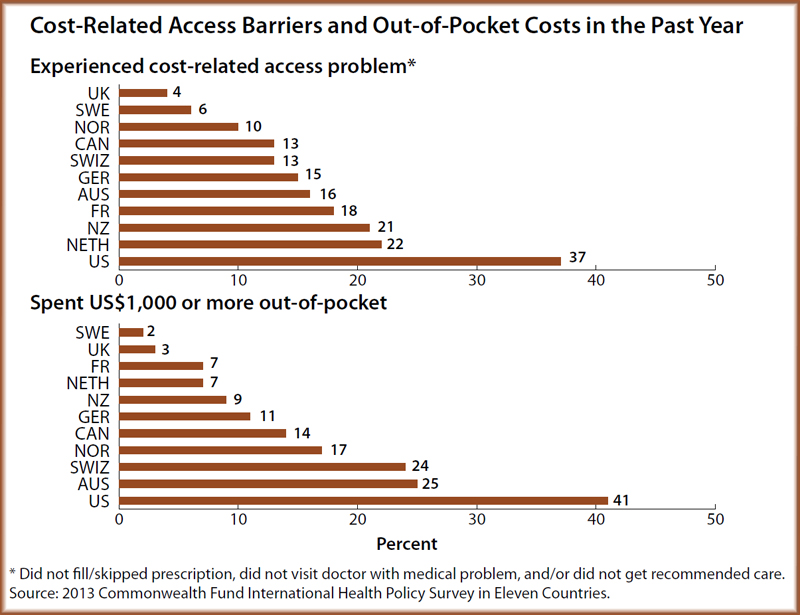
In 2013, more than one-third (37%) of U.S. adults went without recommended care, did not see a doctor when they were sick, or failed to fill prescriptions because of costs, compared with as few as 4 percent to 6 percent in the United Kingdom and Sweden.

Roughly 40 percent of both insured and uninsured U.S. respondents spent $1,000 or more out-of-pocket during the year on medical care, not counting premiums. High deductibles and cost-sharing, along with no limits on out-of-pocket costs, may explain why even insured people in the U.S. struggled to afford needed health care, the researchers said.

I’m sympathetic to the ideas of Ponnuru and Levin, and if they had been seriously proposed by the GOP at some point, would have been open to them. But I can’t see them truly changing the core equation – where the US pays far more and gets far less in healthcare than any other comparable country.

When a private sector system means you have ten times as many people failing to get basic treatment as in Britain’s uber-socialized NHS, you realize just how great the market failure is. I’m all for markets, but the facts seem to me to reveal that in healthcare, they are toxic to most people’s actual, you know, health. In what other area does socialism work so much better than capitalism? Isn’t that a first order question conservatives should address?

A Family Tree For Fairy Tales

Victoria Turk explains how anthropologist Jamshid Tehrani is using the tools of evolutionary science to discover the origins of folk stories:

In his introduction to [his] study, published in the journal PLOS One, Tehrani explained that the common historic-geographic method of classifying folktales into “types” was flawed owing to a tendency to lump stories with a few similar plot points together despite dissimilarities they might have, as well as a sampling bias resulting from a focus on European tales over other folklore traditions. Essentially, it’s all very tenuous and subjective.

So he turned to evolution. He used phylogenetic analysis, a technique developed to analyze the evolutionary relationships among biological species, to analyze links between similar folktales. Just as you might map the evolution of an animal by looking at species with similar traits, Tehrani set out to make a tree graph of Little Red Riding Hood’s ancestry based on characteristics it shares with folk stories through history.

Tehrani elaborates on his method:

The idea is to use a biologist’s tool to investigate the evolution of folktales. This is because folktales not only evolve through similar processes as biological species (variation, selection and inheritance), but the problems of reconstructing them are also comparable. Just as the fossil record bears witness to a tiny proportion of extinct ancestral species, the literary record provides scarce textual evidence about early forms of folktales because they have been mainly transmitted through oral means. Phylogenetics can fill these gaps by using information about the past that has been preserved through the mechanism of inheritance.

His findings:

[There’s a] long-running debate about the relationship between Little Red Riding Hood and similar tales from other regions of the world. These include East Asian tales in which a group of sisters are home alone when they hear a knock at the door. It is a tiger (or leopard, or some other predator) disguised as their grandmother. Despite her suspicious appearance (“Granny, why are your eyes so big?!”) they let her in. That night they share a bed, and the tiger eats the youngest girl to the horror of her sisters, who manage to escape.

Another tale, from central and southern Africa, involves a young girl who is tricked by an ogre pretending to be her brother. When her brother finds out he tracks down the ogre, kills him and cuts her out of the villain’s belly. Both these tales bear a clear resemblance to Little Red Riding Hood. But they are also similar to another well-known international type tale: “The Wolf and the Kids,” in which a group of goat kids are devoured by a wolf who gets into their house by impersonating their mother.

By analyzing variables in the plots and characters of 58 folktales using three methods of phylogenetic analysis, I was able to establish, in a paper just published in PLOS ONE, that the African tales are clearly more closely related to The Wolf and the Kids than they are to Little Red Riding Hood. The East Asian tales evolved by blending together elements from both these tales and from local folktales.

Winning Back The Nation’s Trust

Dickerson contends that Obama’s credibility has taken a major hit:

The complexity of the repair job and the history of broken promises means [the Obama team] probably shouldn’t even be guaranteeing the site will be working by a hard date. In a battle for credibility, these claims don’t send calm—they send a warning that another disappointment is coming. Baby please take me back, this time I promise. … Obama’s credibility challenges won’t stop when his incompetently mismanaged health care website is finally repaired. Once that gets fixed, the president will ride another credibility roller coaster: truthfully describing whether the Affordable Care Act is working as designed.

Tomasky’s gives advice to the president:

Actions are needed now. Obama should be up there—not Kathleen Sebelius, and not the website’s Mr. Fix It Jeffrey Zients; Obama—on a daily or near-daily basis explaining to people, “Here’s what we did today to make this better.” He needs to be (non-sports analogy ahead!) like a mayor handling a snowstorm or a garbage strike. That’s what this is. Citizens need to know stuff. They need to feel someone is in charge. One press conference is defense. Daily updates on what’s getting better make for offense.

Of course he’s not going to. If he were that kind of hands-on manager, this mess might not have happened in the first place.

My thoughts on the subject here.

Exporting Online Education

Screen Shot 2013-11-17 at 10.50.53 PM

American MOOCs are in high demand abroad:

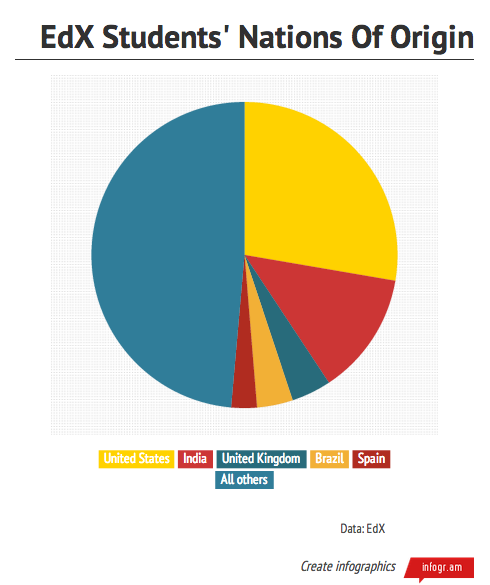
Sixty-eight percent of Coursera’s users come from outside the United States, with India, China, Brazil, and Mexico all in the top 10. In these countries, enrollment in tertiary education is growing by leaps and bounds. Public systems aren’t equal to the demand, and private for-profit options are seen as offering a subpar product.

Anya Kamenetz worries that MOOCs will steamroll local universities:

For example, Kepler, a U.S.-based endeavor, announced its intention to offer an education superior to any available at a Rwandan university for a lower cost. This may benefit a small group of Rwandans in the short term, but it does not assist President Paul Kagame’s struggle to improve education and technology in that country over the long term. It’s easy to imagine a future in which the educational equivalent of reruns of Baywatch – a limited menu of glossy American fare – comes to dominate the cultural landscape in developing countries around the world, making it more difficult for cash-starved universities in those countries to pursue scholarship relevant to local contexts.

Update from a reader:

I’m a long-time reader and cofounder of Kepler, which Kamenetz referenced in her Slate article about the negative impact of MOOCs in Africa. Rwanda’s Ministry of Education has been tremendously supportive of Kepler so far, since they’re curious to know whether a model like ours – online courses, in-person seminars led by Teaching Fellows, job training – can lower cost and improve outcomes within their own university system. African universities are already struggling with low graduation and employment rates, and thanks to the coming, uh, youth bulge, demand is going to increase faster than anywhere else in the world. So while MOOCs aren’t the entire solution, online content is going to be part of any scalable solution. Traditional higher ed is just way too expensive to accommodate exploding demand across Africa. Most governments realize this and are looking at projects like Kepler for innovative solutions.

Previous Dish on massive open online courses here.

Attacking Obamacare’s Foundation

Yuval Levin believes that the ACA is fundamentally flawed:

The key to Obamacare is something it doesn’t have in common with conservative approaches to health care: It seeks to impose a very specific model of insurance and compel people to buy into it. It has the government strictly define the insurance product, requires insurers to sell it, requires consumers to buy it, and calls that a market.

The result is not just a gross constriction of the economic liberty of all involved, though that is no small problem. And the result is not just high prices, either, though those clearly contribute to the difficulties Obamacare is already confronting. The key consequence of this kind of approach is an inability to find that balance between quality and price that could allow for the greater access and security we want: It is a failure to achieve a more efficient system, which is more or less the whole point of reforming American health-care financing.

Applying expert knowledge from the center is just not a recipe for efficiency in a system as enormous and complex as America’s health-care system. And the idea that we already know what the answers are to the quandaries of health-care financing in our country — whether because other countries have found those answers or because the latest effectiveness research makes it clear — just doesn’t hold up to scrutiny. More important, an evolving system as intricate as American health care isn’t going to be made radically more cost-effective by any one model of efficiency over the long-term anyhow. The appeal of a competitive insurance market in which sellers have a constant, huge incentive to give buyers what they want is that such a system is constantly searching for a better answer to our problem, and so is able to evolve as health care and health financing evolve. It doesn’t get stuck with today’s answer forever, let alone with a wrong answer.

Last week, Levin and Ponnuru suggested an alternative to Obamacare that would use “a flat and universal tax benefit for coverage” and cap the employer health insurance tax break. More details:

People who have pre-existing conditions when the new rules take effect would be able to buy coverage through subsidized, high-risk pools. By making at least catastrophic coverage available to all, and by giving people such incentives to obtain it, this approach could cover more people than ObamaCare was ever projected to reach, and at a significantly lower cost.

The new alternative would not require the mandates, taxes and heavy-handed regulations of ObamaCare. It would turn more people into shoppers for health care instead of passive recipients of it—and encourage the kind of insurance design, consumer behavior and intense competition that could help keep health costs down. Redesigned and directed this way, the flow of federal dollars and tax subsidies would do much less to distort health markets than it has for the last several decades, while getting far more people insured.

In response, Adrianna McIntyre points out problems with high-risk pools:

[T]he pools would need to be incredibly well-funded—conservative health policy scholar James Capretta estimated that adequate funding would be on the scale of $15-20 billion a year to cover 4 million individuals. Remember that back in the real world, the GOP quashed a bill for $4 billion in  one-time high risk pool stopgap funding earlier this year.

In the context of Ponnuru and Levin’s plan, high risk pool funding is in addition to their proposed tax credits, which would be sufficient  for individuals without employer-sponsored coverage to purchase catastrophic plans. Ponnuru and Levin argue that their plan is cheaper and would offer more coverage than the ACA, but the column is fuzzy on details, like the Capretta “repeal and replace” proposal it seems to be patterned on. It would be helpful if they had actually defined what a “catastrophic” plan might entail, for example, so it’s difficult to assess how the costs of this proposal would stack up against the ACA.

Did Mao Modernize China?

Reviewing a set of books on China’s path to power in the 21st century, Ian Johnson takes issue with the popular idea that Mao’s reign, much like Stalin’s, proved necessary to modernize a vast, backward country:

[It] supposes that prior to Mao, China was on a dead-end path—that essentially it needed a Mao joeblack4or it wouldn’t have modernized. This used to be a fairly conventional view, but many historians now believe that the pre–World War II Nationalists were well on their way to modernizing China and likely would have stayed in power if Japan had not invaded. [Authors Orville] Schell and [John] Delury are aware of this argument, and mention a “golden decade” of development in their chapter on Chiang Kai-shek; but they don’t follow through on its implications. If Chiang and the Nationalists were succeeding, then why was Mao’s destruction necessary?

Rather, it seems to me that the authors could more easily have portrayed the Mao years as motivated by fuqiang [wealth and power]—and thus not at odds with their overall narrative—but as a period that, nevertheless, led China down a dead-end street. One could even go further and say that the Mao years helped prepare for economic takeoff by creating a literate and healthy workforce—two real accomplishments—while they also laid the Communist Party so low that Deng was forced to experiment with capitalist-style reforms. Instead, there is almost a teleological argument that Mao was necessary, perhaps to give meaning to the series of catastrophes that defined his years in power, such as widespread death by famine during the Great Leap Forward and the millions more who perished in political campaigns like the Cultural Revolution.

(Image of a toy-soldier mosaic of Mao courtesy of artist Joe Black)

A Minimum Income For All?

Switzerland may become the first country to guarantee one by providing all adults about $2,800 each month. Danny Vinik thinks it’s an idea worth importing:

The clear [benefit] is that no American would live below the poverty line. The U.S. has been waging the War on Poverty for a generation now and still nearly 50 million Americans are below the line. This would end that war with a decisive victory. There are knock-on effects as well. Americans would have greater leverage to demand higher wages and better working conditions from their employers thanks to the increased income security. Families could allow one parent to take time off to raise their kids. Eliminating the numerous different government welfare programs would also lead to efficiency gains as adults would simply receive their check in the mail and not have to waste time filling out paperwork at numerous different offices. …

Economists have long shuddered at the thought of a basic income, because it strongly disincentives work. However, a basic income is just that: basic. Most adults would continue to work to earn extra money. The employment effects would not be non-existent and there may be an increase in part-time work. As Lowrey points out, different studies have found the disincentive effects on work are not as strong as economists feared.

McArdle is rightly skeptical:

Consider the cost of real estate, one of the sore points in Switzerland, where there isn’t a whole lot of flat land to build on. In that, Switzerland is a bit like my own home city of Washington: it’s a small area attracting a lot of new, more-affluent residents (wonks and lobbyists, in Washington’s case; international finance types for Switzerland). Many of the poorer residents don’t make enough to compete in the new bidding wars, and they don’t like it one bit.

But suppose we gave everyone in Washington a check for $2500 a month. Would that make it easier for the old residents to get nicer apartments? Not really, because everyone would be getting that check. Poorer residents would have another $2500 to commit to the housing bidding war, but so would the wealthier residents. Unless the $2,500 actually created a larger supply of housing — and that’s as much a matter of planning regulations and building codes as of demand.

She also worries what effect it would have on immigration:

[A] substantial basic income is simply and obviously incompatible with making it relatively easy for people from poor countries to become citizens. A path to citizenship for legal immigrants is one of the foundational values of American society; we are Americans because we are born here or we choose to come here, not because of some ethnic heritage. We couldn’t get rid of it even if we wanted to; the idea that anyone born on American soil is an American is enshrined in our constitution. And of course, if you had to choose between a basic income, and relatively easy immigration, the choice is obvious — at least if you’re interested in improving human welfare.

Alec Liu argues that “the problem, as with many issues economic, is that there is no historical precedent for such a plan, especially at this scale.” However, he concedes a few “isolated instances” of governments providing a minimum income:

Similar plans have been proposed in the past. In 1968, American economist Milton Friedman discussed the idea of a negative income tax, where those earning below a certain predetermined threshold would receive supplementary income instead of paying taxes. Friedman suggested his plan could eliminate the 72 percent of the welfare budget spent on administration. But nothing ever came to fruition.

It’s what makes the potential experiment in Switzerland so compelling. Developed countries around the world are struggling to address the issues of depressed wages for low-skilled workers under the dual weight of automation and globalization.