
Toronto, Canada, 3.40 pm
Toronto, Canada, 3.40 pm
A neuroscientist describes coming to terms with getting Parkinson’s in his mid-30s:
I was diagnosed with Parkinson’s more than two years ago. From that day, I have had a different relationship with the brain — my scientific focus for the past 20 years. I now know what it is like to have a brain disorder and can explore its manifestations first hand. Take the very peculiar symptom known as ‘freezing’. Occasionally, when I attempt to lift my hand it well … won’t. Notice that I didn’t say can’t. There is nothing wrong with my arm. It is still strong and capable of moving, but I have to put effort, even focus, into getting it to move — frequently to such a degree that I have to pause whatever else my brain is doing (including talking or thinking). Sometimes, when no one else is around, I use my other hand to move it.
As a neuroscientist, it is simultaneously fascinating and terrifying to be directly confronted with the intersection of the neurophysiological and philosophical constructs of ‘will’. The way my mind and body do battle forces me to reconsider the homunculus, a typically pejorative (among neuroscientists) caricature of a little man pulling levers inside our heads, reading the input and dispatching the output. Virtually all that we know about how the brain is organized belies this image, and yet there is a dualism to my daily experience.
Parkinson’s, particularly in young people, is primarily a disorder of motor control, not of cognition. Still, my experience, however limited, leads me to speculate about what it is like to be trapped by a brain gone rogue. When one begins to lose the ability to interact with the world, and when one’s faculties for clear perception and cognition are stripped away, what remains of the conscious self?
Elias Leight surveys the spectrum of popular music touched by the drum machine:
Most people credit Sly Stone’s use of a Maestro Rhythm-King MRK-2 on the 1971 No. 1 “Family Affair” as one of the defining early moments for programmed percussion. During the ‘70s, the devices worked their way into hits—Blondie’s “Heart Of Glass,” Donna Summer’s “I Feel Love,” Roxy Music’s “Dance Away”—and carved space in both explicitly regenerative genres like new wave and commercial juggernauts like disco. In the ‘80s, Prince, Michael Jackson, and Madonna all used drum machines. Hip-hop developed into a national force behind acts like Run DMC, LL Cool J, and the Beastie Boys; they had the toughest beats around, put together with drum machines.
There are still corners of the world for the machines to colonize—they probably appear less in country music, for example, though J.J. Cale used them under his loping country grooves—but their unique propulsion is pervasive, and valuable. This is true regardless of how you evaluate music. If your metric is sonic innovation, drum machines have consistently pushed boundaries further: Kraftwerk playing every part of their songs on a machine; Lee “Scratch” Perry using the “Super Rhythmer” to help open reggae’s spaces; Prince working with Linn models, pumping record levels of sexuality and whiplash into funk and pop. (Questlove, drummer for the hip-hop band the Roots, suggested that “Prince is, bar none, the best drum programmer of all time.”) Grandmaster Flash, the Daft Punk influence Jean-Michel Jarre—these people worked with drum machines to create new worlds of music.
Since humans are over-farming salmon and cod, the new, alternative fish “need great salesmen, because attempts to market them come with a small margin of error”:
The simplest way to make a fish catch on – that speaks much strongly to our unadventurous tendencies — is just to call it salmon. That may well be why spiny dogfish, called “rock salmon” in England and “little salmon” in France, works so well for Europe. The salmon trick seems to work for just about anything: When it appears on his menus, [seafood chef Rick] Moonan tells his staff to refer to Arctic char as “salmon lite,” and what he calls steelhead salmon is actually trout.
Regardless of how salmon-y these alternatives are, we need them, because demand for the pink fish far outpaces what wild populations are able to supply. Customers who have learned to turn their noses up at farmed salmon, said [seafood shop director Davis] Herron, have been known to insist upon purchasing the wild variety year-round, relying, when it’s out of season, on wild cuts that, as he puts it, “taste like shit.”
I’m glad the allegedly liberal network does not regard violent homophobic bigotry as something it wants to associate with. Here’s the Baldwin apology. If you haven’t read TNC on this yet, you should.

A paper from earlier this year suggests that the economic fallout of a typhoon is often deadlier than the storm itself. Joshua Keating parses it:
In the areas studied, typhoons reduced household incomes by an average of 6.6 percent. Household expenditure decrease 7.1 percent for the average household in the average year. “In general, households reduce their spending the most on expenditures that most closely resemble human capital investments, such as medicine, education and high nutrient foods that include meat, dairy, eggs and fruit,” the authors write. They also argue that for infant mortality, the impact of the economic deprivations caused by the typhoon is far worse than exposure to the storm itself. “11,300 female infants suffer post-typhoon ‘economic deaths’ in the Philippines every year, constituting roughly 13% of the overall infant mortality rate in the Philippines,” they write. This is roughly 15 times higher than the mortality caused by the storm.
Earlier Dish here on whether First World countries should compensate Third World countries for the damage done by hurricanes and typhoons fueled by global warming.
(Photo: Zosimo Moabando sits with his young grandson Kyle on the roof of their damaged house in the devastated town of Tanuan, south of Tacloban, on November 15, 2013 in Philippines. By Kevin Frayer/Getty Images)
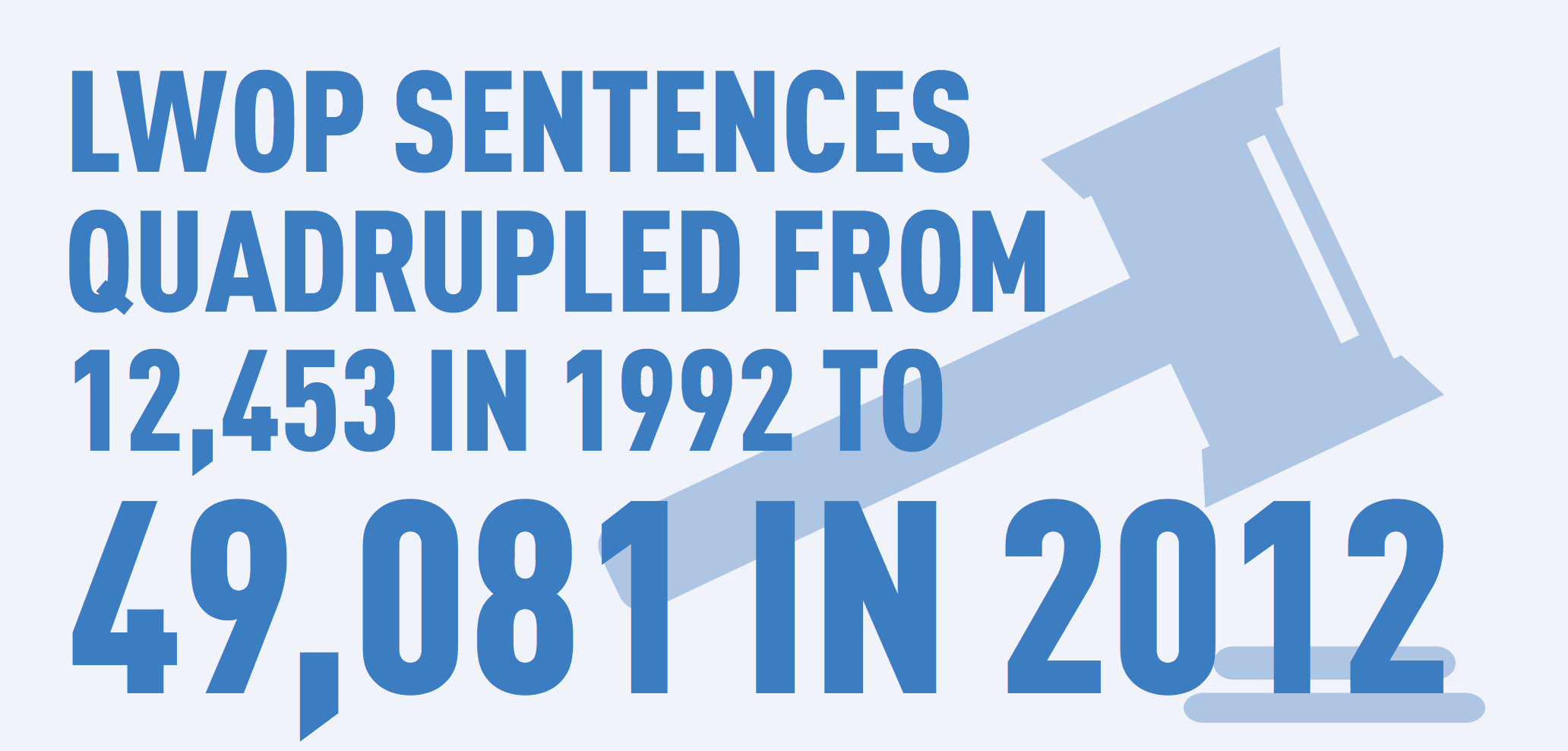
Mark Perry highlights a report on life without parole (LWOP):
A new report released this week from the American Civil Liberties Union ”A Living Death: Life without Parole for Nonviolent Offenses” examines a very disturbing trend that contributes to America’s notoriety as the World’s No. 1 Jailer – the increasing number of nonviolent offenders in the US who are being sentenced to life in prison without parole. As Reason.com reported “The ACLU found, perhaps unsurprisingly, that the War on Drugs, mandatory minimums, and “tough-on-crime” policies are to blame” for the more than 3,000 prisoners in America serving life sentences without parole (LWOP) for nonviolent drug and property crimes.
Kleiman comments:
[T]hough I can understand the politics of the situation, I can’t actually justify President Obama’s failure to commute a bunch of these sentences. If the pardon process is too opaque, then appoint three while male conservative Republican retired federal judges as an unofficial “clemency committee,” with a pre-commitment to commute any sentence for which they unanimously recommend commutation.
No I am not making this up either.
Olivia Loving illuminates it:
Compulsive tics steal most of the limelight when it comes to Obsessive-Compulsive Disorder. Comparatively less attention, meanwhile, is given to the obsessive thoughts that characterize the other half of OCD. The content of these obsessions can range from pedophilia to homicide to sexual identity crises; compulsions “atoning for” the thoughts sometimes follow. For example: A woman, distraught by visions of murdering her child, wakes up several times in the night to check on her daughter.
In discussions about OCD with family and friends, I’ve observed that it is easier for others to adjust to compulsions they can see rather than obsessions they can’t. It is easier for them to understand repetitive hand-washing than, say, the fear of murdering your parents.

 The Dish