Why Big Ag Should Fight For GMO Labels

David Ropeik, a risk consultant, pens an open letter to agricultural CEOs:

Engaging in a potentially risky behavior, knowingly and voluntarily, makes the potential risk feel much less scary. This is the underlying psychological reason why the idea of labeling has so much popular support, and is almost certain to become law despite the millions you are spending to forestall the inevitable. We all want choice over the risks we may face. You do too. Choice makes risks feel voluntary. It makes us feel empowered, more in control of our health and safety, and that makes any risk feel less scary. Time and time again, when people are given choice – as labeling would do – their fears are reduced and they engage in risks they fight tooth and nail when the risk feels imposed.

The fear of GMOs has little to do with the science behind the actual safety of the product, the ground on which you keep fighting your battles. Fighting labeling, denying people choice, feeds that mistrust. It sounds – it is – defensive, self-protective, not really about our health and safety, which you so adamantly argue is not at risk from GMOs, but the safety of your profits. But that is precisely why the focus of the GMO battle on labeling has given you the most dramatic opportunity in years to advance the application of this vital, valuable, and yes, safe technology (according to all the most prestigious independent science and research organizations in the world.) Nothing you could do, and certainly nothing you could say, would have as great an impact on public trust as changing your position and supporting labeling.

Social Media Is Becoming Less Free

In response to Twitter going public, Benjamin Kunkel pens a manifesto arguing that “social media can either be profitable or it can be social. In the end, it can’t be both”:

The IPOs of Facebook and Twitter should therefore be reversed, through the socialization of both companies and other social-media services that attain a similar scale. The time has come, in other words, to socialize social media. Keynes long ago called for “a somewhat comprehensive socialization of investment” in modern economies, while leaving room for the skill and inventiveness of entrepreneurs “(who are certainly so fond of their craft that their labor could be obtained much cheaper than at present), to be harnessed to the service of the community on reasonable terms of reward.” The broader question can await another day. But large social media companies particularly invite socialization—that is, going public in the sense of public ownership—for the reasons that follow.

One of the reasons he outlines:

Social media should be socialized because attaining profitability (through ads or fees) is impossible without degrading the service.

So far executives hope to turn a profit by providing ad space and/or by data-mining users so that information can be sold to advertisers to use more broadly. The more social-media services are infiltrated by ads, the less the user enjoys the fundamental social right of choosing her own company. On Twitter I follow who I want and don’t follow the others. On Facebook, as IRL, I choose my friends as well as those people I find it socially convenient to call “friends.” And as with social life generally, there are no directly assessed fees for participation, any more than I have to pay a toll to walk down the street with a friend (or follower).

Advertising degrades this freedom. I don’t get to choose whose ads I see, or whether I want to see any. Some people may enjoy corporate advertisements—and they should be able, accordingly, to follow Burger King or Pfizer. But I have something to advertise as well: my opinions, the articles I write, the books by other people I think you should buy, et cetera. That is my freedom, just as it’s yours to follow or block or unfriend me. We only lack this freedom when it comes to corporate entities with the budgets to override our choices. And everything suggests that as Facebook and Twitter try to increase revenues and share value, they will pollute social media with ever more ads.

Meanwhile, Kentaro Toyama argues that social media is less and less a liberating force:

[W]hat both Chinese censorship and American surveillance show is that there is nothing inherently democratizing about digital networks, at least not in the political sense. Far-reaching communication tools only make it easier to impose constraints on the freedom of expression or the right to privacy. Never before have Chinese censors had it so easy in identifying subversive voices, and never before has the NSA been able to eavesdrop on the private communications of so many people.

Silicon Valley feeds us a myth of technology trumping politics, but if anything, it’s the other way around. How else would the NSA have been able to strong-arm nine tech giants like Apple, Facebook, Google, and Microsoft into cooperating with its PRISM program? What’s telling was the embarrassed semi-apology that these firms issued to the public – their excuse came down to, “We didn’t want to. What we did wasn’t so bad. They made us do it.” Meanwhile in China, Internet companies are a seamless extension of the government’s censorship machine.

Gun Control Slips Off The Front Pages

Enten reviews the data:

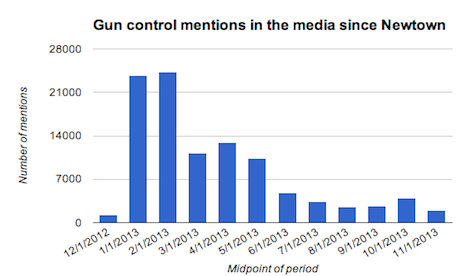
Using the site NewsBank, we know that in the month following Newtown the number of news stories that Gun Control Mentionscontained the phrase “gun control” was 23,712. The month after that, the number was 24,244. That was up from just 1,266 in the month prior to the Newtown shooting. Clearly, Newtown was “different”.

The problem is that the media ended up switching gears. In this 24-hour news cycle, it was only a matter of time before there was something new happening. Check out how the number of news stories dropped off since the second month after Newtown.

In the three months following the first two, the number of news stories dropped by half. Then the bottom fell out, and the number of news stories referencing gun control since that point has never climbed above 5,000. Last month, the number hit its post-Newtown low of 2,001. Don’t be surprised if that falls even further as Newtown fades even further into memory, and the holiday season begins in earnest.

Without the media, the public polling trend is quite unlikely to be reversed. The percentage of people who don’t want stronger gun control will outnumber those who do.

Fighting Pop With Pop?

Alyssa ponders Lily Allen’s new music video:

The video is simultaneously pastiche and critique, referencing everything from Robin Thicke’s discussions of his anatomy in balloon writing to Miley Cyrus’ use of twerking African-American backup dancers as objects, and linguistically playing off Three 6 Mafia’s “It’s Hard Out Here For a Pimp.” And as apt as the song and video feel now, it’s also part of a long tradition of female pop stars whose brands rely on the idea that they’re different from their fellow pop tarts making music and videos that explicitly swipe at the conventions of their industry.

But she has misgivings:

The truth is that, as much as I adore Pink and Lily Allen in particular, artists like them and songs like these effectively function as a pressure valve for Big Music. By giving these women money and a platform to critique the industry in which they’ve succeeded, large labels prove exactly how tolerant and expansive they are, while continuing on their merry way to make the kind of music and images Allen, Jewel, and Pink deplore.

Prachi Gupta is much harder on Allen:

Allen opted to just stuff some sexist shit into a box, wrap it in a bow that says, “The contents of this box are sexist, so fuck this box, but also, go ahead and open the box.” Lily Allen is smart enough and talented enough that she doesn’t need to repackage that shitty box. She can throw it out and make something better.

Ayesha Siddiqi brings race into the debate:

It is not feminist to mock talented dancers of color for exercising skills Allen doesn’t possess. It is not feminist to claim that women who cook and dance provocatively are as damaging as a manager barking at her to lose weight. It is not feminist to remain blissfully colorblind in a world that functions along race.

Allen responds to critics:

The message is clear. Whilst I don’t want to offend anyone. I do strive to provoke thought and conversation. The video is meant to be a lighthearted satirical video that deals with objectification of women within modern pop culture. It has nothing to do with race, at all.

Selling Out Can Be Smart

Yglesias is pleased by Snapchat’s refusal to sell to Facebook for $3 billion:

The company’s founders and investors may or may not be making a terrible mistake. But from the sidelines, I think one should almost always root against the acquisition exit. It’s boring. It’s lame. The bet when you turn down $3 billion is that there’s some chance that in the future your company will be worth $30 billion or $300 billion and you want to reach for those stars and dare to dream.

Joshua Gans calls this “jaw droppingly bad analysis”:

Ultimately, while it is easy to pull apart these arguments, the actual real history of entrepreneurial firms tells us that most of them succeed by cooperating with established firms rather than competing with them as Yglesias is cheering here. As a person responsible for much of that research (see herehere,here and here to name but a few), let me tell you that the struggle in getting acquired is getting a big payout from stronger incumbents; something Snapchat, like Groupon before them, seem to have overcome. To be sure, there are companies like Google and Dropbox (who each turned down a small amount), that end up doing quite well. But they are the exceptions rather than the rule. Snapchat may prove me wrong but I have to say, kids, you should have taken the money.

Obama’s Obamacare Fix: Reax

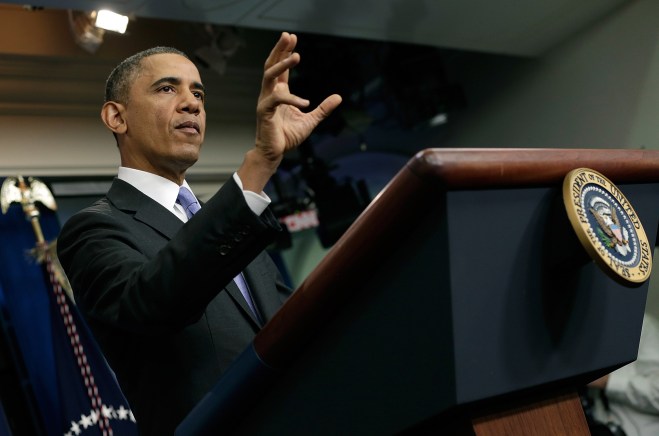
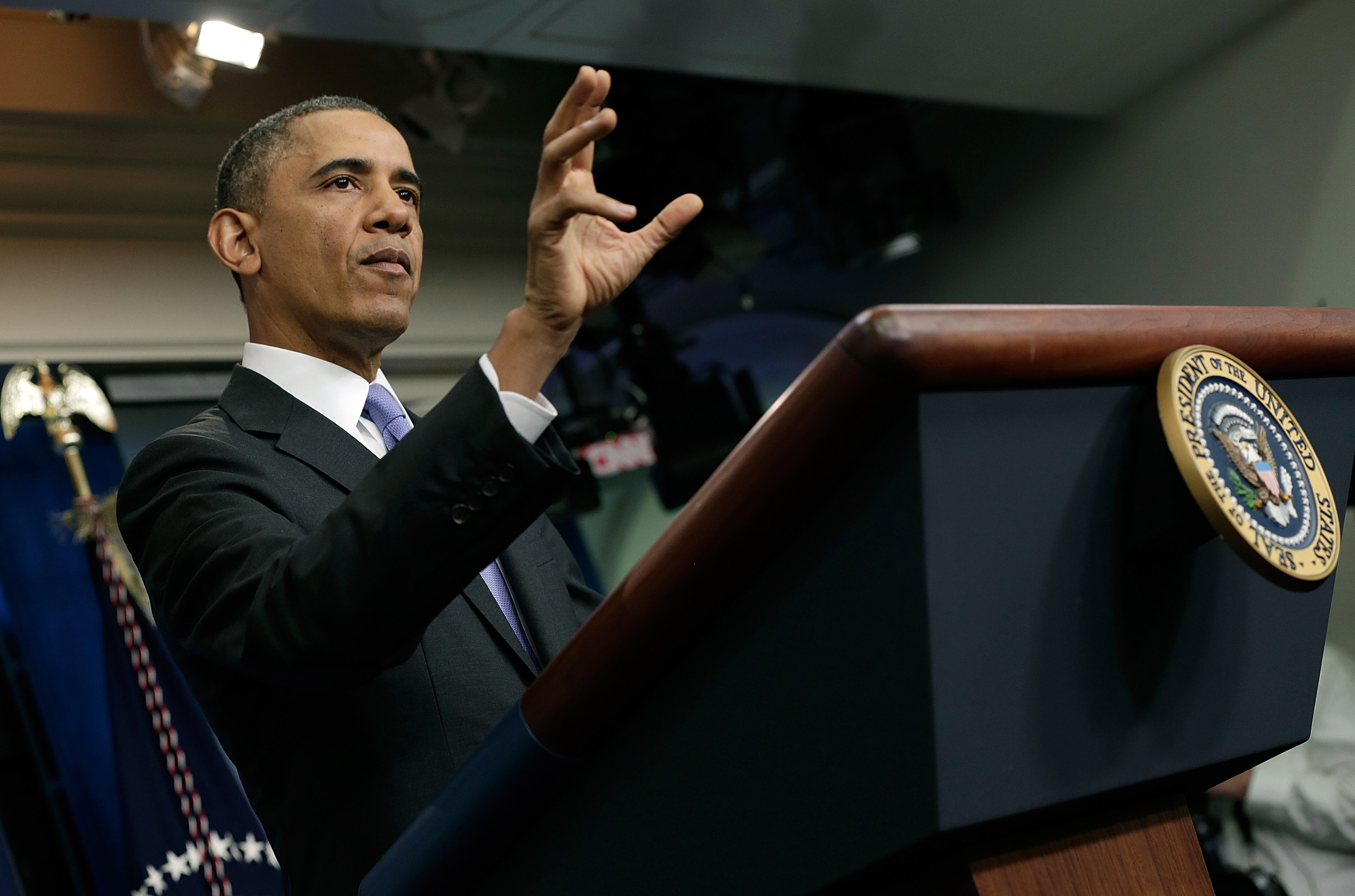
Obama Speaks On The Affordable Care Act In White House Briefing Room

Robert Laszewksi explains what Obama’s announcement means for insurance companies:

This means that the insurance companies have 32 days to reprogram their computer systems for policies, rates, and eligibility, send notices to the policyholders via US Mail, send a very complex letter that describes just what the differences are between specific policies and Obamacare compliant plans, ask the consumer for their decision —  and give them a reasonable time to make that decision —  and then enter those decisions back into their systems without creating massive billing, claim payment, and provider eligibility list mistakes.

Sarah Kliff considers insurers’ options:

[I]nsurers are in a bit of a tricky spot. It will look pretty bad if they don’t allow people to keep enrolling in their 2013 plans; as the president said, its a whole lot harder to blame the cancellations on Obamacare. But if they do allow that to go forward, it could screw up the risk pool in the new insurance marketplaces by letting the younger and healthy people (who would likely stick with their skimpier plans) stay out of the exchange. They’d essentially be siphoning off the exact same customers they were hoping to woo into the exchanges.

Beutler has no sympathy for insurers:

Obama’s remedy is a justified comeuppance for carriers who defaulted beneficiaries into obscenely expensive plans, which they characterized as “comparable” to the canceled coverage, without apprising them of their options, and blamed the whole disruption on Obamacare. It’s a scolding reminder to particular insurance companies that their lack of integrity exacerbated a problem that might have been contained if they hadn’t acted with such avarice. They are now reaping the whirlwind.

Drum echoes:

I think that most of the canceled policies have been canceled because insurance companies wanted to cancel them. They were designed in the first place to entice buyers away from their old grandfathered policies, and insurance companies did this explicitly so that they would be free to cancel them when 2014 rolled around. This allowed insurers to replace them with more expensive policies without taking any heat for it. They could just blame it on Obamacare.

This is just speculation on my part, so don’t take it to the bank. But I think Obama’s main goal here is to remove this handy excuse.

But, as Suderman points out, the administration needs the cooperation of insurance companies if the law is going to succeed:

Obama is creating a long-term policy problem in order to solve a short-term political problem. Even if this temporarily reduces some of today’s political pressure, those long-term policy problems will rebound to create additional political problems as time goes by. Premiums will rise, and if consumer demand turns out to be lower than expected as a result, plans may withdraw from the market. At the same time, insurers, who have been targeted by the administration for blame and had their assurances about the state of the law (and thus their business plan) upended, will be less likely to cooperate with the administration. They are already frustrated with the administration, and this will hasten the break between them. The opposition of insurers will add a new layer of opposition that the administration must contend with in order to make the law—which is built around the goal of making insurance coverage accessible—work.

Rich Lowry questions the legality of the administrative fix:

In attempting to stem the panic of congressional Democrats, Obama has thrown the insurers who had bought into Obamacare under the bus, a move that itself could harm the law’s long term prospects. He has once again acted unilaterally and (presumably) lawlessly rather than going to Congress, but he has undercut his own spin that Obamacare is the immutable “law of the land” and in his press conference, admitted that many of the law’s failures are on him rather than the result of Republican sabotage. We’ll see now whether the president has at least stabilized his position on Capitol Hill. Regardless, a bad day for him and the law.

Nicholas Bagley reviews relevant law and finds that “the administrative fix may be vulnerable to even sharper claims of illegality than the delay of the employer mandate.” Ramesh expects the change to only make the law worse:

In recent weeks, proponents of Obamacare have been arguing that we shouldn’t make too much of its early troubles, because President George W. Bush’s prescription-drug program saw early fumbles, too. (The people behind Obamacare may not be good at building websites, but they’re great at manufacturing excuses.) It’s perverse, of course, to suggest that the difficulties of a smaller, far less complex program are a good omen for Obamacare. But the bigger problem is that Obamacare is vulnerable to adverse selection in a way that Bush’s program was not.

Weigel anticipates the GOP’s new spin:

Whatever Obama does, it won’t restore all the canceled plans. Republicans (and anyone who’s talked to any insurer, ever) know this is not the case. After this week, Republicans will be able to react to any new stories about canceled plans by pointing out that, hey, they wanted to fix this, but the president arrogantly refused them and went with his own plan.

Chait’s bottom line:

Obama’s announcement mainly leaves the law in the same place it’s been for a month and a half: waiting to see if the administration can fix the website.

(Photo: U.S. President Barack Obama speaks on the Affordable Care Act in the White House briefing room November 14, 2013 in Washington, DC. By Win McNamee/Getty Images)
Alec Baldwin Is A Homophobic Bigot

(The video below is NSFW!)

We knew that already, of course. His instinctive, reflexive recourse to homophobic slurs is now well established. Let us review the previous evidence. This is what he said about a vile Daily Mail dirtbag who offended him:

“George Stark, you lying little bitch. I am gonna fuck you up … I want all of my followers and beyond to straighten out this fucking little bitch, George Stark. @MailOnline … My wife and I attend a funeral to pay our respects to an old friend, and some toxic Brit writes this fucking trash … If put my foot up your fucking ass, George Stark, but I’m sure you’d dig it too much … I’m gonna find you, George Stark, you toxic little queen, and I’m gonna fuck … you … up.”

Staggeringly, Baldwin insisted that that rant was not a sign of his homophobia. That’s how entitled he thinks he is. Now we have an almost identical outburst against another indefensible photographic stalker – but after Baldwin won a suit against another stalker. The video is here. The key expletive is the term “cock-sucking fag” which Baldwin utters under his breath as he is walking away from the hack who was harassing him, his child and his wife.

Look: Baldwin’s anger in both cases was thoroughly merited. But he continually resorts to this kind of homophobic poison when he’s angry. Just as Mel Gibson revealed his true feelings about Jews in his drunken rant, so Baldwin keeps revealing his own anti-gay bigotry. These outbursts reveal who he actually is.

I should add that this is a free country and he has an inviolable right to use these words. But he has no right to pretend in any way to be a tolerant liberal when he is anything but, when it comes to gay people.

So many liberals, of course, give him a pass when they would never dream of doing so with anyone who was conservative or Republican. Even after his bigotry was on full display, MSNBC hired him for a new show as a liberal pundit. For too many of them – especially gay establishment liberals, like the tools at GLAAD or the terminally naive like Hilary Rosen – there is a glaring double standard here. It seems to me that this double standard cannot stand any more. And this raging, violent bigot cannot be defended any longer.

The Misery Of Miscarriage, Ctd

A reader writes:

Thank you for pointing me to Ariel Levy’s account of her baby’s stillbirth.  But as I read it, I think it’s important to say it’s a stillbirth, not a miscarriage … a minor change in language, but it better expresses the pain and grief she experience.  To say this is not to trivialize miscarriage – which is incredibly painful, and a loss often ignored – but to pick up on the details of her experience.  Actually, it’s not even a stillbirth, as the baby was briefly alive.  But we don’t have words for that experience.  And maybe that matters.

Another:

My wife and I have four wonderful kids, but I can still see the image in my mind from the doctor’s office of the blank ultrasound screen where a very small baby used to be.