Bugged Out

The Carrizo Plain National Monument

Jeffrey Lockwood is an entomologist-turned-entomophobe who investigates the fear of insects in his new book, The Infested Mind. In an excerpt, he describes his first brush with bug fear, in a canyon in Wyoming:

Grasshoppers boiled in every direction, ricocheting off my face and chest. Some latched on to my bare arms and a few tangled their spiny legs into my hair. Others began to crawl into my clothing — beneath my shorts, under my collar. They worked their way into the gaps between shirt buttons, pricking my chest, sliding down my sweaty torso. For the first time in my life as an entomologist, I panicked.

In a review of the book, Michelle Nijhuis reasons that “entomophobia seems pretty rational”:

There may be some hard-wiring involved, but we learn a lot of our entomophobia — from unfortunate childhood experiences with beehives or anthills, from our parents, or from the culture at large.  ”We are weevils/We are evil/We’re aggrieved/Since time primeval,” begins a poem in Douglas Florian’s Insectlopedia. Read that at bedtime for a few nights, parents, and you’ll have a thriving little entomophobe on your hands.

While Lockwood thoroughly dissects the biology and psychology of our infested minds, he can’t explain away his own fears. In the years after his encounter in the Wyoming canyon, he moved out of traditional scientific research and into work that combines science and the humanities — an intellectual evolution that he credits in part to his phobia. He has come to a sort of peace with his fear, learning to see it not as a handicap but as a reaction to the sublime. For most of us, he points out, a skittering insect is as alien as the open space at the edge of a cliff, and we’re repelled by it and drawn to it in a similarly paradoxical way. So next time you floss a cricket leg out of your molars, remember: It’s not disgusting. It’s sublime.

An interview with Lockwood is here.

(Photo by David McNew/Getty Images)

Blockbusted, Ctd

Readers continue the thread:

One comment I think deserves to be made about the demise of Blockbuster is that it was specifically their aggressive late-fee policies which gave Netflix its beachhead into the market. People tend to forget that Netflix started out as a mail subscription service where physical disks were sent to the customer. On the face of it, that sounds like a crazy business. Why would I wait several days to get a movie when I can just go down to the local Blockbuster and get one immediately? The answer, of course, is the hassle and cost of the late fees. Netflix’s no-late-fee policy was a critical differentiator that gave them a toe-hold in a market that Blockbuster was dominating.

Another:

I wrote a paper in college on Blockbuster and how their management was a classic example of a reactionary business strategy. It’s really not their business model that sank Blockbuster, but rather their poor management style. Let’s not forget they had an opportunity to buy Netflix several times for as low as $50 million (currently valued at $20 billion) back in 2005. By the time Blockbuster launched their own dvd mail service in 2007, Netflix had started streaming video online.

I’m afraid it only gets more ridiculous from there. Blockbuster was actually on the cutting edge of video-on-demand back in the late ’90s and even set-up a partnership with one of the largest companies in the world in order to provide video-on-demand service via a nationwide broadband system. One problem though: that company was Enron. So that didn’t work out so well …

Another:

I’m going to be closing my fifth and final Blockbuster store this holiday season and I am sad – but also relieved.

I joined the company right around the time when Jason Bailey worked there (2005). And I have had a much, much different experience than he has. Most of the managers I’ve worked with, especially these past two years, have shared my enthusiasm for movies and do not treat their work as just collecting a paycheck. I make sure all my employees love movies and we’ve had a great relationship with our regular customers since I took over my store recently. We even had an awesome Halloween party last month with a lot of kids and it reminded me how much families did enjoy coming into the store and relying on our service to help find the best movies for them.  Ironically, we finally learned to turn ourselves into the mom-and-pop stores that Blockbuster drove out of the communities so long ago.

Most employees would tell you this has been a slow death – we had over 1,500 stores when Dish Network bought us back in 2011 and they’ve been shedding stores since. But they would also say they thought we had time through the holidays to try to turn things around. I don’t even think most at the corporate level in Blockbuster knew that Dish Network would deliver the axe so swiftly. We were gearing up for the holidays and had a giant holiday guide ready to go!

I don’t get upset that much anymore when people bring up Netflix or Redbox bringing about our doom. I actually think small, independent stores (much like the book industry) can thrive in this market. If you look at Family Video, a growing chain in the Midwest, they are consistently busy. They don’t have to pay rent (the company owns the plazas they’re in) and they’re busy enough to keep the lights on.

I would like to echo that sentiment that going to the video store is a communal experience. If the right people are in place, video stores can provide the right place for people to share their love for movies and that obscure horror film about zombie Nazis or share quotes from Princess Bride or just take in the spectacle of Joss Whedon’s Avengers playing on the nearby TV.

Another hated those TVs:

They would play previews for all sorts of movies on several large screens with the sound jacked up. The problem was that many of those previews were inappropriate for the children that I sometimes had in tow. When previewing a slasher movie they may cut out the worst, but taking a four-year-old through a store to a soundtrack of screams and explosions was not merely unpleasant, it was entirely inappropriate.  The managers said that they had no authority to shut the previews down. Once when I complained, a manager replied, “How do you think I feel? I have to listen to this crap all day.”

The good thing is that in many communities there are still small independent video stores, just like there are small bookstores. My favorite is staffed by dyed-in-the-wool movieheads who are basically curators and are able to direct me to good flicks far more effectively than Netflix et al.

The One Word To Survive Babel

“Huh?” is near universal:

Researchers traveled to cities and remote villages on five continents, visiting native speakers of 10 very different languages. Their nearly 200 recordings of casual conversations revealed that there are versions of “Huh?” in every language they studied – and they sound remarkably similar. … The languages studied were Cha’palaa, Dutch, Icelandic, Italian, Lao, Mandarin Chinese, Murriny Patha, Russian, Siwu and Spanish. (English wasn’t included in the study.) Across these languages, they found a remarkable similarity among the “Huhs?” All the words had a single syllable, and they were typically limited to a low-front vowel, something akin to an “ah” or an “eh.” Sometimes this simple word started with a consonant, as does the English “Huh?” or the Dutch “Heh?” (Spellings are approximate.) Across all 10 languages, there were at least 64 simple consonants to choose from, but the word always started with an H or a glottal stop – the sound in the middle of the English “uh-oh.”

Why would “huh?” take on similar forms in unrelated languages? The researchers’ theory:

In conversation, we are under pressure to respond appropriately and timely to what was just said; when we are somehow unable to do this – for example, when we didn’t quite catch what the other person just said – we need an escape hatch. This particular context places constraints on, and functional motivations for, the form of the word. The signal has to be something maximally simple and quick to produce in situations when we’re literally at a loss to say something; and it has to be a questioning word to signal that the first speaker must now speak again. In language after language, we find a word like ‘Huh?’ that fits the bill perfectly: it is a simple, minimal, quick-to-produce questioning syllable.

We propose this is a form of convergent evolution in language. Convergent evolution is a phenomenon well-known from evolutionary biology. When different species live in similar conditions, they can independently evolve similar traits. In a similar way, the similarity of huh? across a set of widely divergent languages may be due to the fact that the constraints from its environment are the same everywhere.

Can Three Geeks Save Obamacare? Ctd

A reader writes:

Not to pooh-pooh the efforts of these guys, but it’s worth mentioning that their “strong suit”, California, has its own exchange and website, and the CA site has had none of the problems of healthcare.gov. It’s long had an easy way to preview plans with subsidy information. So, to the extent that these dudes are making things easier for non-Californians, good for them. But presenting this as a “fix” and using California as an example does CoveredCA.com a disservice.

Another points out:

Go to https://www.healthcare.gov/find-premium-estimates/ and you can do exactly what Health Sherpa does. This feature was functional from the start but no one knows about it. Also the big issue is the back side compatibility with the insurance companies and their systems. That’s where the big problems are. Also, HealthSherpa isn’t getting anywhere near the traffic, but that’s really an early launch issue at this point. Now why did they decide not to display shopping options upfront (which IS a big design flaw)? Two reasons:

1) ID verification: This is necessary for the “conservative” means-testing so that there won’t be fraud by people getting extra discounted insurance

2) Subsidies: In an attempt to avoid sticker shock, they want people to know they aren’t going to pay full price.

You can’t show people the discounts (aka subsidies) they get without the ID verification. So you want people to see that they aren’t getting a raw deal? Well, you have to verify. If anything this is showing the flaw of conservative reform, which in any version was based upon exchanges and subsidies.

Another reader:

The Health Sherpa has received some good press over the past couple weeks, mostly along the lines of “3 geeks built a better Obamacare in almost no time”. This is not a very complete or accurate picture of what’s going on here. Here are a few things to note:

* This site would not be possible without heathcare.gov because it uses data directly off https://data.healthcare.gov – a freely available service provided by the government.  CMS (Center for Medicare and Medicaid Services) and their contractors did the hard work of getting, and approving, the rates from the insurance companies, often through processes regulated by the states, and building out infrastructure to store and deliver that data.

* The data provided by data.healthcare.gov is out of date and does not contain accurate plan specifications such as deductibles, coinsurance rates, OOP maxes and copays.  All it gives for each plan is an estimated premium for a single adult aged 27, a child of unspecified age, an older adult aged 50, a couple of unspecified age, a single-parent household where the parent and child’s ages are unspecified, and a family of unspecified size and ages.  Tobacco is not factored in, as it would be if you actually applied for insurance.  So, if you are a smoker aged 49, you’re getting the same estimate from this data as if you’re a nonsmoker aged 21.  Premiums and Metal Ratings alone are a bad way to shop for insurance. Depending on the cost of the care you need, a Bronze plan could end up costing you less overall than a Silver plan, depending on the deductibles and coinsurance rates.

* Since the data was released in mid-October, building apps to make use of it was a logical step. Here are a few your readers might enjoy: a search engine using the same data (including subsidy calculations), another search engine using the same data (including subsidy calculations and support for Idaho and New Mexico), and http://www.healthdig.info (disclosure: I am the author of this site).

Another shifts gears with an epic rant:

This post hits home. I have worked as a government contractor for over 20 years and the system is broken and wasteful. It’s no surprise to me that the Obamacare website doesn’t work. The bigger the project is, the more money at stake, the more the overpaid and unqualified managers fight for work scope within and between companies and the more bureaucratic gamesmanship within the agency. I’ve been wanting to write an article or call a whistleblower group or stand on the street and scream. Instead, I keep collecting my paycheck waiting for someone else to break the story on this huge example of waste, fraud, and abuse – the legal contracting activity right in front of your nose.

There’s so much wrong, I hardly know where to start. First, the federal staff – the more the government relies on contractors, the less the government employee knows how to DO the actual work. They only “manage” the work. After a few years of this, few have kept abreast of changing industry standards and practices. The experience they may have once had becomes increasingly irrelevant.  They know the jargon and the history of a project(s) but they rely increasingly on contractor managers to develop strategy, budget, and schedules. These contractor managers’ influence over their federal counterparts derives more from their friendship or their powers of persuasion more than actual skill.

Plus, the federal staff have civil service protections, so if they screw up a project, there are few repercussions.  I’ve seen federal staff spend $5-10 million dollars on a project that we knew would not further project goals and in most cases alienated the very players, such as state and local governments, that we needed as partners. No amount of polite warnings (you don’t want to say anything too bluntly because friendly relations keep the task assignments and cash flowing) can dissuade a federal manager from their path if their ego is at stake. And yet, I have never seen consequences for incompetent decision-making. They keep getting their salaries and their promotions and can do so for 30 years all without a track record of success or productivity.

Next is the demented contracting system. Often, a government office responsible for a project will have a “Management & Operating” (M&O) contractor and a “support services” contractor. There are legal differences between these two but in practice the feds simply pit the contractors against each other. The M&O contractor will write a project plan. The client doesn’t like the M&O so they hand the document to the support services contractor to review and comment. The competitor rips the document and tells the client they aren’t being well served. The client asks the support services contractor to draft their own project plan and now taxpayers have paid twice for the same work. Before the 1960s (pick your decade, government contracting has been expanding rapidly since WWII), the federal employee would have written the damn project plan. Now they aren’t competent enough to assess the work on their own.

The world of government contracting is very hard to enter, therefore a few companies get much of the work (just look around DC and the suburbs at the HUGE buildings that go on for miles along each commuter artery with the names of contracting companies). These companies become bureaucracies themselves. I’ve had a few excellent managers who would succeed anywhere but most have one skill – they retired from the agency for which they now contract and have excellent relations with the federal staff. They make six figure salaries for holding meetings with the clients and then their staff to relay the message from the meeting with client. They hold another meeting make sure everyone is trained to the latest irrelevant safety measure, and generally interfere with the work. They seldom do any of the work themselves and often don’t know anything about the subject they oversee.

The staff at the contracting companies, who often have the field experience and actually conduct the work, spend equal amounts of time 1) explaining the work to their managers, and 2) explaining and educating their clients why a project needs to roll-out a certain way. The real work to advance a project is squeezed in around these wasteful responsibilities. In addition, the profit for these companies increases with the number of employees they can directly charge to the project. The surfeit of people on these large multi-million dollar contracts makes me sick. Supposedly they can be fired at will, but sleeping at your desk, harassing other employees, having no skills directly related to the work at hand has never gotten someone fired in my experience – because their presence generates profit. Because of the profit motive, there is no incentive to work efficiently.

For example, the client may need to post material on a website to further public communication. The contractor has no incentive to see if a satisfactory website already exists that meets the client needs. Instead, they will spend millions developing a new site with fancy bells and whistles and populating with their own studies without regard to cost-savings or the needs of the users.

Finally, what drives me the most crazy is the argument that private companies replacing government is somehow supposed to be more conservative??? It is nothing but corporate welfare and inefficient use of taxpayer dollars. If you want to shift responsibility for weapons production or waste management or environmental cleanup, then shift the responsibility to private industry and get government out of it. But if anyone thinks hiring companies to do the work the feds used to do is efficient, they haven’t stepped outside their echo chamber long enough to look at reality. These contracting company officials are so savvy at playing the politicians, the regulatory system, the contracting system, and the legal system, that they’ve taken us taxpayers for a ride. Sickeningly, many of my colleagues are Tea Party sympathizers who see no conflict in their positions. I wonder how they would fare if they were thrown to the street and had to survive without a federal tit.

Face Of The Day

Relief Efforts Continue After Typhoon Haiyan's Destruction

A man sits crying on a packed C130 aircraft after he and hundreds of other victims of super Typhoon Haiyan are evacuated from the area in Tacloban, Philippines on November 12, 2013. Four days after the typhoon devastated the region, many are without food or power and most lost their homes. Around 10,000 people are feared dead in the strongest typhoon to hit the Philippines this year. By Paula Bronstein/Getty Images.

The Monkey Gaze

Neuroscientist Asif Ghazanfar, whose lab uses monkeys to study auditory and visual perception, set up an experiment to test whether monkeys are capable of following filmic narratives the way people are:

Ghazanfar and his postdoc, Stephen Shepherd, tracked the eye movements of monkeys and people as they watched identical 3-minute clips from three films: the BBC’s “Life of Mammals,” Disney’s “The Jungle Book,” and Chaplin’s “City Lights.” The movies were converted into black and white and played without sound. As it turned out, humans and monkeys have similar cinematic tastes. … “There was a surprising degree of overlap,” Ghazanfar says. The gaze paths of humans and monkeys overlapped 31 percent of the time. A small part of this correlation is due to our shared visual reflexes: Both humans and monkeys are attracted to bright spots. But the bulk of the overlap was driven by the two species’ shared interest in complex scenes, particularly faces, body movements, and social interactions.

But the researchers also found two intriguing differences between the monkey and human gaze paths.

First, “humans appear to look at the focus of actor’s attention and intentions to a much greater extent than do monkeys,” Ghazanfar and Shepherd wrote in a fascinating review published in the film journal Projections. Second, “humans appear to pay attention to related details in a movie for much longer than monkeys do, suggesting that humans integrate events over time in a fundamentally different way.”

In other words, it seems that what makes people different is our ability to follow a narrative. Whereas monkeys look and react to scenes quickly, people fixate on one actor and integrate complex events over time. In a clip showing two monkeys, for example, people tended to look squarely on the monkey sitting quietly in the center of the screen. Monkeys, in contrast, looked at the more active second monkey, even thought it was jumping out of view of the camera. “Monkeys were reacting moment-by-moment instead of assembling and testing a narrative explanation for the scene before them,” the researchers wrote.

Pop Music For The Present Age

In a recent interview, Arcade Fire frontman Win Butler divulged the unlikely influence behind the band’s new album, Reflektor – the 19th century Christian philosopher, Søren Kierkegaard:

I studied the Bible and philosophy in college and I think in a certain sense that’s the kind of stuff that still makes my brain work. There’s an essay by Kierkegaard called The Present Age that I was reading a lot that’s about the reflective age. This is like in [1846], and it sounds like he’s talking about modern times. He’s talking about the press and alienation, and you kind of read it and you’re like, “Dude, you have no idea how insane it’s gonna get.” [Laughs.] …

It reads like it was written here, basically. He basically compares the reflective age to a passionate age. Like, if there was a piece of gold out on thin ice, in a passionate age, if someone went to try and get the gold, everyone would cheer them on and be like, “Go for it! Yeah you can do it!” And in a reflective age, if someone tried to walk out on the thin ice, everyone would criticize them and say, “What an idiot! I can’t believe you’re going out on the ice to try and risk something.” So it would kind of paralyze you to even act basically, and it just kind of resonated with me — wanting to try and make something in the world instead of just talking about things.

Paul Elie digs up the relevant passage from The Present Age:

A Revolutionary Age is an age of action; the present age is an age of advertisement, or an age of publicity: nothing happens, but there is instant publicity about it. A revolt in the present age is the most unthinkable act of all; such a display of strength would confuse the calculating cleverness of the times. Nevertheless, some political virtuoso might achieve something nearly as great. He would write some manifesto or other which calls for a General Assembly in order to decide on a revolution, and he would write it so carefully that even the Censor himself would pass on it; and at the General Assembly he would manage to bring it about that the audience believed that it had actually rebelled, and then everyone would placidly go home—after they had spent a very nice evening out.

Jon Pareles offers more context for the big ideas behind Reflektor:

The album’s lyrics allude to Kierkegaard’s ideas about a “reflective age,” when passion and story line have been replaced by ambiguity and passive contemplation. And they trace a loose plotline similar to the myth of Orpheus and Eurydice: the musician who plays songs that are so beautiful that they persuade Death to give his lover a second chance, though the musician will only lose her again. (Auguste Rodin’s statue of Orpheus and Eurydice is on the album cover.) The songs move through love, rebellious self-affirmation, a struggle to stay together and, at the end, a ghostly mourning. Six minutes of wordless sound at the end of the album, in billowing, burbling, sustained loops reminiscent of Terry Riley’s late-1960’s compositions, may be a glimpse of an eternal next world.

“The Most Contentious Of All Letters”

H, according to Michael Rosen, author of Alphabetical:

In Britain, H owes its name to the Normans, who brought their letter “hache” with them in 1066. Hache is the source of our word “hatchet”: probably because a lower-case H looks a lot like an axe. It has certainly caused a lot of trouble over the years. A century ago people dropping their h’s were described in the Times as “h-less socialists.” In ancient Rome, they were snooty not about people who dropped their Hs but about those who picked up extra ones. Catullus wrote a nasty little poem about Arrius (H’arrius he called him), who littered his sentences with Hs because he wanted to sound more Greek. Almost two thousand years later we are still split, and pronouncing H two ways: “aitch”, which is posh and “right”; and “haitch”, which is not posh and thus “wrong”. The two variants used to mark the religious divide in Northern Ireland – aitch was Protestant, haitch was Catholic, and getting it wrong could be a dangerous business.

Perhaps the letter H was doomed from the start: given that the sound we associate with H is so slight (a little outbreath), there has been debate since at least AD 500 whether it was a true letter or not. In England, the most up-to-date research suggests that some 13th-century dialects were h-dropping, but by the time elocution experts came along in the 18th century, they were pointing out what a crime it is. And then received wisdom shifted, again: by 1858, if I wanted to speak correctly, I should have said “erb”, “ospital” and “umble”.

The ACA Is Worse Than This?

Individual Market

Last week, Ezra Klein argued that Americans with individual market health insurance are more dissatisfied with their plans because the insurance “doesn’t cover them when it’s most necessary.” Barro counters:

I suspect the higher levels of dissatisfaction come from a different source, one that has different policy implications: Unlike people on Medicare, Medicaid and employer-based insurance, people who buy coverage in the individual market know exactly how much they’re paying for it. A plan that you would only rate “fair” when you have to pay $5,000 for it might merit an “excellent” if its apparent cost to you were only $1,000.

Almost all of us should be dissatisfied with our health plans, because the American health care system involves paying twice as much as people in other rich countries do to achieve similar health outcomes. People who buy in the individual market are especially likely to understand how expensive American health care is.

It’s worth remembering that private healthcare in the US is one of the most inefficient industries on the planet. This is what has long frustrated me by GOP defense of it (with a little trivial tinkering, like tort reform). Since when are Republicans supposed to celebrate grotesque inefficiency, poor outcomes, and fathomless waste?

(Chart from Jonathan Cohn)

Stable States

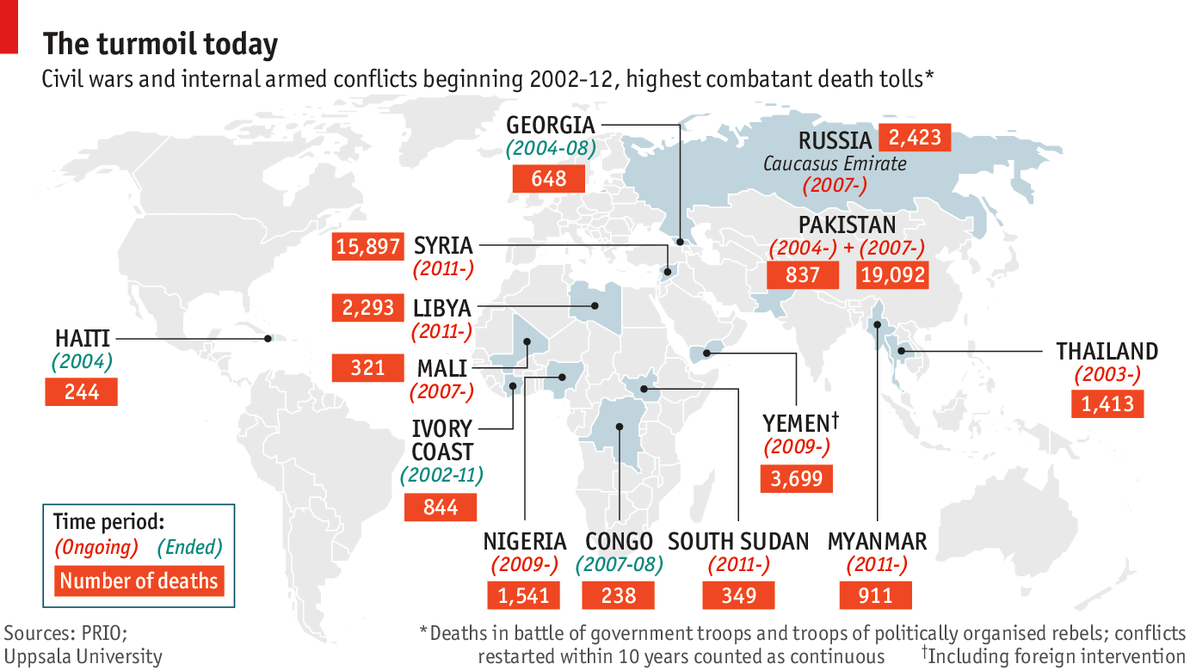
20131109_FBM914

Civil wars are less common than they used to be:

Of 150 large intrastate wars since 1945, fewer than 10 are ongoing. Angola, Chad, Sri Lanka and other places long known for bloodletting are now at peace, though hardly democratic. And recently civil wars have been ending sooner. The rate at which they start is the same today as it has been for 60 years; they kick off every year in 1 to 2 percent of countries. But the number of medium-to-large civil wars under way – there are six in which more than 1,000 people died last year – is low by the standards of the period. This is because they are coming to an end a little sooner. The average length of civil wars dropped from 4.6 to 3.7 years after 1991, according to Kristian Skrede Gleditsch, a professor at the University of Essex.

So far, nothing has done more to end the world’s hot little wars than winding up its big cold one.

From 1945 to 1989 the number of civil wars rose by leaps and bounds, as America and the Soviet Union fueled internecine fighting in weak young states, either to gain advantage or to stop the other doing so. By the end of the period, civil war afflicted 18 percent of the world’s nations, according to the tally kept by the Centre for the Study of Civil War, established at the Peace Research Institute Oslo, a decade ago. When the cold war ended, the two enemies stopped most of their sponsorship of foreign proxies, and without it, the combatants folded. More conflicts ended in the 15 years after the fall of the Berlin Wall than in the preceding half-century. The proportion of countries fighting civil wars had declined to about 12 percent by 1995.