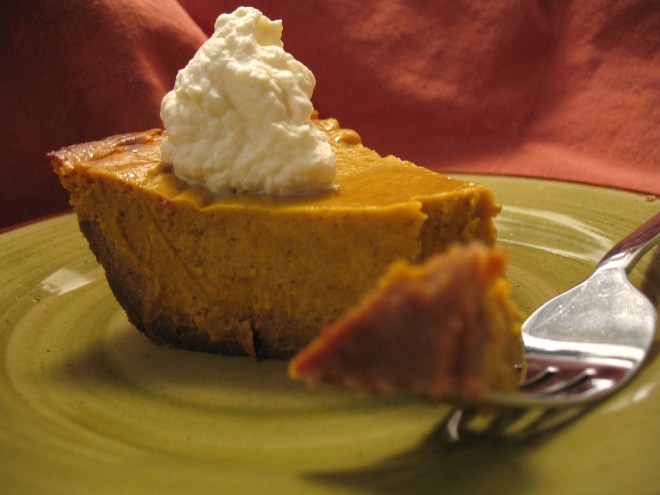
Ryan O’Hanlon nominates pumpkin, declaring that “without pumpkin pie, there would be no reason to continue with this elegiac revisionist-historical sham that is Thanksgiving”:
Pumpkin pie is our ultimate dessert. While your palate is certainly a subjective thing—and attempts at describing how food tastes can lead to disturbing, fanfic-esque nightmares like this—the actual goodness of pumpkin pie is pretty clearly real. If pumpkin pie didn’t taste like the gift from heaven that it is, we wouldn’t have this pumpkin-spice hysteria, would we? The flavor of pumpkin pie is everywhere because people love the way it tastes. And that is often why we eat food.
Is pumpkin pie lazy? Yes. Did it possibly not even exist as a Thanksgiving staple until the previous century? Also yes. Do either of those things matter? No. Thanksgiving is an American holiday, and there are few things more American than dumping a can of pre-prepared mush into pie crust and calling it dessert.
In 2011, Megan Gambino talked to Kathleen Wall, “a foodways culinarian at Plimoth Plantation, a living history museum in Plymouth, Massachusetts,” about what the menu for the very first Thanksgiving would have looked like:
Turkey was not the centerpiece of the meal, as it is today, explains Wall. Though it is possible the colonists and American Indians cooked wild turkey, she suspects that goose or duck was the wildfowl of choice. In her research, she has found that swan and passenger pigeons would have been available as well. “Passenger pigeons—extinct in the wild for over a century now—were so thick in the 1620s, they said you could hear them a quarter-hour before you saw them,” says Wall. “They say a man could shoot at the birds in flight and bring down 200.” …
It is possible that the birds were stuffed, though probably not with bread. (Bread, made from maize not wheat, was likely a part of the meal, but exactly how it was made is unknown.) The Pilgrims instead stuffed birds with chunks of onion and herbs. “There is a wonderful stuffing for goose in the 17th-century that is just shelled chestnuts,” says Wall. “I am thinking of that right now, and it is sounding very nice.” Since the first Thanksgiving was a three-day celebration, she adds, “I have no doubt whatsoever that birds that are roasted one day, the remains of them are all thrown in a pot and boiled up to make broth the next day. That broth thickened with grain to make a pottage.” In addition to wildfowl and deer, the colonists and Wampanoag probably ate eels and shellfish, such as lobster, clams and mussels.
Meanwhile, reviewing a history of turkey-carving, Heather Hess digs up some early advice:
The following instructions for cutting up a turkey first appeared in The Family Dictionary, or Household Companion (London, 1695), and were repeated verbatim in cookery books marketed at English housewives throughout the eighteenth century. Why not take a lesson from history this Thanksgiving?
Raise up the leg fairly, and open the Joint with the Point of your Knife, but take not off the Leg; then with your Knife lace down both Sides of the Breast, and open the Breast-pinion, but do not take it off; then raise the Merry-Thought betwixt the Breast-bone, and the top of it; then raise up the Brawn; then turn it outward upon both Sides, but not break it, nor cut it off; then cut off the Wing Pinions at the Joint, next the Body, and stick each Pinion, in the Place you turn’d the Brawn out; but cut off the sharp End of the Pinion, and take the middle Piece, and that will just fit in the Place.
If that doesn’t work, there is always the electric knife.
6:50 p.m.
Sit down. Time to give thanks. This year, you are thankful for so much. You are thankful you didn’t have to sit in a goddamn airport for five hours and spend four additional hours in traffic to visit relatives who are nice to see for ten minutes before they become tiresome and unbearable. You are thankful for your family but also thankful for their absence. You are thankful for no screaming children, no sitting on an uncomfortable sofa in a TV-less living room, no awkward conversation with your aunt in which she pulls words out of you like teeth, no lukewarm potatoes, no sleeping in a musty childhood bed that’s three feet long. You are thankful that you didn’t have to interrupt the usual business of your life. Because life is just fine.
6:55 p.m.
Some light crying. You miss your family.
7:00 p.m.
Stuffed. Begin House of Cards marathon. Kate Mara looks awfully underfed.
Marilynne Robinson has long argued against the stereotypical understanding of the Puritans as brooding killjoys who dressed in black. Here’s a passage from Robinson’s great essay, “Puritans and Prigs,” from her book The Death of Adam: Essays on Modern Thought:
My reading of Puritan texts is neither inconsiderable nor exhaustive, so while I cannot say they yield no evidence of Puritanism as we understand the word, I can say they are by no means characterized by, for example, fear or hatred of the body, anxiety about sex, or denigration of women. This cannot by said of Christian tradition in general, yet for some reason Puritanism is uniquely regarded as synonymous with these preoccupations. Puritans are thought to have taken a lurid pleasure in the notion of hell, and certainly hell seems to have been much in their thoughts, though not more than it was in the thoughts of Dante, for example. We speak as though John Calvin invented the Fall of Man, when that was an article of faith universal in Christian culture…
Yet the way we speak and think about the Puritans seems to me a serviceable model for important aspects of the phenomenon we call Puritanism.
Very simply, it is a great example of our collective eagerness to disparage without knowledge or information about the thing disparaged, when the reward is the pleasure of sharing an attitude one knows is socially approved. And it demonstrates how effectively such consensus can close off a subject from inquiry. I know from experience that if one says the Puritans were a more impressive and ingratiating culture than they are assumed to have been, one will be heard to say that one finds repressiveness and intolerance ingratiating. Unauthorized views are in effect punished by incomprehension, not intentionally and not to anyone’s benefit, but simply as a consequence of a hypertrophic instinct for consensus. This instinct is so powerful that I would suspect it had a survival value, if history or current events gave me the least encouragement to believe we are equipped to survive.
(Image of Embarkation of the Pilgrims by Robert W. Weir, commissioned in 1837 for the United States Capitol Rotunda, via Wikimedia Commons)
Auden’s final book of poems, published posthumously in 1974, is Thank You, Fog. It contains a poem titled “A Thanksgiving,” and the volume’s best-known line is from “Lullaby”: “Let your last thinks all be thanks.” Dr. Oliver Sacks says of his friend: “Wystan’s mind and heart came closer and closer in the course of his life, until thinking and thanking became one and the same.”
Kurp points to Joseph Epstein’s article (WSJ) on the same theme from 2007:
I wish the poet W. H. Auden were still alive, so that he might be at the same table where I eat my Thanksgiving dinner. Auden, I think, nicely captured the spirit of Thanksgiving when he wrote that, in prayer, it is best to get the begging part over with quickly and get on to the gratitude part. He also wrote, ‘let all your thinks be thanks.’
To be living in a prosperous and boundlessly interesting country, at a time of high technological achievement, and of widening tolerance — much to be thankful for here. ‘Wystan,’ I’d like to tell the poet, ‘you got it right, kid. Now how about a drumstick?’
(Image of Auden from the January, 1957 cover of The Atlantic, by Stanley Meltzof, via Roger Doherty)
Friedersdorf rolls his eyes at the president’s tweet encouraging people to talk about health insurance this Thanksgiving:
Once that conversation is over perhaps you could bring up reproductive rights, immigration reform, and judicial filibusters. They’re all important subjects of national concern. Why not set aside some time on Thanksgiving Day to discuss them too? Maybe just pick up the remote, turn off the football game, and ask everyone if you could have their attention while you explain how progressive public policy can improve their lives if only they do their part. They’ll appreciate it!
Similarly, J.D. Tuccille scoffs at a campaign that urges people to initiate holiday conversations about gun control:
I don’t know what holiday dinners are like at Michael Bloomberg’s house, but I suspect there’s an awful lot of picking at food while the windbag at the head of the table lectures the assembled guests about why he’s right and they’re all idiots. That’s the message I get from his pet Mayors Against Illegal Guns organization, which wants its loyal minions, if there are any, to sit down to their Thanksgiving feasts and immediately start fights with relatives they haven’t seen in a year about gun control. All you need is a handy list of tendentious talking points—and a shitload of patience from Cousin Bob, who rebuilds old pistols for fun and just wrapped himself around half a bottle of Jack Daniels.
Ann Friedman, who disagrees with her family on politics, is grateful that “when we’re together in person for visits or holidays, we’ve learned to steer clear of all vaguely political conversation”:
This live-and-let-live attitude has served us well for more than a decade, although we did learn tolerance the hard way. Unlike the vast majority of teenagers, who tend to agree with their parents’ outlook on politics, I was a burgeoning liberal atheist in a conservative Catholic household. I measured my political progress by the distance I created between my beliefs and theirs, and our fights were explosive. These days, I spend more time thinking about how to stay close to my family when our worldviews — political, religious, cultural — remain so far apart.
Then again, maybe fighting at the dinner table served a purpose:
I’ve always been jealous of friends who were raised by parents who read The New Yorker and had art-museum memberships and voted for liberal Democrats. But I’ve also long suspected that my beliefs wouldn’t have the same amount of fire behind them if I hadn’t forged them in contrast to those of my family. “The bottom line is I’m glad you think for yourself,” my mom said with discernible pride in her voice. “I think it’s better for you to have an opinion on your own, one that you’ve come to based on your feelings and beliefs and what drives you.” And now I’m a little bit sad I won’t be going home for Thanksgiving.
Philip Bump offers some basic tips to avoid conflict:
If someone brings up politics, treat it as you would any other unpleasant and undesired topic. Let’s say you’re sitting across from your grandmother, and she proceeds to describe the battery of tests to which she was subjected, revealing that her rash was impetigo that required a special cream for treatment. You do not want to talk about this, because it’s gross. What do you do? You change the topic. “Oh, well I’m glad they figured it out! Is that why you’re wearing that beautiful blouse, Gran? Where did you get it?” And: boom. Topic changed.
You have this skill. You know how to 1) be nice but also 2) not talk about things you don’t want to talk about. Worse comes to worse, you get up and go to the sideboard / kitchen / KFC for more sides. By the time you get back, the topic has likely changed regardless. In order to make Thanksgiving one that can be enjoyed by non-jerks, take this approach to political topics.
John Cook, on the other hand, relishes Thanksgiving throw-downs:
How Do I Know If I’m Winning? Think of it as one of those blue vs. red military exercises. When your adversary gets frustrated and inadvertently sputters out a transparently racist epithet (I once got my uncle to shout “because they’re swinging on trees and eating bananas!” during a Thanksgiving fight about the Sandinistas), that’s like capturing their flag.
Shove a tray of dough into the oven and something magical happens: that raw mixture of ingredients is transformed into a delightful circle of deliciousness, a cookie. If you’ve ever wondered exactly what science was behind baking, though, this video explains. Zipping through everything from protein structures to the Maillard reaction, it explains some pretty complex chemistry very simply. Maybe go grab a cookie before you sit down and watch it?
Sam Brasch debunks the Internet rumor that rats are producing their own fromage:
The main challenge for a rat cheese maker would be the scale of production. Even sheep and goats don’t produce nearly the quantity of milk you can get from a cow. “The smaller you go down the animal chain the less milk you are going to get,” says Nora Weiser of the American Cheese Society. You’d need an army of 674 rats to produce the 31 kilograms of milk one dairy cow puts out each day.
If you did muster such an operation, rats might actually make for pretty good dairy animals. Rat’s milk is high in protein (8 percent) and contains almost four times the fat by volume when compared to raw cow’s milk, so it would make a great brie and stand as a rich addition to a cup of coffee in the morning. A rodent dairy farm would also earn a stellar environmental report card. 674 rats would only produce .003 percent of the methane that comes from a dairy cow, so a piece le fromage de rat could end up being the most sustainable high-end cheese at the deli counter.
But turkey testicles (aka short fries) are a real dish:
The town of Byron, Illinois—more generally known for its nuclear power station—has been hosting a Turkey Testicle Festival for 35 years. And if you’re lucky enough to be in Huntley, Illinois this week, there’s another testicle festival for you to attend. “If you have never tried a turkey testicle, this is your chance!” the organizers promise. For those who have other plans this year, you should know that turkey testicles are about the size of “large olives,” Calvin W. Schwabe writes in his book Unmentionable Cuisine. They pair well with cocktails and can be prepared “by any recipe for sweetbreads.”
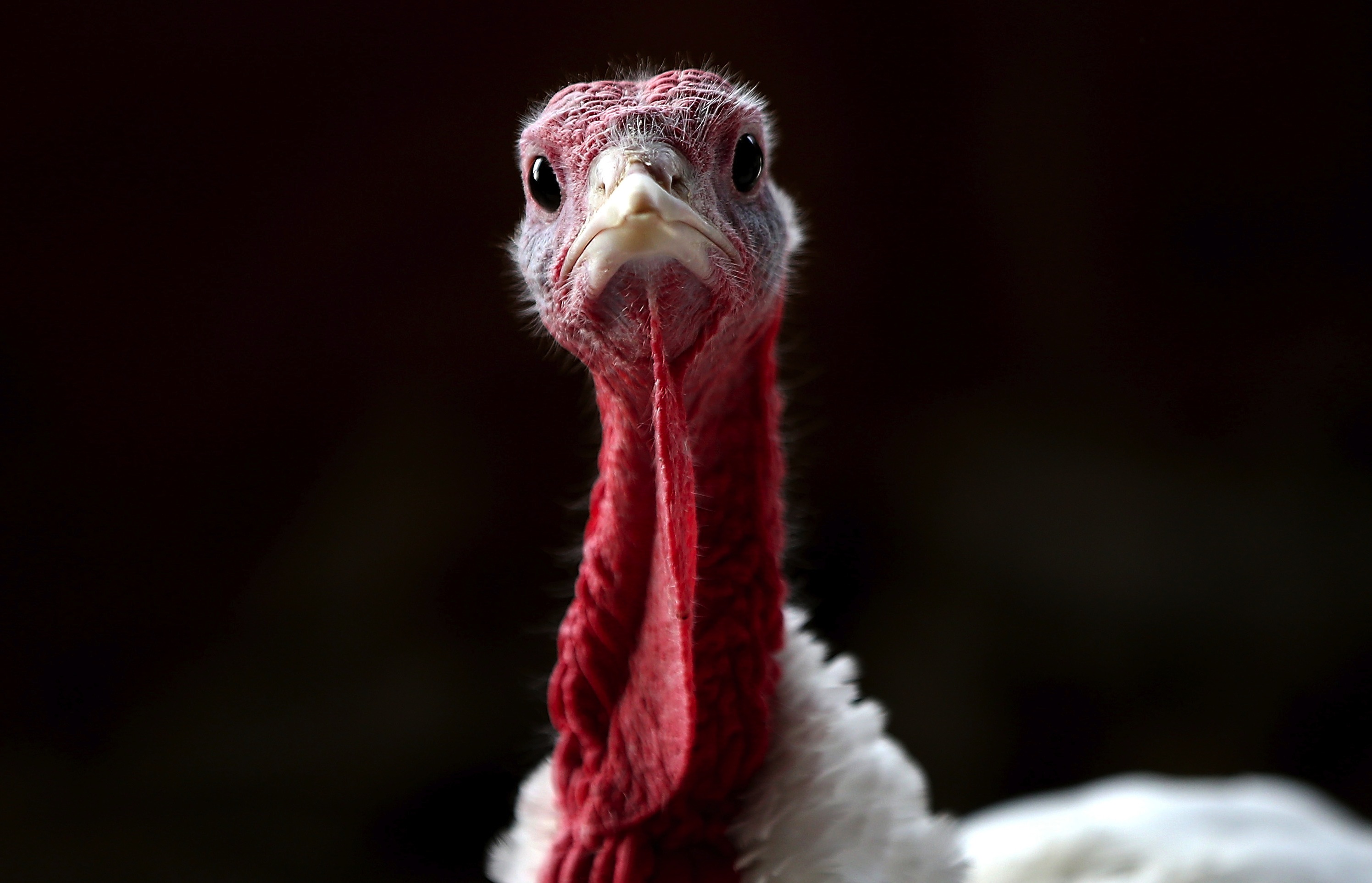
A turkey sits in a barn at the Willie Bird Turkey Farm in Sonoma, California. An estimated 46 million turkeys are cooked and eaten during Thanksgiving meals in the United States. By Justin Sullivan/Getty Images.


 The Dish
