A cartoon (after the jump because of its length) that will probably put a lump in your throat:

Stories of three-legged pups from readers here.
A cartoon (after the jump because of its length) that will probably put a lump in your throat:
Stories of three-legged pups from readers here.
“People with conventional views must repress a gag reflex when considering the mayor-elect of New York — a white man married to a black woman and with two biracial children. (Should I mention that Bill de Blasio’s wife, Chirlane McCray, used to be a lesbian?)” – Richard Cohen, Washington Post.
The argument that the GOP is fueled by cultural bewilderment at a multi-racial, multi-cultural, gay married, multi-faith America is a vital one if you want to understand our irrational politics right now. So I wasn’t going to pile on. But when I thought about it, two words really leaped out at me: “conventional” and “gag-reflex.” No one who holds conventional views gags at an inter-racial couple; only someone with reactionary views does that. Yes, some older folks may still feel discomfort at the sight of an inter-racial couple, but, Gallup shows they only count for a third of even the over 65s. The total approval of a marriage like De Blasio’s hit a record of 86 percent in 2011. So 14 percent is now conventional? Or is Cohen once again telling us something about his issues with African-Americans?
And seriously: “must repress a gag reflex”? Makes you want to vomit? It’s not even a Buchanan “recoil”!
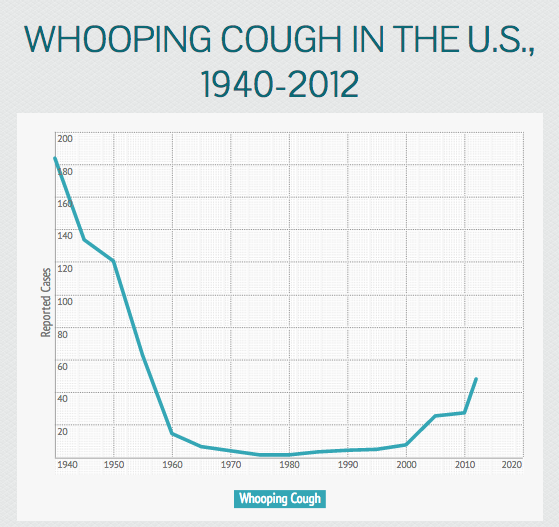
Julia Ioffe describes what it’s like to have whooping cough:
At this writing, I have been coughing for 72 days. Not on and off coughing, but continuously, every day and every night, for two and a half months. And not just coughing, but whooping: doubled over, body clenched, sucking violently for air, my face reddening and my eyes watering. Sometimes, I cough so hard, I vomit. Other times, I pee myself. Both of these symptoms have become blessedly less frequent, and I have yet to break a rib coughing – also a common side effect.
Unsurprisingly, she has some choice words for vaccine denialists:
How responsible are these non-vaccinating parents for my pertussis? Very. A study recently published in the journal Pediatrics indicated that outbreaks of these antediluvian diseases clustered where parents filed non-medical exemptions – that is, where parents decided not to vaccinate their kids because of their personal beliefs. The study found that areas with high concentrations of conscientious objectors were 2.5 times more likely to have an outbreak of pertussis.
Yes, she was vaccinated in childhood:
The problem, in part, is that the protection offered by the pertussis vaccine wears off by the time you reach adulthood. Until recently, however, this was not a problem. Back in those halcyon days when we vaccinated our children, the disease was not bouncing around our population and so it was okay that adults did not get re-immunized. (That’s the whole point of herd immunity: it’s hard to get sick from people who aren’t sick.)
Razib applauds Ioffe for her strategic shaming:
Over the past few years I’ve become much more aware of cultural streams in public health, and the public’s reaction to that health advice, because I have become a father. More specifically, when my wife was pregnant with my daughter, and after she was born, we encountered major pressure from peer networks to not vaccinate. In the social circles in which we were embedded, “progressive,” “crunchy,” and “alternative,” vaccinating one’s child was the heterodox decision. It was rather obvious to us that one of the major reasons that many people do not vaccinate their children is that many of their friends, and vocal people whom they trust, do not vaccinate their children. … [T]his groundswell of denialism must be countered by public opprobrium, and yes, shaming. Peer pressure kills, but it can also save lives.
(Infographic: Jen Kirby)
Tomasky gets real about the ACA:
Obamacare will never be a raging success. This is another error much of journalism is prone to make—looking for it to be an overwhelming success. That won’t happen because at the end of the day we’re still talking about private health insurance, and private health insurance was a pain in the tuchus before Obamacare and will remain one after it. People will always complain about their coverage. But by early 2016, I have little doubt, there will be millions more Americans who’ll be doing the complaining, and they’ll be happy to have the opportunity to do so.
Along the same lines, Beutler expects the GOP’s latest Clinton-seconded reform proposal to backfire:
The Keep Your Health Plan Act would be immensely damaging to Obamacare if it ever became law, and preventing it from becoming law will require Senate Democrats and President Obama to sustain real political damage over the next few weeks. But looking ahead, it will be useful for them to have Republicans on the record against forcing people off of their insurance.
Suderman is much more pessimistic:
[I]t’s time to start considering the worst-case scenarios: that the exchanges continue to malfunction, that plan cancellations go into effect, that insurers see the political winds shifting and stop playing nice with the administration, and that significant numbers of people are left stranded without coverage as a result. Rather than reforming the individual market, which was flawed but did work for some people, Obamacare will have destroyed it and left only dysfunction and chaos in its wake.
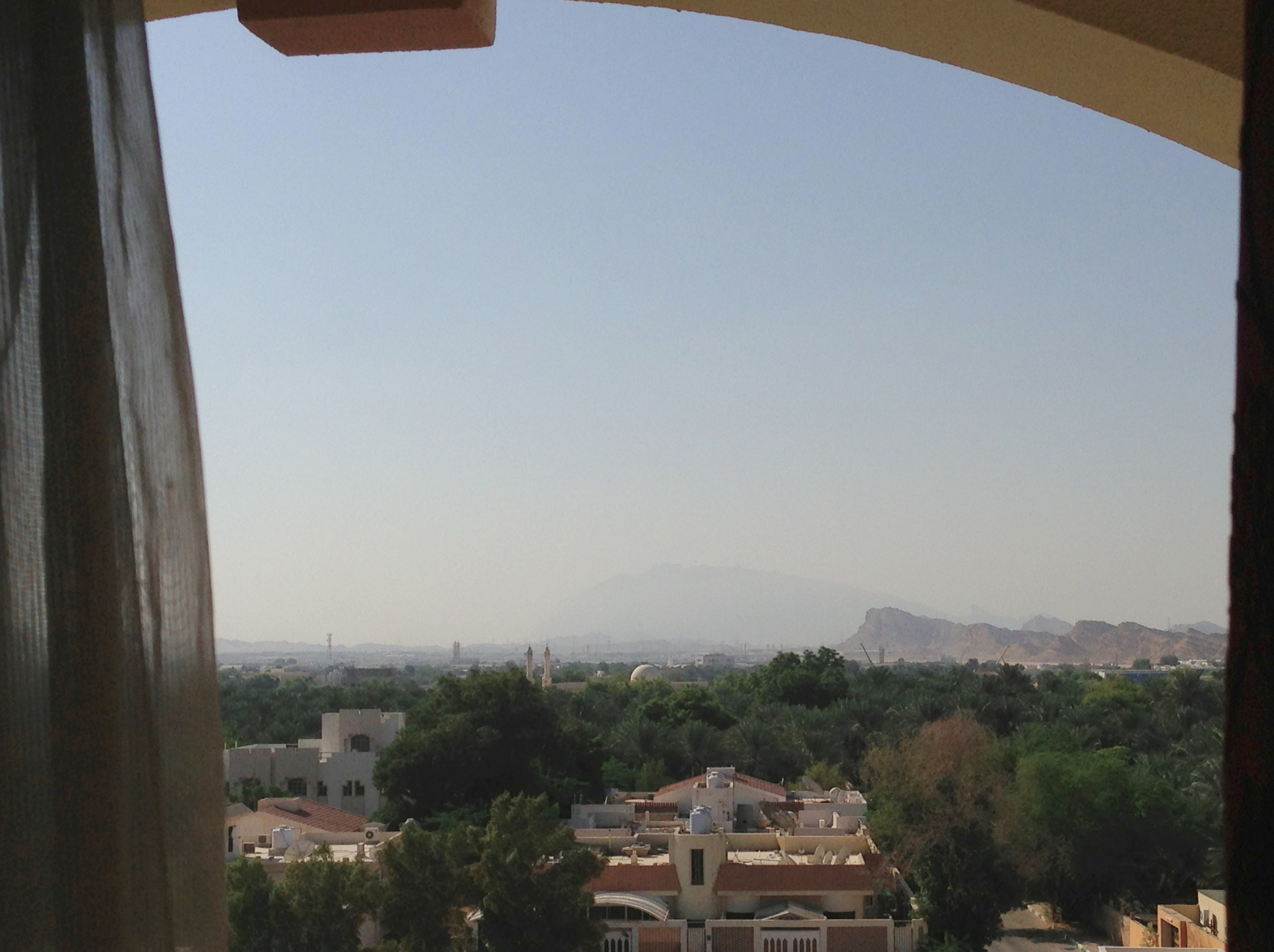
A particularly tough one this week. A reader writes:
Salt cedars. Not a Turkish style of minaret, but not bulb type either. Cliffs, particularly the one off to the right in the distance. Satellite dishes looking SW or WSW, so mountains to the west and north. Looks like water in the distance – river valley? Probably late afternoon with the haze/pollution. After looking at, literally, thousands of minaret images, systematically googling mosques, and looking at different cities with proper orientation, for different countries where salt cedar grow, I give up. Iran? Sigh. But fun anyway.
Another:
The double minarets stood out at once. The landscape also made me think of Turkey. Turning to Google maps to look for Turkish towns on plains but near rocky outcroppings, the town of Batman in South Eastern Turkey caught my eye. That is just too cool a name not to be my guess – Batman!
Another:
The mosques, palatial architecture, and rocky cliffs scream the Gulf … and then the lush greenery throws me for a loop. I’m going to guess Salalah, the greenest town in Oman, just because Oman is my favorite off-the-beaten-path travel destination and I’ve always wanted to go to Salalah. For the fun of specificity, I’ll go for a total guess and say the Frankincense Land Museum on Sultan Qaboos Street.
Another:
I have spent more time trying to find this one window than all the other contests I have entered. I have looked at Google, Flickr, blogs, Wikipedia until my eyes are half-blind. My instinct says Iraq but I can’t find a city there that matches, so I am going with the only thing I found which was the green and white striped curbs, which they have in Pondicherry, India. Might as well be off by a continent or two!
Another:
Blergh!
I give up. I didn’t think this one would stump me so much. I am going to guess Suez, Egypt. I’m anxious to see the answer so I can look at a map and see where I was getting thrown off the scent.
Another:
One drunken night, upon hearing of my love of deserts, a friend told me of his time in the Atlas Mountains of Morocco. I remember nothing of the description, only the image it seared in my mind. This approximates it – an arid land, punctuated by the lush of green where water springs: all overseen by an ancient and majestic range rising toward the sky. I will travel there someday. And I will find that the reality transcends and surpasses the weathered image. And I will hunt down the building from which this photo was snapped.
Another:
My guess is Ras Al Khaimah in the United Arab Emirates. It is almost certainly a view from RAK looking toward the border with Oman.
Right country. Another gets the right city:
Probably a biased guess (since I live in the country), but it looks like that may be Jebel Hafeet mountain in the background. Which would mean that you are in Al Ain, Abu Dhabi, UAE. Which would be a weird place for you to be, but that’s neither here nor there.
Another gets the right building:
Irrigated gardens around aging villas, palm groves, beige minarets and what looks like a hazy Jebel Hafeet in the distance. This sure looks like Al Ain, the “Garden City” of the UAE. Since the picture is up fairly high, I’ll wildly guess that it’s taken from a guest room at the Al Ain Rotana.
Al Ain Rotana it is, and the only reader to guess it. From the submitter:
The contest photo was taken from Room 409 at the Al Ain Rotana Hotel, Al Ain, United Arab Emirates. The photo looks south. The core of the city is out of the image to the left.
Al Ain is an ancient crossroads and oasis about 80 miles inland from Dubai, on the border with Oman. If Dubai is a performance on the world stage, Al Ain is the opposite: a comfortable town for the Emiratis. I was struck by the investment lavished on parks, boulevards, public squares, and a range of architecture, all under a five-story height limit defined by the main mosque. (Mobile phone towers, oddly, get a pass.)
Al Ain is famous for its many oases, which account for much of the lushness in the photo. They are managed as small allotments for date-palm farmers, but are also laced with public paths where the city’s noise vanishes under the endless trickle of falaj irrigation channels.
The high mountain barely visible in the distance is Jebel Hafeet, whose summit can be reached by a steep hairpin road that tempts every Ferrari. The ridges in the near right are part of a whole chain of ridges that lace the city, mostly spreading from Jebel Hafeet like cracks in a window.
The taxi driver who delivered me there at 150 kph said that his brother is missing in Syria but that his mother in Damascus still sees him alive in her dreams. There seemed no appropriate moment to say that a mere 120 kph would be fine with me, so I closed my eyes. Lush and serene Al Ain was the perfect place to open them.
(Archive)
John Culhane examines the state of the civil union:
As I explained here in Slate last year, for the pioneering hetero couples who chose the civil union, marriage wasn’t a choice that appealed to them. Their decisions to elect the civil union over marriage were fueled by a mix of reasons: the association of marriage
with religion; its dismal history relating to gender roles and rules; the view that the law didn’t do enough to recognize other kinds of family forms; and solidarity with same-sex couples who couldn’t marry. These couples didn’t want to marry then, and many of them still won’t want to, even though the gays can now do so.
And the early word is that they won’t have to. The new Illinois law allows those in civil unions to convert them to marriages, at no cost, but doesn’t require them to do so—they can hang onto their civil unions. But Illinois didn’t stop there: Going forward, both same- and opposite-sex couples will continue to be able to choose between marriage and civil union. This is a first, but Illinois won’t be alone for long. The marriage-equality bill in Hawaii is even more interesting, because the legislature has determined to retain not only civil unions, but also an earlier legal status, the reciprocal beneficiary designation, that was created out of the compromise that led to banning same-sex marriages in the mid-1990s. In Hawaii, couples will soon have three options: marriage, civil union, and reciprocal beneficiary (a status that confers certain limited rights and is much easier to exit than the other two).
I think this is a mistake.
It’s a mistake for the gay civil rights movement because it attaches our desire for civic inclusion with weaker quasi-marital institutions that will weaken the bonds between two people, and lower the amount of responsibility they need to take for each other. These two issues are unconnected. We long had one institution for spouses, marriage, an institution that brings families together, and integrates rather than balkanizes, and legally protects a commitment for life. One small segment of society was excluded from it as a mark of stigmatization and inferiority. Mercifully, that has ended in many states – but obviously not enough.
It is a logically distinct and different argument that marriage itself is so burdensome a mutual responsibility – or so freighted with ideological baggage – that we should offer a variety of different options for couples. That will weaken marriage, both gay and straight. We’ll see how many straight and gay couples choose a civil union over civil marriage … and this may turn out to be a small phenomenon. Or it could turn into France, where civil unions may even supplant civil marriages in the near future.
Yes, this makes me a moderate social conservative. But I always have been one on this subject, as well as a classical liberal believer in civil equality.
(Photo: Getty Images.)
In an interview that was, overall, his usually canny defense of the ACA, he urged the president and the Congress to fix the law to keep the clear promise the president made when making the case for the law. Listen:
Perhaps amending this portion – for the individual market – would entail a whole host of other implications. But look: if you made a promise, and it turns out to be empty, you have two options. You can apologize for misleading people, which really does have a corrosive effect on your credibility as president; or you can fix the law so that your promise remains intact. Again, I don’t know what the full policy implications would be – but if this affects only 5 percent of Americans and the issue can be compartmentalized, the politics could help the law, not hurt it.
I’d recommend reading the full context of the remarks and the full video – because it will be distorted by some and the soundbite will be the only news there is. Here’s the summary from the Ozy editors of the interview:
1. The country is better off with the Affordable Care Act than without it.
2. The enrollment website problems are not unlike enrollment issues during the Bush administration’s Medicare drug benefit rollout in 2006. Even though it was less complicated, it was considered a disaster – but in time, it was fixed.
3. People living in states with Republican governors who took advantage of the Supreme Court’s decision to allow them to opt out of the healthcare law’s Medicaid provision are going to experience a bizarre situation. Individuals with incomes between 133 and 400 percent of the poverty level can buy insurance at new, lower premiums, but working people with incomes under 133 percent of the poverty level will have no coverage. This will then stress hospital emergency rooms. Once this becomes evident, more and more states will flip their position and join the program.
4. “If you like what you’ve got, you can keep it.” This is a promise young people heard clearly, and it’s one President Obama needs to keep — even if it requires a change in the law.
“A Warren candidacy would bring a fresh level of scrutiny to both Hillary and Bill Clinton’s relationships with Wall Street, and they will have to deal with that. There is a clear tension between what the Clintons say and what lines their pockets. They have become fabulously, unimaginably wealthy” – an anonymous “progressive Democrat” noting the Clintons’ many well-paid speeches to banking groups.
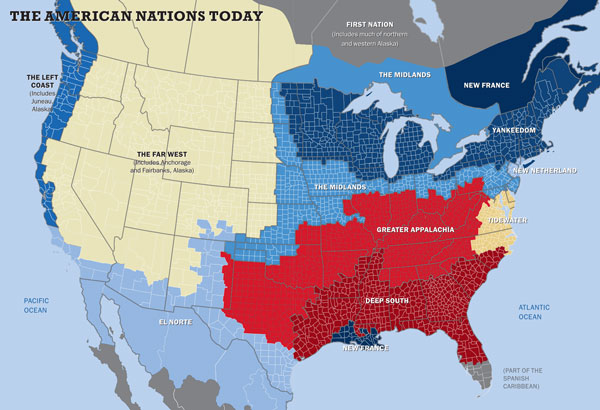
Poring through the cultural, historical and genealogical attributes of America’s regions and states is not a new phenomenon. But it’s always fascinated me. The different brands of religion that colonized different parts of the country in stages, the interaction with existing institutions, and the very different approaches to politics help explain why this fantastically diverse country comes close to being ungovernable as a whole. What Colin Woodward has done is create eleven states of North America and focus on their attitudes toward violence. Here’s the map:
He has a book out explaining his analysis – but here’s the essay’s money quote:
Most scholarly research on violence has collected data at the state level, rather than the county level (where the boundaries of the eleven nations are delineated). Still, the trends are clear. The same handful of nations show up again and again at the top and the bottom of state-level figures on deadly violence, capital punishment, and promotion of gun ownership.
Consider assault deaths. Kieran Healy, a Duke University sociologist, broke down the per capita, age-adjusted deadly assault rate for 2010. In the northeastern states—almost entirely dominated by Yankeedom, New Netherland, and the Midlands—just over 4 people per 100,000 died in assaults. By contrast, southern states—largely monopolized by Deep South, Tidewater, and Greater Appalachia—had a rate of more than 7 per 100,000. The three deadliest states—Louisiana, Mississippi, and Alabama, where the rate of killings topped 10 per 100,000—were all in Deep South territory. Meanwhile, the three safest states—New Hampshire, Maine, and Minnesota, with rates of about 2 killings per 100,000—were all part of Yankeedom.
It’s this regional disparity that helps explain the impossibility of federal gun control of any bite. And on many issues, like stand-your-ground laws and the death penalty, deep cultural legacies about the permissibility of violence still propel the debate:
Of the twenty-three states to pass stand-your-ground laws, only one, New Hampshire, is part of Yankeedom, and only one, Illinois, is in the Midlands. By contrast, each of the six Deep South–dominated states has passed such a law, and almost all the other states with similar laws are in the Far West or Greater Appalachia …
The pattern for capital punishment laws is equally stark. The states dominated by Deep South, Greater Appalachia, Tidewater, and the Far West have had a virtual monopoly on capital punishment. They account for more than ninety-five percent of the 1,343 executions in the United States since 1976. In the same period, the twelve states definitively controlled by Yankeedom and New Netherland—states that account for almost a quarter of the U.S. population—have executed just one person.
The North-South rubric is way too crude. And the reality shows why federalism is the only workable system for this deeply divergent congeries of religion, culture and history.

Many members are welcoming Bowie and me:
Congrats on the new family member. You said about the missing leg: “it is, of course, the first thing you notice about her”. Not necessarily. We have a three-legged labrador. Time after time, we’ve had people over for dinner, only to have them exclaim at the end of the evening, “Wow, I just realized your dog has three legs!”
Another:
Congratulations on finding Bowie, who “runs like the wind.” Shortly after adopting our three-legged dog, Ceiba, my wife and I were walking with Ceiba and our other dog, Chloe, along the C&O Canal towpath outside D.C. Both dogs were off leash. When a deer ran past in the nearby woods, it was Ceiba who led the charge, leaping over fallen trees and crashing through the brush. Both dogs were soon out of sight, their barking growing ever fainter. So much for the handicap.
Fortunately, the deer was faster than the dogs. On another walk along the canal, Ceiba charged into the brush and reappeared with a freshly caught squirrel between her jaws. Hopping along ahead of us (there was no way she was going to give up that rodent), she proceeded to devour the animal, starting by crunching into its skull.
Dog paddling seems to be the only thing our girl can’t do; it’s tough when you’re missing a front leg. At the local park, she’s got dozens of fans, especially kids – “Look, the three-legged dog!” Ten years on, she remains a joy and an inspiration.
Another:
Welcome to the three-legged beagle club! Jake came to my wife Sharon and me via a beagle
rescue organization near Nashville (where we live) several years ago. His previous owners had him tied to a chain in the yard. While they were mowing the yard, the chain had become wrapped around the shaft of the mower and Jake was pulled under, mangling his left front leg beyond saving. Afterward, they were planning to turn him over to a shelter before the rescue organization took him in.
The two things that are most amazing about Jake (it’s hard to narrow down to just two!) are that his default setting is happy – he wakes up wagging his tail every morning – and, as you note about Bowie, he is utterly oblivious to his handicap. Nobody has ever told Jake that missing a leg is a problem, so for him it isn’t. He digs massive holes in the yard, he runs after squirrels and plays with his “sisters” – our two other dogs – and never gives a thought that there is some sort of problem with his curious, hoppy gait.
He is also, of course, nothing but trouble. As Bowie will be.
Another:
One of our older greyhounds got bone cancer in his right rear leg. Instead of putting him down as everybody suggested, a vet surgeon removed his leg and he happily lived for three more years as a tripod … until the cancer returned with a vengeance. But those three years were glorious and happy for him. He could go for long walks and run on the beach and splash in the water and swim though waves. He was also one heck of a draw (and a ham); people would cross the street to say hello to him and give him an ear rub.
And another:
Welcome to the world of a 3-legged rescue dog. We got Lego (formerly Rambo, but he’s no Rambo) about a year and a half ago. A lab mix, he is the sweetest, most joyful dog I’ve ever known. I couldn’t be happier that my wife took him in.
Another asks:
Who is rescuing whom?


 The Dish