Sanctioning Our Way To War

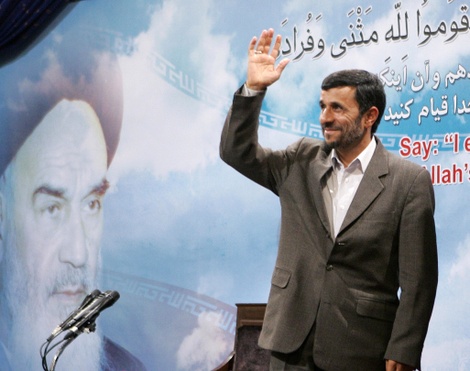
Beinart likes “hearing Iran hawks argue for war because I know they’re being honest.” When they argue for more and more crippling sanctions, despite concessions from Iran, not so much:

Hawks argue that because sanctions are hurting Iran’s economy, and Iran has showed increased flexibility under newly elected President Hassan Rouhani, even more sanctions will make Tehran capitulate completely. Since “international sanctions have forced Iran to the negotiating table,” argued House Foreign Affairs Chairman Ed Royce recently, “we should build upon this success with additional measures to compel Iran to make meaningful and lasting concessions.”

But it’s hard to reconcile that view with any of the information coming out of Iran. While the pain of sanctions may be prompting Iranian leaders to make concessions they would not have previously made, there’s little evidence that the sanctions threaten what Iran’s leaders cherish most: their hold on power. To the contrary, prominent Green Revolution figures have argued that sanctions strengthen the regime at home.  Were Royce’s logic correct, Rouhani would be feeling the heat from Iranian doves outraged that he is not capitulating more fully to Western demands. Instead he’s under attack from hawks outraged that he’s conceding too much and getting little in return.

It’s hard to believe that hawks such as Netanyahu and [House Foreign Affairs Chairman Ed] Royce really believe that ratcheting up sanctions in pursuit of a zero enrichment demand that most foreign governments, and most Iranians, oppose, will bring a diplomatic solution to the Iranian nuclear standoff. Then again, given what they’ve written in the past it’s hard to believe that many hawks really want a diplomatic solution at all.

They don’t, it seems to me. Such a solution would require imagination and a strategic sense of the long view. Netanyahu has powerfully demonstrated that he – along with his extremist allies in the US Congress – has neither. They remain wedded to a past that cannot hold and a future which cannot happen, unless it means catastrophic religious warfare.

My longer take on Israel and Iran is here.

Chart Of The Day

Fewer and fewer politicians serve in the military before taking office:

Vets In Congress

Erik Voeten flags the work of Peter Feaver and Chris Gelpi to explain why this is important:

Feaver and Gelpi establish the following regularities (see especially this book and this chapter-length update):

— On issues that concern the use of force and the acceptance of casualties, the opinions of veterans track more closely with those of active military officers than with civilians.

— The U.S. initiates fewer military disputes when there are more veterans in the U.S. political elite (the cabinet and the Congress).

— The U.S. uses more force in the disputes it initiates when there are more veterans in the U.S. political elite.

— Veterans are less likely to accept U.S. casualties for interventionist uses of force than for “realpolitik” uses of force.

Spending Singles

In China, 11/11 is “Singles’ Day,” the four 1s “symbolizing ‘bare branches,’ Chinese slang for bachelors.” Although “the true meaning of this holiday [is] hating singlehood,” it’s also a boon for business:

Thought to have originated about 20 years ago as a joke on college campuses, Singles’ Day was Screen Shot 2013-11-11 at 1.57.45 AMonce an occasion for confessing one’s feelings to that special someone. But since 2010, online retailers have transformed the holiday, also known as “Double 11,” into an epic online shopping extravaganza akin to America’s Cyber Monday.

China has 271 million online consumers, meaning that almost half of China’s 591 million Internet users buy products online. E-commerce sites Taobao and Tmall, which saw a combined $1 trillion in sales in 2012, will both be running promotional campaigns during China’s Singles’ Day. Among the offers: 50 percent discounts on products like boyfriend body pillows and hoodies that read “I am single because I am fat.” Amazon.cn declared that the site would sell “20,000 products discounted by as much as 90 percent.” That includes a wedding ring, which singles can presumably buy, just in case. Jack Ma, founder of Internet giant Alibaba, told Chinese Premier Li Keqiang late last month that Alibaba’s sales on Singles’ Day 2012  were “nearly $3.3 billion” — more than double the roughly $1.5 billion purchased on Cyber Monday in 2012. For Singles’ Day 2013, Ma expects sales to exceed $4.9 billion.

Update from a reader:

Just thought I’d let you know that this was a really interesting post you put up about China, but the stat you quote that “E-commerce sites Taobao and Tmall, which saw a combined $1 trillion in sales in 2012…” is not actually correct. If you go to the source, it’s a combined 1 trillion Yuan, which would be $160 billion.

Capturing America’s Conflicts

In honor of Veterans Day, the Washington Post has created Portraits of War, a portfolio of some of the greatest war photography of the last 150 years. Among the ten featured photographers is Mathew Brady:

dish_bradyBrady remains the single most famous photographer of the Civil War. His name came to overshadow those of other photographers, causing some mistakenly to believe that Brady had almost single-handedly created the immense photographic archive. Brady deserves credit for envisioning the possibility of using photography systematically to document the war. He would send teams of photographers – and occasionally go himself – to create images of battlefields and important leaders. His public display of “The Dead of Antietam” was the first time the American public viewed images of dead soldiers on the battlefield.

Brady’s efforts to document the Civil War pushed him into a series of bankruptcies. In the years after the war, he campaigned to get Congress to buy his collection of negatives and prints. In 1875, Congress finally bought the rights to his work for $25,000.

See the full tribute here.

(Photo of Union soldier by gun at US Arsenal, Washington DC, 1862, by Mathew Brady via Wikimedia Commons)

What’s So Scary About Relaxing Sanctions?

Dennis Ross claims that “Israelis and others in the Middle East … fear that the limited relaxation of sanctions will quickly erode the sanctions regime”:

Notwithstanding our claims that the sanctions architecture will remain in place, there is a widespread belief in the Israeli security establishment that many governments and their private sectors will see an opening and will be convinced that they can and will be able to start doing business again. As they start approaching the Iranians, the Iranians will see that the sanctions are going to fray and they simply need to hang tough and concede no more. From the Israeli standpoint, the first step will thus be the last one and the Iranian program even if capped, will be at such a high threshold that Iran will have a break-out capability. They see no reason to give up our leverage now and let the Iranians off the hook.

Blockbusted, Ctd

A reader reflects:

I worked at a Blockbuster for about three years, starting in high school and continuing when I was in college. As a budding filmmaker and rabid cinephile, it was pretty much the perfect job for me. Sure, the pay sucked, but the bottom line was I was being paid to indulge in my number one passion.

Blockbuster had an inventory management system whereby if a particular video had not been checked out within the past year, it would get flagged by the system for resale. We’d actually take the video off the shelf, price it, and put it in the used video sale bin. As a movielover, this greatly upset me. So I made it my mission to look up movies that I cared about and check them out under my employee account if they were in danger of being weeded. David Lynch, Jim Jarmusch, and Wim Wenders owe me big time. (Here’s a post I wrote about one of my encounters as a Blockbuster employee.)

Another was there at the beginning:

The recent announcement of the closure of Blockbuster brought back some fond memories for me. I worked at the original Blockbuster in Dallas – the Medallion Store, as we called it (it was located in a strip mall that was then known as the Medallion Center).

I’m sure Jason Bailey’s descriptions of know-nothing employees is accurate, but not in the beginning, certainly not at Medallion. We knew our stuff. I suppose the difference between my 1985 Blockbuster experience and Jason Bailey’s was that, in 1985, we still were a mom-and-pop enterprise. I think by the time I left the store for the real world, there were still only seven stores. And we had employees who loved movies.

We had SMU film majors like Todd, who would occasionally answer the phone in character (Jack Nicholson: “Blockbuster Video, what the hell do you want?”). We had working local actors and actresses like Laurel, keeping a day job in a field she loved that had hours flexible enough for her to ply her craft on the weekends. We had writers like Betsy who was a staple in Dallas-area TV and radio. And we knew our movies; we knew the shit out of them. I had customers who would come directly to me for all of their movie recommendations; I remember pointing a man to a little-known new movie by a couple of then-unknown brothers and winning his loyalty for life (Blood Simple). I remember impressing a girl so much with my foreign film knowledge by pointing her to the films of Jean-Jacques Beineix that we ended up watching Betty Blue together on the couch in her one-bedroom apartment and doing it on that same couch before Betty had even poked her eye out. And we even got the occasional celebrity: I met Chris Evert, NBC sportscaster Bill Macatee (dating Evert at the time, allegedly), and the writer Calvin Trillin (whom I surprised simply by knowing who he was).

Blockbuster had obviously grown too big for its own good; it couldn’t keep pace with modern technology and its passing was inevitable. But I for one will mourn that passing.

Another reader:

I clerked at Blockbuster off and on for four years. It was a part-time college job, and every time I’d leave and come back they’d have a new store manager and would want me to go through training again because they’d changed some insignificant procedural detail of the job like a new step in the nine-step checkout process. Yes, they wanted you to go through all nine steps of a carefully scripted upselling routine, and even though most of us didn’t follow it, every clerk had little printouts of the process taped to our computer monitors.

I tended to only observe steps 1, 8, and 9 because I’m a big fan of not slowing down the line, although we’d often add in the all-important “negotiation over and removal of late fees” steps. Those weren’t in the official process for some reason, but the district manager once told us “it’s not worth losing a customer over a late fee under $10.” I didn’t ask for any clarity beyond that, as it seemed like cart blanche permission to remove all my friends’ fines, and if they racked up larger ones I could just take them off in installments.

The point of sale system that I used in my last year there (2004) was DOS-based and probably hadn’t changed since the early-’90s. It had severe limitations on memory, meaning that transaction-level data would drop off after six months. The system would retain records of old late fees, but we wouldn’t have a way of referencing the original transactions. This meant that one easy way to avoid paying a fee was to just wait a few months and then ask a clerk what movie the fee was for.

Unlike most libraries, the systems were not networked, so I had no way of checking inventory at other stores without calling them. This often played out on busy Friday night shifts with a long line and a popular new release that everyone wanted and no one had in stock. And naturally we’d often get tied up with an insistent customer who wanted us to call every Blockbuster within a 30-minute drive.

Blockbuster settled a class-action lawsuit over late fees in 2001, and for several months we were printing out information about it onto everyone’s receipt. The receipts stretched beyond 3-feet (yes, we measured), and there was a phone number that people could call to get a couple of coupons for free rentals and $1 off candy. Another consequence was that clerks were no longer allowed to refer to these controversial charges as “late fees.” They were now “extended viewing fees,” but the policy didn’t change.

The perks of the job included the free rentals and the exposure to the eclectic mix of customers in the Delmar Loop neighborhood of St. Louis. The Loop is a stretch of bars and restaurants near a university, so you could count on a steady stream of the inebriated from mid-evening to midnight on most nights. I’m also a firm believer working at least one retail or restaurant gig during a holiday season builds character. We found ways to have fun with it all. For my part, I always made sure that Die Hard made its way to the special display of holiday movie rentals.

In hindsight, the only things working against Blockbuster were the ridiculous pricing model, widespread hatred from the customer base over late fee policies, auto-charging of credit cards for said fees, traditional competition from Hollywood Video and indy stores (which could carry porn), new competition from Netflix, Redbox, BitTorrent, YouTube, Amazon, premium cable channels, OnDemand, Dish, and Hulu, and massive cultural shifts in media consumption patterns caused by widespread adoption of the internet and the move away from removable media formats in general. But other than those things, Blockbuster’s business model was completely sound.

Don’t Speak For We

Jeremy Gordon examines the reliance on the collective pronoun in making an argument:

Over time, the “royal we” has made its way from the mouths of Queen Victoria and Margaret Thatcher into our writing. At best, it seems a crutch, while at worst it’s an assumed arrogance. Here’s but one example from The New Yorker’s Sasha Frere-Jones, writing a jeremiad against Jay-Z:

However thick the darkness, we drag ourselves into arguments, up to lecterns, because we have not let go of each other yet. We still think we can fix a thing that shows no sign of ever being fixed.

… [I]t’s clear this isn’t a literal case of the royal “we.” (It’s hard to imagine any music writer being that arrogant.) Instead, it’s a rhetorical trick to make the reader say “I guess I do drag myself into the argument despite the thickness of the darkness!” Because with his “we,” who is Frere-Jones speaking for?

Himself, trying to avoid the English class no-no of using first person? The New Yorker, with the “we” a formal endorsement of what’s being discussed? Is it even more far-reaching than that, leaping off the screen to presume how the reader is supposed to feel? Without some kind of clarification, there’s really no way to know.

Writing in Personal Pronouns in English Language, English professor Katie Wales notes the irony: “‘We’ itself is often used, out of modesty, for example, to resist the egocentricity of a potential ‘I’; yet an egocentric ‘meaning’ will often be re-asserted.” In hiding the individual author, a consensus opinion is born. No one person thinks this thing; we do. And because the entire reason of why you’re reading is because you think the writer has something to say, you’re subconsciously agreeing before you’ve even thought otherwise.

Who Could Beat Clinton?

Noting a series of populist victories among Democrats, Scheiber suggests that such forces could pose a serious obstacle for Hillary. He thinks Elizabeth Warren could prove to be a formidable opponent:

It’s hard to look at the Democratic Party these days and not feel as if all the energy is behind Warren. Before she was even elected, her fund-raising e-mails would net the party more cash than any Democrat’s besides Obama or Hillary Clinton. According to the Times, Warren’s recent speech at the annual League of Conservation Voters banquet drew the largest crowd in 15 years. Or consider a website called Upworthy, which packages online videos with clever headlines and encourages users to share them. Obama barely registers on the site; Warren’s videos go viral. An appearance on cable this summer—“CNBC HOST DECIDES TO TEACH SENATOR WARREN HOW REGULATION WORKS. PROBABLY SHOULDN’T HAVE DONE THAT”—was viewed more than a million times. A Warren floor speech during the recent stalemate in Congress—“A SENATOR BLUNTLY SAYS WHAT WE’RE ALL THINKING ABOUT THE OBNOXIOUS GOVERNMENT SHUTDOWN”—tallied more than two million views.

Warren would have her work cut out for her; Harry Enten calls Clinton “the most formidable presidential frontrunner in the modern era”:

The only candidate anywhere close to Clinton was Al Gore for 2000. Gore had long been in the upper 40s to mid 50s. Gore went on to waltz to the nomination in the single strongest non-incumbent performance in the modern era. He won every single primary and took 76% of the primary vote.

Clinton’s numbers look a lot more like an incumbent. Bush was in the low 70s for 1992. Clinton was in the low 60s to low 70s for 1996. Obama mostly was in the low to mid 60s for 2012, even when matched up against Hillary Clinton.

Moreover, Clinton’s edge extends to the early caucus and primary states. Your national numbers can be amazing, but if you don’t win either Iowa or New Hampshire, you’re likely not going anywhere. Clinton is in the mid 60s in New Hampshire and the low 70s in Iowa.

A Word On Israel And Iran

Life Continues In The Havat Gilad, West Bank Outpost

On the very sensitive issue of Israel, there is often little middle ground that isn’t swamped by angry rhetoric on either side of the debate. So, as the critical talks with Iran proceed, I want to clarify a couple of things.

My dismay at Israel’s rightward lurch, its refusal to freeze settlement construction on the West Bank and East Jerusalem, and its apocalyptic fear-mongering about Iran does not and should not mean that I couldn’t care less about the Jewish state. I can understand how, in the rough and tumble of daily blogging, many reflexive – and some thoughtful – supporters of Israel might infer that I harbor some disdain for the Zionist project, or indifference to the dangers Israel confronts on a daily basis. I don’t. For an Irish-Catholic Englishman, I have long been passionate about Israel’s security and success. It was one of the first foreign countries I ever visited, and for many years (shaped, of course, by my time at The New Republic), I completely sympathized with successive Israeli governments’ frustration at the lack of a decent negotiating partner and the continued, foul incitement to anti-Semitism of much of Palestinian culture.

Things changed for me during my unsentimental education about the world-as-it-is during the Iraq War catastrophe. That war was the defining event for me and my own political understanding of the 21st Century world. For others, it was an error or a failing, but their broader worldview remained intact. Mine didn’t. It didn’t make me an isolationist, but it sure radically tempered my belief in the ability of American power to remake the world in our own image – however well-meant that remaking may have been. It became clear to me that a global conflict between fundamentalist Islam and fundamentalist Judaism and fundamentalist Christianity could become apocalyptic, especially in the Middle East. What was urgently required was a move to pragmatism, toward defusing the most polarizing rhetoric, toward healing the wounds of Iraq, and a calmer, if clear-eyed, engagement with Muslim humankind.

I noticed during this period that, post-Arafat, the Palestinians were no longer an unreliable partner in negotiations. Abbas and Fayyad were ahmadinejadbehrouzmehriafpgetty.jpgabout as good as we were ever going to get, and the Obama presidency was the perfect reagent for a compromise that would defuse some of fundamentalism’s power and return us to the art of the possible. The way in which Israel’s leadership responded – contemptuously – signaled that we were dealing within a very different Israeli government than, say, Rabin’s. Their Gaza war, their hyperbolic rhetoric on Iran, their continued settlement of the West Bank, their constant apartment-grabs in East Jerusalem, and the increasingly extremist tone of Israeli political culture: all this made me see them as the current arrogant problem, and not the Palestinians. The way Netanyahu intervened in American domestic politics to undermine the president also appalled me.
Obviously I am not alone. Someone far more knowledgeable about the country whose views I had long shared – Peter Beinart – also shifted. Many others have among American Jews of the younger generations. And the motive for the shift is not to demonize Israel, but to assert America’s national interest first and foremost, and secondly to save Israel from becoming a pariah state that was hellbent on becoming a permanent occupying power, with all the moral corrosion that occupation implies. It is tempting to say that the moment for a two-state solution is past. But I want to resist that temptation – because without a two-state solution, Greater Israel is not a country the West can support with such largesse indefinitely. And I want to support an Israel that lives up to the best aspirations of its founders.

My support for an agreement with Iran that grants it the right to enrich uranium at low levels and subject to routine, tough inspection regimens is also a function of dealing with the world as-it-is and not as I would like it to be.

The fact is that Iran is a great country with deserved pride, but it’s been run into the ground by fundamentalist fanatics, fascistic in their extreme factions, who spout foul rhetoric and conduct themselves in ways that warrant profound suspicion. The crippling sanctions regime was a proper response to that. But when the Iranian response to years of sanctions is the emergence of a pragmatic faction given legitimacy by support in Iran’s highly constrained elections, and when that faction sends signals it is desperate to end sanctions and eager to rejoin the international community, we have an opportunity, as with Abbas and Fayyad, to defuse the tension.

For me, the emotions of June 2009 affect this too. The Green movement proved that Iran’s younger generation is on the side of freedom, not theocracy. And yet that movement, like the regime, also insists that the country has a right to enrich uranium. On this, all of Iran is united. It is not just foolish but impossible to somehow end that fact by making the end of uranium enrichment our non-negotiable stance. It guarantees failure.

Nor can we erase the fact that Iran has developed the capacity to enrich uranium, even under the most brutal of sanctions, and it is seen as a matter of national pride to retain that capacity. As Roger Cohen notes:

Although Western intelligence agencies believe the Islamic Republic has not taken the decision to make a bomb, Iran’s nuclear program has advanced far enough for the country to have the relevant knowledge. Destroying this know-how is near impossible. Iran knows how to produce weapons-grade fissile material; it may not yet be able to make a deliverable weapon. So, as Stephen Heintz, the president of the Rockefeller Brothers Fund, put it to me, “The key for the international community is to put all that capability in a box where it is verifiable, contained and controlled. That is what the deal is about.”

Indeed it is. Given its past behavior, the regime has to meet more exacting standards for a deal than might otherwise be the case. But without a deal, Iran will increase its nuclear activity, Israel will be tempted to pre-empt it, an arms race with the Saudis might follow, and the cycle of green-peacefundamentalist violence would be ratcheted up a notch. It’s the kind of cycle that can lead to catastrophe. Avoiding this – creating a space for hardheaded relations with Iran and a deep commitment to Israel’s security – seems to me easily the most practical move in the global war on fundamentalist terror by defusing it with pragmatism. Winning that war will make Israel more secure, enhance American policy options in the Middle East, bring down the price of oil, and give Iran’s silent pro-Western majority an opportunity to change the country from within.

That’s what I want to see. I know it’s tough, given the history of the Tehran regime. I know that hope is no longer as powerful an emotion as it was five years ago. But I see this moment of opportunity as similar to the one we faced in the late 1980s with the emergence of glasnost and perestroika in the Soviet Union, and for the same reasons of economic desperation, and pent-up popular frustration. Russia too is a great nation whose fundamentalist atheists had also driven into the ground. We found a way to rescue the country from its regime, by engagement after a ramping up of opposition. I hope Obama and Rouhani can become the Reagan and Gorbachev of this moment. Because the alternative is war at some point – sooner or later – and a tragedy for the Iranian people and for Israel’s core security.

Who really wants that? I mean: really? And what other options do we actually have, apart from the last resort of war – which the American people would not, in my view, support? We are in about the sweetest spot history will hand to us. If we squander this opportunity, the world will darken measurably.

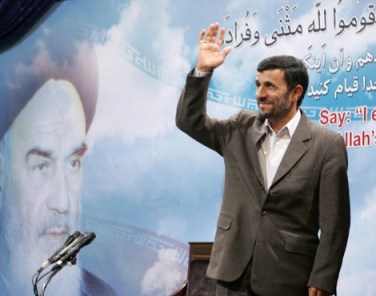
(Photos: A Jewish settler boy swims in a pool near the Jewish outpost Settlement of Har Bracha, West Bank on July 22, 2013. By Uriel Sinai/Getty Images. Mahmoud Ahmadinejad and the Green victory sign by Getty Images.)