Gardner is at his most emotional describing what seem[s] to have been a classically happy marriage — he recalls sitting on the subway with his wife and newborn as one of the happiest moments of his life, a moment of peace and accomplishment, not ambition or prestige — and describing a very traditional sense of religious awe. While Gardner had no patience for supposed evidence of anything supernatural, he remained a firmly nondenominational monotheist for most of his life. He baldly admits that this is a matter of faith and flies in the face of all available evidence, and that it is a choice he has made for the sake of his own happiness. I suppose you could say he proselytizes a bit, but since he knows that his case is weak, he doesn’t come off as particularly confrontational: “I managed to retain faith in a personal God and a hope for an afterlife.” Gardner writes:
Philosophical theism is based unashamedly on posits of the heart, not the head.
It freely admits that atheists have all the best arguments. There are no proofs of God or of an afterlife. Indeed, all experience suggests there is no God. If God exists, why would he so carefully conceal himself? All experience suggests that when we die, our body rots and nothing in our brain survives. […] It’s a lasting escape from the despair that follows a stabbing realization that you and everyone else are soon to vanish utterly from the universe. It is an effort, perhaps genetic, to relieve the anguish of believing the universe is nothing more than the tale of a blind idiot, full of sound and fury and signifying nothing.
A weak case seems to make for a more robust faith.
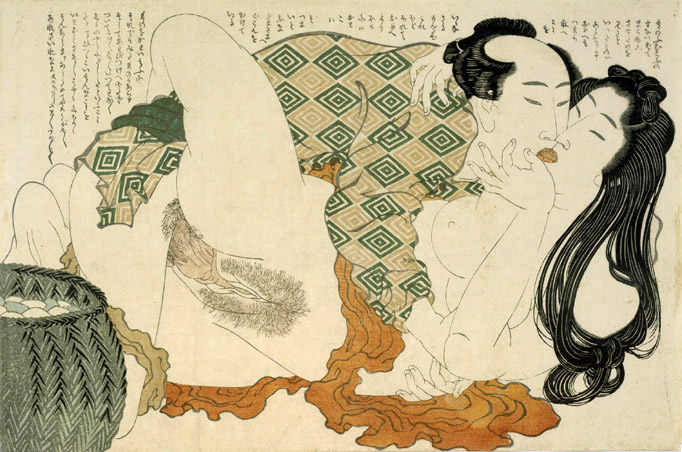
James Polchin visits an exhibit on shunga, a form of erotic art that flourished centuries ago in Japan:
Throughout these works bodies are minimally rendered with undulating lines and a flat, paleness of flesh. Instead, it is the fabric that attracts the attentions, the flows of color and details of patterns that dominate many of these works, often done with vibrate colors or golden paints. It is the actions and gestures that matter, the settings and stories that the images tell. The nakedness of the bodies — what was so concerning to Western viewers at that time — was just another form of dress. The erotic qualities emerged not from the flesh, but from what is hidden and what the artists let us see. Like a striptease, the pleasures of looking are wrapped up in the flow of fabric and flesh. …
Consider Katsushika Hokusai, most famous for his series of wave paintings that have become iconic of Japanese art of the 19th century. Hokusai’s works are often seen as major influence on trends in 19th century France, influencing the works of Gauguin, Toulouse Lautrec, and Degas among others. But Hokusai also produced nearly 20 shunga books and a number of large woodblock prints. His series “Adonis Flower” (c. 1822-3) captures closely pictured scenes of couples entangled in on another, the flow of bodily outlines contrasting with the undulating fabrics and flow of curtains and screens. Unlike his waves paintings with their expansive perspective, these works are tendered with concentrated intimacy, and, like [Torii] Kiyonaga’s horizontal scrolls, present the couples movements, their contorted bodies, crammed into the confining space of Hokusai’s frame.
The Dish recently featured another example of shungahere.
(Image of a print from Hokusai’s series “The Adonis Plant” via Wikimedia Commons)
Christine Baumgarthuber looks back to when charms, elixirs, and hexes were an ordinary part of romantic life:
[L]ove charms were as often as not small, unassuming things — necklaces and rings and
small vials of unfamiliar powders. Many people favored love packets, which they could easily fashion and secret away. The Irish adorned theirs with suns and moons and magic squares. Into them they stuffed toenail pairings and underwear fragments. Amorous Turks similarly fashioned pouches to stuff with even stranger items: a man’s molar and a particular bone in the left wing of a hoopoe (the bird sent by Solomon to the Queen of Sheba), among other things. Under the pillows of pretty women these parcels would go, put there in the hope of stoking passion for the bearer.
Any increase in attraction as a consequence of such doo-dads likely owed more to common belief than occult forces. The objects of such charms and rituals certainly did complain of falling under their influence, blaming them for everything from disappointing marriages to illegitimate children. A dalliance had as its cause a strand of hair left on a pillow; an unexpected pregnancy, a lavender sachet. Such hexes people saw as matter-of-fact events. To disbelieve them they thought unwise.
Natasha Geiling relates the story of Veuve Clicquot, the champagne named for the woman who “created the modern champagne market” in the early 1800s:
Champagne is made by adding sugar and live yeast to bottles of white wine, creating what is known as secondary fermentation. As the yeast digests the sugar, the bi-products created are alcohol and carbon dioxide, which give the wine its bubbles. There’s only one problem: when the yeast consumes all the sugar, it dies, leaving a winemaker with a sparkling bottle of wine–and dead yeast in the bottom. The dead yeast was more than unappetizing–it left the wine looking cloudy and visually unappealing. The first champagne makers dealt with this by pouring the finished product from one bottle to another in order to rid the wine of its yeast. The process was more than time-consuming and wasteful: it damaged the wine by constantly agitating the bubbles.
Barbe-Nicole [Clicquot] knew there had to be a better way.
Instead of transferring the wine from bottle to bottle to rid it of its yeast, she devised a method that kept the wine in the same bottle but consolidated the yeast by gently agitating the wine. The bottles were turned upside down and twisted, causing the yeast to gather in the neck of the bottle. This method, known as riddling, is still used by modern champagne makers.
Barbe-Nicole’s innovation was a revolution: not only was her champagne’s quality improved, she was able to produce it much faster. Her new technique was an extreme annoyance to her competitors, especially [vintner] Jean-Rémy Moët, who could not replicate her method. It wasn’t an easy secret to keep, since Barbe-Nicole employed a large number of workers in her cellars–but no one betrayed her secret, a testament to her workers loyalty, [The Widow Clicquot author Tilar] Mazzeo explains. It would be decades before any of them became wise to the method of riddling, giving Barbe-Nicole another advantage over the champagne market. … Veuve Clicquot helped turn champagne from a beverage enjoyed solely by the upper-class to a drink available to almost anyone in the middle-upper class–a seemingly small distinction, but one that vastly increased Barbe-Nicole’s market.
Christian Happ and his colleagues recruited 60 students (20 men) with varied video gaming experience and had them spend 15 minutes playing the violent and bloody beat-em-up game Mortal Combat vs. DC Universe on the Playstation 3. Some of the participants played the morally good character Superman, while the others played the Joker, the baddie from Batman. Apart from that, the game experience was the same for all participants – their time was spent in hand-to-hand combat against a variety of other computer-controlled game characters.
Another twist to the experiment was that before the game began half the participants read a bogus Wikipedia article about their character, designed to encourage them to empathise with him. For those playing Superman, the article said how he’d come from a loving family. The Joker article described how he’d suffered abuse in his childhood.
After playing the video game, the participants looked at grids of faces on a computer screen and indicated how hostile they looked. Some of the grids contained angry faces, but the crucial test was how hostile the participants rated the grids that contained all neutral faces. The key finding here was that participants who’d played the Joker were more likely to perceive hostility in neutral faces (a marker of an aggressive mindset), as compared with the participants who played Superman.
Another test was an old favourite known as the “lost letter technique”. As the students left the lab, they saw a stamped and addressed envelope on the floor outside. Those who’d played Superman in the violent game were 6.2 times more likely to post the letter or hand it in to the researchers, as compared with those who played The Joker (the rates were 20.7 per cent vs. 3.3 per cent, respectively).
Previous Dish on videogames and violence here, here, and here.
(Video via Devour: “From Wolfenstein 3D to Battlefield 3, here’s a look at how first person shooters have changed since 1992.”)
Matthew Hutson describes the work of psychologist Kurt Gray, whose research into how people objectify each other has yielded intriguing findings:
In one experiment, subjects saw a photograph and a short description of a man or a woman. The photo showed either just the head or also the shirtless torso. When presented shirtless, targets were seen as having less competence. This is just what you might expect from research on objectification: we’re easily induced to see others as mere objects, pieces of meat without thoughts of their own. But it wasn’t that simple. Shirtless targets weren’t seen as devoid of all thought. They were actually seen as being more capable of emotions and sensations than their less exposed selves. They didn’t have less mental life but a different mental life. Objectification is apparently a misnomer.
The photographer Timothy Greenfield-Sanders had shot 30 stars, first fully clothed, then naked, in the same position and with the same expression. The researchers used these images in a series of experiments and … [i]t turned out that naked porn stars are also seen as having less competence but more sensitivity than their clothed selves. And when one actress was shown in an especially sexual pose, the trend only increased, presumably due to greater focus on her body and its pleasures. True objectification, as traditionally conceived of, just did not happen. …
What emerged was that we see the capacity for feelings, whether pleasure or pain or happiness or anger, as distinct from the capacity for intellectual thought and planning. Namely, that we treat those we objectify as less intelligent, yet simultaneously we endow them with a greater ability to feel things. … In most cases, thinking of a person as a body does not lead to objectification in a literal sense, in which the person becomes an object. Rather, he’s dehumanised — he becomes a sensitive beast.
Our brains become addicted to gambling the same way they get hooked on drugs:
Research to date shows that pathological gamblers and drug addicts share many of the same genetic predispositions for impulsivity and reward seeking. Just as substance addicts require increasingly strong hits to get high, compulsive gamblers pursue ever riskier ventures. Likewise, both drug addicts and problem gamblers endure symptoms of withdrawal when separated from the chemical or thrill they desire. And a few studies suggest that some people are especially vulnerable to both drug addiction and compulsive gambling because their reward circuitry is inherently underactive—which may partially explain why they seek big thrills in the first place.
Even more compelling, neuroscientists have learned that drugs and gambling alter many of the same brain circuits in similar ways. These insights come from studies of blood flow and electrical activity in people’s brains as they complete various tasks on computers that either mimic casino games or test their impulse control. In some experiments, virtual cards selected from different decks earn or lose a player money; other tasks challenge someone to respond quickly to certain images that flash on a screen but not to react to others.
A 2005 German study using such a card game suggests problem gamblers—like drug addicts—have lost sensitivity to their high: when winning, subjects had lower than typical electrical activity in a key region of the brain’s reward system.
Previous Dish on gambling addiction here and here.
We probably all knew the acerbic John Lennon could be a bastard, as cruel as he was witty, but Lewisohn uncovers interesting levels of illegitimacy in many of these often part-Irish Catholic families. In fact, they’re not even called the Beatles until 300 pages in; Ringo doesn’t actually join until around page 700. This is the story of the Beatles as schoolboys, of Lennon and McCartney “sagging off” to write in secret at Aunt Mimi’s, of the latest rock’n’roll and R&B cuts, and of lost virginities, of Stu Sutcliffe and Pete Best and Hamburg, of the “Piedels” – the German mispronunciation of Beatles, the Penises – on “prellies” (Preludin, the upper guzzled by many in the cellar clubs), ripping it up on the Reeperbahn. Sometimes, these famous men really seem like motherless children – both McCartney and Lennon lose their mothers in their teens and this huge, shared loss is given sensitive and apposite emphasis. Deaths, desertions and departures are key to the story.
Liz Thomson is also impressed with the author’s rigorous research:
Lewisohn spent six months living in Liverpool, and you can tell. Not just in the way he traces Beatle forebears but in the way he puts those forebears in their socio-historical context; in his understanding of the city’s psychogeography:
what it meant to grow up in rough-tough Dingle, as Ringo did, or in south-suburban Woolton, as John did, or to experience life like Paul and George, on the council estates created by Liverpool Corporation after the war as it moved people out of the city, leaving its bomb-damaged historic heart to rot until the 1980s renewal. The would-be Beatles criss-crossed its gap-toothed streets, guitars on their backs, in search of new musical experiences. Paul and George once crossed town to meet a stranger who they’d heard knew how to form a B7 chord. Today, you’d Google it.
Colin Fleming commends the book for bringing to life the sense of luck and good fortune that drove the group’s career:
If you know the Beatles’ story arc, you are aware that despite the adulation, the chart-topping, the madcap tours, “We’re more popular than Jesus,” Yoko, the breakup—all of that which occurred between 1963 and 1970—the choicest parts of the band’s story are the early, pre-fame years, culminating with 1962. … In this book, which focuses on 1957 to 1962, Lewisohn picks up on that supernal feel to the Beatles’ success, and at times his own wonder that all of this ever happened, with one amazing coincidence after another, feeds into our own.
For instance, crucial, confidence-building early work—a tour as a backing band in Scotland—comes about “not on merit but because no one else could fill the bill and they shifted everything to make it happen.” A recurring moment, the defining scene of this book, which happens about a dozen times: In doubt, and in the dumps, with ostensibly no prospects to ever get anywhere, one Beatle turns to the others and says, basically, “Something’ll happen.” And then, boom: It does.
He also flags the above recording – from a seven-song set in October, 1963 – as an example of the band’s raw energy in those early days:
They open with Paul McCartney’s “I Saw Her Standing There,” and they immediately make clear that this is going to be a full-speed affair. The sound isn’t just loud; it’s over-loud, possibly the loudest rock and roll anyone had ever cut to date. The guitars distort, adding abraded edges that make the song sound more lascivious than it is, the lines of “She was just 17 / If you know what I mean” now sufficiently scabrous to get the likes of Humbert Humbert up and dancing. The four guys sound thrilled, maybe over the fact that for once hardly anyone is screaming back at them.
The book – we’ll call it ‘MWSHWFYTC’ – is a speed read that takes the reader from Delaney’s native Marblehead, Massachusetts in the early 1990s to present-day Los Angeles, where he lives with his wife and two sons. The years in between, though, are where Delaney’s prose is at its most powerful. The comical (if dangerous) bouts of binge drinking suddenly crash into Delaney’s rock bottom, which involves a hospital, rehab and a halfway house.
Many pages of his book are strewn with profanity, fart jokes or comments about genitalia; you’ll finish the book knowing more about his personal evolution in masturbatory habits than his courtship with his wife. The language is stronger than the typical memoir of triumph over struggle, but then again, not every writer can weave body fluids and body parts into a touching essay about a battle with depression, or three halfway house buddies who never made it out. Those vignettes bookending his battles are less engaging, but Delaney’s unflinching description of addiction and depression should be required reading for those who’ve ever struggled with either disease.
At the end of my freshman year I fell asleep on my roommate’s bed when he was out of town. I’d taken a girl to a screening of The Umbrellas of Cherbourg and I’d struck out. So I convinced my other roommates to drink ten or fifteen beers with me, then passed out in his bed instead of my own and pissed in it thoroughly. When I woke up and realized what had happened, I sprang into action.
I washed his comforter, sheets, and mattress pad. Then I dried them and, in the process, melted his mattress pad. Great holes were seared into it, all over, but I put it on his bed anyway with the sheets and comforter over it. When he got back to the dorms, lay down on his bed, and felt the crunchy mattress pad under him, he pulled the sheets off and asked the heavens, “What the fuck?”
Rather than admit I’d passed out on his bed and irrigated it, I told him, “Sometimes mattress pads melt under your sheets when it gets hot.” I don’t know if he believed this, but we didn’t speak of it again, and we went to our respective homes for the summer a few days later. He’s a bank vice president now, as is another of our suitemates, with whom I smoked pot regularly through a hose that hooked up to a Vietnam-era gas mask that we would take turns strapping to our faces.
In an interview at Slate, Delaney explains why, despite the idea of the tortured artist, “depression itself is not a good thing for comedy”:
I remain under a psychiatrist’s care. I took antidepressants this morning. I’ll take them tomorrow morning. But because I don’t drink, because I take that medication, because I exercise and eat reasonably well and try to live my life and try to be a kind person and a compassionate person and a hardworking person, my base level happiness generally is pretty average to high. I’m still a weirdo. If they did an autopsy on me, it wouldn’t surprise me if parts of my brain they could look at and think, “Whoa … this is … OK, here we are. This explains some things.” Just because I’ve been sober for over 11 years, and just because I don’t put my fist through a wall every other week like I did when I was drinking, and just because I’m not destroying relationships, doesn’t mean that I’m not still in some ways the same nutjob.
It’s OK to be crazy. It’s OK to wrestle with negative urges. I wouldn’t feel guilty if I had the thought, “Hey, I’d love a beer right now.” There’s nothing wrong with me because I feel that way. But if I go have that beer, that would be a problem, because that would likely lead to 23 more and a fireball somewhere. I try to think it through now and weigh the consequences. And I’ve achieved peace with the fact that yeah, I’m a drunk, and that’s OK. The only thing bad about me being a drunk would be not acknowledging it.

 The Dish

