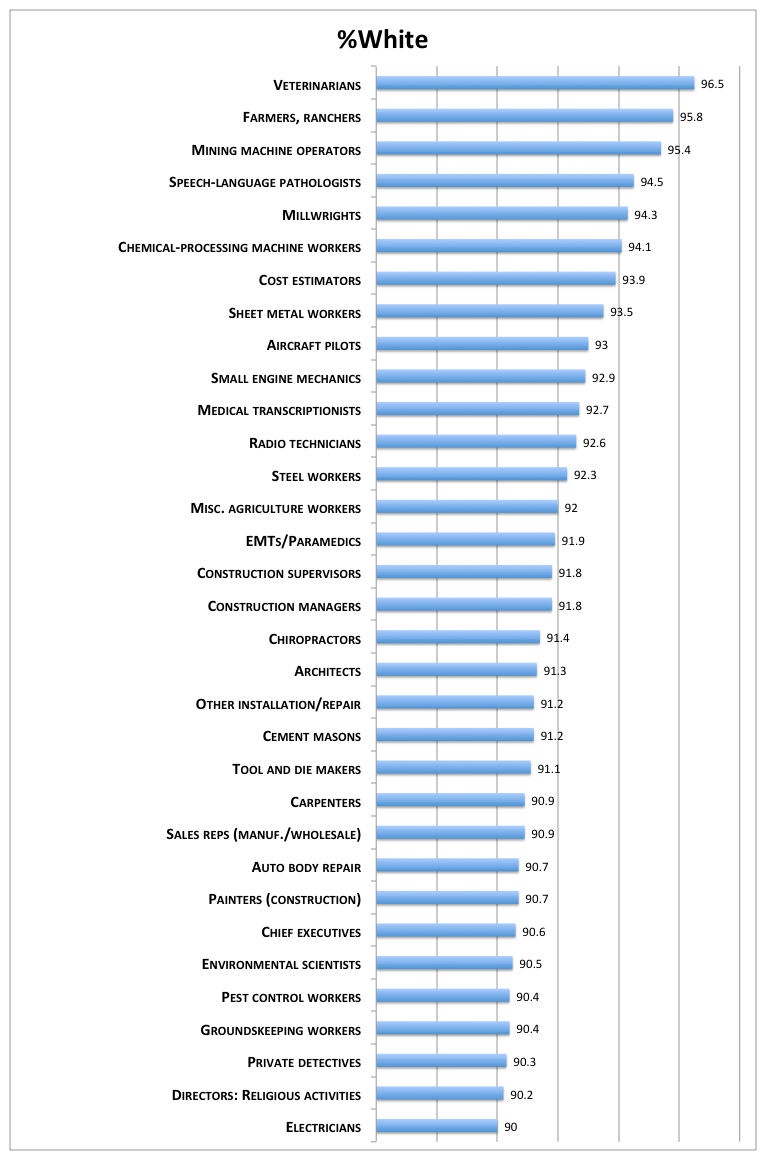
The Whitest Jobs U’ Know

The top 33 in America:

%white

Derek Thompson parses the data on work and race:

[Hispanics] make up about half of all farm workers and laborers, 44 percent of grounds maintenance workers, and 43 percent of maids and house cleaners. Blacks, who make up just 11 percent of the workforce, account for more than a third of home health aides and about 25 percent of both security guards and bus drivers – rather low paying jobs. Whites, on the other hand, make up more than 80 percent of the country’s workers. But they account for nearly all farm managers and ranchers (96 percent) construction managers (92 percent), carpenters (91 percent), and CEOs (90 percent). The story is true for Asians, as well – not included in these graphs for a lack of historical data. Asian-Americans account for 5 percent of the workforce, but also a whopping 60 percent of personal appearance workers, (e.g. hairdressers, nail salon workers), 29 percent of software developers, and nearly one in five physicians and surgeons.

Update from a reader:

The list forgot to include “NFL Head Coach” and “US Senator”.

Pro-Life And Pro-Choice?

Wendy Davis recently caused a stir by describing herself as “pro-life.” Arit John finds that most Americans fall into both camps:

A 2011 study from the Public Religion Research Institute found that there’s an overlap among “pro-choice” and “pro-life.” According to the study, “Seven in ten Americans say the term “pro-choice” describes them somewhat or very well, and nearly two-thirds simultaneously say the term “pro-life” describes them somewhat or very well. This overlapping identity is present in virtually every demographic group.”

More recently, a May 2013 Gallup poll found that while 20 percent of those polled believed abortion should never be legal and 26 percent polled said it should always be legal, 52 percent were in favor of abortions being legal under certain circumstances. So while 78 percent of those surveyed believe abortions should be legal sometimes or always, 45 percent identified as pro-choice and 48 percent identified as pro-life, meaning there were pro-lifers who believe abortion should be legal at least sometimes. Davis could be vote hunting, or trying to “re-claim” the pro-life label, but she might just be acknowledging that the abortion debate isn’t black and white.

Though the full context of her quote is worth noting:

“I am pro-life,” she said, borrowing from the label anti-abortion activists assign themselves. “I care about the life of every child: every child that goes to bed hungry, every child that goes to bed without a proper education, every child that goes to bed without being able to be a part of the Texas dream, every woman and man who worry about their children’s future and their ability to provide for that future. I care about life and I have a record of fighting for people above all else.”

Lunar Unity?

dish_moon

Alex Halperin argues that the “entire moon should be an international history and science preserve—an Off-World Heritage site, if you will”:

[A]n increased sense of conscience about the Apollo sites recently spawned a bill to preserve them. The proposal, put before Congress this past summer, is to eventually nominate them as UNESCO World Heritage sites. It’s not perfect. First, under the Outer Space Treaty of 1967, accepted by 101 countries, no nation can claim the moon as sovereign territory, an official prerequisite for nomination. And the bill doesn’t cover the rest of the moon—only where the astronauts landed and worked. Instead of passing piecemeal bills, let’s go all the way. The moon was part of Earth until about 4.5 billion years ago, according to current models. It could answer key questions about the history of our planet and therefore needs to be protected.

The idea is not without precedent:

[W]e’ve already reached global consensus on preserving an otherworldly place in this way:

Antarctica. The continent is managed by 50 nations under the 1959 Antarctic Treaty “with the interests of science and the progress of all mankind.” The treaty is short (just 14 articles), and the management duties are light (meetings to discuss updates, procedures, and scientific missions). But it works. For more than half a century, the agreement has allowed science and tourism to flourish in an area that belongs to both no one and everyone.

A preservation treaty for the moon would need a few special clauses. For example, while there’s a voluntary moratorium on mining in Antarctica, it doesn’t make sense to ban the practice on the moon: That’s one of the incentives to get us there. Rare substances, such as helium-3 (a possible fuel for nuclear power), are the sort of rewards that will motivate the development of private spaceflight and off-world habitation. So mining should be allowed, pending environmental-impact assessments similar to those conducted by the U.S. Forest Service. As for tourism, we don’t need to wrap the moon in no trespassing signs, but let’s keep ATVs away from important craters.

(Image of moon by Flickr user shahbasharat)

Brain Washing

Why do we sleep? According to Aric Prather, “Not only is sleep good for your well-being, it appears to start that dishwasher in your brain”:

In a recent study, researchers used mice to understand how sleep affects the ability of the brain to “wash away” the toxins from the day. Essentially, waste materials accumulate in the brain as byproducts of everyday brain activity. Cerebrospinal fluid (CSF), which bathes the brain, gathers up these waste products and flushes them out of the system.

How does this happen? Well, there is space between brain cells, known as the interstitial space. It is in this space that CSF interacts with interstitial fluid (ISF) to remove these unwanted byproducts. The larger the interstitial space, the better able CSF interacts with this ISF – and with that you get better, more effective brain cleaning.

The researchers used sophisticated measures of diffusion and imaging to see how this process differed in awake vs. naturally sleeping vs. anesthetized (unnatural but nevertheless sleeping) mice. They found that both the sleeping and anesthetized mice showed dramatic increases in their amount of interstitial space – 60 percent more space. As you might expect, this increase had important effects on byproduct clearance, namely on the clearance of ß-amyloid (Aß). You may have heard of Aß as it is the main component of deposits found in the brains of those who have Alzheimer’s disease.

A Poem For Friday

pinball

“Hubert’s Museum & Flea Circus (1937)” by Adrian Matejka:

Below constellations of pool balls scattering geometry’s
grace. Below pinball machines ringing like telephones
full of congratulations & the streetcar stutter of a movie
viewer: Jack Dempsey clubbing Luis Firpo or being
clubbed by Gene Tunney, depending on the reel & the day.
Below the heavy bag that, with each amateur punch, pulls
down the ceiling like confetti at the end of a parade.
Behind the man with the sagging eye who makes change
for the 25¢ admission by touch, & past the turnstile
that sticks sometimes, so he pushes himself up, dusts
sunflower shells from blue trousers, & exits his smudged
booth to make it work. After Congo the Wild Man’s
caterwaul & Sealo the Seal-Finned Boy’s handclaps,
as slick as fresh meat on the butcher’s table, Jack Johnson
comes out. Dog-eared blue suit & blue beret. Red wine
sipped through a straw: What would you like to know?

(From The Big Smoke © 2013 by Adrian Matejka. Reprinted by kind permission of Penguin Books. Photo by Steven Depolo)

Hoping They Choose The Right Path, Ctd

James Fallon, author of The Psychopath Inside: A Neuroscientist’s Personal Journey into the Dark Side of the Brain and star of the TED Talk seen above, explores the diversity of psychopathy:

As far as public perception goes, I’d say that the best, most badass, sadistic, ultimate example of a psychopath would be the original Hannibal Lecter. That’s who we think a psychopath is. But I’d argue that Will Graham, the FBI agent who tracks Hannibal, is the version of a psychopath we see more often in reality: he’s the pro-social psychopath, the guy in the office who seems a little off but who doesn’t engage in really ugly, egregious criminal behavior. And that’s where I would put myself. I might have a lot of weird, disturbed thoughts, but I don’t act on those thoughts. The Hannibal guys are a small subset, but they’re certainly overrepresented in the media.

He explains why some psychopaths become killers and others successful CEOs:

[Early in my research], I looked around and knew a lot of great poor people and a lot of really rich jerks, so I said “Hey, if the environment is key to all of this, it really isn’t doing the job we think it is.” Instead, I became convinced that we were born and not raised – and I spent my career studying exactly how the brain influences who we become.

But I didn’t fit my own theory. I had similar brain scans to full-blown, psychopathic killers. I had the genetic profile of a psychopath too. So why didn’t I fall into that kind of behavior? Well, I’d say it’s because I had a very fortunate, very warm upbringing with a wonderful family. And a lot of those who have my same genetic makeup and go onto violence endured awful abuse or trauma.

So you need to give environment more credit than I used to, but that doesn’t mean I’ve thrown out biology: around the time this was all happening to me, the field of epigenetics started to explode. Maybe it isn’t that biology doesn’t determine who you are, but that your environment can play a role in which genes are turned on or off.

Previous Dish on nonviolent psychopaths here, here and here.

Why Hasn’t AA Caught On In Russia?

Leon Neyfakh addresses the question:

[I]n Russia, despite the passionate efforts of its proponents, [Alcoholics Anonymous] has struggled for acceptance as a legitimate treatment method and has largely failed to catch on. Since 1987, when an Episcopal priest from New York convened some of Russia’s very first AA meetings, only about 400 groups have formed in the entire country – a tiny number, when you consider that there are about 1,600 such groups in the Boston metropolitan area alone.

Why has Russia proven so inhospitable to AA’s ideas? Certainly, the history of distrust between our two countries hasn’t helped. But there have been other obstacles as well – some religious, some medical, some cultural.

At a basic level, its premise of sobriety through mutual support just doesn’t make sense to a lot of Russians. In the past, this has taken the form of anti-Western suspicion – “What are the Americans trying to get out of this?” is a question Moseeva used to hear regularly. But more fundamentally, the group-therapy dynamic collides with a skepticism about the possibility of ordinary people curing each other of anything. “The idea that another drunk can help you is asinine to most Russians,” said Alexandre Laudet, a social psychologist who has researched Russian alcoholism.

Then there’s the problem of opening up to strangers. The AA method works in part through trust in people you’ve never met before, and coming clean to them about one’s most shameful secrets. “It is much harder for a Russian person to talk about himself than it is for an American,” said a Russian AA member named Mikhail. “And there are a lot of reasons why, including that the generation of my parents – and my own, I’m 55 – couldn’t speak the truth at all, because it was possible to get arrested for it.”

Face Of The Day

The Prince Of Wales And Duchess Of Cornwall Visit India - Day 3

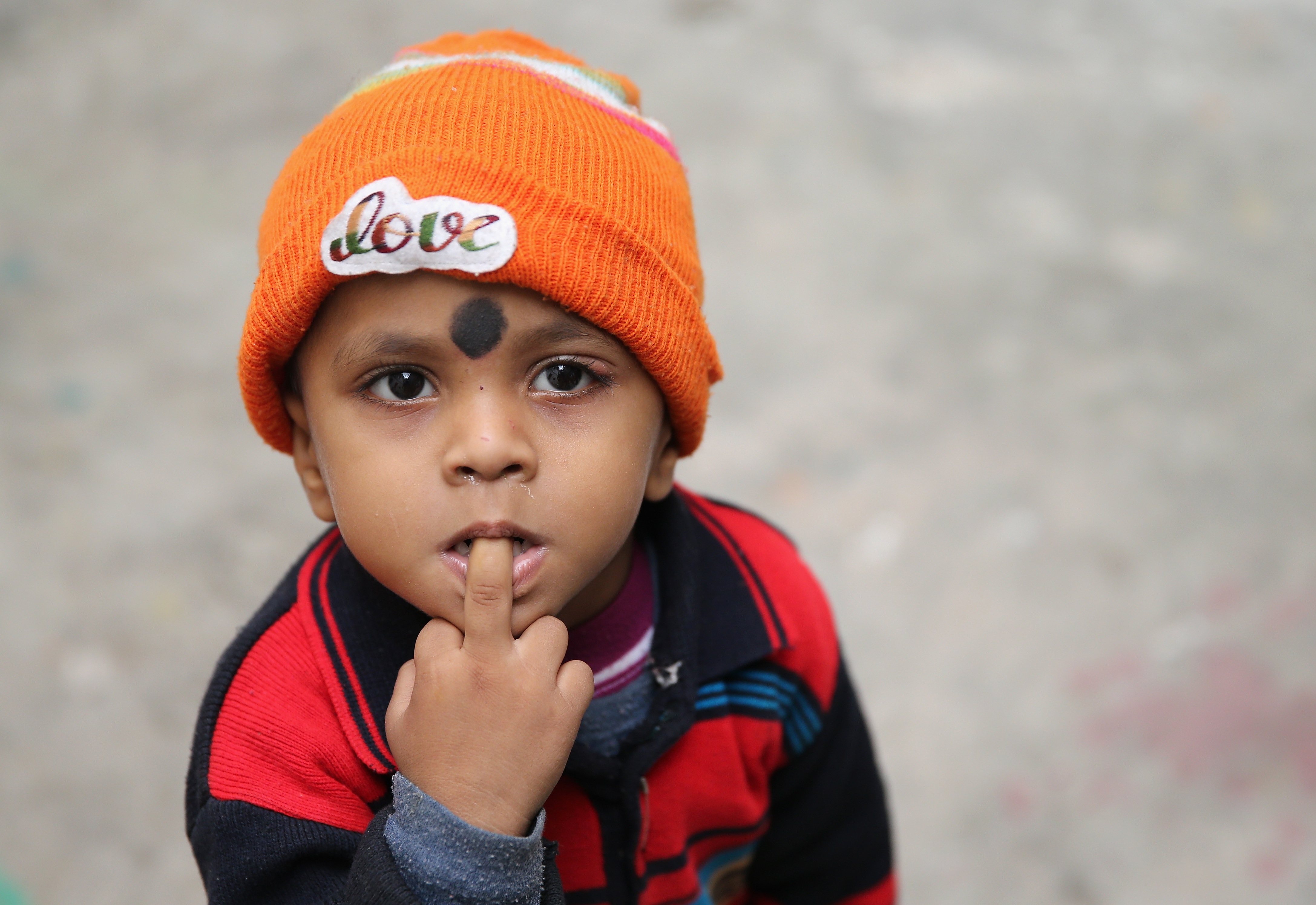
A young Indian child in class at Katha Community School in the Govindpuri slum district of Dehli during Day 3 of an official visit to India of the Prince of Wales and Duchess Of Cornwall on November 8, 2013. This will be the Royal couple’s third official visit to India together and their most extensive yet. By Chris Jackson/Getty Images.

The Facts On The Abortion Pill

Ann Friedman observes how, in “the absence of a rational dialogue about the pros and cons of all abortion methods, it can be hard to know where the truth lies.” She addresses the misinformation surrounding mifepristone, the abortion pill:

[T]here’s a general false perception among women that medication abortion will be quicker and easier than a surgical procedure. “The majority think, ‘Hey, I’m gonna pop a pill and that’ll be it,’” the receptionist at an abortion clinic in Nebraska told me. With an early surgical abortion, a woman goes into a clinic and is sure she’s no longer pregnant when she comes out a few hours later. With medication abortion, the process can take up to 48 hours. Even after counseling at a clinic, many women are unprepared for the experience. “I took one pill at home, and I remember at one point actually feeling my cervix open. It was a terrifying feeling,” says Katie, who had a medication abortion in 2004. Another woman described pain that was “so intense that it’s hard to really remember. You sort of feel like you’re tripping or something.” A nurse at an abortion clinic once told me, “Women who have done both will go back to surgical. I’ve never had anyone who’s done both go back to medical.”

But, even if the medication isn’t particularly pleasant, it is quite safe for the woman:

Of the 1.52 million women who have had a medication abortion, there are eight cases of women dying from an infection after taking mifepristone.

The Iranian Nuclear Deal: Reax

Jonathan Tobin is predictably skeptical of the likely deal being forged in Geneva:

After more than a decade of diplomatic deception, the Iranians finally have what they wanted: an American president and secretary of state ready to recognize their “right” to enrich uranium and to hold on to to their nuclear fuel stockpile and to loosen sanctions in exchange for easily evaded promises. The next stop is not, as the administration may hope, a deal in six months to end the nuclear threat, but an Iran that knows that the sanctions have already begun to unravel emboldened to dig in its heels even further.

Justin Logan chides such hawks for making the perfect the enemy of the good:

[The deal is] not a complete, irreversible end of the problem posed by Iran’s nuclear program. What hawkish observers fail to understand is that there is no such solution, through diplomacy, military strikes, or otherwise. Thus the question was never whether this deal could provide Netanyahu’s desiderata: the shipping out of all enriched uranium, the destruction of Fordow and Arak, and an end to Iran’s pursuit of enrichment altogether. Nobody, perhaps even including Netanyahu thought that was possible. Given his various public statements, Netanyahu seemed to think any deal was a bad deal. So yes, it’s not time to pop champagne corks and forget the world, nor time to throw a tantrum. A prospective interim deal would be a small, but very important, step in the right direction. Given the disaster that would be a war in Iran, we should take this small step and see if it can be built on.

Larison wonders if Netanyahu will harm Israel’s international standing by rejecting the deal:

As Robert Farley and I discussed yesterday, there are three reasons why Israeli officials would publicly attack negotiations with Iran. The first is that they assume that any deal will be unacceptable to them, and are therefore writing off the negotiating process ahead of time. The second is that they want to keep public pressure on to make the deal as tolerable as possible, and the third is that they don’t need to take a risk in endorsing a deal no matter what it involves.

Some combination of the first and third reasons probably explains what Netanyahu thinks he’s doing, but he and his government may be underestimating the danger of isolating Israel on the one issue where Israel enjoys some broader international sympathy. Rejecting the deal out of hand before it has even been finalized gives the U.S. and European governments little reason to listen to Israeli complaints, since the latter are not going to be realistically satisfied, and that will make them much less sympathetic to any Israeli reaction to the deal.

Drum insists the Israeli PM has a credibility issue:

Netanyahu has made it clear that he’s just flatly opposed to any plausible bargain at all. His idea of a deal is that Iran first destroys its entire nuclear infrastructure and then—maybe—sanctions should be eased or lifted. This is pretty plainly not a deal that any national leader in his right mind would ever accept, and Netanyahu knows it. So he’s essentially saying that no deal should ever be made with Iran. Given an attitude like that, who’s going to take him seriously? Nobody. Add to that an unending string of personal affronts against President Obama, and it’s a credit to Obama’s self-control that he’s still willing to talk to Netanyahu at all.

But Max Fisher warns observers not to underestimate Bibi’s power, arguing that he “might be able to exert real leverage over the Iranian talks at perhaps their most vulnerable point: the U.S. Congress”:

Many lawmakers, particularly but not exclusively Republicans, are beginning to rally around the idea that any sanctions relief would be dangerous and requires their opposition. It doesn’t hurt that appearing tough on Iran is a politically popular position that poses few risks for lawmakers and substantial benefit. Keep in mind that according to public opinion polls, Americans hold highly negative views of Iran. In addition, lawmakers have been denouncing the Obama administration over Middle East policy for years. …

This is where Netanyahu could play a major role, and potentially scuttle any nuclear deal with Iran, should one emerge from Geneva. Sanctions relief will be controversial in Congress, and Republican lawmakers will try to draw as much attention to the issue as possible so as to rally public opposition. What they lack is a public face to put on their campaign. Netanyahu can provide that: He is popular in the United States and has demonstrated a flair for rallying Congress. He’s also not particularly shy about criticizing the diplomatic outreaches with Tehran. If Netanyahu continues arguing against an Iranian deal, and particularly if he does so in a way that’s crafted to resonate in any domestic American debate, he could make the Obama administration’s task in Congress much harder.

Meanwhile, Ian Black considers the view from Iran:

In the Islamic Republic, the key to momentum will be sufficiently tangible economic improvements to build up the popular support Rouhani needs to bolster his position vis-a-vis diehard conservatives and the Revolutionary Guards, imbued with decades of suspicion towards the US, the West and their Arab allies. The continuing confrontation over the war in Syria, where Tehran and Lebanon’s Hezbollah back Bashar al-Assad to the hilt while the Saudis support the Sunni rebels, has been a vivid reminder of Iran’s regional reach and influence. For the moment though, Rouhani appears to enjoy the backing of Iran’s supreme leader, Ayatollah Ali Khamenei, who has urged critics “not to consider our negotiators as compromisers.”

Hardliners there have been quiet, but not silent:

As US Secretary of State John Kerry and other foreign ministers of the five permanent members of the United Nations Security Council plus Germany (P5+1) arrive in Geneva in what is being viewed as positive developments in the nuclear negotiations with Iran, most Iranian media have given the latest developments straightforward coverage. Even the most hard-line outlets have not shown a strong reaction to what appears to be the beginning steps of an initial interim deal between Iran and the P5+1.

However, Fars News and Raja News both ran an article by [hardline Iranian analyst Mehdi] Mohammadi titled “Warning about repeating the Reformist experience in the new round of negotiations.” Under Reformist president Mohammad Khatami in 2003, Iran agreed to suspend much of its nuclear activity in an agreement with the EU-3 (Germany, France and Britain). Those negotiations were led by Hassan Rouhani, who was the secretary of the Supreme National Security Council at the time. Iran’s top negotiator today, Foreign Minister Mohammad Javad Zarif, was also part of the 2003 negotiation team. After failing to reach a more permanent arrangement, Iran resumed its nuclear activity in 2005, just before President Mahmoud Ahmadinejad took office. Mohammadi wrote, “The biggest threat in the Geneva negotiations is that we repeat the history of the 2003 to 2005 negotiations.”

Stephen Walt looks ahead:

Which side will win? I don’t know, but I do think this is a winnable fight for Obama if he tries. If the negotiators in Geneva can reach an agreement that 1) avoids war, 2) reduces Iran’s incentive for a bomb, 3) moves them further from the nuclear threshold, and 4) strengthens the already-tough inspections regime, and presents it to the American people as a done deal, I think the public will support it strongly. …

The rest of the P5+1 will be ecstatic (except maybe Russia and China, because they benefit from the United States and Iran being at odds), and they will be making supportive noises as well. Hardline opponents won’t be able to attack the deal without engaging in transparently obvious special pleading, partly on behalf of a country that already has nuclear weapons and hasn’t been all that cooperative lately. Under these circumstances, some of those diehard opponents in Congress might think twice about killing the deal, because their fingerprints would be all over the murder weapon. Indeed, that may be why they are now proposing new sanctions: better to kill the diplomatic process before it produces results than to try to discredit a reasonable deal later on.