Crazy good juggling skills:
Month: November 2013
Debunking The Latest Drug Scare
The Dish recently noted that “Krokodil, a highly addictive designer drug that aggressively eats through flesh, has reportedly arrived in the United States.” A couple of weeks ago, Victoria Bekiempis found reasons to question those reports:
[M]aybe krokodil is starting to be a thing in North America, but there’s scant information out there yet supporting the popular thesis that its use has already spiraled out of control. Rather, the information available points to a few possible cases in Arizona, Illinois and Utah. (Several notorious krokodil deaths in Oklahoma, which prompted much of this krokodil panic, turned out not to be related to krokodil, authorities said this week.)
Part of the reason krokodil, which first made American headlines in 2011 (but surfaced in the East around 2003), has become such a problem in Russia is that heroin addicts, seeking a cheap and readily available fix, were able to acquire codeine over the counter. (That has since changed, according to published reports. The DEA could not immediately confirm the status of codeine in Russia). Since codeine is not easy to get in the U.S., there’s no easy krokodil-cooking startup culture that would kick-start its spread across North America.
Abby Haglage adds:
The less glamorous but more likely culprit in the Krokodil scare—the one that didn’t make headlines—is a drug that Americans have been snorting, sniffing, and injecting for decades: heroin. The sores are nothing new, either. As widely documented on drug policy sites across the web, intravenous drug users are susceptible to a wide range of deadly infections, including HIV, Hepatitis, B/C, and MRSA—many of which can result in gangrenous skin, deep abscesses, and loss of limbs.
Pachyderm PTSD

Childhood trauma scars elephants, not just people:
African elephants that have lived through the trauma of a cull – or selected killing of their kin –may look normal enough to the casual observer, but socially they are a mess. That’s the conclusion of a new study, the first to show that human activities can disrupt the social skills of large-brained mammals that live in complex societies for decades. The finding, experts say, has implications for conservation management, which often solely focuses on the number of animals in a population, and may extend to chimpanzees, dolphins, whales, and other species.
Wildlife officials often used culling as a conservation tool in South Africa from the 1960s to the 1990s. (It is still reserved as a management tool there.) At the time, wildlife managers worried that if there were too many elephants in a fenced reserve, like the famed Kruger National Park, the behemoths would ultimately destroy the habitat, eating or trampling all the vegetation and uprooting the trees. During a cull, a helicopter pilot herds an elephant family into a tight bunch. Professional hunters on the ground then shoot the animals as quickly as possible. Only young elephants ranging from about 4 to 10 years old are saved. Park officials typically shipped them to other parks that lacked elephants or had smaller populations to increase the herds, because elephants are popular with tourists.
Scientists have known since the late 1990s that many of these elephants were psychologically affected by their experiences during the culling. Other studies have described these effects as akin to post-traumatic stress disorder. For instance, the orphaned male elephants at Pilanesberg and another reserve made headlines for attacking and killing 107 rhinoceroses over a 10-year period, something that elephants had never been reported to do. … Because the Pilanesberg elephants grew up without the social knowledge of their original families, they will likely never properly respond to social threats and may even pass on their inappropriate behaviors to the next generation, the team concludes in the current issue of Frontiers in Zoology.
(Photo: Elephants at South Africa’s Pilanesberg National Park. By Robert Nyman)
A Symbolic Legalization Law
Portland, Maine voted this week to legalize marijuana. But Jacob Sullum notes that the ballot measure “merely eliminated local penalties for possession of up to two and and half ounces” and that under “state law, possessing pot in amounts below that cutoff remains a civil violation punishable by fines ranging from $350 to $1,000”:
[I]f Question 1 (which officially takes effect in a month) won’t have much of a practical effect, what was the point? As I suggested last month, the Question 1 campaign was a dry run for statewide legalization efforts in Maine and elsewhere. Its messaging focused on the relative hazards of marijuana and alcohol, with ads featuring respectable-looking pot smokers asking, “Why should I be punished for making the safer choice?” Judging from the large majority the initiative attracted, that message, which also was prominent in Colorado’s successful legalization campaign, resonates with voters.
Mike Riggs made similar points before the measure passed.
High Times A-Changin’
A profile of the magazine offers insight into how cannabis culture has changed over four decades:
Danny Danko (senior cultivation editor): Tons of companies are coming in to
advertise. A lot of the vapor-pen companies, a lot of the hydroponics companies that sort of shied away from us years ago because they didn’t want that connection to marijuana, have come around because they’re just not afraid of the stigma anymore. That’s one of the things I think High Times has done a good job of—just removing the stigma of the “lazy stoner.” Instead, we try to show that whether it’s in the entertainment business or sports or wherever, we are everywhere. We are doctors and lawyers; we are throughout society and in every part of it. …
Bobby Black (senior editor): It used to be, back in the day, it was always rock—psychedelic rock in the ’60s and ’70s—that was the music associated with pot. Then hip-hop came out—well, and reggae, of course, because of the Rasta culture—and they embraced pot in a big way. The thing that’s changed now is that I’m noticing pop stars like Miley Cyrus and Justin Bieber really embracing pot. And it’s not that pop stars never smoked weed before; it’s just that now they’re out about it and don’t really care. It’s become so accepted that the new generation is just like, “So what?”
Dan Skye (executive editor): Jennifer Aniston!

I think she would sell, because we know that she smokes pot—we’ve heard about it for years. We tried; we got no response. And Miley Cyrus is great. We did a poll a few months back: “What celebrity would you most like to smoke with?” And she scored higher than Bill Maher, which we thought was really kind of funny.
Bobby Black: When the magazine started, all throughout the ’70s, sex was an integral part of it. We had beautiful women on the cover. We walk a fine line with it, because we don’t want to be exploiting women. On the other hand, those covers were sexy—and there is nothing wrong with sex. I’ve always stressed this: High Times is about hedonism. But it isn’t about irresponsible, over-the-top hedonism—it’s about enjoying everything life has to offer, and sex is part of that.
But the reason we don’t put [former porn star] Jenna Jameson in her bathing suit on the cover anymore is because the sales just weren’t there. Our readers would rather stare at centerfolds of plants—and that’s just the facts we have learned over the years.
Try not to drool at your desk, stoners:

(Image: Cover of the June 1980 issue via High Times)
Christie’s Weaknesses
Ambers lists them. A big one:
Overconfidence, and an overage of self-piety, will lead Christie to insist that certain potential problems are simply not. (There’s no way that, I, Chris Christie, would allow myself to make that mistake.) To admit otherwise is to introduce cognitive dissonance. But as the Romney vet of Christieshowed, there are potentially significant questions about his judgment that will dog Christie until he answers them without being defensive. This blindness will serve Christie poorly when it comes to choosing advisers, too. (Rudy Giuliani had his Bernie Kerik. And what was galling about it was how Giuliani simply could not contemplate the idea that Kerik was not up to snuff. Giuliani, after all, had picked him to be part of his inner circle.)
Bouie wonders how the midterms will impact Christie’s chances:
Insofar that his message of electability has any chance of resonating with Republican primary voters, it will be because they have given up the quest for purity, and are desperate to win. which means that, for Christie, the best thing that could happen is for Republicans to have a terrible 2014. If the GOP continues down its path of extremism, and loses its shot at capturing the Senate as a result, Christie has perfect ground for making his pitch.
Unfortunately for him, the more likely outcome is that Republicans do pretty well. The combination of a sluggish economy and voter discontent will hurt incumbents, which threatens the Democratic majority in the Senate and precludes the party from making real gains in the House. And a GOP base that does well—or even okay—in next year’s midterms is one that doesn’t have much interest in Christie’s message.
Finally, First Read notes that “inevitable” candidates often lose:
[E]mbracing being front-runner — three years out, mind you — has its own risks. After all, at this point in the 2008 cycle, neither of the front-runners (Hillary Clinton or Rudy Giuliani) won their party’s nomination. And the early presidential birds (think John Edwards, Tim Pawlenty) usually don’t get the worm. Just something to chew on.
The View From Your Window

Seattle, Washington, 8.04 am
Torture Is Forever
The European Journal of Pain has published a study that “found people who have been subjected to torture have different responses to pain than people who haven’t — forever”:
In line with previous research, the torture survivors “exhibited generalized alterations in pain perception and modulation,” meaning they felt more pain than most people when responding to the same kind of stimulus. Their bodies were also less able to “modulate” that pain’s effects. The human body usually responds to pain dynamically, essentially distributing it. The ex-POWs bodies exhibited a worse ability to regulate physical pain than those of the soldiers who had not been taken prisoner.
The study could not determine whether the evidence recorded now, 40 years after the war, were the result of the original experience of torture exclusively, or if four decades of chronic pain afterwards also influenced the breakdown of the body’s pain regulation mechanism. In either case, the study recommended a conception of torture that suggests a physical therapy response to the likelihood of long-term pain problems.
This Extraordinary Pope, Ctd
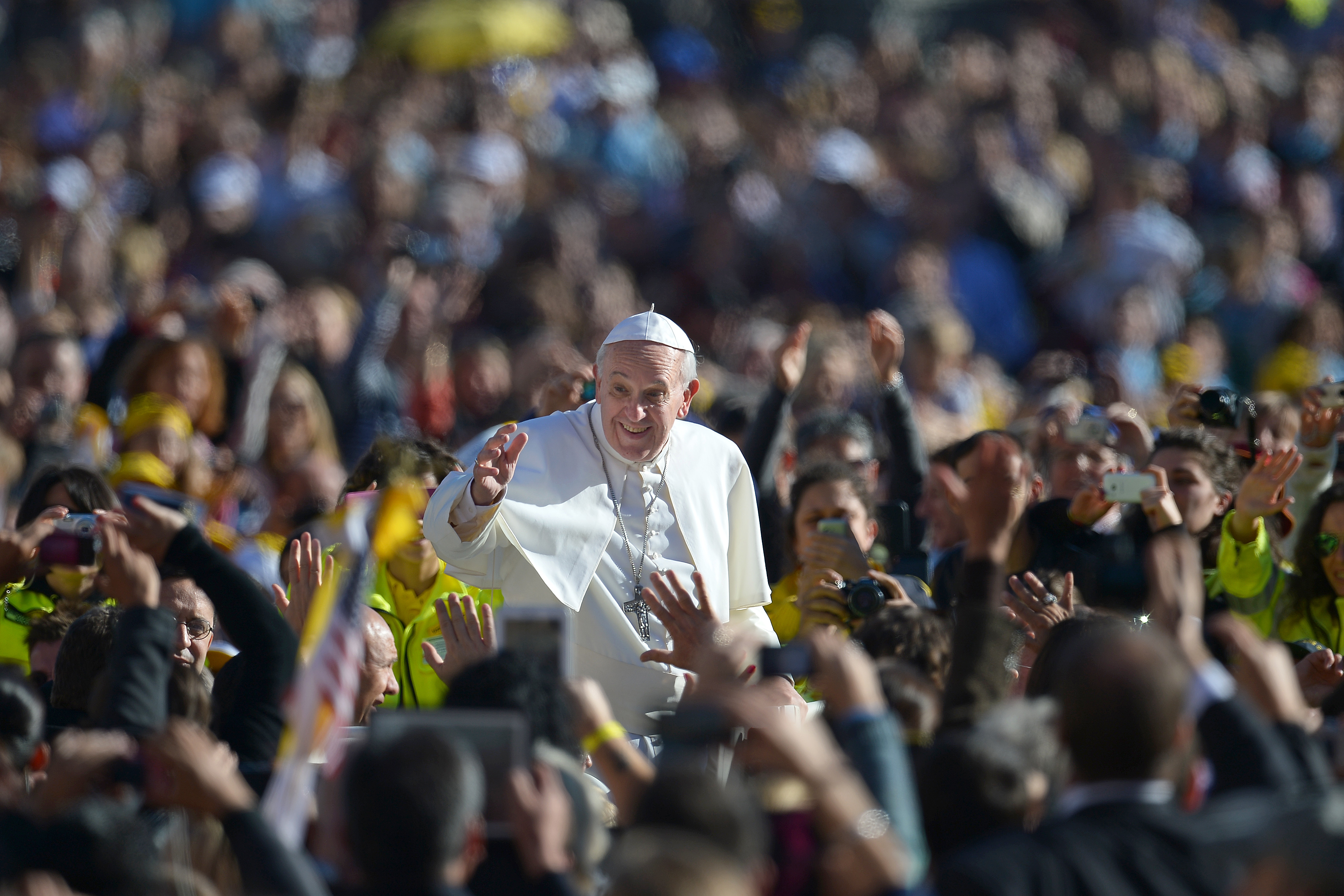
Last week the Vatican released a document laying the groundwork for next year’s Synod of Bishops on the Family, a gathering of bishops from around the world focusing on pastoral challenges related to modern family life. As well as laying out the essentials of relevant Church teachings, the document poses 39 questions to the bishops about the actual families living and working in their communities, and how the Church can best minister to them. Here are the questions under the heading, “On Unions of Persons of the Same Sex”:
a) Is there a law in your country recognizing civil unions for people of the same-sex and equating it in some way to marriage?
b) What is the attitude of the local and particular Churches towards both the State as the promoter of civil unions between persons of the same sex and the people involved in this type of union?
c) What pastoral attention can be given to people who have chosen to live in these types of union?
d) In the case of unions of persons of the same sex who have adopted children, what can be done pastorally in light of transmitting the faith?
The meaning of all this is as vague as the questions are conspicuously neutral. The Vatican has given some conflicting signals as to whether this is something new or something habitual, whether it is a consultation directly between the faithful and the Vatican, or whether the various bodies of national bishops will be the intermediary. In England and Wales, the bishops have put the questionnaire online. In the US, where the bishops are still dominated by reactionaries, no such direct input outside the bishops’ control looks likely. That effectively means, I fear, that the US hierarchy – think Cardinal Dolan – may not convey the real sensus fidelium on these matters:
In the letter he sent to the bishops’ conferences in October, Archbishop Lorenzo Baldisseri, the secretary general of the Vatican’s Synod of Bishops, directed the prelates to distribute the questionnaire “immediately as widely as possible to deaneries and parishes so that input from local sources can be received.”
One question is whether the archbishop and the Vatican meant for the world’s bishops to conduct a survey of their populations using the questionnaire. The U.S. bishops’ conference did not request the U.S. episcopate to undertake that wide of a consultation, telling the bishops in an Oct. 30 memo sent with Baldisseri’s letter only to provide their own observations.
I think American lay Catholics should download the English questionnaire and send their views in directly, if the bishops still insist on controlling the data. And in any case, we already know what American Catholics think on many of these questions. Sophisticated polling outfits have provided the data for a long time. Either this initiative will echo those views or it will skew toward what the bishops want to hear.
But my sense of this Pope – especially in his direct interaction with ordinary people – is that this is a chance for real democratic input, of not democracy itself (which would not be appropriate). Amy Davidson gives them a close read, and comes away thinking that this could be where the Francis revolution begins to move beyond rhetoric:
What Francis seems to be looking for is not a doctrinal or political response to same-sex unions but a pastoral one: taking modern families as they are and live, and seeing how the Catholic Church can be part of their lives. (There is not a question about how best to lobby legislatures.) The synod, according to the document, is meant to address “concerns which were unheard of until a few years ago.” Its summary of these concerns is not in all respects liberal; it mentions “forms of feminism hostile to the Church,” and emphasizes the indissolubility of marriage. And certain situations that it calls novel, like that of single parents and of dowries “understood as the purchase price of the woman,” have been less unheard of than unheeded.
But there are the seeds of something radical here.
There is, for one thing, an attempt to get past pretense. It asks how many people “in your particular church” are remarried, or separated, or are children whose families aren’t the kind in church picture books, and how to reach and include them. In terms of abortion, it asks how people could be persuaded to accept the Church’s teachings—but also how good a job churches are doing at teaching them about “natural” means of family planning, like the rhythm method. Mercy was also a word that came up, with regard to families living “irregular” lives.
It’s not too early to wonder if that synod could be a landmark moment for Francis’s papacy, and his Church.
The divisions in the Vatican are real and obvious:
When Archbishop Lorenzo Baldisseri was asked at the Vatican press briefing Tuesday if that action was something other bishops’ conferences should emulate, he said the “question answers itself” and was “not worth considering.”
I suspect the Pope’s moving accretion of moral authority these past few months with Catholics and non-Catholics alike – along with his new structure of eight cardinals as a kind of cabinet outside the Vatican bureaucracy – will give him more lee-way for change than some might expect. Michael O’Loughlin is optimistic:
I could not have imagined that the church would recognize gays as human beings even a few months ago, never mind ask for ideas on how to serve them, and their children, better. It’s truly revolutionary. And what’s not there in those questions is just as amazing as what is. There’s no mention of sin. Nothing about intrinsically disordered desires. The children aren’t called illegitimate. Instead, there’s language that recognizes gay and lesbian Catholics as human beings, as people who long for lives of faith and meaning.
Update from a reader, who notes something O’Loughlin noted as well:
Regarding the Vatican Survey, there is now a survey that lay Catholics in the US can respond to. Catholics in Alliance for the Common Good has received over 2000 responses since last Friday, and they are incredibly moving. It’s an abbreviated survey, focusing on how folks experience things pastorally in the pews. There is also a Spanish version available to recognize the reality of our US Church.
They may put up the full survey, but the shorter survey is getting a wider range of folks to respond – a priest who printed off a copy and helped a homeless friend fill it in and scan and email it; a 97-year old woman who had waited her life for this. Both surveys have their place – as a person with a theology and a law degree, I’m happy to contribute my thoughts on natural law. But as a person with a sibling who has transitioned from male to female, whether my parish welcomes LGBT folks is a matter of much greater importance – the types of questions the survey asks. When I was struggling most with her transition, mixing up pronouns and so forth, not knowing how to refer to my sibling, not accepting her decision fully, my priest friend provided me with pretty direct fraternal correction: “She’s your sister. Period.” From a guy who is much more comfortable listening and not being too directive about anything, this was a great gift, to be challenged so directly to respect who my sister was created to be.
Please let your readers know about this opportunity. The survey coordinators do have a channel to ensure it gets to the Synod.
(Photo: Pope Francis salutes the crowd as he arrives for his general audience in St Peter’s square at the Vatican on November 6, 2013. By Vincenzo Pinto/AFP/Getty Images.)
Tweet of The Day
It’s a fact: @Eric_Alterman has told @mondoweiss that he would debate @MaxBlumenthal for $10,000.
— Scott Roth (@scottroth76) November 8, 2013
 The Dish
