Obama’s Crucial Six Months

President Obama Speaks On The Government Shutdown In The Rose Garden

In many ways, his entire term as president has been leading up to this winter and spring. This will be when his core advancements in domestic and foreign policy will be tested as never before. This will be when we see whether the Affordable Care Act can gain traction and legitimacy as a reform that is far better than the chaos and inefficiency of the past; and when we see if the West can bring the great nation of Iran back into the fold of the world economy, with clear restrictions on its nuclear program.

The ACA has gotten off to a really rocky start, with the debacle of the website and the chorus of complaints from those whose health insurance plans will experience disruption. But it’s worth recalling that this law has always had a rocky history. It nearly got swallowed up by the urgent need to wrest the country out of a potential Second Great Depression; it wallowed in Senate inertia for months, as Max Baucus hemmed and hawed; it was pummeled by the summer of Tea Party rage; it nearly came undone when Ted Kennedy’s seat was lost to a Republican; it caused a huge loss in the 2010 Congressional elections, which in turn, helped the GOP gerrymander the House even more to their advantage, and block much of the president’s agenda since. It was the casus belli of the government shutdown and the debt ceiling crisis of this fall. When you look back, you realize why every previous president who tried to get this done failed – from Nixon to Clinton.

And yet it’s still alive, even as it’s enduring severe labor pains as it makes its way into the world. As I noted yesterday, support for it has actually risen recently; and, because of the website’s malfunction, the winners are much less vocal now than the losers. But if the process grinds on, that balance may change. The president should not be let off the hook for his previous overly-broad promises or for the clusterfuck of the site. He may need to adjust again a little. But the odds of the core of this law surviving – particularly the principle of universal coverage and the end of denials of insurance for pre-existing conditions – are solid. It may well need further reform, but it has created a framework for both Republican reform (if they can get out of their ideological mania) and even, perhaps, a single-payer system, if the Democrats want to move left. It’s messy, its future could go in several directions, but it’s now entrenched. The president can take the hit for the problems in the next three years, and he should. Because he’s not up for re-election and can veto any attempts to destroy it.

But in some ways, the outreach to Iran is just as important and critical. Again, the policy arc has been long and brutal. We witnessed – and this blog will never forget – the Green Revolution that emerged only months after Obama’s first election, propelled by the same online, youthful hopes that brought this president to office. We then saw the hopes of Obama’s Cairo speech destroyed by the brutal repression of Ahmadinejad and Khamenei. The sanctions that were then imposed were everything a neocon could ask for – except for the war or regime change they still want. Again, it took four more years for the Iranian elites to fully digest how damaging the sanctions were, but in the last elections, Rouhani emerged as a pragmatic interlocutor. During all this, Obama managed to create a truly durable and powerful international coalition for sanctions, and prevent the Israelis from doing the unthinkable and starting a religious war in the Middle East that could have metastasized into a global terror wave, with all the collateral damage in human life and civil liberties that would have entailed.

Much could still go wrong. But there’s no doubt in my mind that both Rouhani and Obama want a deal.

Both have to keep their war factions – the AIPAC-dominated Congress and the Revolutionary Guards respectively – in check, while also using the threat of war or more sanctions from these groups to make the case for a deal in the center. For months now, the Iranian government and the Obama administration have been talking, slowly building trust, with Obama not removing but slightly loosening some of the financial restrictions on the country:

In the six weeks prior to the Iranian elections in June, the Treasury Department issued seven notices of designations of sanctions violators that included more than 100 new people, companies, aircraft, and sea vessels. Since June 14, however, when Rouhani was elected, the Treasury Department has only issued two designation notices that have identified six people and four companies as violating the Iran sanctions.

A six month freeze of nuclear activity would give the talks more time to succeed, without bringing the Iranians closer to the ability to make an actual bomb. It’s not done yet, but it looks close. If the result is a new detente or even a thaw in relations between the West and Iran, it would transform global politics in a way not seen since the end of the Cold War. Because this is the other Cold War that has been going on since 1979. Such a breakthrough would help us ease away from our dependence on the Saudis for oil (along with fracking and discoveries like the massive Australian shale field), and would also give us far more leverage over Israel in the pursuit of a two-state solution.

All this may come crashing down, which is why the next six months will indeed be the critical ones. But let us be clear what the stakes would be for the Obama presidency. It would mean that this president ended the wars in Iraq and Afghanistan, devastated al Qaeda in the region 9/11 came from, killed bin Laden, and ended torture. At home, his legacy would be an avoidance of a second Great Depression, the revival of the US auto industry, a drastic reduction in the deficit, tough executive branch decisions to rein in carbon emissions, a civil rights revolution for gay people and universal healthcare. And as the establishment of the GOP slowly moves against the radicals and extremists that have run its brand into the ground, Obama will have done something else as well. By refusing to blink in the debt ceiling crisis, he may well have done what all truly transformative political leaders do: reform his opposition by making it more responsible in opposition and more pragmatic in government.

I once spoke of him as a potential liberal Reagan. For all the nay-sayers out there, it’s still possible.

(Photo: Chip Somodevilla/Getty.)
Police State Watch, Ctd

After a traffic stop, David Eckert was forced to undergo multiple enemas and a colonoscopy so police could search for drugs. They found nothing. Ken White reflects on the horrific case:

Some people are citing this incident for the proposition that it is terrifying that police officers and doctors would break the law and violate a suspect’s rights. I submit there is something far more terrifying about it: the prospect that a court might find that Mr. Eckert’s rights weren’t violated at all, and that he has no recourse for a team of cops and doctors raping and torturing him.

What’s terrifying is that the warrant requirement is supposed to protect our rights from overzealous cops, but here a judge approved a warrant to probe a man anally premised on fluff an a tip from an anonymous cop.

What’s terrifying is that lawyers are supposed to guide cops in the law, but a Deputy DA approved this warrant.

What’s terrifying is that thought the warrant is extraordinarily flimsy, there’s a decent chance a judge might find it sufficient. That’s because the judiciary has been steadily ground down by decades of law-and-order thin-blue-line rhetoric and by the purported imperatives of the Great War on Drugs, and judges routinely shrug and accept transparently bogus police speculation and awful warrants.

Bibi’s Temper Tantrum

Netanyahu is pissed about the developing Iran-US deal (NYT):

Kilgore reacts:

The likelihood of a deal is underlined by Bibi Netanyahu’s immediate attack on it. Israel’s policy, of course, is that sanctions need to remain in place until Iran’s nuclear capability is eliminated, a position which treats halts in the nuclear program as largely irrelevant.

Those in the U.S., including most of the Republican Party, who take a similar position won’t greet a deal positively, and in any event, many GOP foreign policy hawks don’t support any activity towards Iran unless it’s aimed at regime change.

But for the rest of us, it’s a positive step.

Jeffrey Goldberg considers why Netanyahu is being largely ignored:

The first reason is that U.S. President Barack Obama has him boxed in. Netanyahu can’t launch a unilateral strike on Iran now that the U.S. is actively negotiating with its leaders. That would just be outre. So Netanyahu is in a time-out of sorts — and therefore semi-marginalized.

The second reason is one Netanyahu, so far at least, has refused to comprehend. His unwillingness to permanently freeze settlement growth on the West Bank, to make the sort of grand gesture toward the Palestinians that would advance the peace process, has caused even those in Washington and Europe who are sympathetic to his stance on Iran to write him off as generally immovable and irrational.

Amen, Jeffrey. I’d add another thing. If Iran agrees to freeze its nuclear program for six months (see correction below), as a bigger, more comprehensive deal is negotiated, then Iran looks like a much more reasonable party in global negotiations than Israel. After all, Israel was asked at the outset of Obama’s term to agree to a very similar deal: freeze settlement construction for six months, while negotiating with the Palestinians on a broader agreement. Netanyahu refused and has continued his settlement policy to the fury of the Palestinians and profound frustration of America and anger in Europe. He’s less flexible than Rouhani.

Similarly, if Iran eventually agrees to have rigorous inspections to ensure its nuclear program is civilian alone, and if the amazing progress made to destroy Syria’s WMDs continues, then Israel will be even more isolated. It will be the only power in the Middle East with nuclear bombs and chemical weapons. Netanyahu’s belligerence has only made his country more isolated than any decent Israeli PM would allow. If he insists on keeping those WMDs and forging the Greater Israel he dreams of, he will risk turning Israel into a rogue state, increasingly shunned by the West and by the next generation of American Jews. Heckuva job, Bibi!

There isn’t yet much blog reaction to the forthcoming deal (my post is forthcoming), but here’s some Twitter chatter:

The Guardian is live-blogging the negotiations.

(*Correction: this post originally said that Iran is not a signatory to the NPT. It is and has been since 1970. The exceptions are India, Pakistan and Israel. Apologies.)

The Strongest Storm On Record?


Last night, Nate Cohn compared Super Typhoon Haiyan, which just mauled the Philippines, to Katrina:

So how strong is Haiyan? Based on satellite imagery, the Joint Typhoon Warning Center estimates that Haiyan is… perfect, therefore possessing maximum sustained winds of 195 mph. Those maximum sustained winds are 20 mph faster than Hurricane Katrina at its peak, 5 mph faster than any previous storm. Based on the satellite images, Haiyan may be the strongest in the satellite era.

I’ve been watching hurricanes and typhoons for 18 years, and I’ve never seen anything like Haiyan (with the possible exception of Super Typhoon Angela, but, that was 18 years ago and I don’t remember it well.) It makes Hurricane Katrina look like a typical storm.

Even weather-wonk Jeff Masters is amazed:

After spending 48 hours at Category 5 strength, the strongest landfalling tropical cyclone in world history, Super Typhoon Haiyan, has finally weakened to a Category 4 storm. With top sustained winds of 155 mph, Haiyan is still an incredibly powerful super typhoon, but has now finished its rampage through the Central Philippine Islands, and is headed across the South China Sea towards Vietnam. Satellite loops show that Haiyan no longer has a well-defined eye, but the typhoon still has a huge area of intense thunderstorms which are bringing heavy rains to the Central Philippines. I’ve never witnessed a Category 5 storm that made landfall and stayed at Category 5 strength after spending so many hours over land, and there are very few storms that have stayed at Category 5 strength for so long.

He later writes, “Wind damage on the south shore of Samar Island in Guiuan (population 47,000) must have been catastrophic, perhaps the greatest wind damage any place on Earth has endured from a tropical cyclone in the past century.” Even though no individual weather event can be directly linked to climate change, John Vidal notes that the warming planet plays a role:

We don’t yet know the death toll or damage done, but we do know that the strength of tropical storms such as Haiyan or Bopha is linked to sea temperature. As the oceans warm with climate change, there is extra energy in the system. Storms may not be increasing in frequency but Pacific ocean waters are warming faster than expected, and there is a broad scientific consensus that typhoons are now increasing in strength.

The Betrayal Of Vets With PTSD

Take a moment, if you have one, to read this wrenching, deeply moving and enraging testimony from one Marine veteran with a Purple Heart who returned home and became immobilized by post-traumatic stress. You can read about his heroism – “Oh, so you want to use us as bait? Thanks a lot!” – from an embedded photographer here. Here is his suicide note:

“To the woman I love with my whole heart and soul: You are finally free of the terror I have caused in your life. I am sorry for everything I have done to you. I deserve every bit of sorrow I feel. Never forget how much I love you and cherish the times we spent together. I’ll hopefully see you on the other side.”

He swallowed a bottle of pills, and then somehow reached back to life and vomited them back up. What makes this story more than distressing is that part of what compounded his PTSD was the mockery and contempt of other service-members toward his condition. It was viewed as weakness not illness, even for a Purple Heart recipient:

I wondered if asking for help for my post-traumatic stress disorder and traumatic brain injury was the smartest decision – after all, it had ended my career.

The way my leaders had treated me tore me up on the inside, and their words haunted me. They had convinced me that I was not a Marine in pain, but someone looking for free benefits from the Department of Veterans Affairs. At work, at home, in bed, all I could think about was how my career in the corps had ended in such a terrible, tasteless fashion, with my peers and leaders turning their backs on me because I had enrolled in treatment.

When he checked himself in to a mental health facility – the VA turned him down because he had two days left before he retired! – he was treated horribly. I don’t know about you, but this kind of story rips my heart out. It must not happen to anyone. The military has to make much more of an effort to destigmatize those psychologically traumatized by a war so intense for so many it has understandably altered them for ever. There is hope. But not if there is stigma.

Chart Of The Day

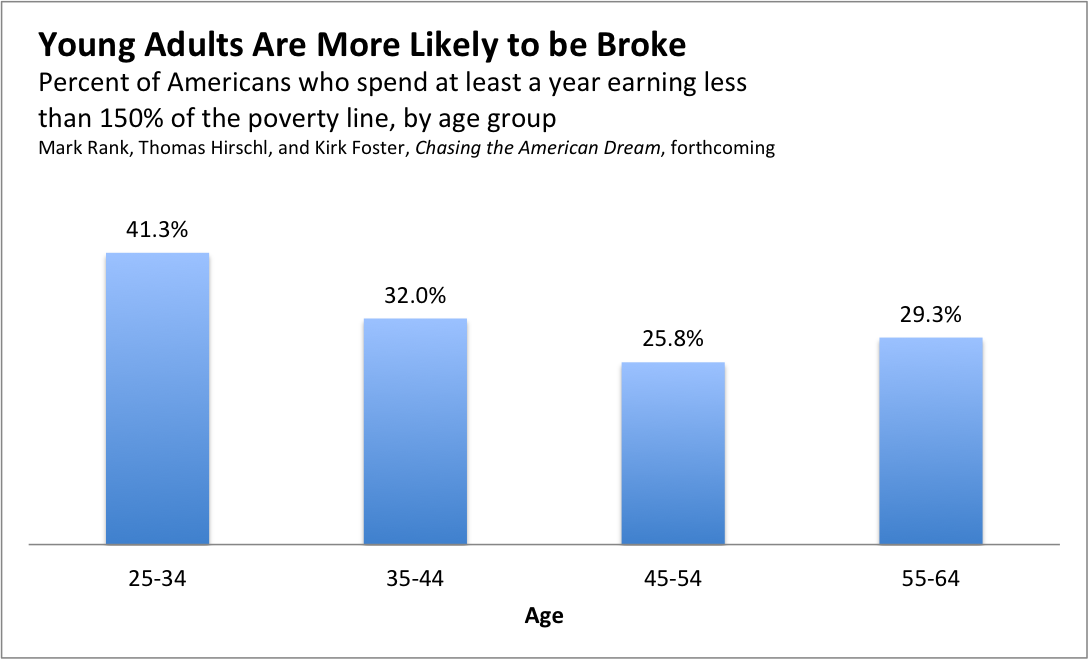
Young Broke

The young have it rough:

Mind you, these numbers aren’t just a snapshot of today’s economy, which has been notoriously dreadful for Millennials. Rather, they’re drawn from an analysis of the Panel Study of Income Dynamics data collected between 1968 and 2009. So in a sense, they’re a longterm assessment poverty through the American lifecycle. What they tell us, then, is that twenty and early thirty-somethings have lived financially wobbly lives in the U.S. for a very long time. Every generation has its horror stories about being young and poor.

Reverence Beyond Religion

Moshe Halbertal reviews Ronald Dworkin’s final book, Religion Without God, which argues that a religious sense of objective order and morality does not require a belief in a deity:

In one of the most insightful sections of the book, Dworkin shows that the theological claim that the source of moral obligation rests in the fact of God’s will and revelation is conceptually incoherent. If God wills the good and the bad into being, why should we obey His will at all? If the answer is that we owe Him a sense of gratitude and dependence as our creator, this is again a value argument, and as such it cannot rest on God’s will because it is the basis for following His will. Unlike morality, religion is not an independent sphere; it rests on a prior value that serves as its premise.

The radical philosophical implication of the strict independence of morality is that all godly religions are based on a prior religion without God, the religion that asserts the inevitability and the independence of moral obligations. A rather subversive and justified claim is therefore established: if religion, in the name of God’s superior revelation, commands something immoral, it undermines its own authority and ground, which ultimately rest on morality.

Mark Movsesian squirms:

Dworkin’s definition of religion … seems tendentious, a way to dilute religion so as to minimize the potential for conflict with the progressive state. This is not surprising. Traditional religion opposes many of the left’s priorities; for the left to succeed, it must continue to marginalize traditional religion. And Dworkin’s argument that religion as such does not merit special protection is very much in the air today. Prominent law professors like Brian Leiter and Micah Schwartzman make versions of this argument, for example. In the Hosanna-Tabor case, the Obama Administration maintained that religious freedom, as such, had nothing to do with a church’s decision to fire its minister.

Would You Take A CompSci Course Taught By Matt Damon?

Some MOOC providers hope so:

“From what I hear, really good actors can actually teach really well,” said Anant Agarwal, CEO of EdX, who was until recently a computer-science professor at MIT. “So just imagine, maybe we get Matt Damon to teach Thévenin’s theorem,” he added, referring to a concept that Agarwal covers in a MOOC he teaches on circuits and electronics. “I think students would enjoy that more than taking it from Agarwal.”

Casting Damon in a MOOC is just an idea, for now: In meetings, officials have proposed trying one run of a course with someone like Damon, to see how it goes. But even to consider swapping in a star actor for a professor reveals how much these free online courses are becoming major media productions—ones that may radically change the traditional role of professors.

Jeffrey Young notes that one MOOC provider, Udacity, already employs scriptwriters who turn lecture notes into productions “complete with demonstrations and suggested jokes.” He adds, “At least one long-time distance education expert argues that it makes sense to look for acting talent rather than deep content knowledge to appear on camera”:

“Having people who are really good at explaining ideas and putting the right graphics and videos around them can create a pretty darn good learning experience,” said Russell Poulin, a researcher with the Western Interstate Commission for Higher Education. “I’m assuming Matt Damon wouldn’t be answering the questions from students,” he added.

In fact, he argued that one benefit of online learning is that the various parts of the professor’s role can be “pulled apart.” In an online course, he argued, there’s no reason to have the same person develop the content, deliver it, and run assessments, when people with skills in each of those areas can work together to create clearer and more effective lessons.

That essentially argues for treating the development of a MOOC like a Hollywood production, with long credits at the end of the many specialists who teamed up on a shared vision. There’s a director running the show, but no one expects the same person to also act all the roles.

Previous Dish on MOOCs here, here, and here.

Bionic Baristas

Matt Buchanan explores the challenges inherent in brewing a consistent cup of coffee:

[E]ven the most advanced machines, using the most objective measurements, can only infer how well a cup of coffee is brewed—not how it actually tastes. This is because, as a paper in the peer-reviewed journal Food Science and Management points out, the “chemistry of coffee flavor is highly complex and is still not completely understood.” It’s hard to measure what isn’t known, and coffee is estimated to contain a thousand aroma compounds. Even what can be objectively measured about a cup of coffee, its extraction and strength, “cannot tell you how good the coffee is…you do that by taste,” Vincent Fedele, whose MoJoToGo tools are widely used in the coffee industry, wrote in an e-mail. Also, there are situations where “the numbers look right but the cup can often be less than ideal.”

Last month, Christopher Mims profiled Briggio’s robot coffee kiosk, which company founder Kevin Nater says “is in essence a small food factory that absolutely replicates what a champion barista does.” Will Oremus flagged a problem with it:

Robots may be more reliable than humans, in the sense that they can work around the clock without a break and achieve levels of precision and consistency that no Starbucks employee can match. But when something goes wrong, robotic systems tend to be less resilient than those that include humans, because humans are far better at reacting to novel circumstances—not to mention soothing the feelings of unsatisfied customers.

Researchers are working on ways to allow machines to detect human emotions, but empathy is one of those human traits that is not easily automated. In general, as I’ve argued before, robots come across as clumsy and incompetent when asked to operate autonomously in human environments. That’s why the conventional wisdom is that robots are best used for work that is “dangerous, dull, and dirty, ”—work, in other words, that humans can’t or don’t want to do. The happy corollary to this is that no one complains about sewer robots or bomb-disposal robots stealing people’s jobs.

The Ho-Hum Of Jet Engines

Virginia Postrel believes the airline industry will never recapture the glamour of its early days, no matter how hard it tries:

3910755129_a08527a59b_b“When the jet age was new and exciting, flying was a glamorous and sexy endeavor,” the Virgin Atlantic website declared in 2006, pledging “to bring this glamour back.” It’s a perennial promise in the contemporary airline industry, usually offered along with an announcement of new in-flight luxuries or stylish new crew uniforms. But however nice the amenities or attractive the uniforms, the old glamour never returns, because Jet Age glamour wasn’t about the actual experience of flying. It was about the idea of air travel and the ideals and identity it represented.

Jet Age glamour expressed the longing to experience a world of variety and excitement, a fast-moving, dynamic, and diverse alternative to the familiar and routine. We now inhabit the real version of that world, a world glamour advertised and helped bring about. We can never bring the old illusion back. We can only invent new ones, reflecting new circumstances, new possibilities, new desires, and new versions of yearnings that never go away.

(Image via James Vaughan)