A protester faces police under the rain on November 6, 2013 in front of the Greek Parliament in Athens during a 24-hour strike. A general strike hit Greece on November 6, paralyzing public services and disrupting transport as EU-IMF auditors worked to finalize the recession-hit country’s next budget, looking to eliminate a fiscal shortfall that could bring more unpopular cuts. By Louisa Gouliamaki/AFP/Getty Images.
Month: November 2013
18th-Century Sock Puppets
As Nicholas Mason tells it, authors were publishing rave reviews of their own works nearly three centuries before Amazon and Goodreads:
The first widespread reports of puffery came in 1730s England, where a number of journalists and wits remarked on the recent shift from straightforward, unembellished announcements of goods for sale to elaborate schemes to trick consumers into buying shoddy merchandise. Two trades in particular were seen as the foremost practitioners of puffery: quack medicines and books. In fact, the first known commercial usage of the term “puff” (the May 27, 1732 issue of London’s Weekly Register) pinned the practice squarely on booksellers: “Puff is become a cant Word to signify the Applause that Writers or Booksellers give to what they write or publish, in Order to increase its Reputation and Sale.”
In fact, the book review from the beginning was “a compromised form”:
Nearly every British writer of the late eighteenth and early nineteenth centuries either participated in or benefitted from ginned-up book reviews.
Mary Wollstonecraft reviewed her own translation of a French book in the Analytical Review. … In an 1817 issue of the Quarterly Review, Walter Scott anonymously reviewed his own Tales of My Landlord, slyly noting “none have been more ready than ourselves to offer our applause.” Other famous Romantic-era puffers included William Hazlitt, who lauded his own Characters of Shakespear’s Plays in the Edinburgh Review; Percy Shelley, who wrote a glowing (but ultimately unpublished) review of his wife’s Frankenstein for the Examiner; and Mary Shelley, who attempted to revive the reputation of her father, William Godwin, by puffing his novel Cloudesley in Blackwood’s Magazine.
Mason adds that “in many respects, the age of Fielding and Richardson is a remarkable analog to our own”:
Just as we grapple with the information overload resulting from the explosion of new media, these writers and their contemporaries were frequently bewildered by the new mores, codes, and ethics of the first great age of print. And just as many now are quick to blame the Internet for the rise of “astroturfing,” several eighteenth-century commentators saw puffery as the direct outgrowth of print culture.
Quote For The Day II
“In politics, when you have to eat shit, you don’t nibble,” – Democratic strategist Chris Kofinis, quoted by CBS News, on president Obama’s attempt to parse and finesse his statements on keeping your insurance plan.
I gave the same unsolicited advice today but without the turd metaphor. A rare moment of restraint.
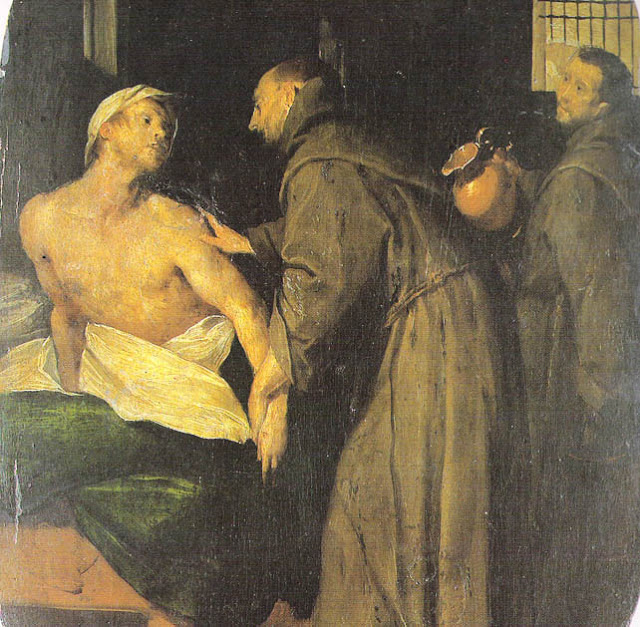
Pope Francis As Saint Francis
These images say more than a thousand encyclicals. It’s worth recalling that Saint Francis, after a brutal time spent as a prisoner of war, emerged a broken man and on his way back home came across a group of lepers. Previously a wealthy young scion of Assisi, fastidious and fancy, he entered the leper colony and began washing their bodies and living among them. It was the beginning of his ministry. And so it begins again …
A reader adds:
This is the first time I’ve ever been compelled to write you about a non-political issue, but your link to the article about Pope Francis embracing a horribly disfigured man really hit me.
I’m a complete and thorough atheist. I was raised religious, but went away from it very consciously and actively as I rejected the entire logical foundation of religion. I am still as confident in my atheism as I’ve ever been. I preface my thoughts this way merely to put into context the unalloyed awe and admiration I have at the actions this Pope has taken. Acts of profound and sincere compassion are all too rare in this world, and whether those acts come from an atheist or a pope, they are to be treasured and cherish.
The reality of horrible disfigurement has always been something which has struck me very hard.
On one level, its simply the pity one feels looking upon the decrepit, and imagining the difficulty of their lives. On another level, I can’t help but feel of overbearing sense of guilt at my own visceral disgust upon looking at disfigured people; it’s a disgust rooted in evolution and natural instincts, not a moral revulsion, but its an undeserved disgust all the same. I’m not going to pretend that seeing the actions of Pope Francis today is going to be able to change that; human instinct is what it is. But it gave me a little more appreciation for the profound acts of kindness that people are capable of when they truly embrace compassion as an ethos. For that, this man is worthy of intense admiration.
In 6 months, Pope Francis has lifted the image of his faith far above anything I’d thought possible in my 28 years of life. May he continue to do so.
Or as Saint Francis once put it: “Preach the Gospel everywhere. If necessary, with words.”
(Painting: Giovanni Battista Crespi, called Cerano, ‘Saint Francis healing the leper’, 1630.)

Obamacare’s Losers, Ctd
Chait asks why the media is so focused on rate-shock victims:
Why has their plight attained such singular prominence? Several factors have come together. The news media has a natural attraction to bad news over good. “Millions Set to Gain Low-Cost Insurance” is a less attractive story than “Florida Woman Facing Higher Costs.” Obama overstated the case when he repeatedly assured Americans that nobody would lose their current health-care plan. There’s also an economic bias at work. Victims of rate shock are middle-class, and their travails, in general, tend to attract far more lavish coverage than the problems of the poor. (Did you know that on November 1, millions of Americans suffered painful cuts to nutritional assistance? Not a single Sunday-morning talk-show mentioned it.)
Frum counters:
Chait is right that some degree of redistribution is inherent in the very concept of insurance. Redistribution is not the core design flaw in Obamacare. The core design flaw is that Obamacare had its priorities upside down: it put coverage expansion first; cost control a very distant second. What we are discovering now is that without cost control, coverage expansion quickly devours itself.
That self-devouring is the process dramatized by the price shock on the exchanges…but the real harm will come in the months ahead, less visibly, as employers confront the same stark shock that the individual purchasers are confronting today. Employers can’t shirk the fines as easily as individual purchasers can. But they can still make the rational choice to pay the fine and dump their employees into the exchanges, where they will encounter the same hostile math that I faced last week. The sick will sign up; the well will drop out; and the prices will keep rising and rising and rising—until either the system crashes or else the government steps in to assume an ever-expanding role as cost controller and price subsidizer.
The View From Your Window
The Rape Double-Standard, Ctd
Readers continue one of our most popular threads of late:
While I agree that rape prevention is never the responsibility of those who might have been victimized, the same is true of those who might be victims of false accusations. And that is the all-important flip side of this question. It is difficult to subject the claims of rape and sexual harassment victims to close scrutiny, because if they have indeed been victimized, it only adds to their trauma. At the same time, plenty of people are falsely accused of rape, sexual harassment, etc, and their lives have been ruined thereby. This goes especially for people in positions of responsibility over young people, like public school teachers. An accusation of rape can end a carefully cultivated career for years, sometimes forever.
While we are teaching people, especially young men, not to rape, and to act as allies when women are threatened with rape (a role I’ve played, BTW, preventing what certainly would have been a rape if I hadn’t acted), we should also teach young people how lives are ruined by careless and misleading accusations.
Sometimes we encourage young people to be open about how a situation makes them “uncomfortable,” when they are too young to judge the possible effects of an accusation. And sometimes the accuser is encouraged by well-meaning adults who are far too credulous and give adolescents too much credit for knowing things they don’t, in fact, know. A few leading questions, an easily-led adolescent with a grievance, and you’re in court, and your family has lost its sole support.
Another:
A reader stated about rape: “Typically, it’s an assertion of power on the part of the male, not a desire to get off sexually without seeking the consent of the other.” I know that you cannot extract power from sex at all (male potency or power may be men’s most erotic trait), but I cannot conceive of how lust can be taken out of the motivation behind most rapes. Statements about how “rape is about power, not sex” seem to want to keep sex as this all benevolent, all natural, all safe part of life … and not concede that sex is an animal instinct that can drive us towards extreme selfishness and harm unless we exert control over it.
Another adds:
One of your readers repeats the durable old feminist chestnut that “male-on-female rape is rarely about sex.” Sometimes this thesis is trotted out to explain male-on-male rape and child molestation as well. But this notion – originated by activist Susan Brownmiller in the 1970s and never supported by any actual science – was essentially a political assertion arising from the zeitgeist of a bygone era. And the notion was criticized early (by D. Symons in The Evolution of Human Sexuality (1979)) and late (by R. Thornhill and C. Palmer in A Natural History of Rape (2000)).
Mental Health Break
Beagle fight!
The Enigma Of Inspiration
Sharon Rawlette observes that “the real trouble lies in that a writer doesn’t know how she does what she does”:
There is no recipe. No blueprint. No line of stepping stones that will lead one to the creation of a brilliant piece of literature without moments of wandering in the dark. We writers strive to bring into being something bold, original, and heart-stoppingly magnificent. But, as clichéd as it may sound, that stuff only arrives by way of inspiration. Don’t get me wrong. We writers have to work hard. We have to show up. We have to put pen to paper or fingertip to key. We have to cry and sweat and bleed. But there’s no direct link between our suffering and the end result. Our tears, our sweat, our blood get poured out, and then, magically, from somewhere off in left field, the miracle appears. And the end result seems so disconnected from our effort that we wonder why it couldn’t have just shown up earlier, before we had that little visit to hell.
But of course, the work was necessary. The work did get us the result. It just happened somewhere in the depths of the unconscious. We couldn’t see the gears turning, the neurons firing, the gods descending and re-ascending from our little brains. And so, when it’s time to face the next blank page, we still have no clue how we do what we do. And we’re not at all sure that it will ever happen again.
Vladimir Nabokov sounded a similar note during a 1964 interview with Playboy:
What inspires you to record and collect such disconnected impressions and quotations?
All I know is that at a very early stage of the novel’s development I get this urge to collect bits of straw and fluff, and to eat pebbles. Nobody will ever discover how clearly a bird visualizes, or if it visualizes at all, the future nest and the eggs in it. When I remember afterwards the force that made me jot down the correct names of things, or the inches and tints of things, even before I actually needed the information, I am inclined to assume that what I call, for want of a better term, inspiration, had been already at work, mutely pointing at this or that, having me accumulate the known materials for an unknown structure. After the first shock of recognition—a sudden sense of “this is what I’m going to write”—the novel starts to breed by itself; the process goes on solely in the mind, not on paper; and to be aware of the stage it has reached at any given moment, I do not have to be conscious of every exact phrase.
I feel a kind of gentle development, an uncurling inside, and I know that the details are there already, that in fact I would see them plainly if I looked closer, if I stopped the machine and opened its inner compartment; but I prefer to wait until what is loosely called inspiration has completed the task for me.
High Taxes
Sullum analyzes Colorado’s new marijuana taxes, which passed by an overwhelming margin last night:
[M]arijuana will be one of the most heavily taxed consumer products in Colorado, taxed at a much higher rate than alcohol even without taking local levies into account. That situation is hard to reconcile with Amendment 64′s aim of taxing marijuana “in a manner similar to alcohol,” and it surely makes no sense in light of the two products’ relative hazards, which were a major theme of the legalization campaign. If legislators take full advantage of their new tax authority, marijuana in Denver, the center of the retail cannabis industry, will be hit by a 15 percent excise tax plus sales taxes totaling 38 percent (including standard and special state and local taxes). With taxes that high, the state-licensed outlets may have trouble competing with the black market and with homegrown marijuana. (Colorodans are allowed to grow up to six plants at home and share the produce, one ounce at a time, “without remuneration.”) Legislators may find that if they set taxes too high, the result will be less revenue rather than more.
Pete Guither sees an upside to the taxes:
While those taxes are significant (and significantly higher than alcohol taxes), and I’m concerned that the state do what it can do encourage legal channels at the beginning rather than discouraging them, still I think that smart producers will still be able to achieve a price point that will satisfy purchasers who would like to buy legally. And the taxes will help the political future of legalization.
Finally, Nicole Flatow notes the marijuana news from yesterday’s election:
By a landslide, Portland became the first east coast city to legalize marijuana Tuesday, in a measure that removes all penalties for small-quantity, adult marijuana possession, but does not decriminalize production or sale of pot. And three Michigan cities passed measures to remove criminal punishment for marijuana possession, bringing the number of Michigan localities that have decriminalized marijuana to 14. In some of these localities, marijuana possession is still a civil infraction that typically carries a ticket and/or fine. But Lansing’s initiative, like Portland’s, removed all civil and criminal penalties.
Earlier Dish on marijuana taxes here.
(Photo: David McNew/Getty Images)