Ramesh Ponnuru likes how Christie has finessed his social conservatism:
Socially conservative positions on hot-button issues don’t seem to be a deal-breaker even for the much more liberal voters of New Jersey. Christie has vetoed legislation to grant state recognition to same-sex marriage — a judge later ordered it, though Christie briefly appealed — and vetoed bills to fund Planned Parenthood five times.
He does not, however, seem obsessed by social issues: Democrats haven’t gotten much mileage out of ads saying that his priorities are different from those of voters, as they have against Cuccinelli. Christie has also avoided taking unpopular socially conservative stands on issues that aren’t live debates, and taken the occasional opportunity to soften his profile.
Samuel Goldman calls Christie’s strategy “Machiavellian” because Machiavelli thought that “the important thing is to seem to possess the moral virtues, rather than actually to practice them.” He argues that “Chris Christie is a good example of this dynamic” because “Christie knew quite well that his challenge to the gay marriage bill was purely symbolic, since the liberal state supreme court was certain to reinstate the law”:
Christie’s Machiavellian approach isn’t popular with dedicated social conservatives. The National Organization for Marriage and the Family Research Council have both condemned Christie’s handling of gay marriage. But symbolic conservatism is popular with more moderate voters, who want to express disapproval from gay marriage and abortion, but are uncomfortable with policies that seem intrusive or intolerant.
The lesson of today’s election, then, will not be that social conservatives can compete in moderate and liberal areas if they offer more explicit and articulate defenses of their views. It’s that they can get away with expressing social conservative beliefs so long as they do nothing to suggest that those beliefs are likely to end up enshrined in law.
Sabrina Rubin Erdely reports that “the trans-rights movement has speedily moved to a brand-new battleground: public schools”:
Kids are coming out as trans earlier than ever: A survey of the San Francisco school district found that 1.6 percent of high school students and, incredibly, one percent of middle-school students identified as transgender. Children are packing the few U.S. clinics like [the Center for Transyouth Health and Development], which are at the forefront of a new therapeutic approach, in which children may live as their preferred gender, complete with appropriate clothing, pronouns and often a new name. This so-called affirmative model has found an increasingly warm reception among the worried parents of trans children. And so while most doctors still consider this “social transition” for kids under the age of 10 to be controversial, already these intrepid young pioneers have begun venturing out into the world – including, in rare cases, female-to-male trans kids who undergo “top surgery” as early as age 13. …
Although 623 American colleges and universities have already adopted nondiscrimination policies to cover gender expression, high schools and middle schools are being forced to grapple with the question of how to deal with trans students in their locker rooms, athletic fields and bathrooms. It’s a haphazard fight raging at district, county and state levels; thus far, 2013 has been what appears to be a watershed year.
This past winter, educators in Massachusetts, Maine, and Portland, Oregon, issued guidelines to accommodate trans students, allowing them to use bathrooms and play on sports teams corresponding to the gender with which they identify. But in August, California trumped them all by becoming the first state to pass legislation spelling out that transgender students can choose which bathrooms, locker rooms and sports teams they wish, based on their gender identity.
[A] firestorm of dissent is building around one section of the bill, stating that transgender students will have the opportunity to play on sports teams and use sex-segregated facilities that correspond with their gender identity, even if this doesn’t match their birth certificate. Opponents of the law, citing privacy concerns, have begun the process of collecting signatures to repeal the law through public referendum. Should these organizations collect the necessary 505,000 signatures required by November 6th, the law’s fate will be voted on by the general public in the 2014 midterm elections.
Previous Dish here on the debate over when a child can be considered transgender.
A reader reminds me of another good reason to move back to DC:
I have to give high marks to the District of Columbia for their ACA website. It took me two minutes to create an account, and a couple more minutes to get to the list of available plans. For me, there are 31 options, 30 of which have lower monthly premiums than my current plan, which I’ll admit is expensive ($613 a month just for me).
Another:
I am a physician living in Washington, DC. (We’re excited to have you back!) I am working 3/4 time by choice, so I am not eligible for group coverage from my employer (a hospital). I am single, 46 years old, and fairly healthy, and I’ve been buying health insurance on the open market. I have a fairly high deductible policy that covers routine preventive care and dental care and is HSA eligible. I am not eligible for subsidies under the ACA. As a physician, I am thrilled with the ACA for my patients. I have plenty who will now be able to obtain insurance, allowing them to see me when needed and allowing me to be paid.
Yesterday I received a letter from my insurance company stating that, due to the ACA, my current policy will be canceled as of 12/31/13.
I have a choice of renewing my plan at “next year’s rate” (which was not specified in the letter) or buying insurance on the exchange from them or another company. The letter was very clear and did not try to sell me on one of their plans, or tell me I’d “default” to one of their plans if I didn’t do anything.
Bracing myself for a price hike, I called the company today. To my pleasant surprise, they are renewing my current insurance for a year at an increase of exactly $3.00 per month. At the end of next year I’ll have to buy insurance on the exchange, but I’m optimistic by that time the DC exchange will have sorted itself out and I will have reasonable options.
So count me among those with a “shrug” for the change to Obamacare. My impression is that it’s helping a lot of people, hurting a few, and not having a huge effect on the vast majority of the rest of us.
Another:
I had been talking with my neighbor on and off the last several weeks about healthcare. He is somebody who I had anticipated ACA would help a lot because he is a self-employed graphic designer who currently does purchase insurance on the individual market. He was excited about ACA, but when we first talked at the end of October, he had not successfully gotten onto healthcare.gov.
He sent me an update e-mail this afternoon, indicating he had gotten onto the site and saved six possible plans to go over in more detail. There are actually enough options that it does take some thinking about one’s personal situation to know which plan might be best given the different premium versus deductible and other out of pocket expenses. But his final paragraph is important to the whole discussion about cost:
All in all the process went fine but I don’t think I’m going to save any money overall. But this is a big step for self employed people. The fact that I don’t have to worry about pre-existing conditions and being turned down for insurance is a huge change from what it was. Can’t wait to hear how many people have signed up. They should know something next week.
I’m sure encouraged that he was able to get onto the website!
It’s been two decades since the issue of marriage equality arrived on the shores of those beautiful islands, and the debate hasn’t stopped. Over the last week, there has been a massive wave of citizen testimony in the legislature, literally thousands of two-minute speeches. Some of this was a deliberate attempt at a kind of citizens’ filibuster, but a large part of it seems to me to be a very healthy airing of differing views in a preternaturally civil fashion. Better still, the bill for marriage equality has strengthened its religious freedom protections, something I’ve long believed in.
Soon, the bill will go to the full House for a vote, then another round in the Senate before it gets to the governor who wants to sign it. Whatever the result, democracy was in action in Hawaii. And that is a good thing.
The bottom line is this: If the national exchanges were functioning as well as the best-functioning state exchange — and encountering the same demand — we’d probably be on the low end of the administration’s acceptable enrollment range. If the middle state were representative of the country as a whole, we’d be below it, but not by an overwhelming amount. That’s not much, but it’s probably the best news supporters of the law have received in a while.
Health plans, with the kind of market share that would have to sign-up 100,000 to 200,000 people for the administration to hit its goal of 7 million people, are generally reporting they have enrolled only about 100 – 200 people over the first 35 days via Healthcare.gov.
He also reports that, among insurers “the confidence that this can all get fixed by December 1 is not high.” Allahpundit wonders what happens if healthcare.gov isn’t fixed by the end of this month, the Obama administration’s self-imposed deadline:
What does [Obama] do on December 1st if we’re still stuck in 404 hell? Allow insurers to bring back plans that have been canceled under the new ObamaCare regs? Extend the enrollment deadline next year from March 31st to some later date, which raises the risk of adverse selection problems for insurers? Delay the entire law until HHS gets its act together? Nothing but bad options here as far as the eye can see.
I am wounded by this to the depths of my soul. I am an omnivore, but this sort of thing makes me question how I justify it. It also makes me question fellow Christians that are so committed to the ” pro-life” movement. This is a creature that is fully conscious of its suffering; how can you consider this to be of less consequence than a fetus that had not developed a fully developed brain?
Another:
I eat meat; the fish I catch or my family catches. I know the farmer who raises the beef I eat. The deer we hunt every fall live good wild lives and then a bullet ends their life; a whole lot better than starving, getting hit by a car or be torn to bits by a pack of dogs/wolves. I do my best to know where my food comes from and how it lived before it came to feed me and my family. Everything dies and becomes food to another living thing, even we humans. I do my utmost to never buy much of anything from Walmart, especially meat, fish or eggs. I support each person’s right to choose what kind of diet best suits their lifestyle and moral choices. Please respect mine, because at the end of the day I know we want the same result: I believe that by consuming only humanely raised animals and sustainable crops I can do more to keep animals safe while supporting the health of my family.
Another responds to my call to contact Dave Warner, the director of communications for the National Pork Producers Council (and his response is below):
Hello Andrew:
I have never in my life written anything like the email below to anyone, on any subject of public attention. Thank you for getting me off my arse!
Dear Mr. Warner:
I got your email address from Andrew Sullivan’s “Daily Dish” blog, where I have been following his recent excellent coverage of the use of ‘gestation crates’ and other factory farming techniques in pig farming. He has thoughtfully presented the moral issues from a Roman Catholic perspective and in the context of the respect for life and stewardship of nature that form a central part of that faith (which I share).
I am a lifelong lover of bacon, ham, and almost every other pork product! But in light of what I have now learned about the treatment of pigs in American factory farms I can no longer, in good conscience, continue to consume pork. While I have no moral objection to the consumption of meat, I will not remain complicit in the unspeakable cruelty apparently routinely inflicted on pigs by American pork producers.
Please convey to your members that I, and many consumers like me, ask that American pork producers discontinue practices like the use of gestation crates and make some concerted effort to provide pigs a life that approximates the natural life an intelligent mammal should be entitled to. Until that time, I will not purchase any pork product other than those that I can satisfy myself came from farms that treat their animals with dignity and (at a minimum) allow them to move around outside. I am prepared to pay a premium for such well-sourced meat.
Thank you for your kind attention.
Warner responds to the Dish:
Andrew Sullivan Monday posted a couple of videos from hog farms and wrote about the “brutal impact of keeping pigs in gestation crates.” But the videos’ images and, more importantly, the narrative that accompanied them don’t tell the accurate story of how America’s family hog farmers raise and care for their animals.
Providing humane and compassionate care for their pigs at every stage of life is one of the ethical principles to which America’s family hog famers adhere. They are passionate about caring for animals in a way that protects their well-being. In fact, housing sows in gestation stalls is one of the ways to ensure their well-being. Those individual pens allow farmers to give sows individual food rations and veterinary care; they also protect sows from aggressive sows.
Janeen Salak-Johnson, an associate animal science professor at the University of Illinois, has studied gestating sows in various housing systems, monitoring their stress, environmental physiology and well-being. She has found that individual pens work well for pregnant sows and that, contrary to claims made by opponents of the housing system, they don’t cause health problems for the animals.
The American Veterinary Medical Association and the American Association of Swine Veterinarians (AASV) recognize gestation stalls as appropriate for providing for the well-being of sows during pregnancy. In fact, the key factor that most affects animal well-being is husbandry skills – that is, the care given to each animal. There is no scientific consensus on the best way to house gestating sows because each type of housing system has inherent advantages and disadvantages. One of the disadvantages of allowing sows to roam freely, for example, is that they will attack each other, with severe injuries and even death often the result. It’s also harder to ensure proper veterinary and nutritional care to sows in group or open housing systems.
Pork producers didn’t just wake up one day and decide to put sows in individual pens. Individual housing came about after years of working with the animals, observing their behaviors and determining what worked best to provide them the best possible care. Why would hog farmers want to abandon a system that provides that?
One practice (blunt force trauma) shown on one of the videos, while a method accepted by the AASV as a way to euthanize nonviable piglets, is being phased out – research on better methods is on-going – by the pork industry.
Certainly, there have been a few instances of animal abuse on hog farms, and that abuse has been condemned by the pork industry and by the farmers at whose operations the abuse occurred. Workers involved, including the worker in one of the videos posted yesterday, have been fired and, in one case, criminally prosecuted.
But most of the videos offered by animal-rights groups do not show any abuse, and even in the videos that do, the majority of the footage does not show abuse despite the groups’ narratives and claims to the contrary. Just because someone asserts that something is abuse – gestation stalls, for example – doesn’t make it so.
Hog farmers around the country are very concerned about the well-being of their animals, but they’re also concerned that the lies being told about how they raise and care for them could win the day and that, then, the United States would go the way of Europe, with animal well-being suffering, farmers going out of business and food prices skyrocketing.
Warner adds that the following video “(at about 1:50) explains why many hog farmers use gestation stalls, if you want to include it with the post”:
Another reader:
I just sent a polite but direct e-mail to Dave Warner. I told him that from now on my family will stop buying pork products and ordering pork in restaurants unless it is clearly marked as humanely raised.
On a tangential note, my parents lost a dear friend to mad cow disease here in the US earlier this year. You may already know this, but it is still possible for humans to contract mad cow disease in this country due to gaps in inspections and other loopholes. So now we only eat and order beef that is clearly labeled as having been fed grass or vegetarian feed. I swear, this nation’s meat industry is slowly turning me into a vegetarian.
Another:
Because you have such a large readership, I am pleased you are reaching a large audience on this topic – Thank You! I can never watch these videos; I suspect I would cry and be depressed the rest of the day. My husband, daughter, and I eat very little meat and when we do, it is from humane sources. As a society, if we reduced our demand for meat by half, our health, the environment, and the lives of animals would improve! Whether it’s “Meatless Mondays” or “Vegan Before 6”, so much good from one small step. Please continue this important topic.
[T]o dissect the issues puts too much emphasis on them. The overarching worry among conservatives will be that no matter what the issue, a man who makes such a fetish of his ability to work with Democrats is going to sell out conservatives in the end. This tension has been at the core of the fight between the Republican Party establishment and grassroots since the 1940s. Sometimes that fight is about policy, but often the candidates are so close in their positions that the fight is more about personality and tactics.
A quote from Michael Bowen’s Roots of Modern Conservatism: Dewey, Taft, and the Battle for the Soul of the Republican Party brings this home. “It is important to bear in mind that the major political controversies today do not center about objectives,” said a Republican staffer, “but mainly about methods of attaining objectives.” That was a quote from more than 60 years ago, but could just as easily apply to last month’s fight over defunding Obamacare.
If Christie runs, and the egomania of last night makes it all but inevitable, he will at some point have to encounter and beat a serious Tea Party candidate. It could be Ted Cruz or Rand Paul or both. It will not just be a personality battle. Christie’s positions on climate science, Medicaid expansion, gun control and immigration reform – cited by Chait – are red flags to the base Christianists and extreme libertarians. Given Christie’s temperament, I’d say it will be a very entertaining but brutal battle for the soul of the party. Christie’s embrace of Obama during Sandy, his state’s marriage equality, his Northeastern roots, and the big establishment money behind him will also polarize the elites and the base. And his political style is not exactly to pour oil on troubled waters. He’ll say something mean and nasty at some point, and it could either cement his stature or make him look very small.
I can see him trashing Paul as someone who’s never run anything and who’s a surrender monkey in foreign policy. I can also see him lambasting Cruz for his recklessness and extreme partisanship. I guess what I’m saying is that I doubt he can win the nomination without a deep and damaging divide emerging – and maybe even a third Tea Party candidate. That’s not a good starting point for a general election, however wide his appeal in the country at large.
Don’t get me wrong.
I think Christie’s pugnacity will resonate in the South – especially with his unreconstructed, Jacksonian neoconservatism and Cheney-style view of civil liberties. I think he can reach what’s left of the Reagan Democrats. I think he can appeal to the populist anti-Washington mood. I think he is the perfect foil to Obama’s temperament – and voters tend to like a candidate who is a corrective to the president he succeeds. I think he could beat Hillary Clinton quite easily if that were the match-up, and if he doesn’t do or say something against her that alienates female voters.
But I also see his massive ego doing a great deal of internecine damage in the primaries, and deepening some of the base’s fear of supporting – yet again – someone who is not one of their own. The GOP’s best candidate may be their most divisive. But of course, these are distant speculations – to be dragged up in the future, I’m sure, when they are proven completely wrong.
But he’s a force all right. And one the Democrats under-estimate at their peril.
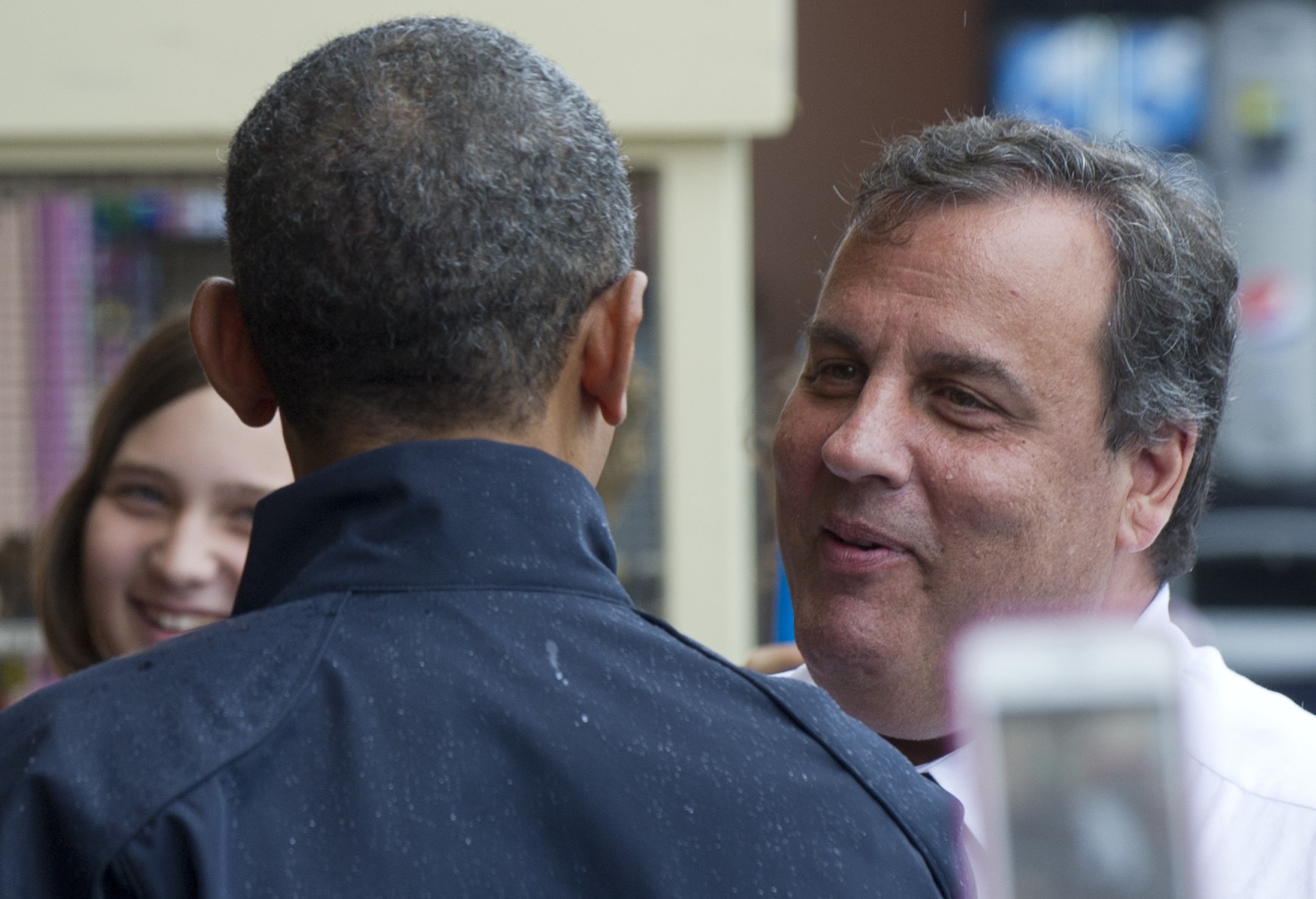
(Photo: US President Barack Obama and New Jersey Governor Chris Christie talk on the boardwalk as they view rebuilding efforts following last year’s Hurricane Sandy in Point Pleasant, New Jersey, on May 28, 2013. By Saul Loeb/AFP/Getty.)
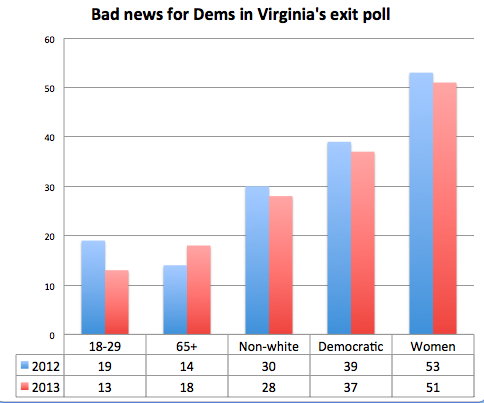
Ezra, who posts the bar graph seen above, finds “worrying signs” for Democrats in Virginia’s exit polls:
[T]he exit polls out of Virginia give Republicans some reason to cheer heading into the 2014 midterms. Though Virginia’s GOP chose a candidate who turned off moderate Republicans and motivated Democrats, and though the Democrats had vastly more money, the exit polls still showed the kind of demographic drift that could help Republicans make gains next year. … One cautionary note here is that exit polls, of course, are imprecise, and 2013′s exit poll has a margin of error of four percentage points — so some of these differences might just be noise. But some, like the age gap, aren’t, and all the movement is in the same direction — towards the Republicans. Remember, too, that the cold logic of statistical uncertainty means the Republican tilt could easily be sharper than these results indicate.
McAuliffe couldn’t win by a wide margin in all but ideal conditions. Most significantly, McAuliffe made few, if any, inroads into GOP territory. McAuliffe did as bad as President Obama in coal country and western Virginia, the exact sort of places where Democrats need to rebound to retake the House. In comparison, Tim Kaine won significant chunks of Republican-leaning terrain in 2005. That’s exactly what Democrats need to win back the House, and if a perfect storm couldn’t produce those gains, then there’s plenty of cause to question whether Democrats can retake the ground necessary to win the House in twelve months.
Sean Trende reads the Virginia numbers differently:
There was a bounce-back from 2009 lows, as expected, but the demographic shifts were probably about more than a bounce-back. To use racial crosstabs as an example, the 2012 electorate was 70 percent white, while the 2009 electorate was 78 percent white. The 2013 electorate was 72 percent white. Most of that difference came from increasing the African-American share of the electorate vis-à-vis 2009. This is probably the most encouraging data point for the Democrats for the night.
Meanwhile, Waldman resists reading too much into yesterday’s elections:
The point is, unless something truly spectacular occurred, the next year or two of American politics would play out exactly the same way no matter what happened in Virginia and New Jersey. You may have found one or both of them to be interesting races on their own terms. But if you’re going to make an argument about what’s going to happen in the future, you’ll have to do better than citing the explanatory power of these elections.
Yes, we all play the expectations game, and Terry McAuliffe only won by two-and-a-half percent, which is less than most of the late polls anticipated. But to read this morning’s spin, you’d think he (and the Democratic Party) actually lost. The results are being widely read exactly as Ken Cuccinelli wanted them to be read: a negative “referendum on Obamacare.” Politico’s James Hohmann, in a piece entitled “Why Terry McAuliffe barely won,” draws bright red arrows pointing to an exit poll showing that 53% of voters said they opposed Obamacare. That’s entirely in line with about three years of polling about the Affordable Care Act, and doesn’t indicate any last minute “surge” against the law.
Sargent’s examination of the exit polls backs up Kilgore:
Indeed, it’s hard to look at last night’s results as a definitive declaration of public opinion on Obamacare either way — whether for or against.
The only conclusion I think you can begin to draw from the results is that an absolutist position against the law doesn’t command sufficient support to win statewide in Virginia, a state that is widely seen by observers as a key indicator of national demographic and political trends. The law is probably still on probation with many voters, but the law’s most ardent foes are wrong — they just don’t represent a majority or mainstream position.
According to the exit polls, only 27 percent of Virginia voters saw the health law as the top issue, and among them, only a bare plurality (49-45) supported Cuccinelli. Far more (45 percent) named the economy.
[P]ollsters seem to have somewhat underestimated the share Cuccinelli would get of the Republican vote. So there might be a reasonable supposition that hammering Obamacare, in this hellish climate, helped him consolidate Republican voters. It’s not conclusive evidence but it is suggestive of that theory.
Even in an election that the Republican candidate was deeming to be a “referendum on Obamacare,” in a state where Obamacare is not popular, against a Democratic nominee whose key career accomplishment is unusual success at influence peddling, the Republican nominee lost.
What lesson should Republicans take away? One is perhaps that, while the public is wary of Obamacare, scorched-earth opposition to it is not a winning electoral strategy.

 The Dish