Milgram Misled Us

Behind the Shock Machine, a new book by Gina Perry, revisits the famous experiment by Stanley Milgram claiming that “nearly two-thirds of subjects will, under certain conditions, administer dangerously powerful electrical shocks to a stranger when commanded to do so by an authority figure”:

Perry reveals that Milgram massaged the facts in order to deliver the outcome he sought. When Milgram presented his finding — namely, high levels of obedience — both in early papers and in his 1974 book, Obedience to Authority, he stated that if the subject refused the lab coat’s commands more than four times, the subject would be classified as disobedient. But Perry finds that this isn’t what really happened.

The further Milgram got in his research, the more he pushed participants to obey. In early variations of the study, those “who resisted four times [were] classified as disobedient,” but in later iterations, especially the 20th one — notably the only variation to use female participants and thus crucial to Milgram’s claims to gender universality — “the same behavior was ignored.” In fact, Williams, the actor who played the lab coat, was only instructed to stick to the script in the first two variations, after which Milgram “tacitly allowed Williams license to improvise.” Williams forced the female participants to endure far more commands than the early male subjects, prodding one female subject 26 times before she finally gave in and was classified as obedient.

This new evidence suggests that Milgram’s female subjects may have been more likely to disobey than his male subjects. Perry also finds that in later variations, Milgram allowed Williams to ad-lib new commands. For example, at one point Williams learned from early trials that some participants had felt obligated to follow his directions in the interest of aiding Yale in its pursuit of knowledge. He then intimated to later subjects that, if they refused to follow his orders, the entire study would be invalidated. Milgram never mentioned these facts in any of his published writing.

Aside from the specific situational implications of these facts, Perry’s evidence raises larger questions regarding a study that is still firmly entrenched in American scientific and popular culture: if Milgram lied once about his compromised neutrality, to what extent can we trust anything he said? And how could a blatant breach in objectivity in one of the most analyzed experiments in history go undetected for so long?
Going Viral In The 19th Century

“Twitter is faster and HuffPo more sophisticated,” acknowledges Greg Miller, “but the parasitic dynamics of networked media were fully functional in the 19th century”:

The tech may have been less sophisticated, but some barriers to virality were low in the 1800s. Before modern copyright laws there were no legal or even cultural barriers to borrowing content, Cordell says. Newspapers borrowed freely. Large papers often had an “exchange editor” whose job it was to read through other papers and clip out interesting pieces. “They were sort of like BuzzFeed employees,” Cordell said. Clips got sorted into drawers according to length; when the paper needed, say, a 3-inch piece to fill a gap, they’d pluck out a story of the appropriate length and publish it, often verbatim.

Is Pot Legalization For White People?

Claiming that the major pot advocacy groups consist of “white, privileged and devoted marijuana smokers” who have “largely ignored” issues of race, research psychologist Carl Hart calls for the movement “to break [its] silence on this issue and make racial justice a central part of the fight against pot prohibition”:

[C]onsider a recent report by the American Civil Liberties Union showing that black people are two to over seven times more likely to be arrested for pot possession than their white counterparts, despite the fact that both groups use marijuana at similar rates. These disparities held up even when researchers controlled for household income. It’s about race, not class.

As a neuropsychopharmacologist who has spent the past fifteen years studying the neurophysiological, psychological and behavioral effects of marijuana, I find this particular effect of pot prohibition most disturbing. Each year, there are more than 700,000 marijuana arrests, which account for more than half of all drug arrests. And now, largely because of the selective targeting of African-American males, one in three black boys born today will spend time in prison if we don’t take action to end this type of discrimination.

David Simon agrees with most of Hart’s analysis but balks at that last sentence:

One in three African-American boys born today will be imprisoned at some point not because of marijuana enforcement, but because of the entirety of the drug war — and only by dealing with all of drug enforcement and its subtext of racial and class control will that trend ever abate, much less be reversed.

In fact, he argues that legalization could, perversely, “consign increasingly isolated poor people of color to the brutalities of the drug war”:

Yes, marijuana is among the least dangerous prohibited substances in the drug world. Yes, any continuing criminal arrests for its use are dysfunctional and draconian. Yes, as with any drug law, such arrests target people of color disproportionately. But accept as well that marijuana is also the most basic and fundamental place where white, middle-class and affluent America intersects with the drug war. It is the place where many, many white families of economic means and political relevance encounter even the most moderate risk to their status and future. For the majority of that cohort, it is the only place where the drug war’s rubber actually hits any stretch of suburban blacktop.

Of course, it is impossible to argue against the immediate practicalities of liberalizing marijuana use and reducing the criminal penalties such. In a country with our levels of alcohol use, no one should be incarcerated or even criminally arrested for smoking weed. But in so liberalizing this single sphere of our national drug war, the actual political isolation of the poor, and of poor people of color especially, will actually deepen. Having removed much of the white, middle-class interaction with drug enforcement from the equation, those who are championing marijuana reform and ignoring the overall disaster of the drug war will be perpetuating the fundamental and continuing injustice.

Money quote from Bill Maher’s epic rant against prohibition seen above:

But this isn’t about me. It’s about the three-quarters of a million people who are arrested for simple possession every year. And the fact that blacks are arrested at seven times the rate of whites. Which is a subtle way to suppress the black vote, because 48 states limit voting rights for convicted felons. Only two states do not: Maine and Vermont. And Maine’s black population consists of a bear.

Face Of The Day

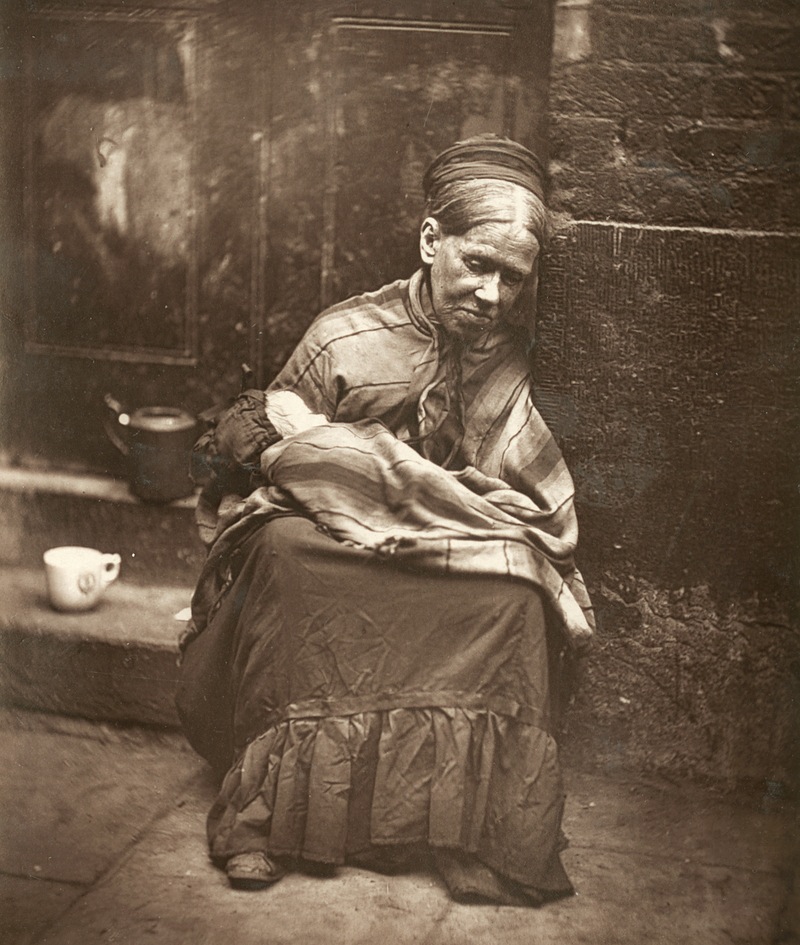
The Telegraph has a wonderful gallery of photographs from nineteenth century London from the LSE’s digital library. “Street Life in London” (Sampson Low, Marston, Searle and Rivington, London, 1877) is annotated by John Thomson and Adolphe Smith. This one leapt out at me:

view

Thomson and Smith write of her:

The crawler, for instance, whose portrait is now before the reader, is the widow of a tailor who died some ten years ago. She had been living with her son-in-law, a marble stone-polisher by trade, who is now in difficulties through ill-health. It appears, however, that, at best, “he never cared much for his work,” and innumerable quarrels ensued between him, his wife, his mother-in-law, and his brother-in-law, a youth of fifteen. At last, after many years of wrangling, the mother, finding that her presence aggravated her daughter’s troubles, left this uncomfortable home, and with her young son descended penniless into the street. From that day she fell lower and lower, and now takes her seat among the crawlers of the district.”

Will Insurers Undermine Obamacare?

Dylan Scott reports that “insurance companies have sent misleading letters to consumers, trying to lock them into the companies’ own, sometimes more expensive health insurance plans rather than let them shop for insurance and tax credits on the Obamacare marketplaces.” Scott begins by telling the story of a woman named Donna who got such a letter:

The letter made no mention of the health insurance marketplace that would soon open in Washington, where she could shop for competitive plans, and only an oblique reference to financial help that she might qualify for, if she made the effort to call and find out.

Otherwise, she’d be automatically rolled over to a new plan — and, as the letter said, “If you’re happy with this plan, do nothing.”

If Donna had done nothing, she would have ended up spending about $1,000 more a month for insurance than she will now that she went to the marketplace, picked the best plan for her family and accessed tax credits at the heart of the health care reform law.

“The info that we were sent by LifeWise was totally bogus. Why the heck did they try to screw us?” Donna said. “People who are afraid of the ACA should be much more afraid of the insurance companies who will exploit their fear and end up overcharging them.”

Donna is not alone.

The Case For ENDA

ENDA Support

Zack Beauchamp makes it:

[T]he core of the debate is about whether employers should have the right to determine whether their employees can be out in the workplace. It’s about replacing individual control over one’s sexual orientation and gender identity in the place where most Americans spend the vast bulk of their day with employer control.

This can’t be squared with a concern for individual rights. The employee-employer relationship grants the employer immense amounts of power over their workers, who depend on their boss’ good will for their livelihood. Allowing employers power to fire employees who come out of the closet, full stop, subjects LGBT employees to immense coercive pressure. Their most basic right to conscience, the right to express a core part of their identity, is obliterated.

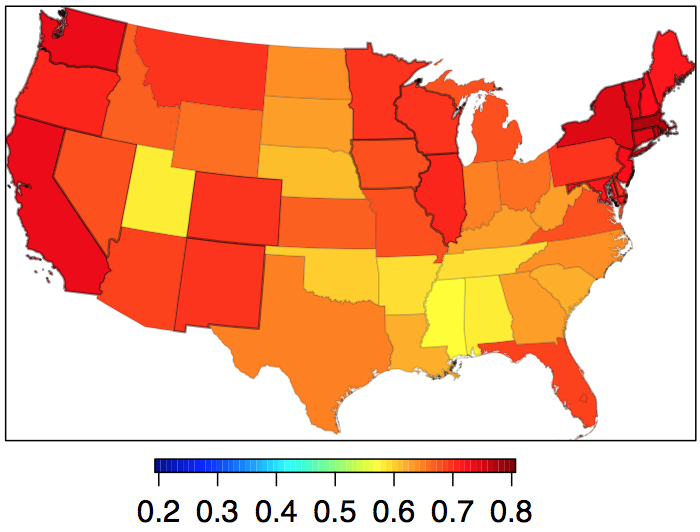
Jeff Lax and Justin Phillips post the above chart, which shows state-by state support for ENDA:

Will ENDA receive the necessary votes? If senators listened to their constituents, the bill would pass overwhelmingly.

Nearly all recent opinion polls indicate that a large majority of the American public — more than 70 percent — supports efforts to make employment discrimination against gay men and and lesbians illegal. Of course, these national numbers are not what the senators are likely to care about. However, when we use national polls to estimate opinion by state, we find that majorities in all 50 states support ENDA-like legislation (note that in 1996, majorities in only 36 states supported ENDA). Today, public support ranges from a low of 63 percent in Mississippi to a high of 81 percent in Massachusetts.

But Mark Joseph Stern is unsure whether the current bill is worth passing:

No version of ENDA has been perfect. In its 2007 iteration, the bill tossed out transgender protections, leading to some truly idiotic in-fighting among gay-rights groups. This time around, the problem isn’t transphobia (yet); it’s religious liberty. The bill’s religious-exemption provision includes the usual exceptions for houses of worship and religious groups. But it also includes a startlingly broad exemption for religiously affiliated organizations that, for whatever ostensibly religious reason, dislike trans or gay people.

That exemption, designed to attract moderate Republicans’ votes, is less of a loophole than it is a blank check for blanket discrimination. Several gay-rights groups have already hoisted a red flag over the religious-liberty provision, noting that they give a “stamp of legitimacy” to anti-LGBT discrimination. They’ve noted, too, that the battle cry of “religious liberty” also mirrors conservatives’ blatantly racist attempts to slip similar exemptions into the civil rights bills of the 1960s and ’70s.

I outlined the case against ENDA last night. Unlike Stern, I favor maximal religious liberty in these cases – and maximal publicity when a gay person is fired merely for being gay.

Blumenthal vs Alterman

I haven’t managed to read Max Blumenthal’s controversial new book, Goliath, based on his reporting in Israel and the West Bank. But one reason to pick it up is the lazy hatchet job performed on it by one of the more egregiously nasty writers in America, Eric Alterman. Alterman’s critique can be read here, titled “The ‘I Hate Israel’ Handbook”, and here. I urge you to read both. Money quote:

It is no exaggeration to say that this book could have been published by the Hamas Book-of-the-Month Club (if it existed) without a single word change once it’s translated into Arabic. (Though to be fair, Blumenthal should probably add some anti-female, anti-gay arguments for that.) Goliath is a propaganda tract, not an argument as it does not even consider alternative explanations for the anti-Israel conclusions it reaches on every page.

The reason I urge you to read it all is because it’s essential background for Blumenthal’s response. It’s always a joy to see a smear artist exposed, trick by trick, con by con – and Max is relentless. To wit:

Alterman carps about the titles of several chapters in my book, claiming they were “titled to imply an equivalence between Israel and Nazi Germany.” He did not bother address the substance of the chapters, which explains the titles. The chapter titled, “How To Kill 51-jsDj2gPL._SY344_BO1,204,203,200_Goyim and Influence People” detailed a Jerusalem conference of prominent state-funded Israeli rabbis who had gathered to defend the publication of Torat Ha’Melech, a book published by their rabbinical colleagues that the Israeli paper Maariv described as “230 pages on the laws concerning the killing of non-Jews, a kind of guidebook for anyone who ponders the question of if and when it is permissible to take the life of a non-Jew.” (Among the book’s lowlights: “There is justification for killing babies if it is clear that they will grow up to harm us…”)

My chapters titled “The Night of Broken Glass” and “The Concentration Camp” detail the officially sanctioned campaign of racist incitement and violence against Israel’s population of non-Jewish African asylum seekers. The former chapter described events leading up to the night of May 23, 2012, when, after an anti-African rally headlined by leading officials from the ruling Likud Party, in which Africans were described from the stage as “a cancer,” hundreds of Jewish Israelis rampaged through African-inhabited areas of South Tel Aviv, attacking their homes and cars and literally smashing the glass of their storefront windows. “I am as afraid to live in the Israel of 2012 as any right-minded German should have been in 1938,” Aliyana Traison, the deputy editor of Haaretz, wrote at the time.

For good measure, Alterman concedes that the book is “mostly technically accurate.” I hate the bullying tactics of those suppressing a discussion of difficult subjects, so am glad to note that Blumenthal himself is not the only one shocked by the shoddiness of Alterman’s smear:

Other writers have already carefully deconstructed his tangled mess of factual errors and deceptive claims: Phan Nguyen, Corey Robin, Ali Gharib, Ira Glunts and Charles Manekin.

I’d particularly recommend Corey Robin’s dissection of Alterman’s account of Blumenthal’s conversation with David Grossman, the legendary liberal Zionist. It’s both a thorough debunking of Alterman but also a disturbing revelation about what has happened to Israel, and why it matters.

Republicans Don’t Support Replacing Obamacare

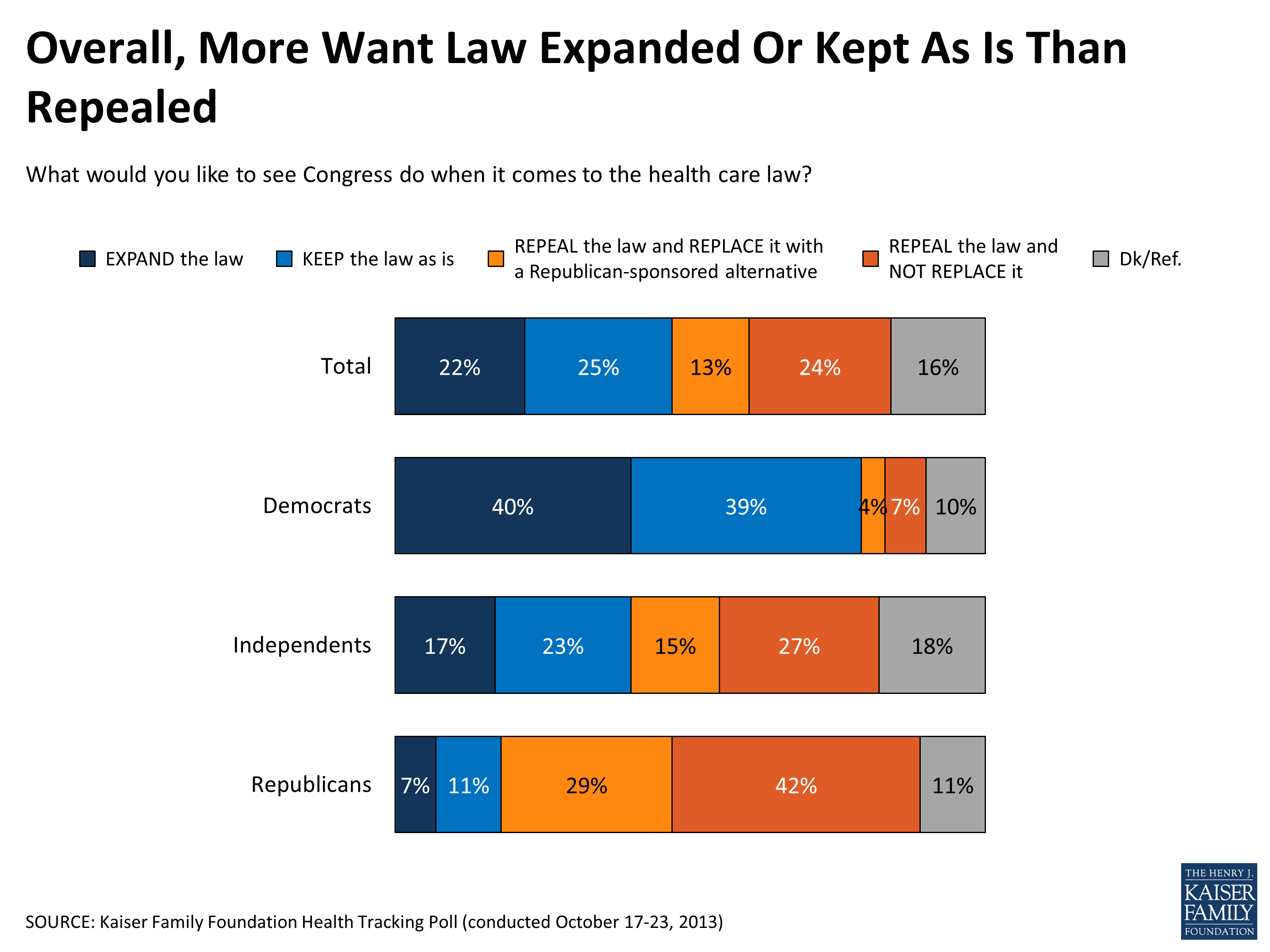
Kaiser checks in on public opinion:

Repeal Or Replace

Barro points out that only “29% of Republicans favor replacing Obamacare with a Republican alternative to Obamacare”:

Republicans spent the last two election cycles hammering Democrats for cutting Medicare. Now they are hammering the president for not letting everyone keep their old plans if they like them. The de-facto Republican health policy platform is a defense of the pre-Obamacare status quo, period, and Republican base voters are with them.

But Jonathan Bernstein argues that going back to the old system isn’t an option:

No one is ever going to kick young adults off their parents’ insurance (or change the law so that insurance companies are allowed to do it). No one is going to bring back the various limitations in pre-ACA insurance policies. Some trimming of the new Medicaid rolls might be possible. But no one — no politician who has to face reelection, at least – is going to just toss all those people off their insurance with nothing to replace it.

Beyond all this is simply the Humpty Dumpty-ness of the situation: The old system has been slowly pushed off the wall for three years now, and by this point it’s really beyond repair, whatever the merits or politics of the situation.

Kilgore chimes in:

I won’t go as far as Jonathan and say that the idea of repealing Obamacare is “dead.” His recitation of what no politician with a brain would do reminds me a lot of all those confident predictions (not by him, but by many others) that no state political leadership would be stupid or benighted or ideological enough to turn down the Medicaid expansion. And there’s also the possibility that Republicans, if they were in a position to do so, would repeal Obamacare and then quickly re-enact some of the easier and more popular provisions, like the provision allowing young adults to stay on their parents’ policies.

Quote For The Day

“So our animals can’t turn around for the 2.5 years that they are in the stalls producing piglets. I don’t know who asked the sow if she wanted to turn around…. The only real measure of their well-being we have is the number of piglets per birth, and that’s at an all-time high,” – Dave Warner, spokesman for the The National Pork Producers Council, in 2012.  For video of what is being done to these animals, see my earlier post here.

Can Christie Expand The Map?

I think he’s easily the most formidable GOP candidate for 2016 – on paper. Reviewing the GOP’s presidential hopefuls, a “plugged-in Republican consultant” ranks Christie #1:

Christie is in the 1 slot now and forevermore — he’s about to get huge margins in his historic reelection in a blue state –he’s the successful model for our Party (from a political perspective) and his governing success is exactly what our country needs from a fiscal perspective. He can compete in about 40 of 50 states. Who else can do that AND run as a conservative? No one.

Bouie notes that Christie is winning an impressive share of the black vote:

This isn’t a small thing; a nominee who can return the GOP to its historic performance with African American voters and other minorities, is a Christie who has done substantial damage to Democratic chances. Without the near unanimous support of blacks, Democrats have a much harder time in newly purple states like Virginia and North Carolina, as well as large swing states like Ohio and Florida.

Freedlander points out that Christie is also doing well with Latino voters. But:

Christie’s strong showing in New Jersey among Hispanics may not be enough to convince Republican bigwigs that he can do the same thing nationwide. For one thing, the Hispanic population in New Jersey, while large and diverse, is not representative of the population in the rest of the country. Only Florida boosts more Cuban-American voters, a constituency that has traditionally voted Republican (One of New Jersey’s U.S. Senators, Robert Menendez, is Cuban-American.) In 2009, Christie eked out a slight win against incumbent governor Jon Corzine and still garnered 32 percent of the Hispanic vote. For him to show broad appeal to Latinos nationwide he may have to do better than the 40 percent he is currently polling among Latinos against weak Democratic opposition.

Barro’s bottom line:

Christie’s pitch to national Republicans is that he can hold that coalition together and rocket way past 47% of the vote. The only question is whether Republicans care enough about winning to take him up on it.