All The President’s Poets

On the 50th anniversary of JFK’s assassination, Adam Gopnik looks back at the way American literati mourned his death:

John Berryman wrote a “Formal Elegy” for the President (“Yes. it looks like wilderness”); Auden an “Elegy for J.F.K.,” originally accompanied by twelve-tone music by Stravinsky. Robert Lowell—who in the Second World War had gone to prison as a conscientious objector, and in the late sixties became a Pentagon-bashing radical hero—wrote to Elizabeth Bishop that the murder left him “weeping through the first afternoon,” and then “three days of television uninterrupted by advertising till the grand, almost unbearable funeral.” The country, he said, “went through a moment of terror and passionate chaos.” Lowell’s friend and fellow-poet Randall Jarrell called it the “saddest” public event that he could remember. Jarrell tried to write an elegy but could get no further than “The shining brown head.”

The death of J.F.K. marked the last time the highbrow reaches of the American imagination were complicit in the dignity of the Presidency. In Norman Mailer’s “Presidential Papers,” published the month Kennedy died, the point is that there was a “fissure in the national psyche,” a divide between the passionate inner life of America and its conformist, repressed official life: “The life of politics and the life of myth had diverged too far.” For Mailer, Kennedy’s Presidency supplied the hope of an epiphany wherein the romantic-hero President would somehow lead his people on an “existential” quest to heal this breach. It sounded just as ridiculous then, but there was something gorgeous in the absurdity.

Caption for the above video:

It was a cold and sunny day in 1961 [during JFK’s inauguration] and the 87 year old Robert Frost could not read his poem, “Dedication”, that he wrote in honor of this special day for he was blinded by the bright sun. He fumpered on the podium because he could not see it and did not know it well. Richard Nixon came and held his top hat to block the sun for Mr.Frost who was extremely old and having problems. Instead, he recited from memory an oft requested poem, “The Gift Outright.”

A Dishonest Environment

We are tempted to cheat by the smallest things around us:

As it turns out, almost anyone will cheat when given even minor, consciously imperceptible behavioral cues. For instance, in a series of three experiments, a group of psychologists found that lighting could affect cheating. In one study, participants in a dimly-lit room cheated more often than those in a lighter one. While both groups performed equally well on a set of math problems, students in the darker room self-reported that they correctly solved, on average, four more problems than the other group—earning $1.85 more as a result, since they were being paid for each correct answer. The authors suggested that the darkness created an “illusory anonymity”: even though you aren’t actually more anonymous in the dark than in the light, you feel as though you are, making you more likely to engage in behaviors you otherwise wouldn’t. Similar effects have been observed with a variety of situational factors that don’t seem directly related to cheating. We cheat more, for instance, when we’re in a messy environment—one that has more signs of socially deviant behavior, like litter, graffiti, and other rubble.

Previous Dish on cheating here, here and here.

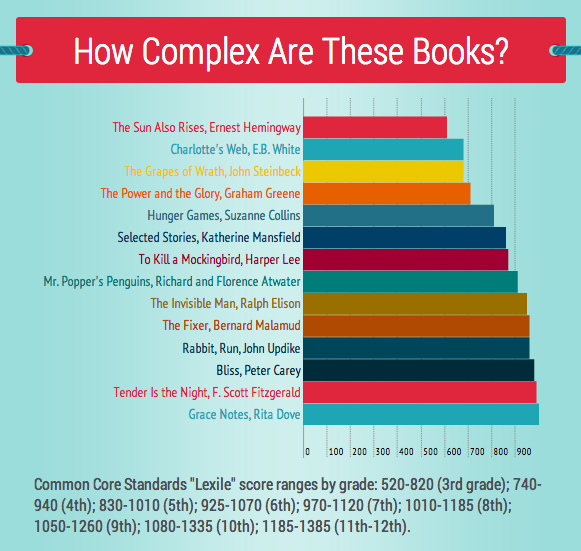
Fifth Grade Is Too Late For Steinbeck?

Screen Shot 2013-11-01 at 7.56.04 PM

According to English professor Blaine Greteman, this seemingly bonkers system of rating “text complexity” is coming to a school district near you:

Lexiles were developed in the 1980s by Malbert Smith and A. Jackson Stenner, the President and CEO of the MetaMetrics corporation, who decided that education, unlike science, lacked “what philosophers of science call unification of measurement,” and aimed to demonstrate that “common scales, like Fahrenheit and Celsius, could be built for reading.” Their final product is a proprietary algorithm that analyzes sentence length and vocabulary to assign a “Lexile” score from 0 to over 1,600 for the most complex texts. And now the new Common Core State Standards, the U.S. education initiative that aims to standardize school curricula, have adopted Lexiles to determine what books are appropriate for students in each grade level. Publishers have also taken note: more than 200 now submit their books for measurement, and various apps and websites match students precisely to books on their personal Lexile level.

Any attempt to quantify literary complexity surely mistakes the fundamental experience of literature.

No one has described that experience better than William Empson, whose Seven Types of Ambiguity wrote the book on literary complexity. A mathematician by training, Empson was no touchy-feely humanist, but he understood that the greatest literary language rarely made “a parade of its complexity.” He particularly admired Shakespeare’s description of trees as “Bare ruined choirs, where late the sweet birds sang,” which he explained contained “no pun, double syntax, or dubiety of feeling”:

but the comparison holds for many reasons; because ruined monastery choirs are places in which to sing, because they involve sitting in a row, because they are made of wood, are carved into knots and so forth…. These reasons, and many more relating the simile to its place in the Sonnet, must all combine to give the line its beauty, and there is a sort of ambiguity in not knowing which of them to hold most clearly in mind.

I try to teach my students to balance such complexities. But many of the smartest and best have learned the Lexile model too well. They’ve long been rewarded for getting “the point” of language that makes “a parade of its complexity,” and they’ve not been shown that our capacity to manage ambiguity without reducing it enables us to be thinkers rather than mere ideologues.

Update from a reader:

I get it, assigning numbers to books seems silly, especially when it leads to conclusions like Mr. Popper’s Penguins is “more complex” than The Grapes of Wrath. The lexile may be a perfectly good way to score “complexity” as it’s narrowly defined here. “Complexity” is just one criterion to consider when choosing books to assign to students. I doubt if any of the folks associated with the Common Core would claim that the lexile measures literary value. And to be clear, I think it’s foolhardy to have rigid rules that assign only books with certain lexiles to certain grades.

Upon graduating from high school, a student should be able to parse a simple contract or legal document. This can be tougher than reading Hemingway – and certainly a lot less pleasurable, and of less artistic value. But when choosing books for students to read, why not consider a book’s complexity, especially when there are other pedagogical goals besides the appreciation of literature?

The Best Time To Drink Coffee

Probably not when you first wake up:

[I]f we are drinking caffeine at a time when your cortisol concentration in the blood is at its peak, you probably should not be drinking it. This is because cortisol production is strongly related to your level of alertness and it just so happens that cortisol peaks for your 24-hour rhythm between 8 a.m. and 9 a.m. on average (Debono et al., 2009). Therefore, you are drinking caffeine at a time when you are already approaching your maximal level of alertness naturally. …

Although your cortisol levels peak between 8 a.m. and 9 a.m., there are a few other times where–on average–blood levels peak again, like between noon and 1 p.m., and between 5:30 p.m. and 6:30 p.m. In the morning then, your coffee will probably be the most effective if you enjoy it between 9:30 a.m. and 11:30 a.m., when your cortisol levels are dropping before the next spike.

The Best Of The Dish This Weekend

Protest in Gaza against power cuts

Some arguments: that Thomas Aquinas was smarter than the New Atheists; that friendship with dogs is all about our shared “spiritedness“; that Rudyard Kipling was more readable than Virginia Woolf; that the Employment Non-Discrimination Act is worth a libertarian critique.

Some beauty: a poem called “X”; an animation triumph; the elders of burlesque.

Leon Wieseltier was meretriciously nasty again; and Richard Rodriguez gave a simple definition of Christian faith in his spiritual memoir, “Darling”:

My brother is no less a good man for not believing in God; and I am no better a man because I believe. It is simply that religion gives me a sense – no, not a sense, a reason – why everyone matters.

Three words: Japanese cunnilingual octopodes (NSFW).

The most popular post of the weekend was “New York, I Love You, But …” followed by New York Shitty.

See you in the morning. And if you want to make the new House ads go away, just [tinypass_offer text=”subscribe”] and the clean, simple Dish you’re used to will be yours for ever. [tinypass_offer text=”Subscribe now!”] and help me stop blegging.

(Photo: A Palestinian boy holds a candle during a protest against power cuts on November 3, 2013 in Gaza City. Gaza’s lone power plant shut its generators on Friday due to a fuel shortage, a move that will likely increase already long blackout hours in the impoverished coastal territory. By Ashraf Amra/Anadolu Agency/Getty Images.)

House Ads And Thanks

We let readers know about incoming House ads for the first time, phasing in this weekend. If you missed the post, here it is.  If you’re a Screen Shot 2013-11-03 at 9.29.31 PMsubscriber, you won’t have seen them – and if you have, remember to log in to make them go away. Special thanks to Special Teams Chas and the crew at Ten Up, for making this possible and putting up with my meddling. So far so great: $3,400 in new subscriptions in our slowest period of the week, which is three times the total of last weekend. We’re now at 31,024 subscribers, $794,000 in gross revenue –  and gaining. Our conversion rate of readers to subscribers went from an average of 2.5 percent to over 6 percent in a day. We might make our goal of $900K if we keep this up.

For subscribers, I thought you’d like to see what some of the ads looked like, because we had a little fun with them. My personal fave:

Screen Shot 2013-11-03 at 8.57.50 PM

That should make the CNN Green Room a little awkward – but hey, prove him wrong! [tinypass_offer text=”Subscribe”]!

Quote For The Day

“I realize now that my prejudices against conservatives were, in many ways, just as uncompromising as the prejudices I’d often projected onto them. They were just people. Not issues. Not votes. People whose daughters go to school with my daughters, whose dogs run away and come back and run away again, whose hands found my shoulders and who didn’t judge, the night I wept over a friend who had taken her own life,” – David James Poissant.

We can talk and bitch and whine and moan about polarization but why not start with ourselves? As I discovered in the decades fighting for gay equality, nothing is more powerful than entering into conversation with someone you fear or dehumanize for their views. If readers have their own stories to tell – not family but friend stories – we’d love to hear from you about bridging the gap. That goes for Republicans engaging Democrats as well, of course. And it also goes for myself.

A Double-Down Cameo

From Heilemann and Halperin’s book on the 2012 campaign and that first debate:

As the full desultoriness of his Denver performance sank in, the president was consumed by a sense of responsibility—and shadowed by fears that his reelection was at risk. Outwardly, he took pains to project the opposite. When his staffers asked how he was doing, he replied, “I’m great.” To Plouffe, who had volunteered to soothe Sullivan, Obama joked, Someone’s gotta talk him off the ledge!

How many times has Plouffe tried to talk me off the ledge? I think twice. But they were texting me that night to tell me to calm the fuck down. For the record, here’s my actual meltdown as it happened. I still don’t think was wrong about his performance that night, as H&H acknowledge. I was wrong about Obama’s ability to bounce back. That’s worth remembering amid his current travails.

The Case Against ENDA

No Child Left Behind

The federal bill banning workplace discrimination against gays, lesbians and transgenders is up for a vote tomorrow. Gay dad Wally Olson makes the case against it – and perhaps his strongest point is on whether it will ever be used:

Statistics from the many states and municipalities that have passed similar bills (“mini-ENDAs”) indicate that they do not serve in practice as a basis for litigation as often as one might expect. This may arise from the simple circumstance that most employees with other options prefer to move on rather than sue when an employment relationship turns unsatisfactory, all the more so if suing might require rehashing details of their personal life in a grueling, protracted, and public process.

To take a similar point on the federal hate crimes law, since it was passed in 2009, there have been two successful prosecutions under the act for anti-gay bias, so far as I can find. One was in March, 2012, in Kentucky, and the second was in Georgia last June. It may well be that neither would have been pursued without the federal law, but still. If I’ve missed any, please let me know. But two successful prosecutions in four years does not suggest a problem so vast that the federal government must be involved. If you care at all about economic liberty, it seems to me you virtually-normalhave to weigh the costs as well as the benefits.
At the same time, the private sector has forged ahead of government, acting rationally to get the best set of employees possible. The Human Rights Campaign annual report (pdf) on voluntary corporate anti-discrimination policies gives us the latest: 88 percent of Fortune 500 companies have non-discrimination policies with respect to homosexuality, and 57 percent also include gender identity in their policies. The progress in the private sector over the last ten years has been remarkable, and HRC can rightly feel proud of their work engaging corporations. But that, of course, suggests that government itself may not be the best way to protect gay employees.

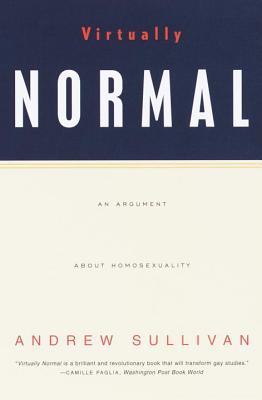
I used to be opposed tout court to such laws on libertarian grounds (and not just for gays but for everyone apart from those subjected to the unique historical burden of slavery and segregation). Virtually Normal also makes the case that the government has no right to compel private citizens not to discriminate against gays when it discriminated so perniciously against gays in civil marriage and military service. But two things have changed my mind over the years.

The first, quite simply, is that the libertarian position on such crimes is largely moot – for good and ill. The sheer weight of anti-discrimination law is so heavy and so entrenched in our legal culture and practice, no conservative would seek to abolish it. It won’t happen. And if such laws exist, and are integral to our legal understanding of minority rights, then to deny protection to one specific minority (which is very often the target of discrimination) while including so many others, becomes bizarre at best, and bigoted at worst. Leaving gays out sends a message, given the full legal context, that they don’t qualify for discrimination protection, while African-Americans and Jews and Catholics and Latinos and almost everyone else is covered by such protections. It’s foolish to stick to a principle, however sincere, in the face of this reality.

Secondly, the federal government has ceased its own discrimination policies in marriage and military service and therefore now has some small sliver of moral standing to lecture private individuals across all states. My objections twenty years ago are now moot.

Put those two developments together and I would not vote against ENDA if I, God help us, were a Senator. But I would vote for it with my eyes open. I don’t think it will make much difference in reality just as I don’t believe hate crime laws make much difference in reality. Of course that’s an empirical question and I promise readers horrified by my luke-warm support of this that I will gladly recant such skepticism if ENDA truly does lead to a flurry of successful suits across the country against anti-gay bias.

But to me, this feels a lot like a) an easy concession to Gay Inc. which has devoted almost its entire existence to this bill, b) an easy vote for a Republican trying to hold onto a marginal seat, c) an even easier way for Democrats to grandstand on the issue, even though it stands a snowball’s chance in Hell of getting through the current House. So I hope it passes. But forgive me for not cheering it on.

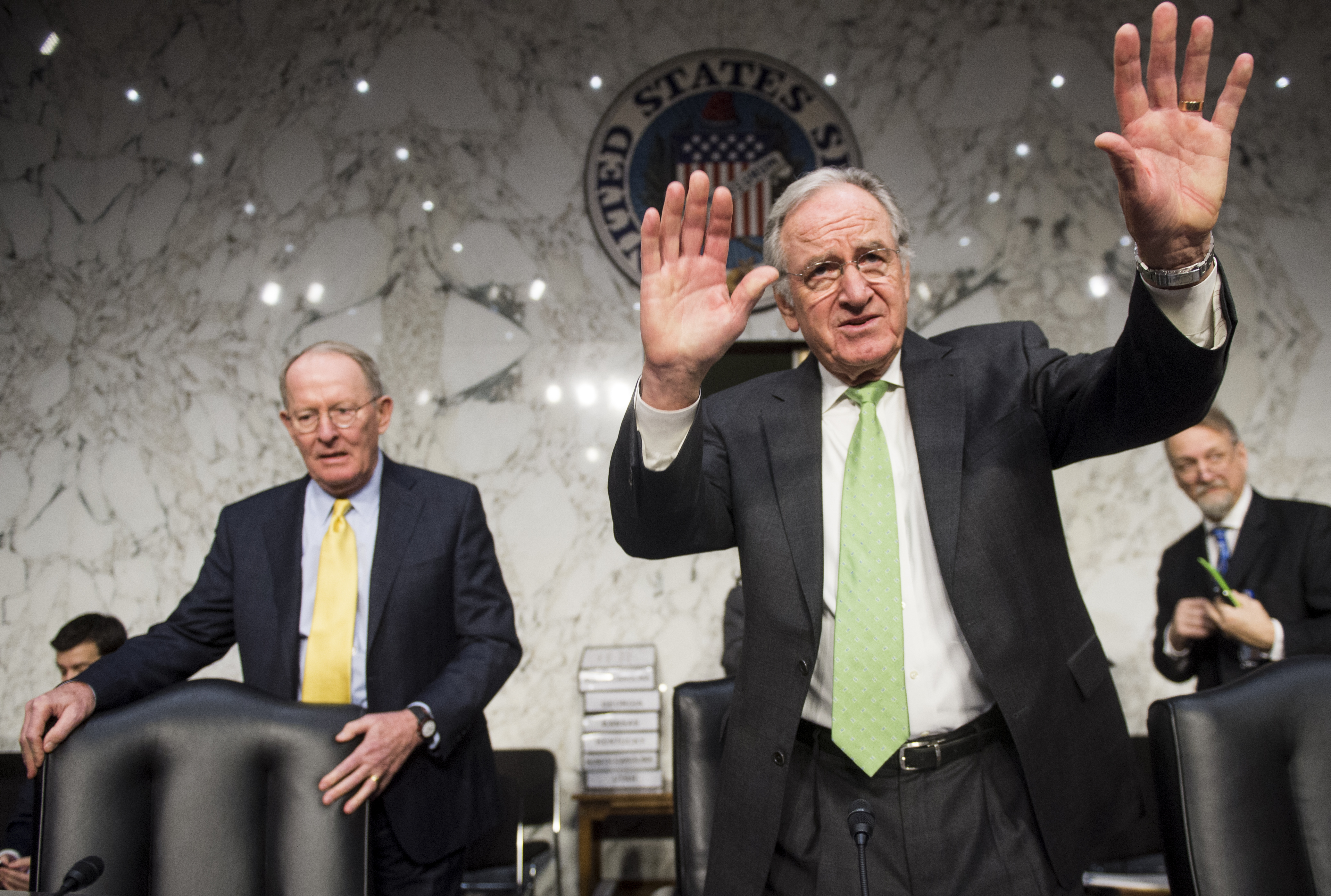
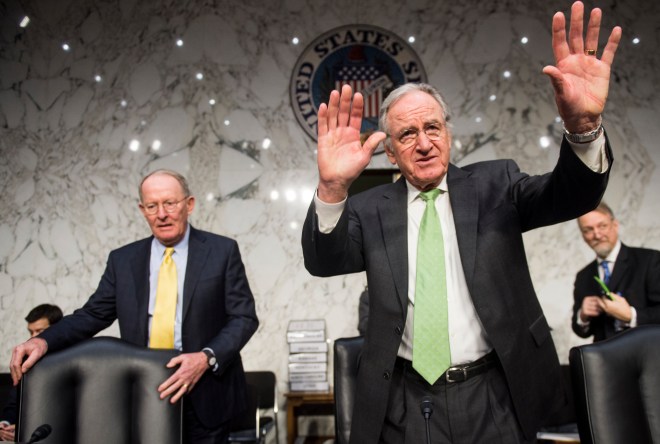
(Photo: Chairman Tom Harkin, D-Iowa, right, tries to quiet a CodePink protester calling for passage of the Employment Non-Discrimination Act on Thursday, Feb. 7, 2013. Sen. Lamar Alexander, R-Tenn., left, takes his seat. By Bill Clark/CQ Roll Call.)
Another Rogue Cop In The Drug War

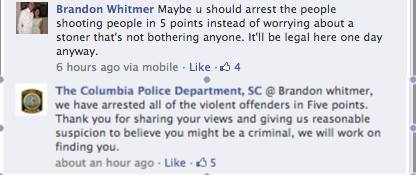
After arresting one man for possessing $40,000 worth of weed in his home, Columbia, South Carolina’s interim police chief got a little blowback from marijuana activists online. Fair enough – the to and fro of public debate. Until we get this on Facebook:

Santiago-1So someone expressing a pro-weed opinion gives the cops “reasonable suspicion” for a raid against him as well. Until we get rid of this ridiculous Prohibition, more of this kind of bullshit will continue.