Thomas Aquinas vs The New Atheists

Robert Barron argues that the God of the great Christian philosopher isn’t the one the New Atheists try to debunk:

[T]he new atheists hold that God is some being in the world, the maximum instance, if you want, of the category of “being.” But this is precisely what Aquinas and serious thinkers in all of the great theistic traditions hold that God is not. Thomas explicitly states that God is not in any genus, including that most generic genus of all, namely being. He is not one thing or individual — however supreme — among many. Rather, God is, in Aquinas’s pithy Latin phrase, esse ipsum subsistens, the sheer act of being itself.

It might be helpful here to distinguish God from the gods. For the ancient Greeks and Romans, for example, the gods were exalted, immortal, and especially powerful versions of ordinary human beings. They were, if you will, quantitatively but not qualitatively different from regular people. They were impressive denizens of the natural world, but they were not, strictly speaking, supernatural. But God is not a supreme item within the universe or alongside of it; rather, God is the sheer ocean of being from whose fullness the universe in its entirety exists.

It is absolutely right to say that the advance of the modern physical sciences has eliminated the gods. Having explored the depths of the oceans and the tops of the mountains and even the skies that surround the planet, we have not encountered any of these supreme beings. Furthermore, the myriad natural causes, uncovered by physics, chemistry, biology, etc. are more than sufficient to explain any of the phenomena within the natural realm. But the physical sciences, no matter how advanced they might become, can never eliminate God, for God is not a being within the natural order. Instead, he is the reason why there is that nexus of conditioned causes that we call nature — at all.

Quote For The Day

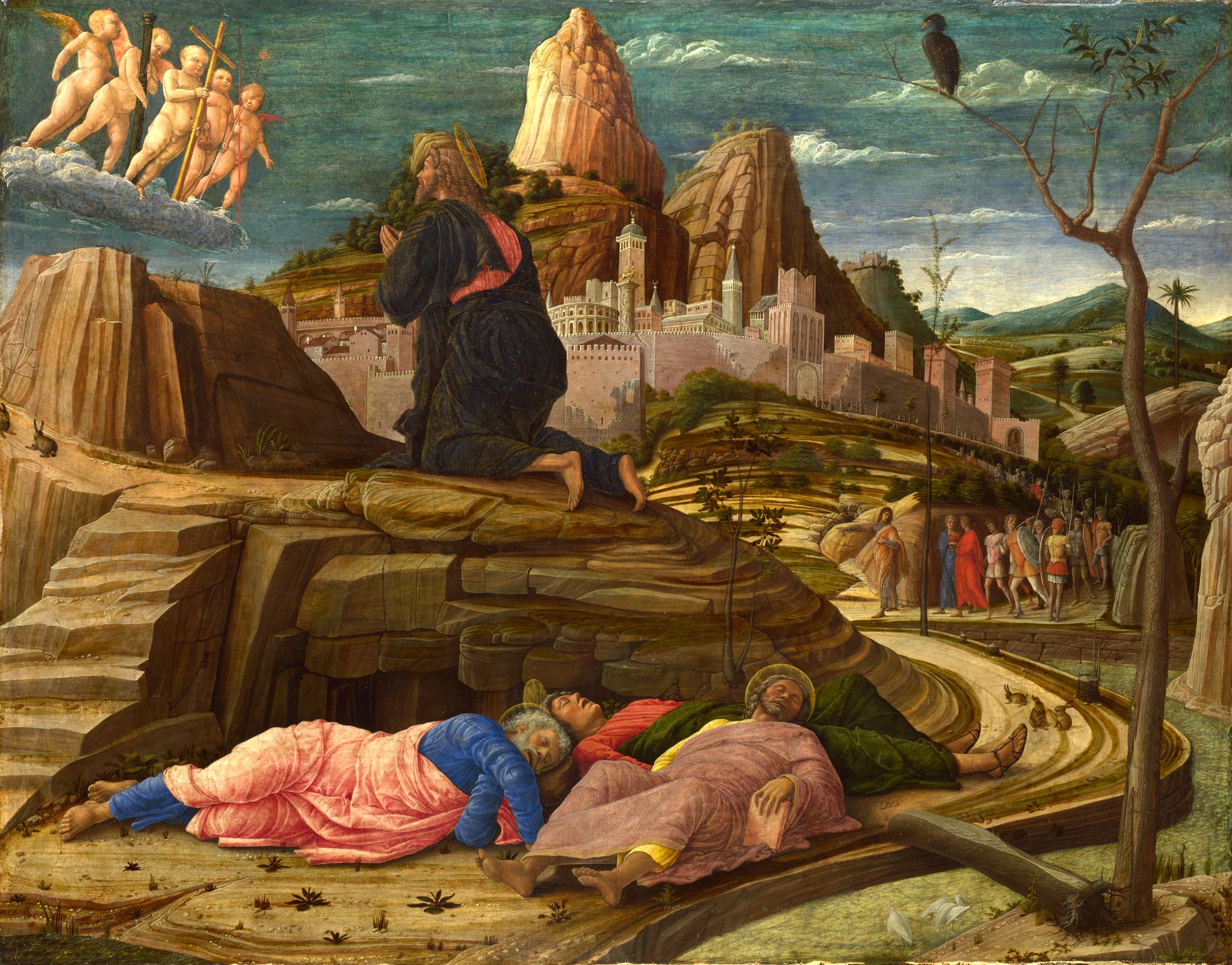
Agony_in_the_Garden

“We ought not to be surprised or wrongfooted if in our prayers we do not have the feeling that we are simply talking to another person just like us. If we are somehow included in Christ’s relation to God the Father, it will not be as if we were relating to an individual on the other side of the room. Something is going on that is deeper than that, but no less personal, no less a real relationship, but something that doesn’t depend entirely on how we feel and what we think: a pouring-in of God’s love that will steadily transform us from inside. We are growing into mature life — growing into a grateful and secure awareness of ourselves that is always reaching out in what may feel like a blind love and searching for an Other beyond words and ideas, receiving always the influx of gift that makes us what we are, yet normally unable to say quite how this works. Praying in Christ, in the way a writer like St John of the Cross sketches it, is being carried on an invisible current of love that is sometimes discernible to us, but often (painfully) not…

In other words, the path of contemplative prayer is a working out of the whole vision we have been thinking about, the process that the creeds try to codify — moving deeper into trust as we discover what it means to be the object of an eternally trustworthy love. It is the outworking of what Martin Luther and his followers called ‘justification by faith’ — the belief that it is trust that sets you right, not achievement, success, perfomance, but the confidence that something has been shown and shared with us in the history that the Bible records which makes it possible for us to risk putting our hands into the hands of God. And when we pray, that is what we do; we put out our hands, as relaxed and open as we can make them, free, aware, without fantasies and projections, into a darkness that is God’s welcoming touch,” – Rowan Williams, Tokens of Trust: An Introduction to Christian Belief.

(Image of Agony in the Garden, by Andrea Mantegna, 1460, via Wikimedia Commons. The painting portrays Jesus praying in the Garden of Gethsamane, not long before his crucifixion.)

Dumbing Down Religion?

T.M. Luhrman, the Stanford anthropologist, recently published essays sympathetic to the religious practice of “speaking in tongues” and to American evangelicals’ penchant for portraying a “personal, intimate God.” Leon Wieseltier responds with a withering critique, describing Luhrman as “peddling another intellectual argument for anti-intellectualism, another glorification of emotion in a culture enslaved to emotion”:

Luhrmann not only studies tongues, she also endorses tongues: “Speaking in tongues might actually be a more effective way to pray than speaking in ordinary language.” The difficulty is that God cannot be adequately captured in language. Religious thinkers since Philo have been wrestling with the incomprehensibility of any concept of the deity that appropriately honors its sublimity. Luhrmann proposes that we give up and babble. “As a technique,” she explains, “tongues capture the attention but focus it on something meaningless (but understood by the speaker to be divine).” Myself, I would rather my nonsense not be sacred and my sacred not be nonsense. “There’s plenty here to alarm secular liberals,” she writes, invoking the stereotype that is designed to embarrass all skepticism. Actually, there’s plenty here to alarm religious conservatives, too.

Many of the world’s great religious traditions have consecrated themselves to the ideal of spiritual articulateness, and to the discovery of valid propositional content for the substance of faith. All this, for Luhrmann, is only “abstract and intellectual,” when it is merely the natural activity of thinking creatures who seek.

“The role of belief in religion is greatly overstated,” Luhrmann declares, “as anthropologists have long known.” Who gave anthropology the last word? This is like saying that the role of beauty in art is greatly overstated because there is so much ugliness in art. My fellow Americans, there are questions that do not allow of empirical answers! I leave aside the place of ideas in the evangelicism that Luhrmann adores. Are we really suffering from a surfeit of thoughtful belief? Have we been neglecting our felicity? “Secular liberalism,” with its demand for the justification of metaphysical opinions, has more to offer religion than the immediate gratifications of a credulous joyriding.

Luhrmann responds by defending the deeper spiritual meaning of “speaking in tongues”:

Wieseltier himself writes chidingly that “God cannot accurately be captured in language.” That is the point. When those who use a sacred language whose words they do not understand—speaking in tongues, but also chanting or reciting prayers in Hebrew, Arabic or Avestan—those words connect them to a God beyond understanding, a God for whom their words fall short. Many of those who pray in tongues prefer to say that they are “praying in the spirit.” One woman in the American evangelical church I studied told me that when she prayed in the spirit, she felt that she joined an angelic chorus that, most of the time, she could not hear. A woman in Ghana explained that she preferred to pray in tongues because those words had not been sullied by ordinary humans. “I am not communicating with any man.” Praying in this way reminds people that the God they reach for is sacred.

Now, to be honest, did I—raised Unitarian in an orthodox Jewish neighborhood—once think that speaking in tongues was pretty odd? Of course. I grew up moved by the sound of ancient language, but when I first encountered tongues, it seemed like babble. Yet I also think that some of the things I do for my own well-being—running hamster-like on a treadmill while watching figure skating reruns—look pretty peculiar to others, too. That’s the anthropological point. We’re all pretty odd to each other, and at its heart, life is mystery.

A Poem For Sunday

candletablewine

“On Wanting to Tell [               ] about a Girl Eating Fish Eyes” by Mary Szybist:

–how her loose curls float
above the silver fish as she leans in
to pluck its eyes.

You died just hours ago.
Not suddenly, no.  You’d been dying so long
nothing looked like itself: from your window,
fishermen swirled sequins;
fishnets entangled the moon.

Now the dark rain
looks like dark rain.  Only the wine
shimmers with candlelight.  I refill the glasses
as we raise a toast to you
as so-and-so’s daughter—elfin, jittery as a sparrow—
slides into another lap
to eat another pair of slippery eyes
with her soft fingers, fingers rosier each time,
for being chewed a little.

If only I could go to you, revive you.
You must be a little alive still.
I’d like to put the girl in your lap.
She’s almost feverishly warm, and she weighs
hardly anything. I want to show you how
she relishes each eye, to show you
her greed for them.

She is placing one on her tongue,
bright as a polished coin—

What do they taste like?  I ask.
Twisting in my lap, she leans back sleepily.
They taste like eyes, she says.

(From Incarnadine © 2013 by Mary Szybist. Reprinted by kind permission of Graywolf Press. Photo by Andrew Malone)

Why Study Theology?

Tara Isabella Burton offers a defense of the “queen of the sciences”:

While the study of history taught me the story of humanity on a broader scale, the study of theology allowed me insight into the minds and hearts, fears and concerns, of those in circumstances [that] were so wildly different from my own. The difference between whether—as was the case in the Arian controversy of the fourth-century AD—the Godhead should be thought of as powerful first, and loving second, or loving first and powerful second, might seem utterly pedantic in a world where plenty of people see no need to think about God at all. But when scores of people were willing to kill or die to defend such beliefs—hardly a merely historical phenomenon—it’s worth investigating how and why such beliefs infused all aspects of the world of their believers. How does that 12th-century French monk’s view of the nature of God affect the way he sees himself, his relationship with others, his relationship with the natural world, his relationship with his own mortality? How does that Byzantine mystic conceive of space and time in a world he envisions as imbued with the sacred? To find such questions integral to any study of the past is not restricted to those who agree with the answers. To study theology well requires not faith, but empathy.

If history and comparative religion alike offer us perspective on world events from the “outside,” the study of theology offers us a chance to study those same events “from within”: an opportunity to get inside the heads of those whose beliefs and choices shaped so much of our history, and who—in the world outside the ivory tower—still shape plenty of the world today.

Glimmers Of God

This embed is invalid

PBS recently featured Dish favorite Christian Wiman, a poet and essayist, on its Religion & Ethics program. One theme that emerges in the above short video is Wiman’s search for a new, fresh language to describe his encounters with the divine – a search intimately bound up with poetry. In his words:

If you ask me, do I get glimpses of God, yes, I get these glimmerings of intuitions, stronger than that really, where the existence of God seems to me absolute. We all go through our lives and then suddenly we’ll have a moment when we think, I have faith right now in something. I find that I’ve had these moments in my life when I have been overcome by what I only know to call God…

In my experience, the artists that I know, even though they wouldn’t call themselves Christians — some would — but they are the ones who are fighting to remake some kind of language to connect us with the ineffable, with the divine.

If we think that metaphor is how we talk of God, and that seems to me very hard to dispute that there’s any other way of talking to God, talking about God, other than metaphorically, then it would follow that the place where metaphor is most powerfully used, most compressed, most concise, most explosive in poetry would be where we would go to find religious enlightenment.

Previous Dish on Wiman here, here, here, here, and here.

Dispatches From Paradise

Rhys Southan surveys the growing genre of memoirs written by people who claim, through near-death experiences, to have glimpsed heaven and returned to tell the tale.  Southan notices that “[o]ne of the major problems with the heaven-and-back literature, at least for those looking to it for inspiration and hope, is that none of the people who have been there agree about what it’s like”:

One possible conclusion is that none of these people actually went to heaven. Call this the Hitchens/Harris/Challies view. It certainly has an intuitive appeal. For one thing, if they’re all sure they went to heaven, and they know that for instance you can or cannot see God’s face, why aren’t they criticizing the obvious frauds who either couldn’t or could? That they don’t all ferociously debate each other implies insecurities about their own visions.

Another possibility is that only one of them went to heaven, but then who to believe?

My money would be on either [Proof of Heaven author] Eben Alexander or [Waking Up in Heaven author] Crystal McVea. Both of them were skeptics before going to heaven, which makes them somehow more credible than a professional reverend like Oden Hetrick or the pastor’s son Colton Burpo who recounts his trip to heaven with the cold affectless demeanor of a psychopath. … Or it may be that there is no one definitive heaven because heaven is what each of us wants it to be. …

But there is another possible explanation for these inconsistencies that would answer the skeptical Christian’s concern that these books undercut the primacy of faith. Maybe God shows every visitor different heavens and tells them to write about these conflicting characters, activities, and landscapes because he’s up to his old mysteriousness business. Does God want to hint to us that heaven is really real, while teasing our craving for evidence by sending us garbled, contradictory messages about what’s actually there – forcing us to rely on faith again after all? Oh God, you sneaky devil you.

One Strange Bird

Reviewing Kansas City Lightning: The Rise and Times of Charlie Parker by Stanley Crouch, Adam Shatz applauds the surprisingly dark first volume of the biography, writing that “each page is haunted by the demons that brought down the man known as Bird”:

The myth of Charlie Parker is that he was self-taught. In fact, as Crouch writes, he studied with a man named Alonzo Davis, an heir to a tradition of conservatory-trained black teachers who had “tattooed their knowledge on the brain cells of many young musicians who went on to shape the evolution of vernacular Negro American music.” Parker seems to have acquired a rapid—and highly exaggerated—sense of confidence on his horn. He was hardly married when he began to stay out all night in clubs, asking to sit in with local musicians when he only knew how to play “Lazy River” and “Honeysuckle Rose.” …

Parker began to find his voice on the alto, and to learn how to listen and respond “in digital time” to other musicians: the art that, as Crouch emphasizes, lies at the heart of his genius as an improviser. But he also discovered the pleasures that would kill him.

According to Crouch, Parker was first prescribed morphine around 1937, after a car accident in which he broke his ribs. A few months after [his wife] Rebecca became pregnant with their son Leon, he invited her to watch as he inserted a needle in his arm, then left for the night. That scene, chillingly described by Crouch, left Rebecca in little doubt about where his loyalties stood. Soon afterward she found a letter from another woman under his pillow; he asked her to return it at gunpoint. He gave her crabs and stole from her. When she miscarried their second child, he flushed it down the toilet. The family doctor told her that if he continued to use heroin, he would live no more than eighteen to twenty years: an accurate prediction.

Back in March, Mike Springer dug up the above video, “the only [known sound film] of him playing live, rather than synching to a prerecorded track”:

The performance is from a February 24, 1952 broadcast on the pioneering DuMont Television Network. The full segment begins with a brief ceremony in which Parker and [Dizzie] Gillespie receive awards from Down Beat magazine, but the clip above cuts straight to the music: a performance of the bebop standard “Hot House,” composed by Tad Dameron around the harmonic structure of Cole Porter’s “What Is This Thing Called Love?”

Update from a reader:

The quote you ran about Charlie Parker’s heroin use made it sound (eventually) recreational. But that’s not my understanding. As per this link, his drug use wasn’t merely subsequent to breaking some ribs, but following a spine injury. I have a spine disease which can, at times, be quite painful. I can easily sympathize with some one who tries to manage his pain with whatever drug, and find condemnation of that management to stem from a lack of comprehension of the challenges that real chronic pain can present.

Imagine having teeth continually pulled without anesthetic. Now try to play an instrument or do math or do anything that requires concentration while enduring that pain. If Parker required heroin to do what he did, hats off to him. He changed the world.

Pioneers Of Sexology, Ctd

In light of the recently revived interest in sexologists William Masters and Virginia Johnson – subjects of Showtime’s new series Masters of Sex – Jesse Bering calls attention to lesser-known sex researchers, such as Kurt Freund:

A prodigious theorist and researcher, Freund’s main claim to fame was his invention of the erection-detection machine (otherwise known as the “penile plethysmograph”). … In the early 1950s, Freund—a Holocaust survivor who’d somehow managed to avoid being deported to the concentration camps altogether during the Nazi occupation—was approached for help with a queer sort of problem by the Czechoslovakian army. Straight recruits were pretending to be gay to avoid their compulsory military service. It occurred to Freund that a soldier’s single dumb erection to a pretty naked lady, or the lack of one thereof, would betray his hidden sexual orientation. The specifics have gotten more complicated in the decades since his original erection-detection machine was patented, but the basics of the procedure have remained largely the same:

A man sits down in a chair, his penis is connected to an erection gauge that can pick up very subtle changes in penile tumescence (it’s so sensitive that it can detect a blood-volume increase of less than one cubic centimeter, which most men wouldn’t even experience consciously), and he’s then shown randomized images of nude models representing distinct erotic categories. The scientist, meanwhile, measures what’s happening with the man’s own equipment as these photographs appear.

A far cry from its initial purpose, Freund’s machine is today used mostly in forensic studies, ascertaining pedophilia in men arrested for sex crimes involving children.

This Octopus Is NSFW

dish_nsfwoctopus

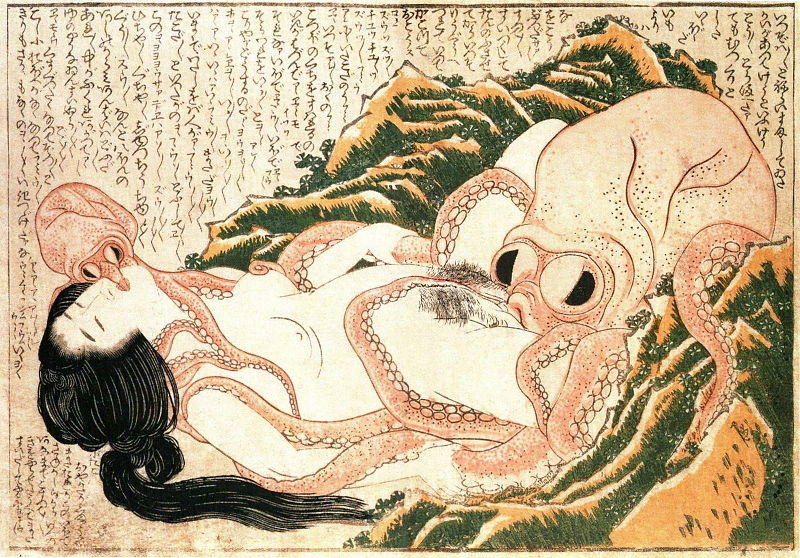
Rachel Nuwer drops some knowledge gleaned from Octopus! The Most Mysterious Creature in the Sea, a new book by Katherine Harmon Courage. She addresses the cephalopods’ allure:

Octopuses, to some, are erotic muses. Japan’s notorious “tentacle erotica” traces back to an 1814 woodblock print (potentially NSFW [pictured above]) titled Tako to Ama, or “Octopus and the Shell Diver.” According to Courage, the image takes inspiration from a legend about a female shell diver who is chased by sea creatures, includ[ing] octopuses, after attracting the eye of a sea dragon god.

For real octopuses, sex is tragic:

Mating and parenthood are brief affairs for octopuses, who die shortly after. The species practices external fertilization. Multiple males either insert their spermatophores directly into a tubular funnel that the female uses to breathe, or else literally hand her the sperm, which she always accepts with one of her right tentacles (researchers do not know why). Afterwards, males wander off to die. As for the females, they can lay up to 400,000 eggs, which they obsessively guard and tend to. Prioritizing their motherly duties, females stop eating. But she doesn’t starve to death–rather, when the eggs hatch, the female’s body turns on her. Her body undertakes a cascade of cellular suicide, starting from the optic glands and rippling outward through her tissues and organs until she dies.

One more money quote:

The plural of octopus is octopuses. The world “octopus” comes from the Greek, októpus, meaning “eight foot.” The word’s Greek roots means it’s pluralized as a Greek word, too, which depends on both a noun’s gender and the last letter it ends with. In this case, an -es is simply tacked on. So no octopi, octopodes or octopussies …

Update from a reader:

I am sure I am only the millionth-or-so Dishhead to point this out, but Rachel Nuwer’s statement about the plural of “octopus” is entirely wrong.  I don’t know how they do things in Greece today, but in classical Greek, the plural of ὀκτώπους is ὀκτώποδες.  The etymologically “correct” plural of octopus is therefore octopodes.  (This is true even if you take the source language as Latin, since like many borrowings from the Greek, octopus was a third-declension noun.) Here is a mildly entertaining Language Log post about the different plurals of “octopus”.

Previous Dish on all things octopus here, here, here, and here.

(Image of Tako to Ama via Wikimedia Commons)