The Spirit Of Faulkner

It’s possible to understand the different sides of the Southern scribe through his choice of drinks:

Kay Boyle wrote in The New Republic in 1938 that there were two Faulkners, “the one who stayed down south and the one who went to war in France and mixed with foreigners and aviators.” The former was elegant, a bit rambly, and “almost ludicrously authentic”; while the latter, inspired by the modernism of Joyce, Eliot, and Stein, was dense, allusive, Guernica-contorted and Guernica-grim, but always (Boyle remarked sharply) “a little awed, a little unsure, provincially aware of the chances he is taking.”

I like to think of these two Faulkners as embodied in his two favorite cocktails: the toddy and the mint julep. The julep is High Faulknerian. Taking in the dense, lush language in his most lauded works—As I Lay Dying, The Sound and the Fury, and Absalom, Absalom!—is precisely like burying one’s nose in a tangle of fresh mint and sipping a strong bourbon. But the other Faulkner, the one who stayed down south, exemplified by the Snopes trilogy and Sanctuary and Light in August, is more like a cold toddy: light, citrusy, superficially graceful, yet deceptively complex.

Faulkner occasionally worked the specific recipes into his fiction:

The key to a toddy, according to Faulkner, is that the sugar must be dissolved into a small amount of water before the whiskey is added, otherwise it “lies in a little intact swirl like sand at the bottom of the glass.” (One of Faulkner’s short stories, “An Error in Chemistry,” hinges on this point: a northern murderer, pretending to be a Southern gentleman, mistakenly mixes sugar with “raw whiskey”; the Southerners recognize his faux pas and immediately pounce on him.) Once the sugar is dissolved, the whiskey is poured over it. Top it off, to taste, with the remaining water—preferably “rainwater from a cistern.”

Previous Dish on Faulkner here, here and here. More on drinking and writing here, here, here and here.

A Filmmaker’s First

Colin Marshall spotlights Memento director Christopher Nolan’s first short film, Doodlebug:

“The depths of insanity are explored by a man chasing something in his apartment with a shoe,” promises the video description of the three-minute Doodlebug. In the center of this shadowy, paranoid tale we have Jeremy Theobald, who would go on to star in Following (and appear as a Gotham Water Board Technician in Batman Begins). Nolan shot it back in his days studying English literature at University College London, a school whose film society he led and which he chose expressly for the availability of its cameras and editing gear. His early, handmade pictures have become even more fascinating to watch in light of his declarations in DGA Quarterly interview that he far prefers shooting in film to shooting digitally, and that 3D technology hasn’t much impressed him. But he hardly disdains spectacle, and the article contains a good deal of talk about how he uses CGI and crafts action sequences.

Over the years, Nolan’s core enthusiasms seemingly haven’t changed; even Doodlebug, especially by student-film standards, has some pretty cool special effects.

Unraveling Roth

Hannah Gersen praises Claudia Roth Pierpont’s Roth Unbound, which is both a study of Philip Roth’s work and a kind of literary biography. Pierpont contends that “for a portrait of what occupied the majority of his time and thoughts — his fiction — I doubt there will be anything more revealing than this volume”:

[O]ne thing that makes Roth Unbound interesting is that Pierpont was able to interview Roth in the first years of his retirement. You can feel Roth’s reflective, relaxed state of mind as he looks back on his career, cataloging his regrets and triumphs. His regrets mostly fall in the realm of his personal life, most significantly his first marriage, which he believes held him back, emotionally and artistically, for most of his late twenties and early thirties, years Roth now views as lost. Another low point occurred in the late nineties, when his ex-wife, Claire Bloom, wrote a memoir that included a scathing account of her marriage to Roth. The memoir had, in Pierpont’s words, “a tremendous effect on Roth’s personal reputation — perhaps more than anything since Portnoy’s Complaint.”

Heller McAlpin notes the costs and benefits of a critique written by a declared admirer:

Pierpont dutifully — and defensively — addresses the accusations of anti-Semitism and misogyny that have shadowed Roth throughout his career, the latter amplified after the 1996 publication of his second wife Claire Bloom’s furious post-divorce memoir, Leaving the Doll’s House.

“It should be clear by now,” she comments, “that Roth, when attacked, prefers to goad rather than retreat: to make mischief, to get adrenaline flowing.” It often seems that he’s fueled by what Mickey Sabbath, his “deliberately abrasive and insanely funny” misanthropic character in Sabbath’s Theater, called the male hormone: “preposterone.”

In her enthusiasm, Pierpont occasionally goes over the top with “not since” pronouncements. “It’s possible that not since Proust has a writer so nearly captured Time,” she writes of Sabbath’s Theater. Or, more broadly: “Not since Henry James, it seems to me, has an American novelist worked at such a sustained pitch of concentration and achievement, book after book after book.” Which leaves me wondering: What about John Updike and Saul Bellow (both of whose relationships with Roth she considers at length)? Not to mention Joyce Carol Oates and E.L. Doctorow.

Cornel Bonca senses Roth hovering over the author’s shoulder, and suggests the book is “part of his attempt to preempt the rough treatment that his controversial career is likely to attract from future biographers”:

Most critical biographies of American writers don’t have the luxury to surge in appreciation toward the end: How many Americans, other than James (and maybe Pynchon?) have such great late periods to celebrate? Even the late novellas — certainly “Everyman” and “Exit Ghost” — have a distilled mastery that show none of the fall-off that’s apparent in, say, Bellow’s late novellas. The reason that Roth stuck with short forms in his last books and then decided to stop writing altogether is suggested in “Exit Ghost” — there [character Nathan] Zuckerman’s memory is so bad that he finds it increasingly tough to keep the details of a fictional narrative in his head, and Roth underlines this with Pierpont. Speaking of his disappointment with Bellow’s “Ravelstein,” he says “It’s hard to write a book at 84. It’s hard to remember from day to day what you’ve done.”

But having stopped writing doesn’t mean Roth is through. As terrific and independent a literary critic as Pierpont is, Roth has got his prints all over this book: In the end it feels like a joint effort to navigate the stormy seas of literary reputation and bring Roth home to the port of The American Canon. It certainly convinces me.

Previous Dish on Roth here, here, and here.

Commemorating Kipling

Patrick Kurp praises Rudyard Kipling, the first English-language writer to receive the Nobel Prize in Literature:

Few writers have known as much as Kipling about life – and books. He was not a university man, never grimly bookish or canon-enslaved, but we still read his translations of Horace. He was no snob, but a democrat of literature. He read like a writer, for sustenance, and he wrote for the reader, to give pleasure. He remains the finest writer of stories in English, and Kim is one of the last century’s best novels by an Englishman, more readable than anything by Virginia Woolf. Kipling’s reading was wide, unsystematic and fruitful. He read like an intelligent boy, not a schoolmaster. … One of the few works of criticism in Kipling’s personal library was Johnson’s Lives of the English Poets, which he claimed to read for the stories, not the critical judgments. In his address to the boys at Wellington [College, in 1912], Kipling says:

“A certain knowledge of the classics is worth having, because it makes you realise that all the world is not like ourselves in all respects, and yet in matters that really touch the inside life of a man, neither the standards nor the game have changed.”

To inhabit lives not our own, to think and feel with another’s sensibility, is bracing, healthy-minded and democratic, and is Kipling’s unspoken assumption as a writer. He befriends his readers, as he does his characters, and doesn’t presume to know what’s best for them.

Kipling’s talk, The Uses of Reading, can be read here.

(Hat tip: Books, Inq)

Dickinson Goes Digital

Casey N. Cep delights in perusing the Emily Dickinson Archive, where, “for the first time since her death, almost all of her poetry, published and unpublished, finished and unfinished, appears together in high-resolution scans”:

Although she wrote 1,789 poems, the Archive includes more than four thousand images: completed poems, but also the drafts and altered versions that reflect her constant dish_dickinson editing and meticulous revisions. Even more material will continue to be added. Never before has the zoom button been so useful: letting us see the very fibers of her paper scraps, the subtle bleed of ink from one side of a page onto another, the creases of bindings and page folds. You can browse by image or by first line and search by date or by recipient. You can press a button and a transcription of the text unfolds to the right of the image. There is even a lexicon, which lets you choose any one of the more than nine thousand words that Dickinson used in her work and then bring up its definition from the very dictionary she used, the 1844 edition of Webster’s. …

Some gimlet-eyed and buttoned-up scholars will rail that real scholarship can still come only from the actual, physical materials Dickinson left behind, but I think they are wrong. The open access archive of Emily Dickinson’s work is hopefully the first of many such online repositories that will allow more of us the opportunity to admire and understand original manuscripts. We have all had the experience of an archive—if not one of a celebrated author, then at least the more important archive of our mother’s attic or our grandfather’s basement—and while dusty hands and allergic sneezes are the traditional badges of such research, the digital archive promises new rewards: annotations and bookmarks, screenshots and downloads.

(Image of an envelope with Dickinson’s writing via the Emily Dickinson Archive)

An Architect Of A.I.

James Somers profiles Douglas Hofstadter, cognitive scientist and author of the Pulitzer Prize-winning Gödel, Escher, Bach: An Eternal Golden Braid, “the bible of artificial intelligence.” Though Hofstadter seemed poised to become a leading figure in AI research after the publication of GEB in 1979, Somers observes that “then AI changed, and Hofstadter didn’t change with it, and for that he all but disappeared”:

He would increasingly find himself out of a mainstream that had embraced a new imperative: to make machines perform in any way possible, with little regard for psychological plausibility. “Very few people are interested in how human intelligence works,” Hofstadter says. “That’s what we’re interested in—what is thinking?” Take Deep Blue, the IBM supercomputer that bested the chess grandmaster Garry Kasparov. Deep Blue won by brute force. For each legal move it could make at a given point in the game, it would consider its opponent’s responses, its own responses to those responses, and so on for six or more steps down the line. With a fast evaluation function, it would calculate a score for each possible position, and then make the move that led to the best score. What allowed Deep Blue to beat the world’s best humans was raw computational power. It could evaluate up to 330 million positions a second, while Kasparov could evaluate only a few dozen before having to make a decision.

Hofstadter wanted to ask: Why conquer a task if there’s no insight to be had from the victory?

“Okay,” he says, “Deep Blue plays very good chess—so what? Does that tell you something about how we play chess? No. Does it tell you about how Kasparov envisions, understands a chessboard?” A brand of AI that didn’t try to answer such questions—however impressive it might have been—was, in Hofstadter’s mind, a diversion. He distanced himself from the field almost as soon as he became a part of it. “To me, as a fledgling AI person,” he says, “it was self-evident that I did not want to get involved in that trickery. It was obvious: I don’t want to be involved in passing off some fancy program’s behavior for intelligence when I know that it has nothing to do with intelligence. And I don’t know why more people aren’t that way.”

Previous Dish on artificial intelligence here, here, and here.

A Poem For Saturday

shower

Recently we’ve posted poems by Frank Bidart and Lucie Brock-Broido, two of the nominees for this year’s National Book Award in Poetry. This weekend, we’ll sample poems by the other three nominees, Matt Rasmussen, Mary Szybist, and Adrian Matejka, so that those who have been reading along might be a bit invested in the outcome when the award is announced on November 20th. Our first selection is “X,” from “Elegy in X Parts” by Matt Rasmussen:

I found a small ring
of your black hair

in the shower.
It could have been

worn like a laurel
by a mole

or hung like a wreath
on death’s tiny door

(From Black Aperture by Matt Rasmussen © 2013 by Matt Rasmussen. Reprinted by permission of Louisiana State University Press. Photo by Phil Roeder)

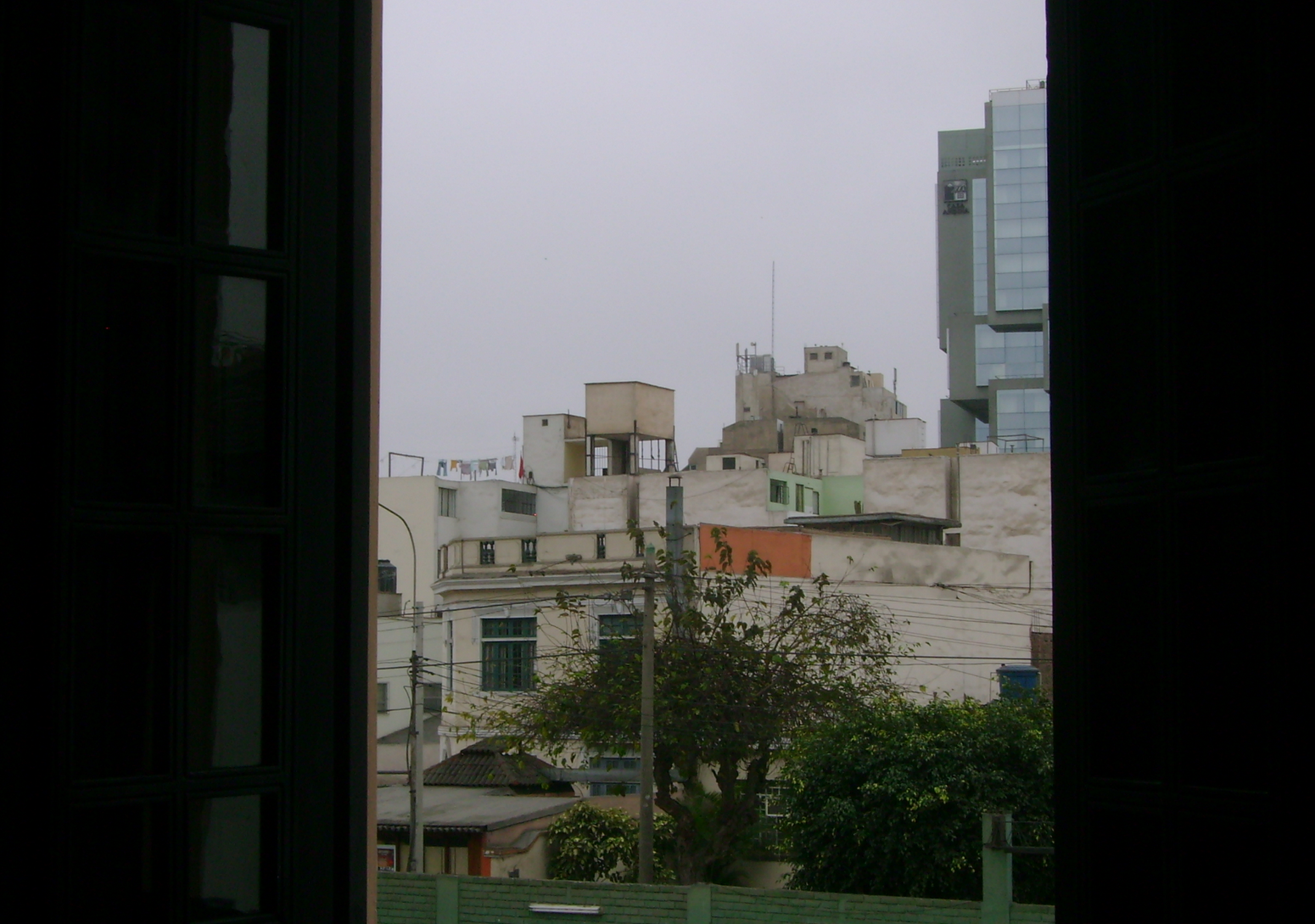
The View From Your Window Contest

vfyw_11-2

You have until noon on Tuesday to guess it. City and/or state first, then country. Please put the location in the subject heading, along with any description within the email. If no one guesses the exact location, proximity counts.  Be sure to email entries to contest@andrewsullivan.com. Winner gets a free The View From Your Window book or two free gift subscriptions to the Dish. Have at it.