The Next Big Drone Market

This embed is invalid


Hollywood:

Drone cinematography is still in its primitive stage. For one thing, the UAVs (unmanned aerial vehicles) don’t have much range (about a mile) and only have enough battery life for 10 to 15 minutes of flight. Plus, the built-in cameras only have 720p resolution, or medium high-definition. (That’s about the quality you might get on a good smartphone.) But the latest drones also come with a camera mount so that they can hoist full HD (1080p) GoPro sports cameras. There’s still the little snag that the Federal Aviation Administration (FAA) does not yet permit private businesses to operate drones in the United States. (Non-commercial filmmakers may use them, but only below 400 feet and in sparsely populated areas.) But the agency will begin issuing drone licenses to businesses by 2015, and Hollywood could be the first set of private users.

The MPAA has already lobbied the FAA for drone privileges.

This Extraordinary Pope, Ctd

It was great that he asked the German Bishop of Bling to take a leave of absence after he spent $40 million on his official residence. But this is even greater:

Yesterday, church officials in Limburg said they were taking their own steps to admonish Bishop Franz Peter Tebartz-van Elst. “The residence is like an inherited sin which the bishop has left in his wake,” said a spokesman for the Caritas organisation for the homeless. “People who seek sanctuary with us could be given food in the residence,” he added. Turning the complex into a refugee centre would follow the practice of a former Limburg bishop who housed a refugee family from Eritrea while he moved into a residence for novice priests.

Isn’t it wonderful to see the teachings of Jesus actually followed by His church?

Will Clinton Campaign On Change?

Clinton Global Initiative Annual Meeting In New York

Chotiner looks at her overall challenges:

Hillary Clinton can’t reinvent herself as an Elizabeth Warren–type populist, and I doubt she will be running against big banks. But she can still run on “change,” channeling a streak of populism and appealing to a disgruntled left-wing of the Democratic Party. Much of the appeal to one’s base is about attitude. Howard Dean’s popularity among the netroots could coexist with his relatively moderate record as governor because he seemed angry. The point isn’t that Clinton is angry; rather, it is that you can appeal to different groups with non-policy related appeals. …

Will Clinton’s new rhetoric succeed? It’s probably smart of her to embark on it relatively early in the campaign, and there is reason to think it will be more effective than it would have been had she tried a similar strategy in 2008. She isn’t currently in government, for starters, and she has four years as Secretary of State behind her. This is the one cabinet job that seems to distance you from petty politics, and may go some way to making her seem like a figure who can rise above the fray.

Good luck with that. With today’s GOP, her ascendance is, alas, likely to drive them almost insane. The trouble for Clinton is that she really has never shown much chops as an actual politician. Her loss to Obama – when she was thirty points ahead for a long time – reveals her lack of instinct for the game. She’s not a good speaker; she’s not that great at schmoozing; and she can be easily rattled. Then there’s the fact that she doesn’t change much. The same clique that surrounded her in the White House still hover around. Exhibit A: this great Ben Smith piece explaining why the Clintons still drive the press and many of their closest friends crazy.

(Photo by Getty)

A Junker Of A Stimulus Program

Cost Per Job

A new paper by Ted Gayer and Emily Parker evaluates the effectiveness of Cash For Clunkers – remember that? Plumer summarizes the key points:

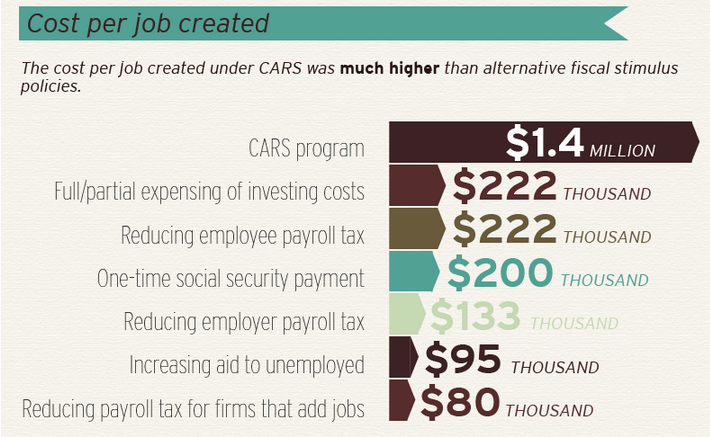
Gayer and Parker estimate that pulling these vehicle sales forward probably boosted GDP by about $2 billion and created around 2,050 jobs. That means the program cost about $1.4 million per job created — far less effective than other conventional fiscal stimulus measures, such as cutting payroll taxes or boosting unemployment benefits:

Why does this matter? It was just one tiny program, after all. Yet inefficient stimulus programs add up. One recent study by economists Gerald Carlino and Robert Inman found that the 2009 Recovery Act could have been fully 30 percent more effective in boosting the economy if it had been better designed (i.e., more focused on things like aid to states and payroll tax cuts).

Where Bikes Are Driving Cars Off The Road

Krishnadev Calamur examined vehicle sales in Europe and found that “bicycle sales outpaced new-car sales last year in [27 European Union] countries, except Belgium and Luxembourg.” Sydney Brownstone elaborates:

dish_bikecarchartSome of this trend could be linked to the dip in car sales due to the global recession, since the most extreme differences were seen in countries with lower GDPs than their more prosperous EU peers. Lithuania sold nearly 10 times as many bikes as it did cars. In Greece, new bike sales outnumbered car sales by more than five to one. The same held true for Romania and Slovenia, while bike sales in Hungary quadrupled those of cars.

Still, a similar pattern held true for Spain, Italy, France, Britain, and Germany, all countries that also witnessed more bikes than cars sold in 2012. As NPR noted, this was the first time more bikes than cars were sold in Italy since World War II.

What’s The GOP’s Alternative To Obamacare?

Jonathan Cohn argues that most Republican healthcare plans would be more far disruptive than the ACA:

With Obamacare, a small number of people lose their current insurance but they end up with alternative, typically stronger coverage. Under the plans Republicans have endorsed, a larger number of people would lose their current insurance, as people migrated to a more volatile and less secure marketplace. Under Obamacare, the number of Americans without health insurance at all will come down, eventually by 30 or 40 million. Under most of the Republican plans, the number of Americans without insurance would rise.

Honest Republicans would justify their policies by arguing that Medicaid is a wasteful, inefficient program not worth keeping—and their changes, overall, would reduce health care spending while maximizing liberty. In other words, forcing people to give up their coverage is worth it. I don’t agree with those arguments, but they are honest. But they should stop pretending that it’s possible to address the problems of American health care without disrupting at least some people’s insurance arrangements—because, after all, they want to do the very same thing.

Chait thinks this is why Republicans have failed to propose a real Obamacare alternative:

Every iteration of an alternative conservative health-care proposal would impose far more disruption on the status quo than would Obamacare. Most conservative plans involve drastically curtailing the tax deduction for employer-based insurance. That would create cancellation notices for many times the number of people currently seeing them. Even the more modest plans to scale back Obama’s regulation of the individual market would run the GOP into a political minefield. Which regulations do they want to strip away? Discrimination against people with preexisting conditions? Discrimination against potentially pregnant women? Mental-health parity? Every single one of those changes creates millions of angry potential victims.

This is exactly why the actual Republican Party health-care plan is not repeal and replace, but repeal and cackle. Republicans are on strong ground exploiting fear of change. They have understood perfectly well that they must avoid having to defend a different set of changes to the status quo. They have kept their various replace ideas safely to the side for exactly that reason.

Beutler piles on:

[S]mart conservatives — which is to say, policy wonks without much cachet on Capitol Hill — would replace all insurance with subsidized catastrophic coverage and tax-preferred health savings accounts. Nobody with private insurance or Medicaid would get to keep what they have, no matter how much they like it.

Reihan objects:

To be sure, there are some people who think that government policy should lean against comprehensive insurance. David Goldhill, author of Catastrophic Care, favors something like single-payer catastrophic coverage. Brad DeLong has floated the idea as well. The conservatives I think Beutler has in mind certainly like the idea of catastrophic insurance. It’s just that they have no problem with allowing people to buy comprehensive insurance if that’s what they’d like to do with their money, and they recognize that low-income and disabled individuals will need larger subsidies than other people. …

One can definitely imagine alternatives to Obamacare that would be more disruptive than Obamacare. If consumers were banned from purchasing comprehensive health insurance, for example, there would definitely be a lot of disruption. But by and large, “reform conservatives” favor more modest measures that are designed to ease the transition to a more sustainable system.

“Two Sides Of One Bad Coin”

Yuval Levin reflects on last month’s two big political stories, the populist-fueled government shutdown and the technocrat-led Obamacare roll-out:

If abject populism or gross technocracy were our only options for governing ourselves, the experience of this past month would be enough to leave us in despair. And it does sometimes seem as though we imagine those are our options. But I think the past month should actually be cause for hope that we might see beyond these two dead ends. Not only are technocracy and populism not the only choices we have, they are not really quite alternatives at all: They are in a sense two sides of one bad coin.

In their extreme forms, the forms we have seen this month, both populism and technocracy assume that the answers to our most profound public problems are simple, and are readily available. One assumes that the people possess these answers, and that they are denied the power to put them into effect by some elite that wants to oppress them; the other assumes the experts possess these answers, and they are denied the power to put them into effect by a system that empowers heedless and prejudiced majorities or the venal economic interests of the wealthy over the attainment of the objectively obvious good of the people.

That’s an interesting take, and I largely agree with it. The conservative alternative to today’s Republicanism would be a) never to risk the US and global economy just to make a point – let alone be reckless enough to wait until the very final minutes before possible default to concede, and b) to craft policies that only reform what can practically be done, without any grand scheme of progressive general improvement.

Where I’d differ with Yuval is in his excessive critique of the ACA. Our current healthcare and health insurance market is dreadful. The private sector is grotesquely inefficient and often inhumane. Insurance that can be canceled when you really need it, that screens any sick people out, that costs a fortune compared with other countries, that burdens the economy in ways not seen in our competitors – is not something conservatives should want to conserve.

And any serious reform of it will have to be technocratic.

The ACA, moreover, was not a technocratic dream invented out of the blue. It’s actually a product of federalism in the best sense – it models a successful and existing system in one state, Massachusetts, and attempts to replicate it on a bigger scale. If I had my druthers, I’d favor the states taking the lead on this, rather than the feds. I’d end the employer subsidy and create HSAs and a marketplace not unlike Obamacare’s to empower individual insurance policies. But if I am asked to pick between Obama’s vision and nothing (which is effectively the GOP’s position), I’ll go with Obama’s and aim to amend it as time goes by.

My difference with the GOP is that I do not question the sincerity or legitimacy of this president or the importance of upholding the law. I also favor universal coverage. The president won two elections with this policy out in the open. We should give him the chance to make it work, instead of hurling spitballs, egging on sabotage, and mindlessly piling on. And we should acknowledge that being bankrupted because you are sick is not a good thing. It’s inhumane; it’s cruel; and it’s not like other products that people can do without. “Amend it, not end it” would be my preference. That’s neither technocratic in any overweening sense, nor populist pabulum.

New York I Love You, But

I just want to second everything Kermit sings. I loved New York City with a passion until I tried to live here. It’s been over a year and I am horribly home-sick. So we’re going to move back to DC next month. I miss my DC apartment (1500 square feet of a school classroom I got for a steal in 1991); I miss my friends, many of whom I’ve known for decades, and some of whom I bonded deeply with during the plague years of my 20s and 30s; I miss the relative calm; I miss the green; I miss the increasing vibrancy of the city – which somehow doesn’t make it harder to live in. I miss the oases of quiet and the energy of a new emerging city that is both a second Brooklyn and a global hub of media and politics.

But I’ll be commuting to New York City for up to two weeks a month – as a visitor. So it’s more like finding a home I love while keeping New York close. I realize I’m married to Washington, and it’s best for me to think of New York as a mistress. Besides, I need to be here for the Dish (all my colleagues are New Yorkers), and for AC360 Later. I also have many friends here I think I’m more likely to spend time with if I’m not actually struggling every day to handle the, er, challenges of actually settling into the massive metropolis. And in this experience – to love and yet leave this amazing place – is not new, I’m relieved to say. Eryn Loeb just reviewed a new essay collection Goodbye to All That: Writers on Loving and Leaving New York, an anthology inspired by Joan Didion’s 1967 essay of the same name:

As laid out by Didion and the anthology’s contributors, it happens like this: First there’s anticipation, imagining how your life will finally make sense when you arrive. The actual experience of living here is one of finding your place, followed by an intense feeling of ownership. You can stay at that point for years. But eventually, sometimes without knowing it, you begin the slow slide toward a moment of decisiveness. Sometime after that, there’s the actual leaving. And then, the having left. Living in New York turns out to be a process of earning nostalgia — hoarding enough memories to give you the kind of claim on a place that makes it possible to leave it. When you reach your limit and set out elsewhere, memories are your consolation prize. (Bonus points for writing about them.)

If you’re tired of hearing about how New York is the center of the universe, you’re not alone.

Even those of us who live here and love it get annoyed at the relentless fascination with the city, the way people project so much onto it and then feel betrayed when it doesn’t live up to their expectations. (Emma Straub, who grew up here, captures this tension nicely in her essay, writing, “because my hometown is New York City, everyone else thinks it belongs to them, too.”)

But even in basic ways, the city is still special enough to justify the fixation. It’s concentrated. It’s diverse. It’s where a lot of important things have happened and influential people have lived, and so it is full of history and legend. It’s a place of ideals, “where anything is possible.” And yet it’s also a place of limits, one people leave when their desire for more space or stability — or very often, a family — begins to clash with reality.

Previous Dish on New York and its discontents here, here, here and here. Update from a reader:

I’ve lived in NYC for exactly 11 years as of today. But on Thanksgiving weekend, I’ll be packing up all of my stuff and moving into a home in Vermont that my father left to me after his death this year. My girlfriend and I just got engaged – and she’s converging on VT that weekend as well from Chicago to settle down with me.  I’ll still be working for the same NYC firm up there remotely.  So I’ll have a slim tether keeping NYC in my life – which feels just about right.  I didn’t want to totally break up with this place, despite the fact that it has ground me down into fine powder.  I look forward to missing the city again and coming back to visit it.

I’ll also be running the NYC Marathon on Sunday – which feels like a real nice way to say goodbye to the place that I once deeply loved, but now curse every day.

The World’s Most Powerful Trolling

Earlier this week, Forbes put out a “World’s Most Powerful People” list with Putin at the top. I wasn’t kind. (It’s a bit of an epic smackdown, if you want to watch). Simon Tisdall was also gob-smacked:

[T]he praise for Putin from Forbes, a magazine that supposedly champions individual free enterprise, as a man who “has solidified his control over Russia”, is jaw-dropping. If power is to be measured by the successful imposition of authoritarian governance, then surely Kim Jong-un, North Korea’s dictator, should be Forbes’ No 1? On this basis, Saddam Hussein and Joseph Stalin would qualify for emeritus awards.

In point of fact, Putin’s power is largely illusory – a false idol erected and nurtured by a phalanx of Kremlin cronies, and maintained through control of Russia’s fast-depleting oil and gas revenues and an ever more repressive grip on civil society and the media.

The whole farce was obviously a way to get media attention (success!) but also an obvious product of Obama derangement syndrome. Some people cannot see foreign policy in anything but crude schoolyard terms – in which case, Obama’s willingness to give Putin the Syria WMD brief was clearly a sign of the president’s comparative weakness. This vote was obviously designed to stick the president in the eye. And have you looked at Forbes lately? They make Buzzfeed look like a virgin when it comes to advertorial.

More to the point, we’ve seen that Russia’s oversight has – so far – resulted in an unexpected success in destroying the chemical weapons sites by the deadline, which is today. You won’t hear that on Fox – but it’s a huge success. Obama’s avoidance of getting dragged into Syria’s civil war was obviously a wise move; to get an end to Syria’s WMDs at the same time is pretty damn cool. The outcome was a win-win for both Obama and Putin – and the world. And Obama made it happen. Not so powerless after all.