Democracy’s Discontents

Noting that our current political angst has a long pedigree, David Runciman argues that lamenting “the failings of democracy is a permanent feature of democratic life, one that persists through governmental crises and successes alike.” Unsurprisingly, Tocqueville got there first:

The history of modern democracy is a tale of steady success accompanied by the constant drumbeat of anticipated failure. The intellectual commentator who first spotted this distinctive feature of democratic life (and who did most to explain it) was Alexis de Tocque­ville. When he traveled to America, in 1831, Tocqueville was immediately struck by the frenetic and mindless quality of democratic politics. Citizens were always complaining, and their politicians were endlessly throwing mud at one another. The grumbling discontent was frequently interrupted by bursts of outright panic as resentments spilled over. Yet Tocqueville noticed something else about American democracy: that underneath the chaotic surface, it was quite stable. Citizens’ discontent coincided with an underlying faith that democratic politics would see them right in the end.

Runciman goes on to note that intellectuals are particularly prone to hand-wringing. The reasons why:

First, and most obviously, democratic politics entails free speech, which must include the freedom to say that democracy doesn’t work. Second, democracy is, as Tocqueville put it, an “untimely” form of government. Its strengths are revealed only in the long run, once its restless energy produces the adaptability that allows it to correct its own mistakes. At any given moment, democracy tends to look a mess: shallow, petty, and vituperative. Democracies are bad at rising to the occasion. What they are good at is chopping and changing course so that no occasion is too much for them. Finally, rationalist modern intellectuals are inherently suspicious of blind political faith. It is unnerving to encounter a political system that works only because ordinary people believe that it works. Ordinary citizens get frustrated with the workings of democracy but rarely, if ever, give up on it. The people who tend to lose faith are intellectuals who can’t reconcile themselves to the mismatch between the glorious promise of democratic life and its grubby reality.

The Best Of The Dish Today

IMG_4413

I’m way too shagged to write a proper one of these tonight/this morning. Had a great evening among legends at the British Political Studies Awards and feel myself careening to the first really solid night’s sleep since I got here. Of course, today is when Pope Francis began to show signs that he is, in fact, a world-historical figure. I will tackle it after a good night’s sleep tomorrow. This is not one I’m going to rush.

The best post of the day? Just take a look at the wheelchair freestyle. I’m sure the dude will hate it, but it was my exhilarated Tuesday cry. He treats his disability the way Bowie does hers.

The most popular post of the day was The Party of No, No, No, Never. Second up was: “What’s So Wrong With ‘Sucks’?” What indeed?

Yes, that’s Eddy and Bowie, a week and a half after moving in together.

See you in the morning.

“The Joy Of The Gospel”

VATICAN-RELIGION-CHRISTIANITY-POPE-AUDIENCE

That’s the title of the even-more bracing-than-we-expected, apostolic exhortation Pope Francis released today. John Allen compares it to MLK’s “I Have a Dream” speech. Here’s Francis’ dream:

“I dream of a ‘missionary option,'” Francis writes, “that is, a missionary impulse capable of transforming everything, so that the church’s customs, ways of doing things, times and schedules, language and structures can be suitably channeled for the evangelization of today’s world, rather than for her self-preservation.” In particular, Francis calls for a church marked by a special passion for the poor and for peace. The theme of change permeates the document. The pope says rather than being afraid of “going astray,” what the church ought to fear instead is “remaining shut up within structures that give us a false sense of security, within rules that make us harsh judges” and “within habits that make us feel safe.”

Much of the document, following longtime Catholic social teaching, condemns soaring economic inequality and the “tyranny” of market capitalism. Here’s a representative passage:

Some people continue to defend trickle-down theories which assume that economic growth, encouraged by a free market, will inevitably succeed in bringing about greater justice and inclusiveness in the world. This opinion, which has never been confirmed by the facts, expresses a crude and naïve trust in the goodness of those wielding economic power and in the sacralized workings of the prevailing economic system. Meanwhile, the excluded are still waiting.

This is a Pope attacking Reaganomics! I’d also note that among the long-held tenets of Catholic social theory is universal healthcare. How to achieve universal healthcare is up for grabs among Catholics; but the moral need for universal healthcare isn’t. Michael Sean Winters argues that Francis is “encouraging us to view service to the poor differently” than we might expect:

It is not, first and foremost, about securing our own salvation, a case of our moral status. It is about something deeper.

It is about a genuine “culture of encounter” in which the faithful encounter the poor not only because we are commanded to, but with the awareness that the poor hold a privileged place in God’s love. We will meet Christ when we “go out” to meet the poor. The privileged place the poor are accorded in the Gospels, must translate into their receiving a privileged place in the heart and mind and work of the Church if we are to remain faithful to the Gospels, if we are to be continually be nourished by the Lord, if our Eucharist is to be a worship in truth, not isolation. That vision permeates the text.

Yglesias loves the Pope’s emphasis on poverty, and makes a completely inarguable point:

I’ve heard a number of conservative Catholic commentators remark numerous times that it’s silly for left-wing people to be highlighting Pope Francis’ thoughts on economic policy because all this stuff has been Catholic doctrine for a long time. I think this misses the point. Obviously a new pope isn’t going to make up a new religious doctrine from scratch. But when you have a corpus of thinking and tradition that spans centuries, it makes a great deal of difference what you emphasize.

I remember very clearly having been an intern in Chuck Schumer’s office and attending with the senator, some of his staff, and a wide swathe of New York City political elites an event at St Patrick’s Cathedral to celebrate the posthumous award of the Congressional Gold Medal to Archbishop John O’Connor. His successor, Archbishop Egan, delivered an address that went on at length about O’Connor’s charitable work, but on a public policy level addressed almost exclusively the Church’s support for banning abortion, for discriminating against gay and lesbian couples, and for school vouchers. That was a choice he made about what he thought it was important for people to hear about. Pope Francis is making a different kind of choice.

And, in case you were wondering, Jimmy Akin explains just what an “apostolic exhortation” is:

It’s a papal document that, as the name suggests, exhorts people to implement a particular aspect of the Church’s life and teaching. Its purpose is not to teach new doctrine, but to suggest how Church teachings and practices can be profitably applied today… It is one of the more important papal documents—more important, for example, than a Wednesday audience or a homily. As it is of a pastoral nature rather than a doctrinal or legal nature, though, it is ranked lower than an encyclical or an apostolic constitution.

Read the whole document here. I’m going to do it when I wake up.

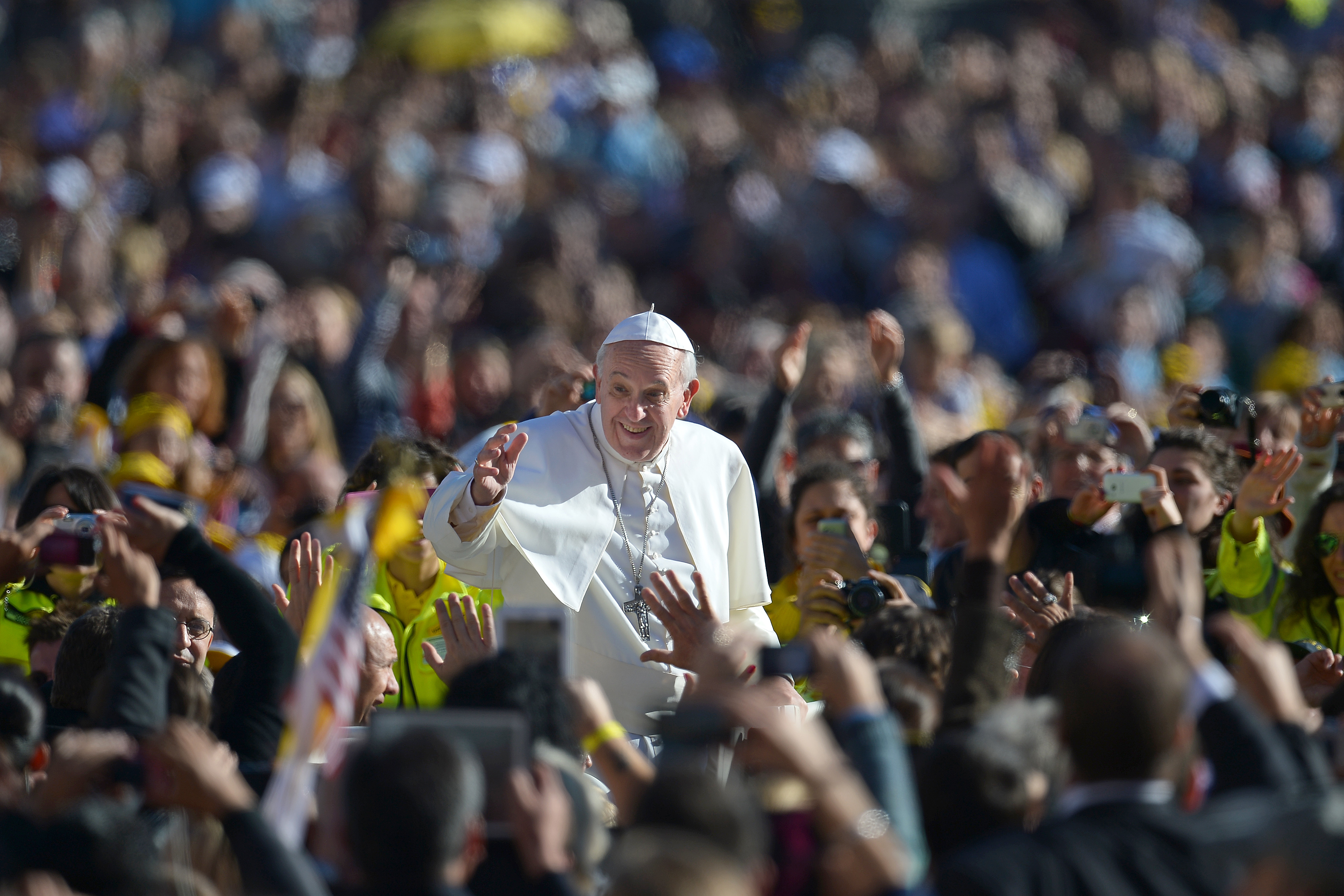
(Photo: Pope Francis delivers his speech during a meeting with young people on September 22, 2013 in Cagliari, Italy. By Franco Origlia/Getty Images.)

Face Of The Day

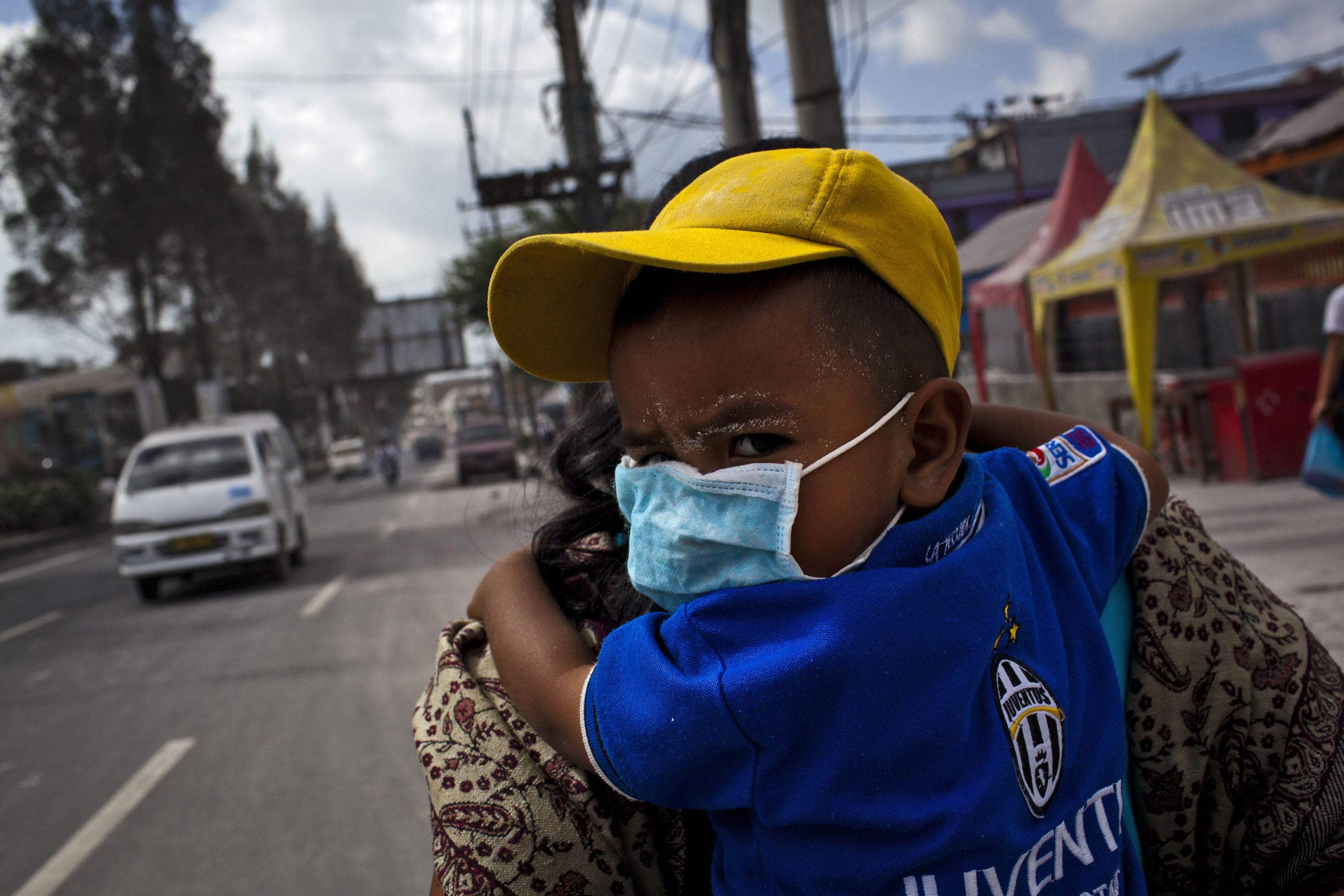
Evacuation Zone Expanded As Mount Sinabung Continues To Erupt

A boy wearing a mask is carried through an area covered by ash after Mount Sinabung erupted spewing volcanic materials at Berastagi village in Karo district, North Sumatra, Indonesia. Mount Sinabung, which has been intermittently erupting since September, erupted eight times in just a few hours on Sunday. Officials have reported of rocks raining down over a large area, forcing thousands to flee their homes. The Indonesian government has called for people living within five kilometres (3.1 miles) of the volcano, on the northern tip of Sumatra Island, to evacuate their homes as the volcanology agency raised the alert level for the volcano to the highest point on a four-stage scale. By Ulet Ifansasti/Getty Images.

Branded Storms

With news that a winter storm might wreak havoc on Thanksgiving travel plans, Ian Crouch notes how, unlike hurricanes, “big winter storms have always been nameless, at least until last year, when the Weather Channel introduced Athena, Brutus, Caesar, and so on down to Zeus, which brought a foot of snow through the upper Midwest last April”:

The Weather Channel had gone rogue, staking out what amounted to a sole claim over the charismatic personalities of winter weather. Their competitors’ argument that it would manage to sow chaos was partly correct, but with a twist: it would only be confusing to the public if other weather forecasters attempted to generate their own, competing names for the same storms. To submit to the naming convention owned and managed by a rival would be equally unpalatable. By being first, the Weather Channel had handcuffed the entire weather-news industry: join in, or be boring. This year, they’re back at it—and so, this week, those of us looking for a pithy way to talk about this storm have a ready option at hand. At AccuWeather and elsewhere, it is “that big churning storm headed for the East Coast.” At the Weather Channel, it is Boreas. It’s pretty clear which of these makes the better hashtag.

Crouch’s take on the innovation:

Maybe the Weather Channel is right, and naming winter storms is in the public interest. But it is notable that this opinion has not been shared by anyone in the nonprofit scientific community. For now, the winter-storm names seem like just another innovation by a company that long ago mastered the form of selling rain, sleet, hail, snow, and wind.

Has Wes Anderson Entered His “European Period”?

Colin Marshall thinks so:

His next feature film, The Great Budapest Hotel, which comes out in March, takes place in its titular location. His new short film Castello Cavalcanti [seen above], too, takes place in its titular location, a hamlet tucked away somewhere undisclosed in Italy. Then again, hasn’t Anderson, aesthetically and referentially speaking, always enjoyed something of a European period? (Maybe we can call it European by way of his native Texas, which, for me, only adds to the visual interest.) This, combined with his apparent fascination with the objects and built environment of the early- to late-middle twentieth century, has won him a great many fans sympathetic to his sensibilities. (Along with, of course, a handful of detractors less sympathetic to them.) This brief but vibrant new piece should, for them, resonate on several levels at once.

Forrest Wickman has more on Castello Cavalcanti:

Starring Anderson favorite Jason Schwartzman, an American who crashes into a piece of his own past, the short is—like so many Wes Anderson ads—also an opportunity for Anderson to pay tribute to his cinematic ancestors.

Specifically, Castello Cavalcanti seems to be full of nods to the work of Federico Fellini. (Another director, by the way, who made commercials.) In The Wes Anderson Collection, Anderson cites Fellini as an influence for his work in caricature. Here, the caricatures are all over town, but the Christ statue in the center seems to have been air-lifted from La Dolce Vita, alongside the motorcycle-riding paparazzo, and the car race itself seems to be an homage to the car race in Fellini’s Amarcord. And it’s not just Fellini: The title character seems to be named after Brazilian-born director Alberto Cavalcanti, of whom Anderson is a fan.

Kristie Puchko isn’t bothered that Anderson made the film for Prada, remarking, “True to Anderson’s style, the colors are vivid, the dialogue is sharp, and the performances are brightly dynamic.” Peter Weber compares the Prada connection to Chipotle’s artsy, anti-factory farming “stealth ad” that went viral in September:

My bet is that, as explicitly stated by Chipotle, Prada is trying to reach a generation of young consumers who don’t necessarily sit through commercials on TV. And if you’re not going to shell out for a high-dollar spot during, say, the Super Bowl, you have a lot more money available to pay top directors and actors to make interesting, 8-minute films that people will go out of their way to watch. Isn’t that more fun?

Previous Dish on Anderson here, here, and here.

The Misery Of Miscarriage, Ctd

More readers share their stories:

My wife and I have suffered 2-5 miscarriages, depending on how you count them (the second time she miscarried quadruplets). We were not using in vitro fertilization, so the chances of us conceiving quadruplets is somewhere around 1/800,000. With the first miscarriage, I think we took some (small) comfort in discovering how often they occur – that the traumatic event we were living was not some special misfortune that God had reserved for only us.  But the bizarre macabre nature of seeing four lifeless embryos on the screen afforded no such comfort.  I remember my wife’s words on the car ride home after we scheduled the D&C: “I feel like a walking tomb.”

I want to thank you for posting these stories.  They aren’t stories people like to recount but they are so common and they touch those involved so deeply.  The fact that this community has emerged on the blog of a gay man with no children is profoundly touching. The human capacity to empathize and share in the joys and sorrows of others is celebrated on the Dish, and it’s why I’m a subscriber.

Another:

Reading this thread is hard. Not only because I have had a two miscarriages, but also because of my family history.  In the years after my older sibling’s birth and mine (four years), my mother had six miscarriages. As a result, her OB put her on a “artificial” estrogen, or DES,  to help her carry full term.  I was on the tail end of her using the drug.  As a result, I have several abnormalities of my reproductive organs and have had several small tumors removed from my cervix. I was told at 19 that I would never be able to conceive or carry to term a normal pregnancy.

I had resigned myself to being childless.  My birth control choice was more for prevention of disease rather than pregnancy.  When I met the wonderful man I married, I told him that I probably could never have children and we discussed adoption.  Six months after becoming engaged, I missed two periods (not unusual because of my abnormalities; my cycle is very irregular), but then I started bleeding heavily at work. Because I worked in a hospital I went to the ER where they did a blood test that showed I was pregnant.

Over three days, I alternately cried, prayed and bled.

My future husband flew back from a business trip early to be with me and we both grieved.  My mother gently reminded me that miracles occur on a regular basis and that I was proof of that.  Fast forward a year and half later, and a skiing accident landed me in the ER again.  I was asked if I could be pregnant and I smiled at my husband and said yes (another missed period, but not unusual), so they did a blood test before they would x-ray my ankle.  I joked with my husband that we could give the “positive” test results to the parents for Christmas.  And we did, because I was indeed pregnant.

They called the perinatologist on staff and made me an appointment for the next day.  Because of my medical history, I was very much a high-risk pregnancy.  Because my hormone levels are so weird (because of the DES exposure), we could only estimate the date of conception and how long until safe delivery.  I had ultrasounds that guesstimated I was about 12 weeks pregnant.  I was put on immediate maternity leave and monitored on a biweekly basis.  I delivered a healthy baby boy six months later via c-section. (Because of previous surgeries, my cervix never dilated at all despite 12 hours of labor and pitocin).

When my son was two,  I “felt pregnant” again and blood tests confirmed it.  For about four months, things went smoothly then terrible cramps, bleeding, etc.  It didn’t feel like labor but rather more like a rolling sensation through my pelvis. After about six hours, the tiny little girl slid out of my body.

I wept copiously and so did my husband.  Despite the fact that she never drew a breath, our family priest offered to baptize her.  We had no service but that and had her remains cremated and sealed into a small walnut box that will go with us when we die.

Two years later, again I “felt pregnant” and had a blood test. Negative. But I still didn’t have a period. Weeks later my son had a nightmare and he climbed into bed with us. He poked me and told me that my stomach was kicking him. My husband looked at me, jumped out of bed and sped to the nearest gas station.  He bought a EPT test and told me that the attendant looked at him in wonder (3 am, frazzled man in jeans and t-shirt).  I peed on the stick and then waited … positive.

I called my OB the next day and told them; they got me in that day. We took a blood test, two different ultrasounds and saw the tiny little boy kicking and cried.  I was six months along and delivered that lively little boy three months and ten days later via c-section.  During that c-section the doctor saw why I didn’t lose this little boy; I had a large tumor growing from my cervix into my uterus.  It prevented me from losing that pregnancy.  I had to have a hysterectomy, because the frozen section showed a particularly aggressive type of cervical cancer cells.

My younger son has some secondary DES-related problems, and both boys are at a higher risk for testicular and other cancers.  There is not a lot of research out there on the effects of the fourth generation, but in some ways, despite the problems, both my husband and parents are grateful to DES, otherwise I would not be here.  I still have periodic tests and I have to be more vigilant than the ordinary woman, but I will always grieve for the soul of my little Kristina Katherine and the unknown child that I lost.

Another:

I’m a subscriber, and long-time reader, but have never written in before. I’ll be honest with you: although I read the quoted piece you posted initially, I can’t bring myself to click the link and read the full thread, because I know it is he articulation of my greatest fear.

A little over two years ago (my wife remembers the dates and due dates; I’ve blocked them out), my wife and I had a miscarriage. It was about a week or so after a positive pregnancy test. Since it was our first time being pregnant, we approached the pregnancy like I imagine most first-time parents do: unrestrained glee. It happened to be the week before Fathers’ Day and she got me a Fathers’ Day card. We went out to a nice restaurant to celebrate.

When she started bleeding, we went in for an ultrasound. I should tell you at this point that I’m a lapsed Catholic/agnostic who hasn’t been to church in years. When we went in for the ultrasound, I found myself praying as we looked at the monitor, straining to see signs of life and hoping that things were ok, in spite of what we’d seen to that point. There was nothing there. Since it was so early, we hadn’t told anyone about the pregnancy, but we told family and close friends what happened.

Months later, we found out that we were pregnant again. Again, we told no one. This time, we had an ultrasound at six weeks and saw a heartbeat. Seeing that on the monitor was like nothing else that had happened in my life. To know that I would be a father meant everything to me.  We decided we wouldn’t do a fancy celebratory dinner – just in case – so we did something casual. Although my wife was reluctant, I convinced her that we should start enjoying the fact that we were pregnant – we’d seen a heartbeat! – and should look at baby items, which we did. We started to think about how best to tell our families (Christmas ornaments? Ultrasound pictures? Something more creative?).

About three weeks later, we went in for another ultrasound. We were still nervous, but, again, we’d seen a heartbeat. When the ultrasound tech came in, she started the procedure and kept moving around the probe, not saying anything along the lines that expectant parents want to hear.  She said she would need to get the doctor to look at the image. At that point, I remember looking at that somewhat confused, but somehow already haunting image, and asking God to be with us – asking Him if he were there, could he please make sure they pointed the ultrasound wand at the heartbeat we knew was already there, so that we could go on with our lives and figure out how best to tell our families we were pregnant.

When the doctor came in, he told us we’d had another miscarriage. The embryo was dead. I felt like I’d been kicked in the stomach. It was hard to breathe. Another round of sobbing telephone calls to our family to tell them the news, along with another awkward rollout to our close friends.

My email’s long enough, so I won’t bore you with the details, but my wife and I have been seeing a fertility specialist for the better part of a year, and are now pregnant again. We’ve had a roller coaster ride of blood tests the last few weeks (everything looks normal, congratulations!; your blood work indicates a likely miscarriage, you should be prepared). Today we had a second ultrasound at seven weeks. The first showed a very early heartbeat. We were both sick to our stomachs with worry in the days leading up to the ultrasound. Again, despite my lapsed faith and our history, I found myself saying continuous Hail Marys through tears at the doctor’s office today while we waited for the image. We saw another heartbeat.

Making Art Museums Less Boring

dish_bellini

In his new book, Art as Therapy, reviewed by Joshua Rothman, Alain de Botton argues that museums “have embraced as their guiding paradigm the discipline of art history,” focusing on arranging pieces by period or artist, rather than emphasizing “what actually makes art interesting”:

Most people, [de Botton] thinks, care only a little about who commissioned what. When a visit to a museum succeeds, it usually isn’t because the visitor has learned facts about art but because she’s found one or two works that resonate in a private way. And, yet, museums do very little to foster these kinds of personal connections; if anything, they suggest that our approach to art should be impersonal and academic. “The claims I’m making for art,” de Botton said, “are simply the claims that we naturally make around music or around poetry. We’re much more relaxed around those art forms. We’re willing to ask, ‘How could this find a place in my heart?’”

On a stroll with Rothman through the Frick, de Botton offered practical examples of what he means:

Museums, de Botton believes, would be more energetic, unpredictable, and useful places if curators thought less like professors and more like therapists.

Instead of being organized by period—“British eighteenth-century painting,” say—galleries could be organized around human-scale themes, like marriage, aging, and work. Rather than providing art-historical trivia, wall text might address personal questions: How do I stop envying my friends? How can I be more patient? Where can I find more beauty in my life? …

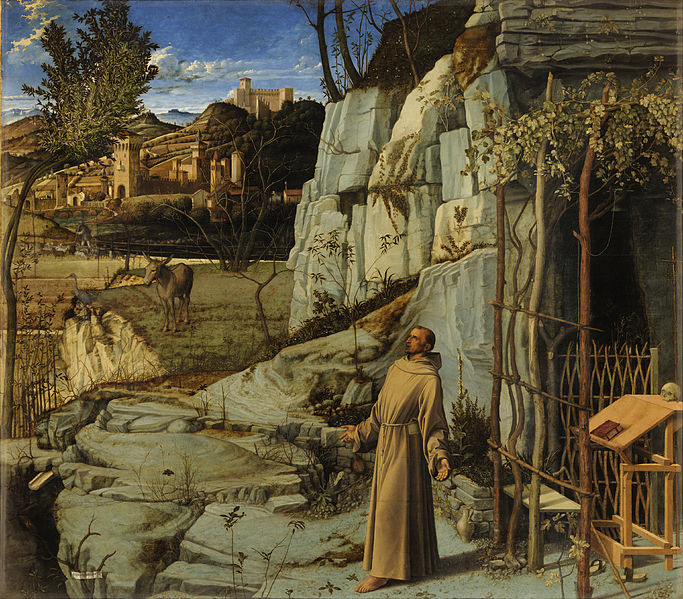
The word “therapy”—a “big, simple, vulgar word”—is meant, de Botton said, to be taken broadly. It can be therapeutic to acknowledge “the ugly, the complicated,” or to be reminded of one’s neglected, inner possibilities. Contemplating Bellini’s “St. Francis in the Desert,” what struck de Botton wasn’t Francis’s story, per se, but Bellini’s attention to detail—a dirty hare amongst the rocks, a perfect little town in the distance, the Saint’s toes. “This picture can make us feel guilty, and a bit sad, about how we’ve neglected close observation,” he said. “We rush through experience. We’re on our phones. But that’s also why it’s moving. My theory is that many of the things that move us are things we long for but find hard to do.” (In a video from 2010, the Frick’s former curator, Colin Bailey, offered an alternate, but still de Bottonian, reaction: “The picture gives us comfort because it seems so restful, so joyous, so joyful.”)

(Image of Saint Francis in the Desert by Giovanni Bellinni, 1480, via Wikimedia Commons)

A Think Tank With An Agenda

Julia Ioffe highlights the growing extremism of the Heritage Foundation:

DeMint was known nationally as a warrior for purity, spending more of his time seeking out like-minded candidates for the U.S. Senate rather than passing legislation. But, at Heritage, DeMint found kindred spirits in [Chairman of the Board Thomas] Saunders and [Heritage Action CEO Michael] Needham, who created a Heritage Action scorecard to grade Republican members of Congress on their ideological mettle. (The standard is so high that, at this writing, the House Republican caucus gets a paltry 66 percent rating.)

Among the consequences of Heritage’s transformation:

With DeMint’s arrival, Heritage’s government relations team, which once boasted the ability to meet with 250 GOP and as many as 40 Democratic congressmen on any given day, disappeared. “The people at government affairs would go down to the Hill, and they had Hill folks saying, ‘Listen, we don’t want to meet with you because of what the folks at Heritage Action did yesterday,’” says the former Heritage staffer. Heritage analysts now have a hard time getting meetings on the Hill, even with Republicans. The congressional staffer told me that, for many Republican members of the House, “their research staff is probably not dealing much with Heritage anymore. They’re systematically going elsewhere for their information.”

Pareene chimes in:

Truth be told, Heritage was always mostly political hacks, they just used to be effective political hacks with a realistic agenda. What was different now was the cheerful absense of any coherent and/or achievable goal — beyond fundraising and image-boosting for Heritage Action itself.

Animals May Have Been Harmed In The Making Of This Film After All

How the American Humane Association – which confers the “No Animals Were Harmed” label on movies – sells itself:

The organization is now under fire:

A Husky dog was punched repeatedly in its diaphragm on Disney’s 2006 Antarctic sledding movie Eight Below, starring Paul Walker, and a chipmunk was fatally squashed in Paramount’s 2006 Matthew McConaughey–Sarah Jessica Parker romantic comedy Failure to Launch. In 2003, the American Humane Association chose not to publicly speak of the dozens of dead fish and squid that washed up on shore over four days during the filming of Disney’s Pirates of the Caribbean: The Curse of the Black Pearl. Crew members had taken no precautions to protect marine life when they set off special-effects explosions in the ocean, according to the AHA rep on set. And the list goes on … All of these productions had AHA monitors on set.

An AHA employee describes as the organization’s 99.98 percent safety rating record as “a total B.S. number made up for PR purposes.” Nora Caplan-Bricker parses the expose:

[The Hollywood Reporter] lays [the] filmmaking fatalities at the feet of the American Humane Association, the non-profit that hands out the “No Animals Were Harmed” designation that is such a staple of TV and movie credits, building a portrait of an organization that is far too cozy with Hollywood to effectively police it. The regulator is actually on the movie industry’s payroll: AHA’s Film & TV Unit subsists largely on a multi-million dollar grant from the SAG-AFTRA actors’ union and the Alliance of Motion Picture and Television Producers, and it’s currently working on a “fee-for-service” plan, under which producers will pay AHA to monitor sets starting as early as January. In other words, this litany of Hollywood’s furry casualties is a familiar parable of what happens when a powerful entity regulates itself.