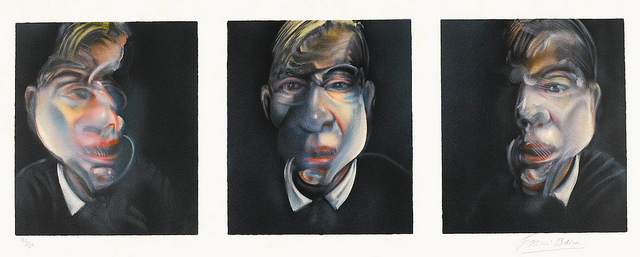
David Griffiths, a Catholic writing professor, broke down in tears when he heard the announcement that the new pope would be named Francis. Looking back, he realized how the experience helped him make the connection between two of his heroes – St. Francis and the artist Francis Bacon, both of whom were “bursting with a desire to embrace the ugliness and spiritual poverty of this world in a way that called attention to it, named it, so that others might see”:
In retrospect, my reaction to Pope Francis’s election makes so much more sense when I consider that during my tenure at the college my artistic guiding lights were St. Francis and the painter Francis Bacon. About as far from a saint as one can imagine, Bacon is infamous for showing us things that perhaps we would rather not see: nightmarish self-portraits, unnerving studies of screaming popes, and writhing and wrestling biomorphic forms.
But Bacon was not interested in merely horrifying us. He was painting, as he said in an interview, to “excite himself”; spreading paint in a way that was expressive of his anger, his lust, and his love of painting. In a rare explanatory moment, he revealed to an interviewer that his numerous paintings that reference crucifixion were not religious but “an act of man’s behavior to another.” Some moralists have said that his paintings are corrupting and harmful, but I’ve always felt that they do no more harm than if one took to hanging around a butcher shop or meat packing plant. To me, his paintings, like all great art, make us confront essential questions about the human condition.
(Image of Francis Bacon’s Three Studies for Self-Portait (1981) from Flickr user Cea.)
 The Dish