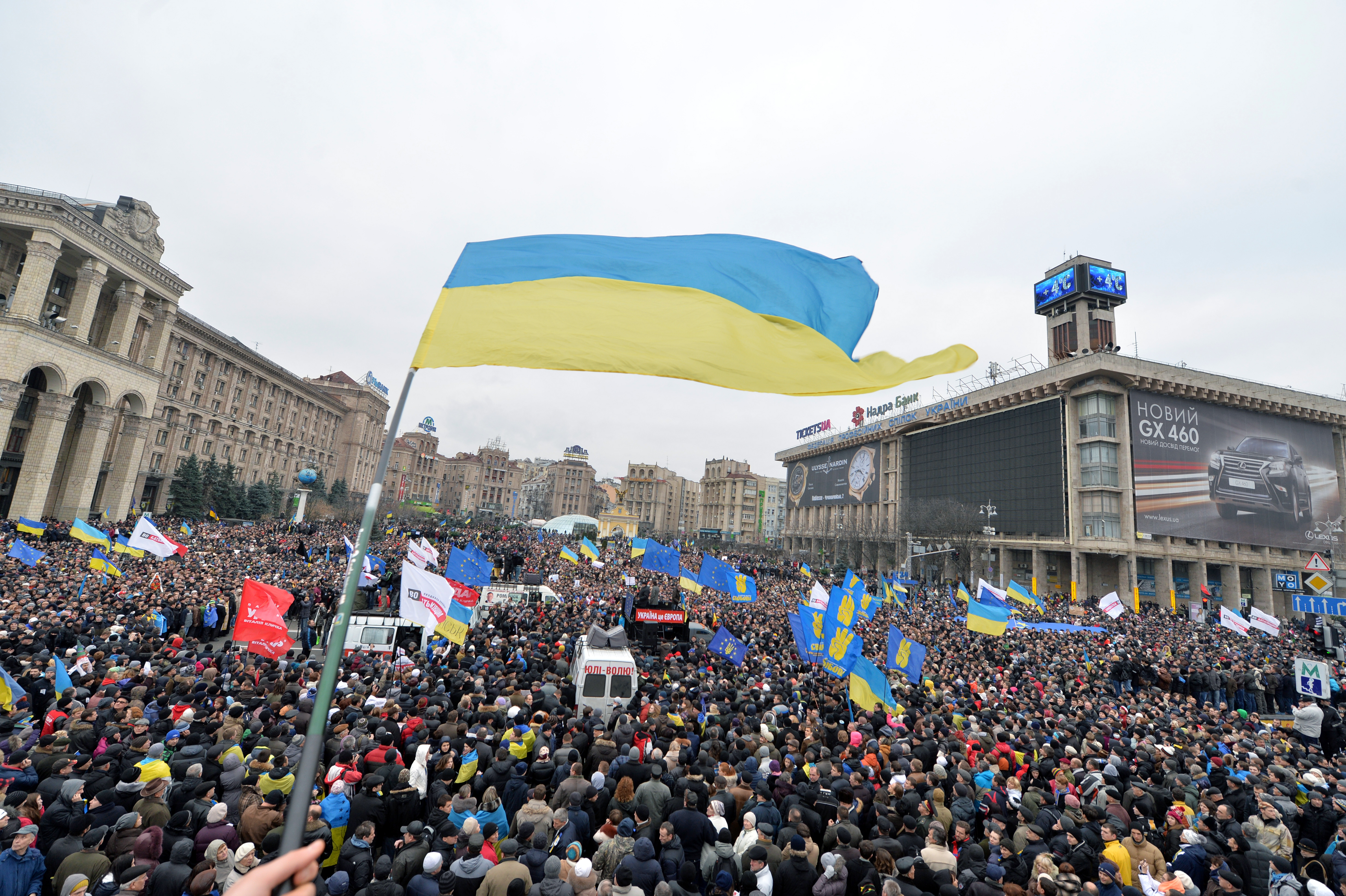
President Viktor Yanukovich turned down an EU trade agreement, under pressure from Moscow, to do a deal with Russia instead. Over the past several days, hundreds of thousands of Ukrainians have protested the decision. Frum warns against letting Putin strong-arm Ukraine back into Russia’s sphere of influence:
Since Putin’s entry into power, Russia minus Ukraine has sought to influence and corrupt the democracies of Europe. A Russia that reintegrated Ukraine would possess the power — like the Soviet Union of old — to intimidate and bully democratic Europe. Russia minus Ukraine can aspire to become a normal nation state, a democracy, even a liberal democracy. A Russia that holds Ukraine by force must forever be a militarized authoritarian regime, a menace to its own people as much as to the rest of the European continent and the democratic world. Upholding Ukrainian independence is thus a deep concern, not only to the Ukrainians, but to all the free countries of Europe — and thus to the United States, free-Europe’s security and trading partner.
Larison pushes back:
Ukrainian political independence is not imperiled, and European security certainly isn’t. Ukraine’s economic dependence on Russia would not have been ended by the EU’s association agreement, and it was this dependence that ultimately made it impossible for Ukraine to finalize the agreement over Russian opposition. More to the point, as Mark Adomanis points out, “the idea that Ukraine is the secret to some geopolitical great game is anachronistic nonsense.” The only thing at stake in this dispute is whether Ukraine opted for a closer relationship with the EU at very high short-term cost or accepted something very much like the status quo for the foreseeable future. It’s just not that dramatic or significant for any countries except Ukraine and perhaps its immediate neighbors. The “future of the European continent” definitely does not hang in the balance.
Julia Gray analyzes the situation:
[W]hat’s primarily in the balance is Ukraine’s image. The company a country keeps can change its reputation, as I’ve argued. Reputations can, of course, translate into material gains – greater access to capital on financial markets, if portfolio investors perceive you to be more likely to honor your debt obligations. I’ve shown that international agreements can often serve as a seal of approval to portfolio investors.
This particular case is no exception.
Caught between one club it doesn’t particularly want to join (the Russian-led customs union) and another that won’t let it come much closer (the EU), Ukraine is currently taking heat from both sides as well as in the international press. Tying itself to the EU might make Ukraine look more attractive on the international front in the long term, but if Russia cuts Ukraine off, the short-term economic consequences could be devastating – particularly since it’s far from clear that Ukraine can get any closer to the EU than it already is. At the same time, any further crackdowns on protesters will only make them seem less like a country that belongs in Europe.
Daisy Sindelar looks at the personalities leading the massive “EuroMaydan” demonstrations:
Some Maydan protesters are motivated by their longing for the West. Others, like nationalist Oleh Tyahnybok, are motivated by the loathing of the East. Tyahnybok is the 45-year-old head of Ukraine’s Svoboda (Freedom) political movement, which stormed Kyiv’s city administration building on December 1 and has since called for a national strike. “A revolution is starting in Ukraine,” said Tyahnybok, who has accused Russia of “waging virtual war” on Ukraine; he has called for a visa regime with Russia and argued against the introduction of Russian as a second state language.
Tyahnybok, who has had a long, slow-growing career, may also see the protests as a political opportunity. Tyahnybok first entered parliament in 1998 and eventually won reelection as a member of Viktor Yushchenko’s Our Ukraine bloc. But his nationalist views eventually saw him ousted from the bloc, and have routinely set back his political progress, with critics regularly accusing him of anti-Semitism.
Mary Mycio wonders whether Yanukovich can maintain control:
When fear of a strongman begins to melt, so does his power. Seeing hundreds of thousands of protesters on the streets of Kiev may have emboldened members of the country’s elite to begin to move against the president. Ukraine’s rapacious oligarch’s may—for the first time—have found common ground with their increasingly impoverished compatriots in getting rid of a tyrant. The next telltale sign will be if the oligarchs—or their media monopolies—begin to call for new elections or political consensus in parliament that freezes out Yanukovich. What would have been unthinkable a short time ago could now be in the offing. Five members of parliament associated with Lyovochkin have quit Yanukovich’s party. There are rumors that at least 20 more may be ready to follow. Pressure from the street might make all the difference.
Leonid Bershidsky notes that “Putin is watching the Kiev events with apprehension”:
The raw power of the Ukrainian protests could re-energize the Russian opposition movement, which he successfully quashed last year. “The events in Ukraine resemble a pogrom rather than a revolution,” Putin said. “The opposition is trying to topple the legitimate authorities. These are well-prepared actions.”
Putin is wrong about the preparation. What’s happening in Ukraine is a spontaneous outpouring of indignation with a rotten, corrupt, bungling regime very much like Russia’s own. The main difference is that high oil prices provide Russia’s leaders with enough money to keep opposition at bay, while Ukraine is nearly bankrupt. If Russia’s already stagnant economy falters, Moscow could see similar outbursts.
Ioffe doubts that Russia will follow in Ukraine’s footsteps. Among her various reasons why:
Russia is a police state; Ukraine is…not quite. According to Bloomberg, Russia is the most heavily policed country in the world, Ukraine is 12th on the list. (The U.S. is 32nd.) Moreover, the security services have much more political power in Russia than they do in Ukraine. This is in part why, when a cry went up about police brutality, the Kiev police chief resigned (though his resignation wasn’t accepted). When this happened in Moscow, in May 2012, injured policemen were rewarded for their suffering with apartments and the unarmed protesters who attacked them were arrested and hauled to trial.
Drezner looks at the bigger picture:
It seems highly unlikely that the current Ukrainian government will resort to massive repression at this point — which means the worst-case scenario is that Ukraine doesn’t join either economic bloc. The only way this ends as a win for Putin would be if he was able to use force to seize control — or coerce the Ukrainian security apparatus to do the same. I seriously doubt that he is either willing or able to pull off such a coup d’etat
Stepping back, let this be an important lesson about the limits of economic power.
(Photo: An opposition rally packs Independence Square in Kiev on December 1, 2013. Some 100,000 Ukrainians chanting ‘Revolution!’ swarmed the central Kiev square Sunday in a mass call for early elections meant to punish President Viktor Yanukovych for rejecting an EU pact. By Sergei Supinsky/AFP/Getty Images)
 The Dish